
Mercury Hour Magazine

Mercury Hour was a celebrated, long-running participatory astrology journal published by Edith Custer from 1974 through the late 1990s. Renowned for its open forum format, the magazine served as a vital bridge between professional astrologers and enthusiastic students, featuring lively exchanges on chart interpretation, predictive techniques, and astrological debate. This archival collection offers a candid, historic look at the evolving theories, techniques, and community discussions that shaped late 20th-century astrology.

Edith Custer & Collaborators

Magazine

23 Document(s)

Edith Custer

1970s-1990s

Filters

Filters


See more See less
See more See less
See more See less
See more See less
See more See less
See more See less
See more See less

Sorting

Medical Astrology, Mundane Astrology, and Fixed Stars serve as the primary focus areas of this historical astrological literature. This archival item is the April 1999 issue (100th Edition) of Mercury Hour, a long-running quarterly astrological magazine edited and published by Edith Custer in Lynchburg, Virginia. The issue highlights the first installment of Guy de Penguern’s course on 21st-century medical astrology and genetic astrophysics, a review of Enrique Linares’s A Scientific Approach to the Metaphysics of Astrology by Marguerite dar Boggia, Virginia A. Reyer’s study on fixed stars and health, and Dorothy J. Sarka’s examination of the I Ching. Additionally, the issue documents extensive reader discussions on political horoscopes and current events, including the Bill Clinton impeachment, Y2K software predictions, the 1999 Israeli election, and natal chart data for prominent figures such as Jesse Ventura and Ehud Barak.


Issue Highlights

Book Review

A Scientific Approach to the Metaphysics of Astrology by Enrique Linares

– Marguerite der Boggia


Articles

21st Century Medical Astrology Course, Part 1 of 3 – Guy de Penguern [extract]

Fixed Stars, Part 2 of 2 – Virgina A. Reyer

The Hidden Code of the I Ching – Dorothy J. Sarka


Discussions

Ken Starr/Bill Clinton impeachment

Chart of Bill ClintonU.S. Declaration of Independence

W.H. Chaney/Jack London

Astro-Twins (examples)

Asteroid rulership/association

Moon Out-of-Bounds

Israel election 1999

Y2K

August 1999 Grand Cross eclipse

August 1998 eclipse effect on Russia

Sun/Moon angle and conception


Chart data

Barak, Ehud

Bush, George

Chaney, William

Hand, Rob

Jayne, Charles

Keller, Helen

Netanyahu, Benjamin

Rose, Buddy “Playboy”

Ventura, Jesse

Russia


Notable contributors

Marion March (various topics)
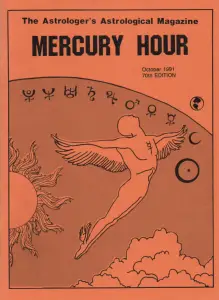
 

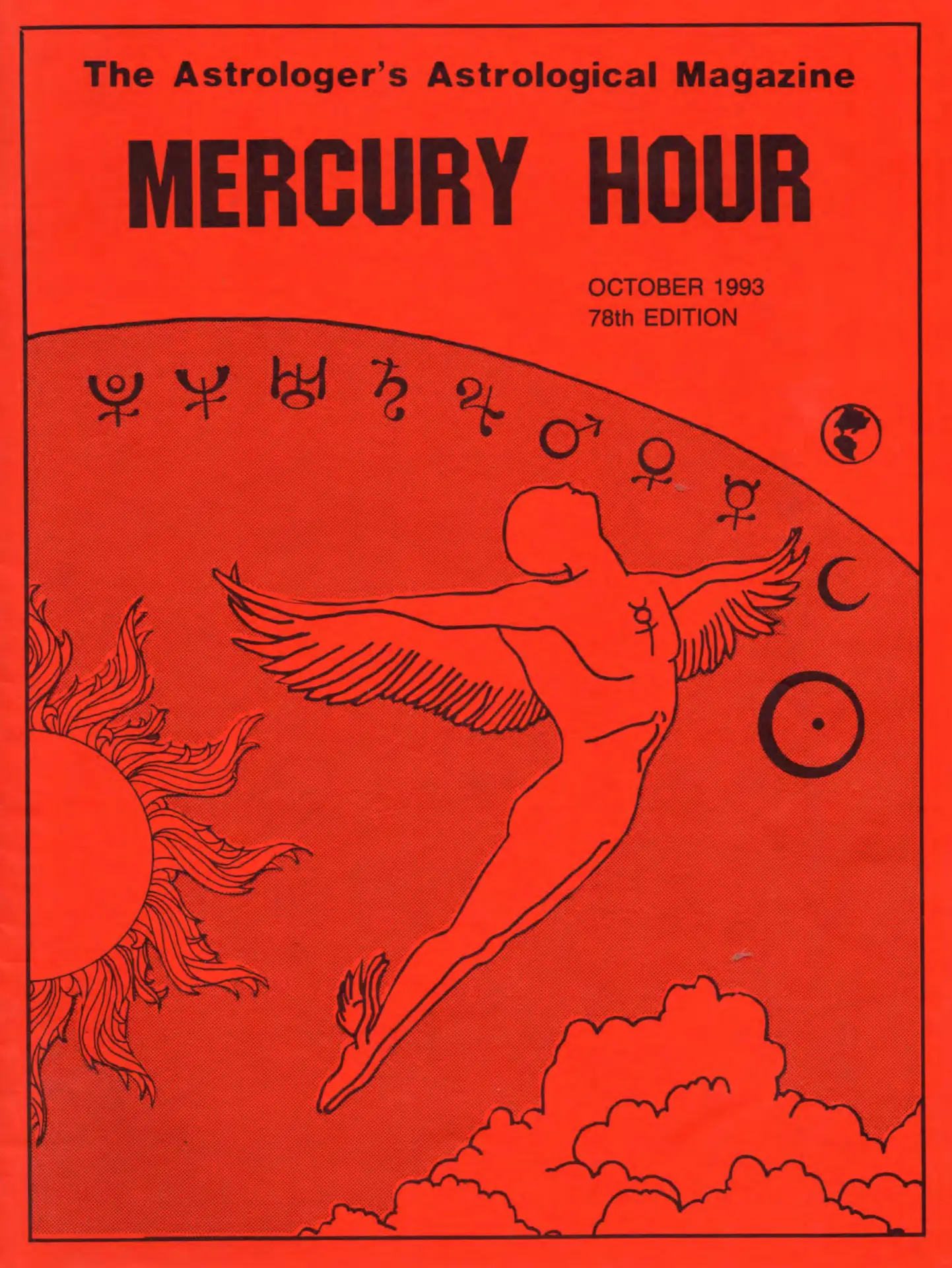
Astrology Community, Mundane Astrology, and Astrology History serve as the primary focus areas of this historical astrological literature. This archival item is the October 1991 issue (70th Edition) of Mercury Hour, “The Astrologer’s Astrological Magazine,” a reader-driven correspondence periodical edited and published by Edith Custer of Lynchburg, Virginia. Structured largely as an open forum of subscriber letters, it documents the working preoccupations of a grassroots American astrological community, with debates over classical versus modern technique, chart-matching blind tests, and the interpretation of stations, midpoints, solar returns, and heliocentric charts. Reflecting its Gulf War moment, the issue features mundane analysis of the Gulf War chart, the USSR’s dissolution, and comparative studies of Saddam Hussein, Jim Jones, and Adolf Hitler; alongside contributions from Ted George, M.J. Makransky, Joyce Wehrman, and Lee Lehman, a memorial for statistical researcher Michel Gauquelin (1928-1991), chart data for figures such as Napoleon and Helen Herron Taft, and period advertisements for early astrological software that capture the field’s transition into desktop computing.

Issue Highlights


Book Review

Working with Astrology by Michael Harding & Charles Harvey – Doris Greaves


Articles

Missing Visa Book – Marie DeLeone

Student’s Corner [the Ascendant] – Annibale F. Verzumo

Jupiter-Neptune, The Celestial Twins, Part I – Ted George

NCGR Conference [report] – Edith Custer

Indications of a Winner *or* Do You Have a Gambling Chart? – Cammille Adams

Planet Watch – Paul O. Hewit

The Natural Disposition, Part II – M.J. Makransky

Michel Gauquelin 1928-1991 – J. Lee Lehman

[USSR charts] Part I – Annibale Verzumo

The Three Amigos, Part II, Conclusion [Saddam Hussein, Jim Jones, Adolph Hitler]– Susan J. Kientz

[Risks of publishing astrological materials] Part II, Conclusion – C. J. Puotinen

Central American Data – M.J. Makransky

Her Proudest Moment [Helen Herron Taft] – T. Patrick Davis

Pluto, Part II, Transpluto – Joyce Wehrman [transcription of talk]

The Gemini Theme, Using the Astrological Language, Part III, Conclusion – Anne Foley

Autumn Equinox September 23, 1991 – Dorothy S. Willis


Discussions

Astrological weather prediction

Solar returns

Chart of Napoleon

Neptune

Gulf War chart

Heliocentric charts

Finding the time of sunrise in birthchart


Chart data

Bonaparte, Napoleon
Taft, Helen Herron
Iraq War
Costa Rica
El Salvador
Guatemala
Honduras
Nicaragua


Notable contributors

Marion March (semi-sextiles)

Lee Lehman (classical astrology techniques; homosexuality & astrology)

Marc Penfield (the astrology of Orlando, FL & Disney World)

Astrology, Ephemerides, Mundane Forecasts, Predictive Techniques, Chart Rectification, and Esoteric Studies. This issue of Mercury Hour explores a wide array of specialized astrological topics, ranging from generational planetary cycles and weather forecasting to tarot associations and historical chart rectifications. Ann Kreilkamp examines the Uranus/Pluto in Virgo generation (1962–1968), highlighting the revolutionary tendencies and psychological profiles of individuals born during this period. Robert Cole discusses the reliability of economic and meteorological forecasting against statistical probability in ‘The Prediction Game’ and outlines cycles in ‘The Aquarian Agenda’ and ‘The Tenth Aquarian Age.’ Marc Penfield contributes multiple articles analyzing market trends, the Southern States of the Confederacy, county incorporation dates, and the natal chart of Tina Turner (‘Hot Legs from Nutbush’). Other notable contributions include Lew Paxton Price’s study on astrology in the Bible, Dorothy Willis on weather forecasting via Saturn and Uranus transits, Kevin W. Barrett on Sidereal house influences, John H. Roth, Jr. on reinterpreting astrological basics through tarot and equilibrium systems, and Frank Faustino on numerical keys to Einstein’s unified theory. The magazine also features extensive book reviews by Marion March, letters, data exchanges, and discussions surrounding astrological organization politics within the AFA and AFAN.

Issue Highlights:

Articles:
A Flood Warning for New Year’s – Nancy Ray
The Uranus/Pluto in Virgo Generation 1962-68 – Ann Kreilkamp
The Prediction Game – Robert Cole
The Market Goes Up and Down – Marc Penfield
Massacre or Escape? – Marc Penfield
The Aquarian Agenda – Robert Cole
Astrology in the Bible, Part I – Lew Paxton Price
Down to Earth Astrology – Howard Stephen Berg
Reagan’s Real Ascendant, Part I – John Kalus
Astrology & The Weather, Forecasting the Weather – Dorothy Willis
Sidereal Astrology: Influence of the Houses, Part 1 – Kevin W. Barrett
Relationships and Astrology, Part 1 – Klara Henderson
The Southern States of the Confederacy – Marc Penfield
The Counties of America – Marc Penfield
Hot Legs from Nutbush: The Chart of Tina Turner – Marc Heereen Penfield
Reinterpreting the Basics – John H. Roth, Jr.
The Tenth Aquarian Age – Robert Cole
Comments on our Marvelous Solar System – Wendy Hawks
Horoscope Du Jour – T. Patrick Davis

Discussion:
Statistical accuracy of weather and economic forecasting vs. astrology
Uranus/Pluto conjunction generational traits and societal impact
Tarot correspondences with astrological houses and signs
AFA organizational politics and democratic reform
Biblical numerology and tribal configurations in relation to the zodiac

Chart data:
Sunny von Bulow
Eli Cohen
Tina Turner
Ronald Reagan
AFA (American Federation of Astrologers)

Notable contributors:
Marion March (Book Reviews and UAC Report)
Al H. Morrison (Chiron Glyph and Cosmopolitics notes)
Reinhold Ebertin (Cosmopolitics excerpts)
Joylyn Hill (India/Israel mundane analysis and afflicted Moon studies)

Ask A Librarian

Need assistance with your research or navigating our collection? Our library team is here to help.

Please fill out the form below with details about the topics, authors, or archival materials you are looking for, and one of our librarians will review your query and respond shortly.

Help

Whether you are looking for rare historical texts or trying to locate a specific book nearby, Alexandria iBase offers two primary ways to search. Here is how to choose the right tool for what you need:

The Library Catalogue

Think of this as your global master index.

The Catalogue works just like a traditional library search system, designed to help you locate books and media across the broader astrological landscape.

  • Physical Books: Find out where physical copies of books are held in libraries, archives, or collections near you.

  • Digital Files: Access downloadable or viewable digital editions when available.

  • Best Used For: Standard research, finding specific ISBNs or authors, and tracking down physical items in the real world.

Browse Catalogue

SPECIAL COLLECTIONS

Think of this as Alexandria’s exclusive private vault.

Collections gives you direct access to Alexandria’s own curated archive of rare, proprietary, and historic astrology media.

  • Exclusive Material: Features unique texts, manuscripts, audio recordings, and visual media that are not available anywhere else.

  • Direct Access: Digitized content ready to explore straight from the platform.

  • Best Used For: Deep-dive research, discovering hidden gems, and exploring rare, one-of-a-kind astrological resources.

Browse Special Collections

Cash & In-Kind Donations

Make a one-time or recurring tax deductible cash donation.

Payment options include donating directly with us, PayPal Giving and GoFundMe.

GoFundMe for Charities and PayPal Giving are registered for tax deductions and have no required processing fees. It does offer the option to tip.

Donate

*Subject to 2.5% processing fees

Contact Us

Have a question, feedback, or a inquiry about our archives? We’d love to hear from you. Please fill out the form below with your details and message, and a member of our team will get back to you as soon as possible.

Thank you for reaching out to the Alexandria iBase Project!