
Predictive Astrology

Predictive Astrology is a specialized branch of astrological practice focused on anticipating future trends, developmental phases, and specific events by analyzing the interaction between a native birth chart and ongoing planetary movements. Utilizing core timing methodologies such as transits, secondary progressions, solar arc directions, and solar return charts, this approach evaluates how dynamic celestial cycles activate natal potentials over time. Rather than assuming strict fatalism, modern predictive techniques function as a structural framework for recognizing cyclic opportunities and challenges, allowing practitioners to map the unfolding timeline of an individual’s life or collective mundane events.

Filters

Filters


See more See less
See more See less
See more See less
See more See less
See more See less
See more See less
See more See less

Sorting

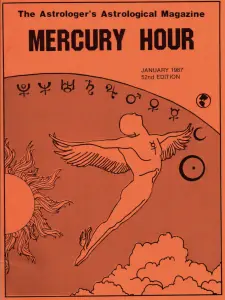
Astrological Research, Midpoints, Mundane Astrology. This issue of Mercury Hour serves as a dynamic forum for technical and philosophical astrological discourse during the early 1980s. The magazine balances detailed technical research—such as midpoint analysis, heliocentric vs. geocentric chart comparison, and mundane astrology applied to political events (e.g., the situation in Lebanon and Poland)—with active reader correspondence. A significant portion of the content is dedicated to challenging mainstream perceptions of astrology, exploring the intersection of psychology and astrology, and critiquing the rapidly emerging field of computerized chart calculation.

Issue Highlights:

Articles:
Chart Mart – Marc Penfield
Tragedy at Tanque Verde Falls: A Case for Midpoints – Barbara May
Khomeini’s Days Are Numbered – Manik Chand Jain
Mercury – Erin Sullivan
An Astrological Review of Passages (by Gail Sheedy) – Bil Tierney
Astrology vs. Psychology: A Minor Dilemma for the 80’s – Stanley Kustesky

Discussion:
Astrological research on incest
Astrological birth control (human and equine)
Ayatollah Khomeini
Pluto transits
Heliocentric astrology
Charts of Israel
Chart of Ronald Reagan
Astro*Carto*Graphy
Crash of AirFlorida Jet, Jan 13, 1982

Chart data:
Lucille Ball, John Lennon, Elvis Presley, Harvey Milk, Dan White, Pope John Paul II, Ronald Reagan, Ayatollah Khomeini

Notable contributors:
Zane Stein (eclipses, quincunxes, Association for Studying Chiron)
Michael Erlewine (Heliocentric astrology)
Al H. Morrison (Void-of-Course Moon)
Erin Sullivan (diverse astrological topics)

Mundane Astrology, Astrology History, and Astrological Techniques. This archival item is the April 1985 issue (14th Extra Edition) of Mercury Hour, a quarterly astrological magazine edited and published by Edith Custer in Lynchburg, Virginia. Featured articles include Raul Davila’s comparative study of published birth times for Ronald Reagan, Judy Goodwin’s research on name etymology in “The Astro-Punology of Names,” Marc Penfield’s chart analysis of the State of Israel, and T. Patrick Davis’s survey of geocentric and heliocentric Mars-to-Moon aspects alongside historical charts of the 1941 Pearl Harbor attack. Additional contributions cover Mary Mackenzie’s application of John H. Nelson’s heliocentric radio propagation forecasting methods, Judith Gee’s analysis of the 1939 Hitler-Stalin Pact, Marion March’s commentary on planetary configurations, and Joylyn Hill’s reflections on Atlantis. The issue also preserves community discussions regarding Gauquelin’s “Mars Effect,” astrological triggers for agoraphobia, forensic chart analyses of the Lindbergh baby kidnapping, and legal regulations surrounding professional astrology.


Issue Highlights

Book Review:

Relationships & Life Cycles, Modern Dimensions of Astrology by Stephen Arroyo – Rochelle Gordon


Articles:

Saturn Through the Signs – Bil Tierney

Crisis in the Near East – Gregg Castellucci

Chiron and Group Fusion – Tom McNamara

The Discovery of the Asteroids – Joylyn Hill

In the Winter of our Discontent – Marc Robertson (Jupiter-Saturn cycles)

Pluto (Part III) – R.C. Davison


Discussions:

AFA Conventions

Void of Course Moon

Ted Bundy

Inherited family traits


Chart data:

Ali, Mohammad
Anderson, John B.
Bergen, Candice
Crawford, Joan
Jones, Jim
Israel


Notable contributors:

Marion March (Fiji conference)

Lois Rodden (notes on chart data)

Jim Lewis (notes on A*C*G* maps of US Presidential candidates)

Lee Lehman (research on astrology & homosexuality)

Mundane Astrology, Astrology History, and Astrological Techniques. This archival item is the April 2000 issue (104th Edition) of Mercury Hour, a quarterly astrological magazine edited and published by Edith Custer in Lynchburg, Virginia. Key highlights include Ken Negus’s translation and commentary on Johannes Kepler’s 1608 chart interpretation for Generalissimo Albrecht Wallenstein, Rowena Wall’s astrological profile of media mogul Ted Turner following the Time Warner/AOL merger and his marital separation from Jane Fonda, and Virginia Reyer’s rectified natal and event analysis of Theodore Kaczynski (the Unabomber). The issue also features Susan Manuel’s geo/helio analysis of the Mars Polar Lander mission, Pat Geisler’s essay on professional ethics for practicing astrologers, Joan Titsworth’s overview of esoteric ray astrology, and Mary Downing’s historical reference table of Democratic National Conventions and nominees. Additional contributions document Walt Masters’ mathematical formulas for twelve “House Parts” (Arabic Parts), the 1999 Texas A&M bonfire collapse, out-of-bounds declinations, and chart analyses for prominent political figures including Vladimir Putin, Al Gore, George W. Bush, Bill Bradley, and John McCain.


Issue Highlights 


Articles


“Mouth of the South” Does it Again! [Ted Turner] – Rowena Wall


Kepler as Practicing Astrologer, Translation and Commentary – Ken Negus


Helio Planets: Mars Polar Lander – Susan Manuel


Esoteric Astrology in the World Today – Joan Titsworth


The Aquarian Eclipses of 2000 – Carol Willis


Ted Kaczynski – Virginia Reyer


Democratic National Conventions and Presidential Nominees [table]– Mary Downing


The Ethics of Astrology – Pat Geisler


Tidbits from the Tabloids – Arlene Marcia Nimark


Discussions


The 12 Arabic Parts


Bonfire collapse at Texas A&M (1999)


Declinations/Out-of-Bounds planets


Chart of Camilla Parker-Bowles


The Vertex


Chart data


(some incomplete or in question)


Bradley, Bill


Bush, George H.W.


Gore, Al


Kaczynski, Ted


McCain, John


Putin, Vladimir


Canada


Battle of Toronto (War of 1812)


Bonfire collapse at Texas A&M (1999)


Notable contributors


Marion March (avoiding generalizing in Astrology)

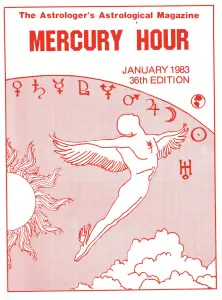
Astrology, Mercury Hour, Natal charts, Transits, Progressions, Mundane Astrology, Astro*Carto*Graphy, Chiron, Void of Course Moon, Solar Returns, Uranian astrology, Cosmobiology. This 36th Edition of Mercury Hour (January 1983), edited and published by Edith Custer, is a comprehensive astrological magazine featuring diverse correspondence, extensive theoretical and technical articles, book reviews, conference reports, and in-depth chart delineations. Key themes explored across the publication include life-stage transitions such as the ‘Catch-30’ passage and Uranus age cycles, mundane and political astrology including analyses of nuclear war threats, the Falklands crisis, and the chart of Israel, as well as technical discussions regarding software, heliocentric nodes, house systems, and the accuracy of astrological statistics (such as Gauquelin studies).

Issue Highlights:

Articles:
The Vertex – Jan Popelka
Student’s Section: A Visit to Astrologers in the U.S.A. – Ann Stevens-Patacchiola
The Catch-30 Passage: [28-32], Part III – Bil Tierney
[Uranus age cycle] Part II – Dale Huckeby
Mysterious Neptune, Part II (Marcia Moore’s chart and death) – Manik Chand Jain
Moon Void of Course in the Signs, Part I – Ted George
Is Nuclear War in Our Future? [An Astrological Call to Action] – Virginia Miller
The Pshaw Report – Jayj Jacobs
The Role of the Moon’s Nodes in World Events – Alan Richter
The New Orleans Air Crash of July 1982 – Jeff Jawer
The Effects of Saturn Transits in the Lives of the Pacific Club Members – Dona Shaw
A Royal Baby (Prince William) – Judith Gee
Determining the Winner of a Game – Sophia Mason
The Psychological Patterns of Jesus Christ – Frank Jakubowsky

Discussion:
Astro*Carto*Graphy, geodetic equivalents, and mundane predictions
Astrology hardware and software (Osborne, Astro Star, Matrix software reports)
Sunspot activity and the stock market
Gauquelin studies and statistical analysis
Lindbergh baby kidnapping and Bruno Hauptmann chart analysis
Intruder in the Queen’s Bedroom (Michael Fagan and Elizabeth II charts)
Fraternity for Canadian Astrologers 1st National Conference awards

Chart data:
August Belmont
David Crosby
Richard Dreyfuss
Michael Fagan
Andy Gibb
Bruno Hauptmann
Charley Pride
Victoria Principal
Ronald Reagan
Michael Trestrail
Israel and Partition
United Kingdom

Notable contributors:
Jim Lewis (Astro*Carto*Graphy and Ronald Reagan chart)
Jeff Jawer (First Canadian National Conference)
Barbara Watters (Grand trines and Sex and the Outer Planets)
Tracy Marks (financial compensation for astrologers)
Zane Stein (Chiron research)
Erin Sullivan (astrology of sexuality)

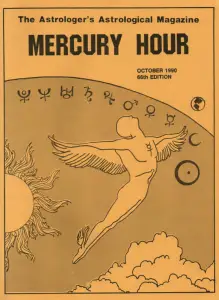
Mundane Astrology, Astrology History, and Astrological Techniques. This archival item is the October 1990 issue (66th Edition) of Mercury Hour, a quarterly astrological magazine edited and published by Edith Custer in Lynchburg, Virginia. Featured articles in this issue include Marc Penfield’s solar chart analysis of Donald Trump and natal study of Greta Garbo, Part I of M.J. Makransky’s series correlating zodiacal degrees with geographical locations and political shifts in Guatemala, Robert Baumgartner’s examination of a Demotic astrological text regarding the Egyptian star Sothis, Joseph S. DeMello’s instructional guide on diurnal charts, Paul Hewitt’s analysis of the 1989 Eastern European revolutions, and T. Pat Davis’s geo-helio study of the 1901 Texas oil discovery at Spindletop. Additional contents include reviews of Alan Oken’s Soul-Centered Astrology and Margaret Millard’s The Genetics of Astrology, weather forecasts by Dot Willis, and historical discussions regarding Tycho Brahe’s birth chart, the Society for the Advancement of Astrology, the 1992 Philippine presidential election, and birth data for figures including Saddam Hussein and Kenneth Branagh.


Issue Highlights


Book Reviews


Soul-Centered Astrology: A key to the expanding Self by Alan Oken – Marguerite dar Boggia


The Genetics of Astrology by Margaret Millard – Teresa Hamilton


Articles


The Great Garbo: Sphinx or Siren? – Marc Penfield


Guatemala, Part I – M.J. Makransky


The Egyptian Sothis in Gemini – A Demotic Astrological Text, Part I – Robert Baumgartner


Saturn, Our Night-Light, Part I – Ann Foley


Living the Hero’s Journey, Part I – Carol Voeth-Lavoie


Diurnal Charts – Joseph D. DeMello


Next Philippine President – Serafin Lanot


Autumn Ingress, September 23, 1990 – Dot Willis


Students Corner: Aspects – Anne Toth


[Essential charts of Chicago], Part I – Sonja Foxe


Saturn Anxiety, Part I – Carole Devine


Donald Trump: His Solar Chart – Marc Penfield


Eastern Europe – The Revolution of 1989, Part I – Paul Hewitt


Texans Discover Oil – T. Pat Davis


Discussions


Ethics of predicting death


Chart of Tycho Brahe


History of the Society for the Advancement of Astrology

Sun sign columns


Polio vaccine/SV-40 virus/AIDS

Warren and Florence Harding


Neptune transit of Capricorn


Chart of San Francisco Astrolocality Page 2 of 2


Chart data
(some incomplete or in question)

Iraq
Kuwait
Saudi Arabia
United Arab Emirates
San Francisco, CA
Common Market/EEC

Brahe, Tycho
Branagh, Kenneth
Griffith, Melanie
Hussein, Saddam
Linares, Enrico
Quayle, Dan
Stuart, Matthew & related charts

Notable contributors

Joe DeMello (the semi-sextile aspect)
Marion March (Joan Quigley’s involvement with the Reagans)
Kay Shinker (solar returns)
Lois Rodden (chart data)
Frances McEvoy (Matthew Stuart/Boston murder case)

Mercury Hour 101st Edition (A) July 1999

Mercury Hour Magazine, Special Collections

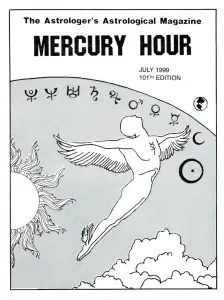
Medical Astrology, Mundane Astrology, and Astrological Technique. This archival item is the July 1999 issue (101st Edition) of Mercury Hour, an astrological periodical edited and published quarterly by Edith Custer in Lynchburg, Virginia. Featured contributions include the second installment of Guy de Penguern’s course on 21st-century medical astrology focusing on genetic predispositions to cancer and amino acids, Virginia A. Reyer’s technical guide to calculating and interpreting the Vertex/Anti-Vertex axis alongside a chart analysis of Jack Kevorkian, Mark Pottenger’s mathematical correction regarding the Equation of Time and Local Apparent Time in computer software, and excerpts from Robert P. Blaschke’s treatise on progressions. Additional community discussions cover out-of-bounds planets, solar return methodologies, debates on geographic versus geocentric latitude, and classifications of the three distinct Liliths (Dark Moon, Asteroid, and Black Moon). The issue also preserves mundane astrological commentary on late-1990s events, including the Kosovo conflict and Slobodan Milosevic’s birth data, Y2K software preparedness, the August 1999 Fixed Grand Cross eclipse, and verification efforts regarding natal data for the Columbine High School shooting perpetrators.


Issue Highlights 


Articles

21st Century Medical Astrology Course, Part 2 of 3 – Guy de Penguern [extract]

The Case of the Clock Dial – Mark Pottenger

Jack Kevorkian, Part 2 of 2 – Virginia A. Reyer

“Mutable Dilemma”: Do You Mean Apparent? [Apparent vs. Mean Time]

– Mark Pottenger


Discussions

Chart of Bill Clinton

The three Liliths

Astrology & fertility

Solar returns

August 1999 Grand Cross & eclipse

The Vertex

The true “Blue Moon”

Charles Keating event/diurnal chart

Declinations/out-of-bounds planets

Equation of Time in chart calculations

Geocentric vs. heliocentric latitude


Chart data

Harris, Eric

Hussein, Saddam

Klebold, Dylan

Milosevic, Slobodan

Nicholson, Jack 


Notable contributors

Marion March (astrology & fertility)

Robert Blaschke (Astrology: A Language of Life; Volume I – Progressions [excerpt])

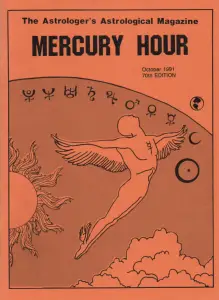
Astrology Community, Mundane Astrology, and Astrology History serve as the primary focus areas of this historical astrological literature. This archival item is the October 1991 issue (70th Edition) of Mercury Hour, “The Astrologer’s Astrological Magazine,” a reader-driven correspondence periodical edited and published by Edith Custer of Lynchburg, Virginia. Structured largely as an open forum of subscriber letters, it documents the working preoccupations of a grassroots American astrological community, with debates over classical versus modern technique, chart-matching blind tests, and the interpretation of stations, midpoints, solar returns, and heliocentric charts. Reflecting its Gulf War moment, the issue features mundane analysis of the Gulf War chart, the USSR’s dissolution, and comparative studies of Saddam Hussein, Jim Jones, and Adolf Hitler; alongside contributions from Ted George, M.J. Makransky, Joyce Wehrman, and Lee Lehman, a memorial for statistical researcher Michel Gauquelin (1928-1991), chart data for figures such as Napoleon and Helen Herron Taft, and period advertisements for early astrological software that capture the field’s transition into desktop computing.

Issue Highlights


Book Review

Working with Astrology by Michael Harding & Charles Harvey – Doris Greaves


Articles

Missing Visa Book – Marie DeLeone

Student’s Corner [the Ascendant] – Annibale F. Verzumo

Jupiter-Neptune, The Celestial Twins, Part I – Ted George

NCGR Conference [report] – Edith Custer

Indications of a Winner *or* Do You Have a Gambling Chart? – Cammille Adams

Planet Watch – Paul O. Hewit

The Natural Disposition, Part II – M.J. Makransky

Michel Gauquelin 1928-1991 – J. Lee Lehman

[USSR charts] Part I – Annibale Verzumo

The Three Amigos, Part II, Conclusion [Saddam Hussein, Jim Jones, Adolph Hitler]– Susan J. Kientz

[Risks of publishing astrological materials] Part II, Conclusion – C. J. Puotinen

Central American Data – M.J. Makransky

Her Proudest Moment [Helen Herron Taft] – T. Patrick Davis

Pluto, Part II, Transpluto – Joyce Wehrman [transcription of talk]

The Gemini Theme, Using the Astrological Language, Part III, Conclusion – Anne Foley

Autumn Equinox September 23, 1991 – Dorothy S. Willis


Discussions

Astrological weather prediction

Solar returns

Chart of Napoleon

Neptune

Gulf War chart

Heliocentric charts

Finding the time of sunrise in birthchart


Chart data

Bonaparte, Napoleon
Taft, Helen Herron
Iraq War
Costa Rica
El Salvador
Guatemala
Honduras
Nicaragua


Notable contributors

Marion March (semi-sextiles)

Lee Lehman (classical astrology techniques; homosexuality & astrology)

Marc Penfield (the astrology of Orlando, FL & Disney World)

Astrology, Ephemerides, Mundane Forecasts, Predictive Techniques, Chart Rectification, and Esoteric Studies. This issue of Mercury Hour explores a wide array of specialized astrological topics, ranging from generational planetary cycles and weather forecasting to tarot associations and historical chart rectifications. Ann Kreilkamp examines the Uranus/Pluto in Virgo generation (1962–1968), highlighting the revolutionary tendencies and psychological profiles of individuals born during this period. Robert Cole discusses the reliability of economic and meteorological forecasting against statistical probability in ‘The Prediction Game’ and outlines cycles in ‘The Aquarian Agenda’ and ‘The Tenth Aquarian Age.’ Marc Penfield contributes multiple articles analyzing market trends, the Southern States of the Confederacy, county incorporation dates, and the natal chart of Tina Turner (‘Hot Legs from Nutbush’). Other notable contributions include Lew Paxton Price’s study on astrology in the Bible, Dorothy Willis on weather forecasting via Saturn and Uranus transits, Kevin W. Barrett on Sidereal house influences, John H. Roth, Jr. on reinterpreting astrological basics through tarot and equilibrium systems, and Frank Faustino on numerical keys to Einstein’s unified theory. The magazine also features extensive book reviews by Marion March, letters, data exchanges, and discussions surrounding astrological organization politics within the AFA and AFAN.

Issue Highlights:

Articles:
A Flood Warning for New Year’s – Nancy Ray
The Uranus/Pluto in Virgo Generation 1962-68 – Ann Kreilkamp
The Prediction Game – Robert Cole
The Market Goes Up and Down – Marc Penfield
Massacre or Escape? – Marc Penfield
The Aquarian Agenda – Robert Cole
Astrology in the Bible, Part I – Lew Paxton Price
Down to Earth Astrology – Howard Stephen Berg
Reagan’s Real Ascendant, Part I – John Kalus
Astrology & The Weather, Forecasting the Weather – Dorothy Willis
Sidereal Astrology: Influence of the Houses, Part 1 – Kevin W. Barrett
Relationships and Astrology, Part 1 – Klara Henderson
The Southern States of the Confederacy – Marc Penfield
The Counties of America – Marc Penfield
Hot Legs from Nutbush: The Chart of Tina Turner – Marc Heereen Penfield
Reinterpreting the Basics – John H. Roth, Jr.
The Tenth Aquarian Age – Robert Cole
Comments on our Marvelous Solar System – Wendy Hawks
Horoscope Du Jour – T. Patrick Davis

Discussion:
Statistical accuracy of weather and economic forecasting vs. astrology
Uranus/Pluto conjunction generational traits and societal impact
Tarot correspondences with astrological houses and signs
AFA organizational politics and democratic reform
Biblical numerology and tribal configurations in relation to the zodiac

Chart data:
Sunny von Bulow
Eli Cohen
Tina Turner
Ronald Reagan
AFA (American Federation of Astrologers)

Notable contributors:
Marion March (Book Reviews and UAC Report)
Al H. Morrison (Chiron Glyph and Cosmopolitics notes)
Reinhold Ebertin (Cosmopolitics excerpts)
Joylyn Hill (India/Israel mundane analysis and afflicted Moon studies)

ASPECTS Vol. 6 No. 1 Winter 1980-1

ASPECTS Magazine

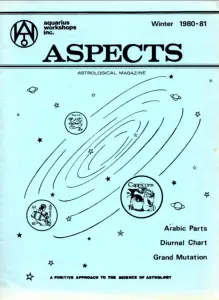
Astrological Techniques, Arabic Parts, Mundane Astrology. This issue of ASPECTS magazine provides a deep dive into advanced astrological applications, specifically focusing on the interpretation and calculation of Arabic Parts and the impact of the Great Mutation (Jupiter-Saturn conjunction). The technical content is complemented by foundational series columns, such as Joan McEvers’ exploration of the 5th House and Nancy Cassidy’s analysis of sextile aspects. These articles bridge the gap between abstract mathematical derivations and practical, house-by-house interpretations of human experience and psychological drives.

Issue Highlights

The magazine documents the transition into a new astrological era marked by the shift of Jupiter-Saturn conjunctions from Earth signs to the Air element, specifically referencing the 1980 conjunction in Libra. It also serves as a chronicle of the burgeoning astrological community in the early 1980s, highlighting the South-Western Astrology Conference (SWAC) of 1980, upcoming conferences in Zurich, and the general professionalization of the field through organizations like Aquarius Workshops, Inc.

Articles:
How To Calculate Your Arabic Parts – Robert ‘Buz’ Myers
The Great Jupiter/Saturn Conjunction – Marion D. March
The Diurnal (Daily) Chart – Lenora M. Hill
The Point of Life – Enrique Linarés
Keys to Learning (5th House) – Joan McEvers
Building Blocks (Sextiles) – Nancy Cassidy
Capricorn Ingress – Judy Johns

Discussion:
The transition from Earth to Air element in major planetary conjunctions
Calculation and interpretation of 10 specific Arabic Parts across 12 houses
The professional development of astrology in educational and conference settings

Chart data:
10/28/75, 1:24 pm PST, Encino, CA
12/21/1980, 11:56:00 EST, Washington, DC

Notable contributors:
Robert ‘Buz’ Myers (Arabic Parts)
Marion D. March (Mundane Astrology/Conjunctions)
Joan McEvers (Astrological Education)

ASPECTS Vol. 3 No 2. Feb 1978

ASPECTS Magazine

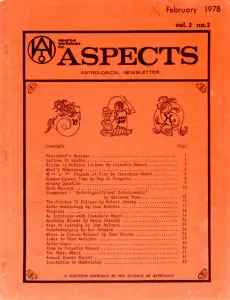
Astrology, Aquarius Workshops, Eclipses, Horary, Graphoanalysis, Ingress Charts, Planetary Aspects. This issue of Aspects Astrological Newsletter (Vol. 3, No. 2, February 1978) covers a wide range of advanced and beginner astrological techniques, organizational news, book reviews, and interviews. Highlights include discussions on Uranus and Neptune dynamics, the October 12 eclipse impact, the application of ingress charts for personal forecasting, astro-numerology, and graphoanalysis techniques correlating handwriting slant with emotional responsiveness.

Issue Highlights:
Features extensive reports on conferences, upcoming workshops by prominent astrologers like Isabel Hickey and Gina Ceaglio, presidential messages from Marion D. March, and detailed technical articles exploring natal chart interpretation, house systems, and predictive methods.

Articles:
Review of McEvers Lecture – Cornelia Hansen
Friends or Foes – Constance Mayer
Humano-Cosmic Time – Guy de Penguern
Horary Question – Anonymous
Viewpoint – Astrologer/Client Relationship – Marianne Dunn
The October 12 Eclipse – Robert Jansky
Astro-Numerology – Joan McEvers
An Interview with Constance Mayer – Marion D. March
Building Blocks – Nancy Cassidy
Keys to Learning – Joan McEvers
Graphoanalysis – Sue Johnson
Where is Cousin Melvin? – Jean Graves
Astro-Logic – Anonymous
The Phase Wheel – Anonymous
Annual Dinner Report – Karen McCauley

Discussion:
Using ingress charts for prognostications and personal forecasting
Comparing Uranus and Neptune symbolism and manifestations
Humano-Cosmic Time previewing system based on 11-minute 12-second zodiacal ticks per year of life
Turning the house method in horary and natal charts (‘Every house is a first house’)
The psychological and physiological impacts of solar and lunar eclipses across houses
Graphological analysis of writing slant and emotional styles (FA, AB, BC, CD, DE, E+)

Chart data:
Capricorn Ingress Chart (December 21, 1977)
Horary Chart for Marriage Question (July 5, 1977)

Notable contributors:
Joan McEvers (Ingress charts, astro-numerology, keys to learning)
Constance Mayer (Planetary comparison of Uranus and Neptune)
Robert Jansky (Eclipse analysis and book reviews)
Marianne Dunn (Client-astrologer relationship ethics)
Guy de Penguern (Humano-Cosmic Time system)
Sue Johnson (Graphoanalysis)
Nancy Cassidy (Beginner blocks on Leo)
Jean Graves (Derivative house systems)

Ask A Librarian

Need assistance with your research or navigating our collection? Our library team is here to help.

Please fill out the form below with details about the topics, authors, or archival materials you are looking for, and one of our librarians will review your query and respond shortly.

Help

Whether you are looking for rare historical texts or trying to locate a specific book nearby, Alexandria iBase offers two primary ways to search. Here is how to choose the right tool for what you need:

The Library Catalogue

Think of this as your global master index.

The Catalogue works just like a traditional library search system, designed to help you locate books and media across the broader astrological landscape.

  • Physical Books: Find out where physical copies of books are held in libraries, archives, or collections near you.

  • Digital Files: Access downloadable or viewable digital editions when available.

  • Best Used For: Standard research, finding specific ISBNs or authors, and tracking down physical items in the real world.

Browse Catalogue

SPECIAL COLLECTIONS

Think of this as Alexandria’s exclusive private vault.

Collections gives you direct access to Alexandria’s own curated archive of rare, proprietary, and historic astrology media.

  • Exclusive Material: Features unique texts, manuscripts, audio recordings, and visual media that are not available anywhere else.

  • Direct Access: Digitized content ready to explore straight from the platform.

  • Best Used For: Deep-dive research, discovering hidden gems, and exploring rare, one-of-a-kind astrological resources.

Browse Special Collections

Cash & In-Kind Donations

Make a one-time or recurring tax deductible cash donation.

Payment options include donating directly with us, PayPal Giving and GoFundMe.

GoFundMe for Charities and PayPal Giving are registered for tax deductions and have no required processing fees. It does offer the option to tip.

Donate

*Subject to 2.5% processing fees

Contact Us

Have a question, feedback, or a inquiry about our archives? We’d love to hear from you. Please fill out the form below with your details and message, and a member of our team will get back to you as soon as possible.

Thank you for reaching out to the Alexandria iBase Project!