
Home » Earth » Page 2

Earth

In standard geocentric astrology, the Earth is the implied center of the chart and is not explicitly mapped. However, in heliocentric astrology, the Earth is plotted as a functional celestial body (always exactly opposite the geocentric Sun), interpreted as the physical grounding point and the immediate material manifestation of solar energy.

Filters

Filters


See more See less
See more See less
See more See less
See more See less
See more See less
See more See less
See more See less

Sorting


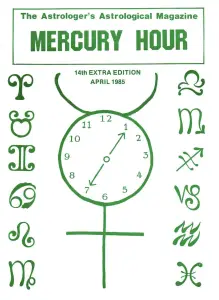
Mundane Astrology, Astrology History, and Astrological Techniques. This archival item is the April 1985 issue (14th Extra Edition) of Mercury Hour, a quarterly astrological magazine edited and published by Edith Custer in Lynchburg, Virginia. Featured articles include Raul Davila’s comparative study of published birth times for Ronald Reagan, Judy Goodwin’s research on name etymology in “The Astro-Punology of Names,” Marc Penfield’s chart analysis of the State of Israel, and T. Patrick Davis’s survey of geocentric and heliocentric Mars-to-Moon aspects alongside historical charts of the 1941 Pearl Harbor attack. Additional contributions cover Mary Mackenzie’s application of John H. Nelson’s heliocentric radio propagation forecasting methods, Judith Gee’s analysis of the 1939 Hitler-Stalin Pact, Marion March’s commentary on planetary configurations, and Joylyn Hill’s reflections on Atlantis. The issue also preserves community discussions regarding Gauquelin’s “Mars Effect,” astrological triggers for agoraphobia, forensic chart analyses of the Lindbergh baby kidnapping, and legal regulations surrounding professional astrology.


Issue Highlights


Articles

Published Birthtimes for Ronald Reagan – Raul Davila

Sampling of the Research from the Astro-Punology of Names – Judy Goodwin

The State of Israel – Marc Penfield

Geo & Helio Mars-to-Moon Aspects in 150 Charts – T. Patrick Davis

Excerpts From Letters to Michael Erlewine – John McCormick

The Basic Meaning of Configurations – Marion March

Atlantis and Astrology – Joylyn Hill


Discussions

Gauquelin’s “Mars effect”

Astrological triggers for agoraphobia

Commentary on Marion March’s “The Many Faces of Pluto”

John H. Nelson’s heliocentric planetary aspects & ham radio operation

Pearl Harbor attack

Birth of Astrology


Chart data

Cuomo, Mario
Duncan, Isadora
Gacy, John Wayne
Liddell, Alice (daughter of Lewis Carroll)
Mondale, Walter
Sepeda, Loren Faith (abducted child & related charts) Spungen, Nancy

AFA (Sideral/Lavagnini Houses)

Pact between Hitler and Stalin, Aug 1939

Pearl Harbor attack, Dec 1941

State of Israel

Weizman-Peres Agreement, Tel Aviv, Aug 1984


Notable contributors

Mark Melton (scientific method in astrological research)

Marc Penfield (birthtime/rectification of chart of Ronald Reagan; numerological axioms of the American Presidents)

Al H. Morrison (house systems; natal Moon void-of course; astrology and the federal Dictionary of Occupational Terms)

Ivy Goldstein-Jacobs (brief non-astrological piece on the escalation of medication)

Zane Stein (Halley’s Comet; Chiron; beginning of the Aquarian Age; rulership of body parts)
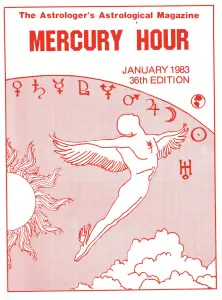
 

Astrology, Mercury Hour, Natal charts, Transits, Progressions, Mundane Astrology, Astro*Carto*Graphy, Chiron, Void of Course Moon, Solar Returns, Uranian astrology, Cosmobiology. This 36th Edition of Mercury Hour (January 1983), edited and published by Edith Custer, is a comprehensive astrological magazine featuring diverse correspondence, extensive theoretical and technical articles, book reviews, conference reports, and in-depth chart delineations. Key themes explored across the publication include life-stage transitions such as the ‘Catch-30’ passage and Uranus age cycles, mundane and political astrology including analyses of nuclear war threats, the Falklands crisis, and the chart of Israel, as well as technical discussions regarding software, heliocentric nodes, house systems, and the accuracy of astrological statistics (such as Gauquelin studies).

Issue Highlights:

Articles:
The Vertex – Jan Popelka
Student’s Section: A Visit to Astrologers in the U.S.A. – Ann Stevens-Patacchiola
The Catch-30 Passage: [28-32], Part III – Bil Tierney
[Uranus age cycle] Part II – Dale Huckeby
Mysterious Neptune, Part II (Marcia Moore’s chart and death) – Manik Chand Jain
Moon Void of Course in the Signs, Part I – Ted George
Is Nuclear War in Our Future? [An Astrological Call to Action] – Virginia Miller
The Pshaw Report – Jayj Jacobs
The Role of the Moon’s Nodes in World Events – Alan Richter
The New Orleans Air Crash of July 1982 – Jeff Jawer
The Effects of Saturn Transits in the Lives of the Pacific Club Members – Dona Shaw
A Royal Baby (Prince William) – Judith Gee
Determining the Winner of a Game – Sophia Mason
The Psychological Patterns of Jesus Christ – Frank Jakubowsky

Discussion:
Astro*Carto*Graphy, geodetic equivalents, and mundane predictions
Astrology hardware and software (Osborne, Astro Star, Matrix software reports)
Sunspot activity and the stock market
Gauquelin studies and statistical analysis
Lindbergh baby kidnapping and Bruno Hauptmann chart analysis
Intruder in the Queen’s Bedroom (Michael Fagan and Elizabeth II charts)
Fraternity for Canadian Astrologers 1st National Conference awards

Chart data:
August Belmont
David Crosby
Richard Dreyfuss
Michael Fagan
Andy Gibb
Bruno Hauptmann
Charley Pride
Victoria Principal
Ronald Reagan
Michael Trestrail
Israel and Partition
United Kingdom

Notable contributors:
Jim Lewis (Astro*Carto*Graphy and Ronald Reagan chart)
Jeff Jawer (First Canadian National Conference)
Barbara Watters (Grand trines and Sex and the Outer Planets)
Tracy Marks (financial compensation for astrologers)
Zane Stein (Chiron research)
Erin Sullivan (astrology of sexuality)

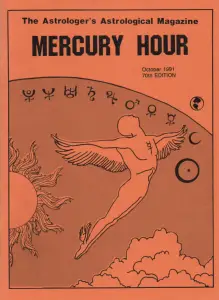
Astrology Community, Mundane Astrology, and Astrology History serve as the primary focus areas of this historical astrological literature. This archival item is the October 1991 issue (70th Edition) of Mercury Hour, “The Astrologer’s Astrological Magazine,” a reader-driven correspondence periodical edited and published by Edith Custer of Lynchburg, Virginia. Structured largely as an open forum of subscriber letters, it documents the working preoccupations of a grassroots American astrological community, with debates over classical versus modern technique, chart-matching blind tests, and the interpretation of stations, midpoints, solar returns, and heliocentric charts. Reflecting its Gulf War moment, the issue features mundane analysis of the Gulf War chart, the USSR’s dissolution, and comparative studies of Saddam Hussein, Jim Jones, and Adolf Hitler; alongside contributions from Ted George, M.J. Makransky, Joyce Wehrman, and Lee Lehman, a memorial for statistical researcher Michel Gauquelin (1928-1991), chart data for figures such as Napoleon and Helen Herron Taft, and period advertisements for early astrological software that capture the field’s transition into desktop computing.

Issue Highlights


Book Review

Working with Astrology by Michael Harding & Charles Harvey – Doris Greaves


Articles

Missing Visa Book – Marie DeLeone

Student’s Corner [the Ascendant] – Annibale F. Verzumo

Jupiter-Neptune, The Celestial Twins, Part I – Ted George

NCGR Conference [report] – Edith Custer

Indications of a Winner *or* Do You Have a Gambling Chart? – Cammille Adams

Planet Watch – Paul O. Hewit

The Natural Disposition, Part II – M.J. Makransky

Michel Gauquelin 1928-1991 – J. Lee Lehman

[USSR charts] Part I – Annibale Verzumo

The Three Amigos, Part II, Conclusion [Saddam Hussein, Jim Jones, Adolph Hitler]– Susan J. Kientz

[Risks of publishing astrological materials] Part II, Conclusion – C. J. Puotinen

Central American Data – M.J. Makransky

Her Proudest Moment [Helen Herron Taft] – T. Patrick Davis

Pluto, Part II, Transpluto – Joyce Wehrman [transcription of talk]

The Gemini Theme, Using the Astrological Language, Part III, Conclusion – Anne Foley

Autumn Equinox September 23, 1991 – Dorothy S. Willis


Discussions

Astrological weather prediction

Solar returns

Chart of Napoleon

Neptune

Gulf War chart

Heliocentric charts

Finding the time of sunrise in birthchart


Chart data

Bonaparte, Napoleon
Taft, Helen Herron
Iraq War
Costa Rica
El Salvador
Guatemala
Honduras
Nicaragua


Notable contributors

Marion March (semi-sextiles)

Lee Lehman (classical astrology techniques; homosexuality & astrology)

Marc Penfield (the astrology of Orlando, FL & Disney World)

Ask A Librarian

Need assistance with your research or navigating our collection? Our library team is here to help.

Please fill out the form below with details about the topics, authors, or archival materials you are looking for, and one of our librarians will review your query and respond shortly.

Help

Whether you are looking for rare historical texts or trying to locate a specific book nearby, Alexandria iBase offers two primary ways to search. Here is how to choose the right tool for what you need:

The Library Catalogue

Think of this as your global master index.

The Catalogue works just like a traditional library search system, designed to help you locate books and media across the broader astrological landscape.

  • Physical Books: Find out where physical copies of books are held in libraries, archives, or collections near you.

  • Digital Files: Access downloadable or viewable digital editions when available.

  • Best Used For: Standard research, finding specific ISBNs or authors, and tracking down physical items in the real world.

Browse Catalogue

SPECIAL COLLECTIONS

Think of this as Alexandria’s exclusive private vault.

Collections gives you direct access to Alexandria’s own curated archive of rare, proprietary, and historic astrology media.

  • Exclusive Material: Features unique texts, manuscripts, audio recordings, and visual media that are not available anywhere else.

  • Direct Access: Digitized content ready to explore straight from the platform.

  • Best Used For: Deep-dive research, discovering hidden gems, and exploring rare, one-of-a-kind astrological resources.

Browse Special Collections

Cash & In-Kind Donations

Make a one-time or recurring tax deductible cash donation.

Payment options include donating directly with us, PayPal Giving and GoFundMe.

GoFundMe for Charities and PayPal Giving are registered for tax deductions and have no required processing fees. It does offer the option to tip.

Donate

*Subject to 2.5% processing fees

Contact Us

Have a question, feedback, or a inquiry about our archives? We’d love to hear from you. Please fill out the form below with your details and message, and a member of our team will get back to you as soon as possible.

Thank you for reaching out to the Alexandria iBase Project!