
Home » House Systems » Page 3

House Systems

House Systems are the mathematical frameworks used to divide the ecliptic (or spatial quadrants) into twelve distinct sectors (houses). Astrological and astronomical texts categorize these into Direct (e.g., Equal, Solar), Projection (e.g., Campanus, Regiomontanus, Placidus), and Intersection (e.g., Koch) systems, each presenting different astronomical philosophies and geographical limitations.

Filters

Filters


See more See less
See more See less
See more See less
See more See less
See more See less
See more See less
See more See less

Sorting

Astrological Techniques, Mundane Astrology, Historical Research. This 79th edition of Mercury Hour (January 1994) functions as a dynamic forum for practitioners to share research, personal experiences, and technical debates. A major focus throughout the issue is on natal chart rectification, the debate over house systems (specifically Lavagnini, Morinus, and Placidus/Koch), and the practical application of planetary transits and progressions to mundane events, such as the Israel-PLO accord, the Clinton presidency, and the Michael Jackson investigations. The issue also features a heavy emphasis on early American astrological history, with Robert Zoller exploring how astrology was utilized and viewed in pre-1860 American colonies and academic settings.

Technical discussions extend to specialized methodologies, including the evaluation of “accidental ascendants,” the use of Chaos Theory and septile aspects, and reviews of foundational translations like Paulus Alexandrinus. Contributors wrestle with the philosophical and ethical dimensions of the craft, debating whether astrology can be considered “from the devil” or if it serves as a valid system for psychological understanding and life navigation. The publication serves as a nexus for the community, highlighting professional conferences, software reviews (such as Matrix Software), and the ongoing efforts of Project Hindsight to recover ancient techniques.

Issue Highlights:
Articles:
Winter Solstice [1993] – Dorothy Willis
Introduction to M-13: Spiritual Theory, Part II, Conclusion – Defiance Gregg
Will Daniel Day-Lewis Get an Oscar? – Barbara Dunn
Is Astrology “From the Devil?” – Carole Devine
Open Letter of Complaint re the UAC Conference – Dorothy Martin
More Founding Dates, Part 3, Conclusion – Marc Penfield
Student Corner Rewrite [hemispheres of the chart] – Joseph S. DeMello
Student’s Corner, Part 2 of 2 [7th & 10th houses] – Annibale F. Verzumo
American Astrology Prior to 1860 – Robert Zoller
An Astrological Review of Passages, Part 5 of 6 – Bil Tierney
Computers – Joseph S. de Mello
A Review of Project Hindsight’s First Translation: Paulus Alexandrinus, Introductory Matters – Michele C. McKee

Discussion:
Lavagnini house system
Chart of Michael Jackson
Chart of Bill Clinton
Astrology & crime-solving
Evangeline Adams “accidental ascendant” technique
Chart of Baltimore, MD
Coming earth changes/polarity shift
U.S. Presidents & Chinese astrology
Universal Number/Chaos Theory/septile aspect
J. Edgar Hoover
Age of Aquarius

Chart data:
Henry, Patrick
Jackson, Michael
Koresh, David
Baltimore, MD
Israel/recognition of PLO

Notable contributors:
Lois Rodden (Bill Clinton and David Koresh birth charts, chart ratings)
Karen Christino (Saturn Return)
Marion March (Tropical vs. Sidereal)
Astrology, Horary, House Systems, Synastry, and Transits. This edition of Mercury Hour features extensive reader discussions and technical articles covering various astrological branches. Topics include an exploration of planetary speeds and Kepler’s theories by Donald E. Byrne, declination and out-of-bounds planets by Gilbert Navarro, synastry and musical charts comparing John Lennon, Paul McCartney, Richard Nixon, and Yoko Ono by Dianne Lawson, as well as a concluding critique of the Koch House System by M. J. Makransky. Additional articles cover astrolocality mapping variants, Russian history and charts by Annibale F. Verzumo, Vernal Equinox charts, I Ching trigrams, and book reviews covering computer software, house development, and planetary stations.

Issue Highlights:

Articles:
Where is Vulcan & Nemesis? Part I – Donald E. Byrne
John Lennon and Paul McCartney, Richard Nixon, and Yoko Ono – Dianne Lawson
The Last Word on the Koch House System and Further Critique of the Koch House System, Part II, Conclusion – M. J. Makransky
Precession of the Equinox – Donald E. Byrne
How to Make Astrology Pay From A-Z, Part II, Conclusion – Adze Mixxe
Variant Forms of Astrolocality Mapping, Part I – M. J. Makransky
[Russia] Part III, Conclusion – Annibale F. Verzumo
Vernal Equinox March 20, 1992 – Dorothy S. Willis
Corrections: The Book of World Horoscopes – Nicholas Campion
I Ching: The Trigrams-Fu Hai Arrangement – Dorothy J. Sarka

Discussion:
Transpluto/Pluto Square 1991 – 1993
December 21, 1991 lunar eclipse
Secondary progressions
CSICOP and Humanistic astrology
Antichrist and Judgement Day discussions
Gulf War charts and Horary missing articles

Chart data:
Bill Clinton
Paul Keating
John Lennon
Paul McCartney
Richard Nixon
Yoko Ono
Paul Tsongas

Notable contributors:
Marion March (problematic astrological terminology)
Gilbert Navarro (declination)
Lee Lehman (humanism and CSICOP)
Diana Rosenberg (Jeffrey Dahmer chart)
Edith Custer (defending astrology)

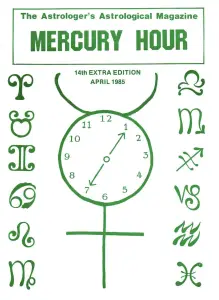
Mundane Astrology, Astrology History, and Astrological Techniques. This archival item is the April 1985 issue (14th Extra Edition) of Mercury Hour, a quarterly astrological magazine edited and published by Edith Custer in Lynchburg, Virginia. Featured articles include Raul Davila’s comparative study of published birth times for Ronald Reagan, Judy Goodwin’s research on name etymology in “The Astro-Punology of Names,” Marc Penfield’s chart analysis of the State of Israel, and T. Patrick Davis’s survey of geocentric and heliocentric Mars-to-Moon aspects alongside historical charts of the 1941 Pearl Harbor attack. Additional contributions cover Mary Mackenzie’s application of John H. Nelson’s heliocentric radio propagation forecasting methods, Judith Gee’s analysis of the 1939 Hitler-Stalin Pact, Marion March’s commentary on planetary configurations, and Joylyn Hill’s reflections on Atlantis. The issue also preserves community discussions regarding Gauquelin’s “Mars Effect,” astrological triggers for agoraphobia, forensic chart analyses of the Lindbergh baby kidnapping, and legal regulations surrounding professional astrology.


Issue Highlights

Book Review:

Relationships & Life Cycles, Modern Dimensions of Astrology by Stephen Arroyo – Rochelle Gordon


Articles:

Saturn Through the Signs – Bil Tierney

Crisis in the Near East – Gregg Castellucci

Chiron and Group Fusion – Tom McNamara

The Discovery of the Asteroids – Joylyn Hill

In the Winter of our Discontent – Marc Robertson (Jupiter-Saturn cycles)

Pluto (Part III) – R.C. Davison


Discussions:

AFA Conventions

Void of Course Moon

Ted Bundy

Inherited family traits


Chart data:

Ali, Mohammad
Anderson, John B.
Bergen, Candice
Crawford, Joan
Jones, Jim
Israel


Notable contributors:

Marion March (Fiji conference)

Lois Rodden (notes on chart data)

Jim Lewis (notes on A*C*G* maps of US Presidential candidates)

Lee Lehman (research on astrology & homosexuality)


Mundane Astrology, Astrology History, and Astrological Techniques. This archival item is the April 1985 issue (14th Extra Edition) of Mercury Hour, a quarterly astrological magazine edited and published by Edith Custer in Lynchburg, Virginia. Featured articles include Raul Davila’s comparative study of published birth times for Ronald Reagan, Judy Goodwin’s research on name etymology in “The Astro-Punology of Names,” Marc Penfield’s chart analysis of the State of Israel, and T. Patrick Davis’s survey of geocentric and heliocentric Mars-to-Moon aspects alongside historical charts of the 1941 Pearl Harbor attack. Additional contributions cover Mary Mackenzie’s application of John H. Nelson’s heliocentric radio propagation forecasting methods, Judith Gee’s analysis of the 1939 Hitler-Stalin Pact, Marion March’s commentary on planetary configurations, and Joylyn Hill’s reflections on Atlantis. The issue also preserves community discussions regarding Gauquelin’s “Mars Effect,” astrological triggers for agoraphobia, forensic chart analyses of the Lindbergh baby kidnapping, and legal regulations surrounding professional astrology.


Issue Highlights


Articles

Published Birthtimes for Ronald Reagan – Raul Davila

Sampling of the Research from the Astro-Punology of Names – Judy Goodwin

The State of Israel – Marc Penfield

Geo & Helio Mars-to-Moon Aspects in 150 Charts – T. Patrick Davis

Excerpts From Letters to Michael Erlewine – John McCormick

The Basic Meaning of Configurations – Marion March

Atlantis and Astrology – Joylyn Hill


Discussions

Gauquelin’s “Mars effect”

Astrological triggers for agoraphobia

Commentary on Marion March’s “The Many Faces of Pluto”

John H. Nelson’s heliocentric planetary aspects & ham radio operation

Pearl Harbor attack

Birth of Astrology


Chart data

Cuomo, Mario
Duncan, Isadora
Gacy, John Wayne
Liddell, Alice (daughter of Lewis Carroll)
Mondale, Walter
Sepeda, Loren Faith (abducted child & related charts) Spungen, Nancy

AFA (Sideral/Lavagnini Houses)

Pact between Hitler and Stalin, Aug 1939

Pearl Harbor attack, Dec 1941

State of Israel

Weizman-Peres Agreement, Tel Aviv, Aug 1984


Notable contributors

Mark Melton (scientific method in astrological research)

Marc Penfield (birthtime/rectification of chart of Ronald Reagan; numerological axioms of the American Presidents)

Al H. Morrison (house systems; natal Moon void-of course; astrology and the federal Dictionary of Occupational Terms)

Ivy Goldstein-Jacobs (brief non-astrological piece on the escalation of medication)

Zane Stein (Halley’s Comet; Chiron; beginning of the Aquarian Age; rulership of body parts)


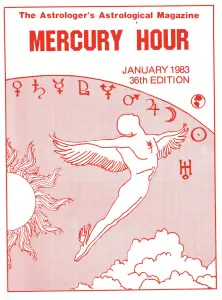
Astrology, Mercury Hour, Natal charts, Transits, Progressions, Mundane Astrology, Astro*Carto*Graphy, Chiron, Void of Course Moon, Solar Returns, Uranian astrology, Cosmobiology. This 36th Edition of Mercury Hour (January 1983), edited and published by Edith Custer, is a comprehensive astrological magazine featuring diverse correspondence, extensive theoretical and technical articles, book reviews, conference reports, and in-depth chart delineations. Key themes explored across the publication include life-stage transitions such as the ‘Catch-30’ passage and Uranus age cycles, mundane and political astrology including analyses of nuclear war threats, the Falklands crisis, and the chart of Israel, as well as technical discussions regarding software, heliocentric nodes, house systems, and the accuracy of astrological statistics (such as Gauquelin studies).

Issue Highlights:

Articles:
The Vertex – Jan Popelka
Student’s Section: A Visit to Astrologers in the U.S.A. – Ann Stevens-Patacchiola
The Catch-30 Passage: [28-32], Part III – Bil Tierney
[Uranus age cycle] Part II – Dale Huckeby
Mysterious Neptune, Part II (Marcia Moore’s chart and death) – Manik Chand Jain
Moon Void of Course in the Signs, Part I – Ted George
Is Nuclear War in Our Future? [An Astrological Call to Action] – Virginia Miller
The Pshaw Report – Jayj Jacobs
The Role of the Moon’s Nodes in World Events – Alan Richter
The New Orleans Air Crash of July 1982 – Jeff Jawer
The Effects of Saturn Transits in the Lives of the Pacific Club Members – Dona Shaw
A Royal Baby (Prince William) – Judith Gee
Determining the Winner of a Game – Sophia Mason
The Psychological Patterns of Jesus Christ – Frank Jakubowsky

Discussion:
Astro*Carto*Graphy, geodetic equivalents, and mundane predictions
Astrology hardware and software (Osborne, Astro Star, Matrix software reports)
Sunspot activity and the stock market
Gauquelin studies and statistical analysis
Lindbergh baby kidnapping and Bruno Hauptmann chart analysis
Intruder in the Queen’s Bedroom (Michael Fagan and Elizabeth II charts)
Fraternity for Canadian Astrologers 1st National Conference awards

Chart data:
August Belmont
David Crosby
Richard Dreyfuss
Michael Fagan
Andy Gibb
Bruno Hauptmann
Charley Pride
Victoria Principal
Ronald Reagan
Michael Trestrail
Israel and Partition
United Kingdom

Notable contributors:
Jim Lewis (Astro*Carto*Graphy and Ronald Reagan chart)
Jeff Jawer (First Canadian National Conference)
Barbara Watters (Grand trines and Sex and the Outer Planets)
Tracy Marks (financial compensation for astrologers)
Zane Stein (Chiron research)
Erin Sullivan (astrology of sexuality)

Asteroid Juno, Marriage, Power Struggles, Prominent Figures. This article explores the astrological significance of the asteroid Juno, known in mythology as the wife of Zeus and queen of the gods, focusing on her role in partnerships, marriage, jealousy, fidelity, and power dynamics. The author examines Juno’s orbital cycles, particularly its movements in Capricorn and Aquarius, and analyzes its placement in the natal charts of numerous historical figures, celebrities, and political leaders. The text highlights how prominent women often feature strong Juno placements, connecting the asteroid to public fame through marriage, career support, or notable domestic struggles.

Issue Highlights:

Articles:
JUNO: FIRST LADY OF THE GODS – Frances McEvoy

Discussion:
Astrological significance of the asteroid Juno
Juno’s cycles and stations in Capricorn and Aquarius
Juno in natal charts of political figures and celebrities
Connections between Juno aspects and marriage, divorce, and widowhood

Chart data:
Barbara Bush
Rose Kennedy
Elizabeth Taylor
Eleanor Roosevelt

Notable contributors:
Frances McEvoy (Astrological analysis of the asteroid Juno)

Ask A Librarian

Need assistance with your research or navigating our collection? Our library team is here to help.

Please fill out the form below with details about the topics, authors, or archival materials you are looking for, and one of our librarians will review your query and respond shortly.

Help

Whether you are looking for rare historical texts or trying to locate a specific book nearby, Alexandria iBase offers two primary ways to search. Here is how to choose the right tool for what you need:

The Library Catalogue

Think of this as your global master index.

The Catalogue works just like a traditional library search system, designed to help you locate books and media across the broader astrological landscape.

  • Physical Books: Find out where physical copies of books are held in libraries, archives, or collections near you.

  • Digital Files: Access downloadable or viewable digital editions when available.

  • Best Used For: Standard research, finding specific ISBNs or authors, and tracking down physical items in the real world.

Browse Catalogue

SPECIAL COLLECTIONS

Think of this as Alexandria’s exclusive private vault.

Collections gives you direct access to Alexandria’s own curated archive of rare, proprietary, and historic astrology media.

  • Exclusive Material: Features unique texts, manuscripts, audio recordings, and visual media that are not available anywhere else.

  • Direct Access: Digitized content ready to explore straight from the platform.

  • Best Used For: Deep-dive research, discovering hidden gems, and exploring rare, one-of-a-kind astrological resources.

Browse Special Collections

Cash & In-Kind Donations

Make a one-time or recurring tax deductible cash donation.

Payment options include donating directly with us, PayPal Giving and GoFundMe.

GoFundMe for Charities and PayPal Giving are registered for tax deductions and have no required processing fees. It does offer the option to tip.

Donate

*Subject to 2.5% processing fees

Contact Us

Have a question, feedback, or a inquiry about our archives? We’d love to hear from you. Please fill out the form below with your details and message, and a member of our team will get back to you as soon as possible.

Thank you for reaching out to the Alexandria iBase Project!