
Home » Transits » Page 5

Transits

Transit is a fundamental predictive technique in chart mechanics that tracks the continuous, real-time movement of celestial bodies across the zodiac and their geometric relationships to the fixed points of a natal or reference chart. By measuring where current planetary positions activate natal planets, angles, or houses, astrologers identify specific windows of psychological development, external events, and cyclical timing. This dynamic method bridges the permanent architecture of the birth chart with the unfolding passage of time, offering deep insight into how cosmic shifts manifest in daily life.

Filters

Filters


See more See less
See more See less
See more See less
See more See less
See more See less
See more See less
See more See less

Sorting

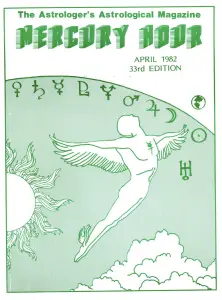
Astrology, Horary, House Systems, Synastry, and Transits. This edition of Mercury Hour features extensive reader discussions and technical articles covering various astrological branches. Topics include an exploration of planetary speeds and Kepler’s theories by Donald E. Byrne, declination and out-of-bounds planets by Gilbert Navarro, synastry and musical charts comparing John Lennon, Paul McCartney, Richard Nixon, and Yoko Ono by Dianne Lawson, as well as a concluding critique of the Koch House System by M. J. Makransky. Additional articles cover astrolocality mapping variants, Russian history and charts by Annibale F. Verzumo, Vernal Equinox charts, I Ching trigrams, and book reviews covering computer software, house development, and planetary stations.

Issue Highlights:

Articles:
Where is Vulcan & Nemesis? Part I – Donald E. Byrne
John Lennon and Paul McCartney, Richard Nixon, and Yoko Ono – Dianne Lawson
The Last Word on the Koch House System and Further Critique of the Koch House System, Part II, Conclusion – M. J. Makransky
Precession of the Equinox – Donald E. Byrne
How to Make Astrology Pay From A-Z, Part II, Conclusion – Adze Mixxe
Variant Forms of Astrolocality Mapping, Part I – M. J. Makransky
[Russia] Part III, Conclusion – Annibale F. Verzumo
Vernal Equinox March 20, 1992 – Dorothy S. Willis
Corrections: The Book of World Horoscopes – Nicholas Campion
I Ching: The Trigrams-Fu Hai Arrangement – Dorothy J. Sarka

Discussion:
Transpluto/Pluto Square 1991 – 1993
December 21, 1991 lunar eclipse
Secondary progressions
CSICOP and Humanistic astrology
Antichrist and Judgement Day discussions
Gulf War charts and Horary missing articles

Chart data:
Bill Clinton
Paul Keating
John Lennon
Paul McCartney
Richard Nixon
Yoko Ono
Paul Tsongas

Notable contributors:
Marion March (problematic astrological terminology)
Gilbert Navarro (declination)
Lee Lehman (humanism and CSICOP)
Diana Rosenberg (Jeffrey Dahmer chart)
Edith Custer (defending astrology)
Astrology, Horary, Mundane, Chart Techniques, Software, Ethics. This edition of Mercury Hour features an eclectic collection of letters, articles, and discussions from the astrological community of the late 1980s. Key technical discussions focus on the application of horary techniques to personal events, the validity of progressions versus transits, the use of heliocentric charts, the debate surrounding psychological counseling by astrologers, and methods for calculating progressed angles. Several contributors engage in a lively back-and-forth regarding the “True Time” of the U.S. founding, with specific arguments favoring the July 4th, 1776 date.

Issue Highlights:
The issue serves as a forum for various professional and amateur astrologers to share research, personal anecdotes, and technical feedback on software and methodology. Notable articles explore the potential “Viper’s Nest” chart pattern in relation to criminals like Ted Bundy, the debate against professional astrological counseling, and techniques for natal chart rectification using historical and event-based data. Much of the content is shaped by the editor’s return to the magazine, establishing a welcoming space for community debate, software reviews, and the sharing of “Chart Mart” data.

Articles:
Salem, or A Cynic’s Centiloquy – Don Borkowski
Horary Techniques Applied to Personal Events – Edward Dearborn
Another Asteroid Turned Comet (Chiron) – Richard A. Kerr
Against Astrological Counseling – Robert Cole
Will the Real Duchess of Windsor Stand Up – Carolyn H. Caufman
Moving to Paradise – Marc Penfield
Joyce’s Key Phrases for Transiting Aspects – Joyce Wehrman
Ted Bundy’s “Viper’s Nest” Chart Pattern – John Kalus

Discussion:
Calculating progressions and progressed houses
Speculative charts for Mikhail Gorbachev and U.S. historical events
Weather predictions based on Winter Solstice and planetary alignments
The ethics of professional astrological counseling
Use of heliocentric versus geocentric charts

Chart data:
Mikhail Gorbachev
Wallis Simpson
Cheryl Crane
Davy Crockett
Katherine Hepburn
George Bush
Michael and Kitty Dukakis
Joan Quigley

Notable contributors:
Michael Munkasey (Chart of the U.S.A.)
Al H. Morrison (Neptune aspects; shamanism; horary timing)
Jim Lewis (1988 U.S.A. election)
Marion March (C-Sections; Chiron; Jesse Jackson)

Mundane Astrology, Astrological History, and Astrological Techniques. This archival item is the July 1984 issue (42nd Edition) of Mercury Hour, a quarterly astrological magazine edited and published by Edith Custer in Lynchburg, Virginia. Key contents include legal and advocacy discussions surrounding the municipal “fortune telling” arrests of astrologers in San Jose and Los Angeles, alongside the organizational development of the Astrological Network (AFAN) and its relationship with the American Federation of Astrologers (AFA). The issue features articles such as Danni Herman’s “An Astrological Anatomy of Behavior,” Ted George’s exploration of “Paragon” (a proposed satellite of Mercury), Jack Fertig’s compilation of AIDS case data, and Marc Penfield’s “Chart Mart” containing extensive birth data for public figures and speculative horoscopes for historical events. Additional contributions cover reviews of books by Linda Carbone, Liz Greene, Stephen Arroyo, and Barry Lynes, as well as reader discussions on karma, heliocentric planetary applications, and chart data for figures such as Ronald Reagan, George Bush, and Jesse Jackson.


Issue Highlights 


Book Reviews


Interpreting Your Retrograde Planets by Linda Carbone – Marion March


The Jupiter/Saturn Conference Lectures by Liz Greene and Stephen Arroyo – Marion March


Astroeconomics: The Union of Astrology and Economics by Barry Lynes – Marguerite Dar Boggia


The Astrology of Choice by Roy Alexander – Carolyn Dodson


The Cosmic Informer by Robert Pelletier and Leonard Cataldo – Edith Custer


Articles


An Astrological Anatomy of Behavior, Part IIB – Danni Herman


Paragon, the Twin of Mercury – Ted George


IAO Research Center News – Robin Armstrong (President)


Houses – Marc Penfield


Uranian Astrology – Penny Bertucelli


Neptune – Terri Kerins


AIDS Data – Jack Fertig


Creativity – Defiance Gregg


AFA/AFAN – Jeff Jawer


Astrology and the Law – Angel Thompson


Magic, Madness, and a Cancer Stellium – Amy M. Franco


Astrology and its Implications for Education of the Gifted – Lynette Nygaard


Astrology Now – Bonnie Parker [Humanistic Astrology]


Discussions


Karma and reincarnation


Charts of Ronald Reagan and George Bush


1984 Korean airliner shooting


Chart of Kansas City


San Jose, CA and Los Angeles, CA “Fortune Telling” legal cases


Chiron


Charts of USA and American Civil War


Taurus degrees


Chart data


(some incomplete or in question)           

(Marc Penfield’s Chart Mart appended)


Andropov, Yuri
Diamond, Neil
Glenn, John
Jackson, Jesse
Olivier, Lawrence
Westmoreland, William
Williams, Tennessee


Foundation of Russia


Notable contributors


Al H. Morrison
Marion March


Additional Chart Data 


From Chart Mart – Marc Penfield


“Some more from Gauquelin’s new book on American birthdata:”


Annenberg, Walter
Banks, Ernie
Black, Karen
Browning, John
Cage, John
Davis, Miles
Chandler, Otis
Felker, Clay
Fleischer, Leon
Gibson, Althea
Greene, Joe
Grier, Roosevelt
Hirsch, Elroy
Hutton, Lauren
Janov, Arthur
Jones, Jack
Jurgensen, Sonny
Kahn, Madeline
Lawrence, Carol
Lopez, Nancy
McCambridge, Mercedes
Maris, Roger
Martin, Billy
Masters, Wm. H.
Moore, Terry
Naber, John
Patchen, Kenneth
Patterson, Floyd
Poston, Tom
Rigby, Cathy
Salinger, Pierre
Schorer, Mark
Simon, William
Simone, Nina
Summer, Donna
Valenti, Jack
Warwick, Dionne
Williams, Cindy
Williams, Ted


Additional charts from Penfield:


Cruise, Tom
Daltry, Roger
Fairchild, Morgan
Hepburn, Audrey
Holmes, John
Keynes, John Maynard
Koestler, Arthur
Lupino, Ida
Mandrell, Barbara
Moore, Dudley
Newton-John, Olivia
Roberts, Xavier
Sanders, Col. Harlan
Savalas, Telly
Stewart, Rod
Updike, John


Mehmet Ali Agca
(speculative chart) 


Vancouver, BC

Astrological Research, Midpoints, Mundane Astrology. This issue of Mercury Hour serves as a dynamic forum for technical and philosophical astrological discourse during the early 1980s. The magazine balances detailed technical research—such as midpoint analysis, heliocentric vs. geocentric chart comparison, and mundane astrology applied to political events (e.g., the situation in Lebanon and Poland)—with active reader correspondence. A significant portion of the content is dedicated to challenging mainstream perceptions of astrology, exploring the intersection of psychology and astrology, and critiquing the rapidly emerging field of computerized chart calculation.

Issue Highlights:

Articles:
Chart Mart – Marc Penfield
Tragedy at Tanque Verde Falls: A Case for Midpoints – Barbara May
Khomeini’s Days Are Numbered – Manik Chand Jain
Mercury – Erin Sullivan
An Astrological Review of Passages (by Gail Sheedy) – Bil Tierney
Astrology vs. Psychology: A Minor Dilemma for the 80’s – Stanley Kustesky

Discussion:
Astrological research on incest
Astrological birth control (human and equine)
Ayatollah Khomeini
Pluto transits
Heliocentric astrology
Charts of Israel
Chart of Ronald Reagan
Astro*Carto*Graphy
Crash of AirFlorida Jet, Jan 13, 1982

Chart data:
Lucille Ball, John Lennon, Elvis Presley, Harvey Milk, Dan White, Pope John Paul II, Ronald Reagan, Ayatollah Khomeini

Notable contributors:
Zane Stein (eclipses, quincunxes, Association for Studying Chiron)
Michael Erlewine (Heliocentric astrology)
Al H. Morrison (Void-of-Course Moon)
Erin Sullivan (diverse astrological topics)

Mundane Astrology, Astrology History, and Astrological Techniques. This archival item is the April 1985 issue (14th Extra Edition) of Mercury Hour, a quarterly astrological magazine edited and published by Edith Custer in Lynchburg, Virginia. Featured articles include Raul Davila’s comparative study of published birth times for Ronald Reagan, Judy Goodwin’s research on name etymology in “The Astro-Punology of Names,” Marc Penfield’s chart analysis of the State of Israel, and T. Patrick Davis’s survey of geocentric and heliocentric Mars-to-Moon aspects alongside historical charts of the 1941 Pearl Harbor attack. Additional contributions cover Mary Mackenzie’s application of John H. Nelson’s heliocentric radio propagation forecasting methods, Judith Gee’s analysis of the 1939 Hitler-Stalin Pact, Marion March’s commentary on planetary configurations, and Joylyn Hill’s reflections on Atlantis. The issue also preserves community discussions regarding Gauquelin’s “Mars Effect,” astrological triggers for agoraphobia, forensic chart analyses of the Lindbergh baby kidnapping, and legal regulations surrounding professional astrology.


Issue Highlights

Book Review:

Relationships & Life Cycles, Modern Dimensions of Astrology by Stephen Arroyo – Rochelle Gordon


Articles:

Saturn Through the Signs – Bil Tierney

Crisis in the Near East – Gregg Castellucci

Chiron and Group Fusion – Tom McNamara

The Discovery of the Asteroids – Joylyn Hill

In the Winter of our Discontent – Marc Robertson (Jupiter-Saturn cycles)

Pluto (Part III) – R.C. Davison


Discussions:

AFA Conventions

Void of Course Moon

Ted Bundy

Inherited family traits


Chart data:

Ali, Mohammad
Anderson, John B.
Bergen, Candice
Crawford, Joan
Jones, Jim
Israel


Notable contributors:

Marion March (Fiji conference)

Lois Rodden (notes on chart data)

Jim Lewis (notes on A*C*G* maps of US Presidential candidates)

Lee Lehman (research on astrology & homosexuality)

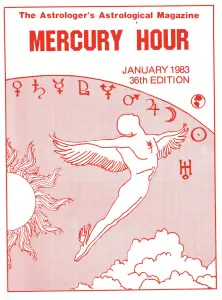
Astrology, Mercury Hour, Natal charts, Transits, Progressions, Mundane Astrology, Astro*Carto*Graphy, Chiron, Void of Course Moon, Solar Returns, Uranian astrology, Cosmobiology. This 36th Edition of Mercury Hour (January 1983), edited and published by Edith Custer, is a comprehensive astrological magazine featuring diverse correspondence, extensive theoretical and technical articles, book reviews, conference reports, and in-depth chart delineations. Key themes explored across the publication include life-stage transitions such as the ‘Catch-30’ passage and Uranus age cycles, mundane and political astrology including analyses of nuclear war threats, the Falklands crisis, and the chart of Israel, as well as technical discussions regarding software, heliocentric nodes, house systems, and the accuracy of astrological statistics (such as Gauquelin studies).

Issue Highlights:

Articles:
The Vertex – Jan Popelka
Student’s Section: A Visit to Astrologers in the U.S.A. – Ann Stevens-Patacchiola
The Catch-30 Passage: [28-32], Part III – Bil Tierney
[Uranus age cycle] Part II – Dale Huckeby
Mysterious Neptune, Part II (Marcia Moore’s chart and death) – Manik Chand Jain
Moon Void of Course in the Signs, Part I – Ted George
Is Nuclear War in Our Future? [An Astrological Call to Action] – Virginia Miller
The Pshaw Report – Jayj Jacobs
The Role of the Moon’s Nodes in World Events – Alan Richter
The New Orleans Air Crash of July 1982 – Jeff Jawer
The Effects of Saturn Transits in the Lives of the Pacific Club Members – Dona Shaw
A Royal Baby (Prince William) – Judith Gee
Determining the Winner of a Game – Sophia Mason
The Psychological Patterns of Jesus Christ – Frank Jakubowsky

Discussion:
Astro*Carto*Graphy, geodetic equivalents, and mundane predictions
Astrology hardware and software (Osborne, Astro Star, Matrix software reports)
Sunspot activity and the stock market
Gauquelin studies and statistical analysis
Lindbergh baby kidnapping and Bruno Hauptmann chart analysis
Intruder in the Queen’s Bedroom (Michael Fagan and Elizabeth II charts)
Fraternity for Canadian Astrologers 1st National Conference awards

Chart data:
August Belmont
David Crosby
Richard Dreyfuss
Michael Fagan
Andy Gibb
Bruno Hauptmann
Charley Pride
Victoria Principal
Ronald Reagan
Michael Trestrail
Israel and Partition
United Kingdom

Notable contributors:
Jim Lewis (Astro*Carto*Graphy and Ronald Reagan chart)
Jeff Jawer (First Canadian National Conference)
Barbara Watters (Grand trines and Sex and the Outer Planets)
Tracy Marks (financial compensation for astrologers)
Zane Stein (Chiron research)
Erin Sullivan (astrology of sexuality)

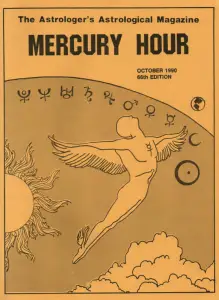
Mundane Astrology, Astrology History, and Astrological Techniques. This archival item is the October 1990 issue (66th Edition) of Mercury Hour, a quarterly astrological magazine edited and published by Edith Custer in Lynchburg, Virginia. Featured articles in this issue include Marc Penfield’s solar chart analysis of Donald Trump and natal study of Greta Garbo, Part I of M.J. Makransky’s series correlating zodiacal degrees with geographical locations and political shifts in Guatemala, Robert Baumgartner’s examination of a Demotic astrological text regarding the Egyptian star Sothis, Joseph S. DeMello’s instructional guide on diurnal charts, Paul Hewitt’s analysis of the 1989 Eastern European revolutions, and T. Pat Davis’s geo-helio study of the 1901 Texas oil discovery at Spindletop. Additional contents include reviews of Alan Oken’s Soul-Centered Astrology and Margaret Millard’s The Genetics of Astrology, weather forecasts by Dot Willis, and historical discussions regarding Tycho Brahe’s birth chart, the Society for the Advancement of Astrology, the 1992 Philippine presidential election, and birth data for figures including Saddam Hussein and Kenneth Branagh.


Issue Highlights


Book Reviews


Soul-Centered Astrology: A key to the expanding Self by Alan Oken – Marguerite dar Boggia


The Genetics of Astrology by Margaret Millard – Teresa Hamilton


Articles


The Great Garbo: Sphinx or Siren? – Marc Penfield


Guatemala, Part I – M.J. Makransky


The Egyptian Sothis in Gemini – A Demotic Astrological Text, Part I – Robert Baumgartner


Saturn, Our Night-Light, Part I – Ann Foley


Living the Hero’s Journey, Part I – Carol Voeth-Lavoie


Diurnal Charts – Joseph D. DeMello


Next Philippine President – Serafin Lanot


Autumn Ingress, September 23, 1990 – Dot Willis


Students Corner: Aspects – Anne Toth


[Essential charts of Chicago], Part I – Sonja Foxe


Saturn Anxiety, Part I – Carole Devine


Donald Trump: His Solar Chart – Marc Penfield


Eastern Europe – The Revolution of 1989, Part I – Paul Hewitt


Texans Discover Oil – T. Pat Davis


Discussions


Ethics of predicting death


Chart of Tycho Brahe


History of the Society for the Advancement of Astrology

Sun sign columns


Polio vaccine/SV-40 virus/AIDS

Warren and Florence Harding


Neptune transit of Capricorn


Chart of San Francisco Astrolocality Page 2 of 2


Chart data
(some incomplete or in question)

Iraq
Kuwait
Saudi Arabia
United Arab Emirates
San Francisco, CA
Common Market/EEC

Brahe, Tycho
Branagh, Kenneth
Griffith, Melanie
Hussein, Saddam
Linares, Enrico
Quayle, Dan
Stuart, Matthew & related charts

Notable contributors

Joe DeMello (the semi-sextile aspect)
Marion March (Joan Quigley’s involvement with the Reagans)
Kay Shinker (solar returns)
Lois Rodden (chart data)
Frances McEvoy (Matthew Stuart/Boston murder case)

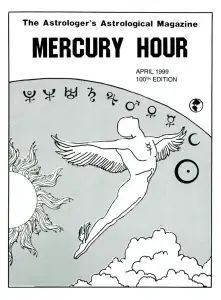
Medical Astrology, Mundane Astrology, and Fixed Stars serve as the primary focus areas of this historical astrological literature. This archival item is the April 1999 issue (100th Edition) of Mercury Hour, a long-running quarterly astrological magazine edited and published by Edith Custer in Lynchburg, Virginia. The issue highlights the first installment of Guy de Penguern’s course on 21st-century medical astrology and genetic astrophysics, a review of Enrique Linares’s A Scientific Approach to the Metaphysics of Astrology by Marguerite dar Boggia, Virginia A. Reyer’s study on fixed stars and health, and Dorothy J. Sarka’s examination of the I Ching. Additionally, the issue documents extensive reader discussions on political horoscopes and current events, including the Bill Clinton impeachment, Y2K software predictions, the 1999 Israeli election, and natal chart data for prominent figures such as Jesse Ventura and Ehud Barak.


Issue Highlights

Book Review

A Scientific Approach to the Metaphysics of Astrology by Enrique Linares

– Marguerite der Boggia


Articles

21st Century Medical Astrology Course, Part 1 of 3 – Guy de Penguern [extract]

Fixed Stars, Part 2 of 2 – Virgina A. Reyer

The Hidden Code of the I Ching – Dorothy J. Sarka


Discussions

Ken Starr/Bill Clinton impeachment

Chart of Bill ClintonU.S. Declaration of Independence

W.H. Chaney/Jack London

Astro-Twins (examples)

Asteroid rulership/association

Moon Out-of-Bounds

Israel election 1999

Y2K

August 1999 Grand Cross eclipse

August 1998 eclipse effect on Russia

Sun/Moon angle and conception


Chart data

Barak, Ehud

Bush, George

Chaney, William

Hand, Rob

Jayne, Charles

Keller, Helen

Netanyahu, Benjamin

Rose, Buddy “Playboy”

Ventura, Jesse

Russia


Notable contributors

Marion March (various topics)


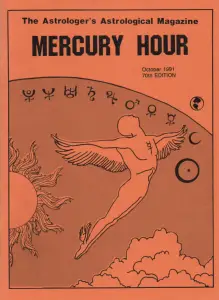
Astrology Community, Mundane Astrology, and Astrology History serve as the primary focus areas of this historical astrological literature. This archival item is the October 1991 issue (70th Edition) of Mercury Hour, “The Astrologer’s Astrological Magazine,” a reader-driven correspondence periodical edited and published by Edith Custer of Lynchburg, Virginia. Structured largely as an open forum of subscriber letters, it documents the working preoccupations of a grassroots American astrological community, with debates over classical versus modern technique, chart-matching blind tests, and the interpretation of stations, midpoints, solar returns, and heliocentric charts. Reflecting its Gulf War moment, the issue features mundane analysis of the Gulf War chart, the USSR’s dissolution, and comparative studies of Saddam Hussein, Jim Jones, and Adolf Hitler; alongside contributions from Ted George, M.J. Makransky, Joyce Wehrman, and Lee Lehman, a memorial for statistical researcher Michel Gauquelin (1928-1991), chart data for figures such as Napoleon and Helen Herron Taft, and period advertisements for early astrological software that capture the field’s transition into desktop computing.

Issue Highlights


Book Review

Working with Astrology by Michael Harding & Charles Harvey – Doris Greaves


Articles

Missing Visa Book – Marie DeLeone

Student’s Corner [the Ascendant] – Annibale F. Verzumo

Jupiter-Neptune, The Celestial Twins, Part I – Ted George

NCGR Conference [report] – Edith Custer

Indications of a Winner *or* Do You Have a Gambling Chart? – Cammille Adams

Planet Watch – Paul O. Hewit

The Natural Disposition, Part II – M.J. Makransky

Michel Gauquelin 1928-1991 – J. Lee Lehman

[USSR charts] Part I – Annibale Verzumo

The Three Amigos, Part II, Conclusion [Saddam Hussein, Jim Jones, Adolph Hitler]– Susan J. Kientz

[Risks of publishing astrological materials] Part II, Conclusion – C. J. Puotinen

Central American Data – M.J. Makransky

Her Proudest Moment [Helen Herron Taft] – T. Patrick Davis

Pluto, Part II, Transpluto – Joyce Wehrman [transcription of talk]

The Gemini Theme, Using the Astrological Language, Part III, Conclusion – Anne Foley

Autumn Equinox September 23, 1991 – Dorothy S. Willis


Discussions

Astrological weather prediction

Solar returns

Chart of Napoleon

Neptune

Gulf War chart

Heliocentric charts

Finding the time of sunrise in birthchart


Chart data

Bonaparte, Napoleon
Taft, Helen Herron
Iraq War
Costa Rica
El Salvador
Guatemala
Honduras
Nicaragua


Notable contributors

Marion March (semi-sextiles)

Lee Lehman (classical astrology techniques; homosexuality & astrology)

Marc Penfield (the astrology of Orlando, FL & Disney World)

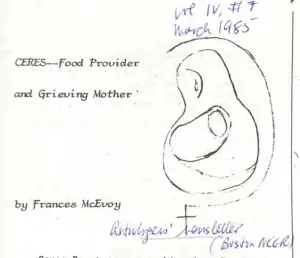
Ceres: Food Provider and Grieving Mother (1985)

Frances McEvoy, Special Collections

Ceres, Asteroids, Natal Astrology, Mythology. The provided text is an in-depth astrological and mythological exploration of the asteroid Ceres. The author, Frances McEvoy, characterizes Ceres as the ‘Food Provider’ and ‘Grieving Mother,’ drawing parallels between the planet’s discovery in 1801—a moment when it was positioned on the ecliptic and linked to solar and lunar eclipses—and its mythological role as the goddess of agriculture, fertility, and maternal nurturing. The synthesis explains Ceres’s 23-year cycle and its symbolic resonance with the Earth, substantiality, and the cycles of planting and harvest.

Issue Highlights:

Articles:
CERES–Food Provider and Grieving Mother – Frances McEvoy
CERES–The Earth Mother (Continued) – Frances McEvoy

Discussion:
The symbolic interpretation of Ceres in natal astrology as a representative of maternal instincts and nurturing.
The correlation between the transit of Ceres through Taurus and its impact on agriculture, famine, and economic stability.
Case studies of famous figures illustrating Ceres’ placement and its effect on their personal lives, grief, and nurturing roles.

Chart data:
Gloria Vanderbilt
Liza Minelli
Clara Barton
Liv Ullman
Isadora Duncan
Eleanor Roosevelt
Edward Kennedy
Queen Victoria
Queen Mary
Ingrid Bergman
Rose Kennedy
Ethel Kennedy

Notable contributors:
Frances McEvoy (Astrological interpretation of Ceres mythology and natal placement)

Ask A Librarian

Need assistance with your research or navigating our collection? Our library team is here to help.

Please fill out the form below with details about the topics, authors, or archival materials you are looking for, and one of our librarians will review your query and respond shortly.

Help

Whether you are looking for rare historical texts or trying to locate a specific book nearby, Alexandria iBase offers two primary ways to search. Here is how to choose the right tool for what you need:

The Library Catalogue

Think of this as your global master index.

The Catalogue works just like a traditional library search system, designed to help you locate books and media across the broader astrological landscape.

  • Physical Books: Find out where physical copies of books are held in libraries, archives, or collections near you.

  • Digital Files: Access downloadable or viewable digital editions when available.

  • Best Used For: Standard research, finding specific ISBNs or authors, and tracking down physical items in the real world.

Browse Catalogue

SPECIAL COLLECTIONS

Think of this as Alexandria’s exclusive private vault.

Collections gives you direct access to Alexandria’s own curated archive of rare, proprietary, and historic astrology media.

  • Exclusive Material: Features unique texts, manuscripts, audio recordings, and visual media that are not available anywhere else.

  • Direct Access: Digitized content ready to explore straight from the platform.

  • Best Used For: Deep-dive research, discovering hidden gems, and exploring rare, one-of-a-kind astrological resources.

Browse Special Collections

Cash & In-Kind Donations

Make a one-time or recurring tax deductible cash donation.

Payment options include donating directly with us, PayPal Giving and GoFundMe.

GoFundMe for Charities and PayPal Giving are registered for tax deductions and have no required processing fees. It does offer the option to tip.

Donate

*Subject to 2.5% processing fees

Contact Us

Have a question, feedback, or a inquiry about our archives? We’d love to hear from you. Please fill out the form below with your details and message, and a member of our team will get back to you as soon as possible.

Thank you for reaching out to the Alexandria iBase Project!