Special Collections » General Astrology Articles

General Astrology Articles

Various

Various

6 Document

Various

1980s-2000s

alexandria ibase astrology library

The General Astrology Articles collection brings together a diverse repository of foundational essays, practical guides, and specialized studies from prominent 20th and 21st-century astrologers. Designed to support both novice students and seasoned researchers, this collection covers a broad spectrum of topics—from fundamental natal chart analysis and planetary aspects to predictive techniques, house systems, and transit interpretations. It serves as an essential archival resource for exploring the evolution of modern astrological thought, practice, and educational literature.

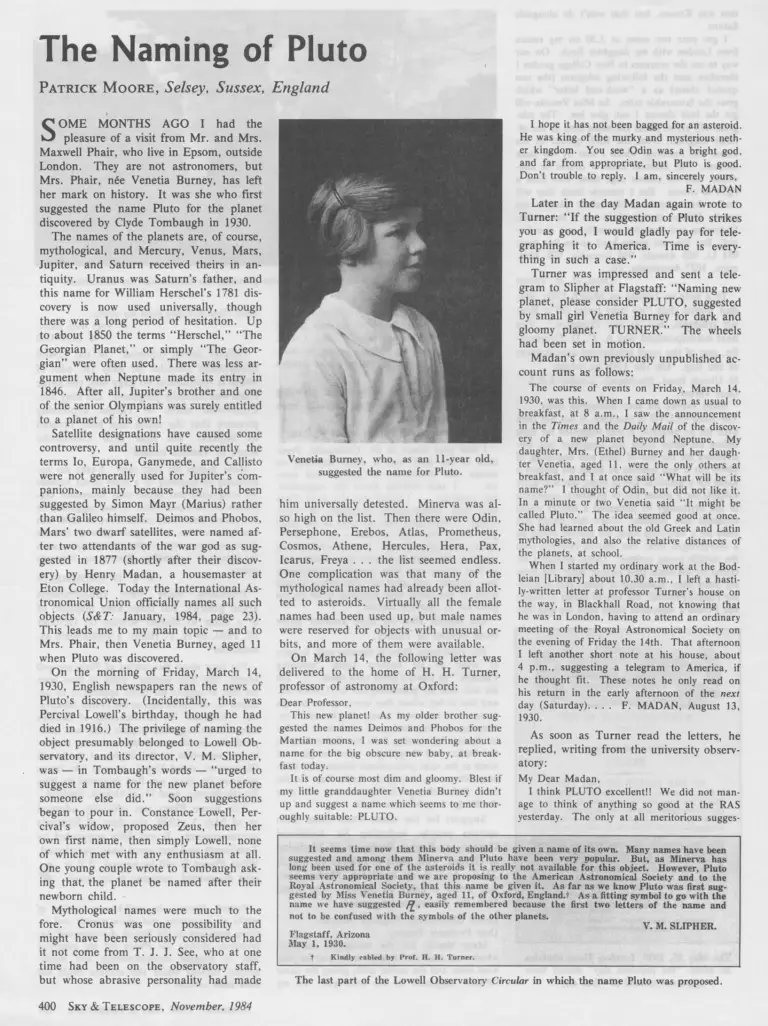
The Naming of Pluto (1984)

From Sky & Telescope, November 1984

History of Astronomy, Planetary Naming, and Pluto. This archival document is an article titled “THE NAMING OF PLUTO” by Patrick Moore, published in Sky & Telescope in November 1984. The text documents the historical account of how the planet Pluto received its name following its discovery by Clyde Tombaugh in 1930. Moore details how 11-year-old Venetia Burney of Oxford, England, suggested the name “Pluto” during a breakfast conversation with her grandfather, Falconer Madan, who passed the proposal to Oxford astronomy professor H. H. Turner. The article traces the correspondence, telegrams, and official actions between Turner, A. C. D. Crommelin, and Lowell Observatory director V. M. Slipher, leading to the official adoption of the name Pluto on May 1, 1930.

View
alexandria ibase astrology library

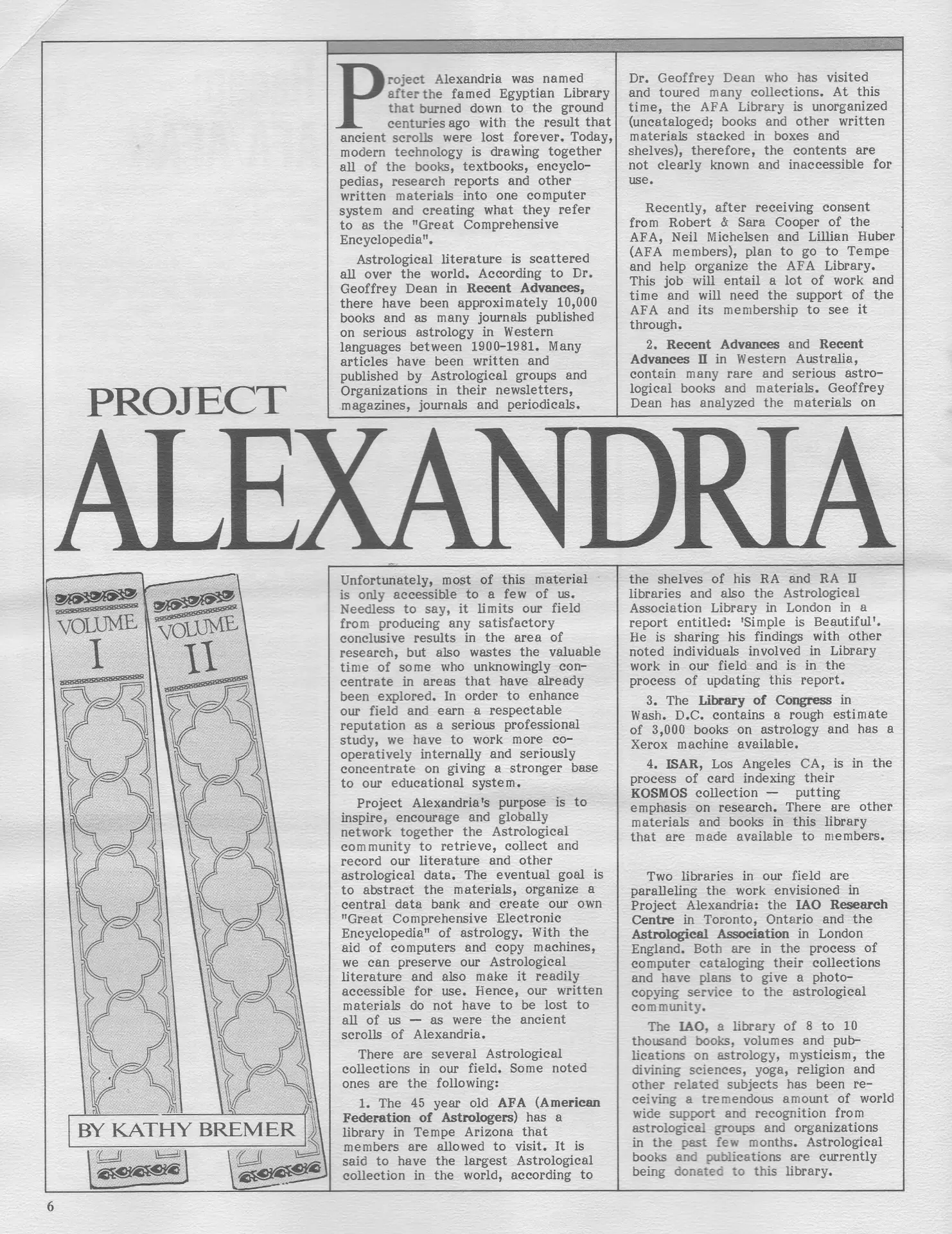
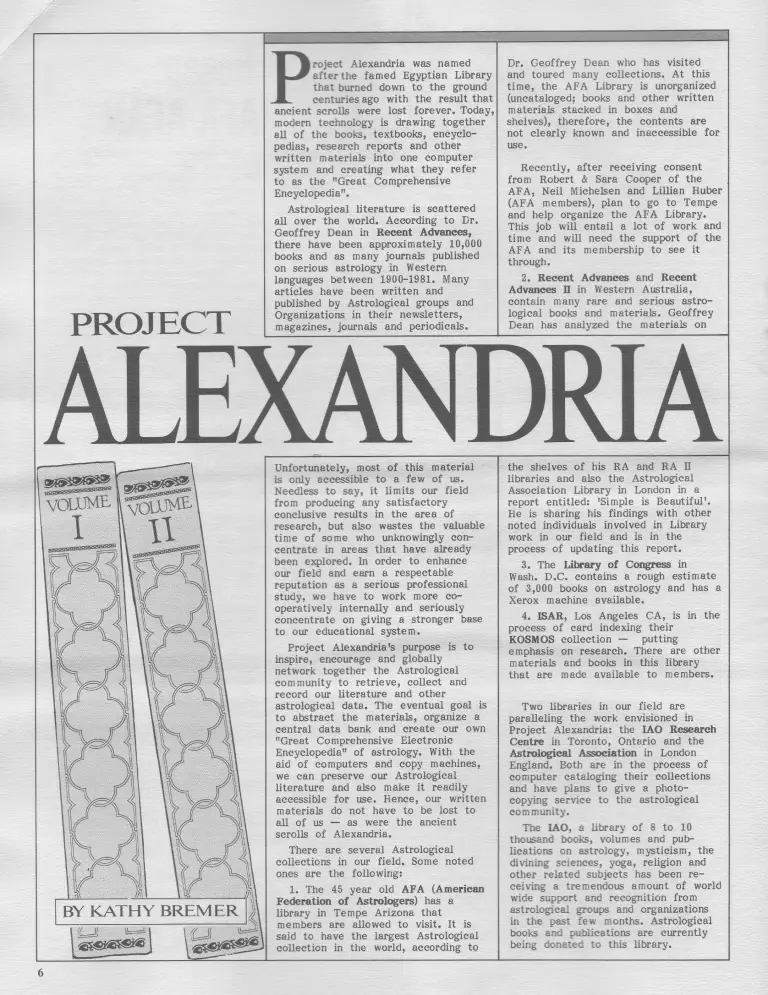
Project Alexandria (1983)

Applied Astrology, Astrological Associations, and Astrological Research. This archival document contains an article titled “PROJECT ALEXANDRIA” by Kathy Bremer, accompanied by an editorial note by Michael Erlewine, published in 1983. The text outlines an AFAN-supported initiative aimed at globally networking the astrological community to collect, digitize, and catalog astrological literature into a centralized data bank and “Great Comprehensive Electronic Encyclopedia”. Bremer reviews key international library collections—including the AFA Library in Arizona, the IAO Research Centre in Toronto, the Astrological Association in London, and ISAR’s database initiatives. Erlewine’s appended note addresses misconceptions regarding the status of the AFA library, presenting insights from Bob Cooper, Lilian Huber, and Neil Michelsen, alongside Michelsen’s proposed plan for a volunteer-led, computer-supported cataloging effort.

View

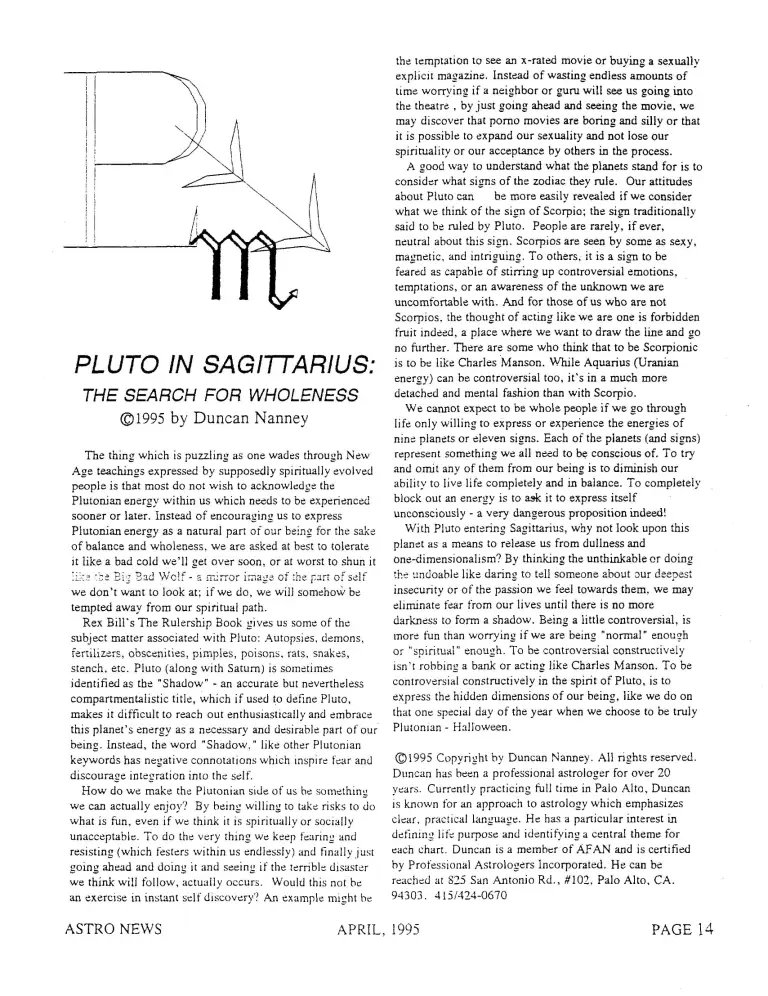
Pluto in Sagittarius – The Search for Wholeness (2)

Plutonian Astrology, Psychological Astrology, and Transits. This archival document is an article titled “PLUTO IN SAGITTARIUS: THE SEARCH FOR WHOLENESS” by Duncan Nanney, published in April 1995. Nanney critiques contemporary New Age frameworks for treating Plutonian energy as a negative “Shadow” to be shunned rather than a vital component of personal wholeness. He argues that psychological integration requires individuals to consciously experience and express taboo, intense, or feared aspects of the self—such as deep passions, hidden insecurities, or controversial desires—instead of repressing them into the unconscious. Drawing connections to the sign of Scorpio, Nanney advocates for taking constructive risks and embracing the transit of Pluto into Sagittarius as an opportunity to eliminate fear, release dullness, and live a balanced, multi-dimensional life.

View

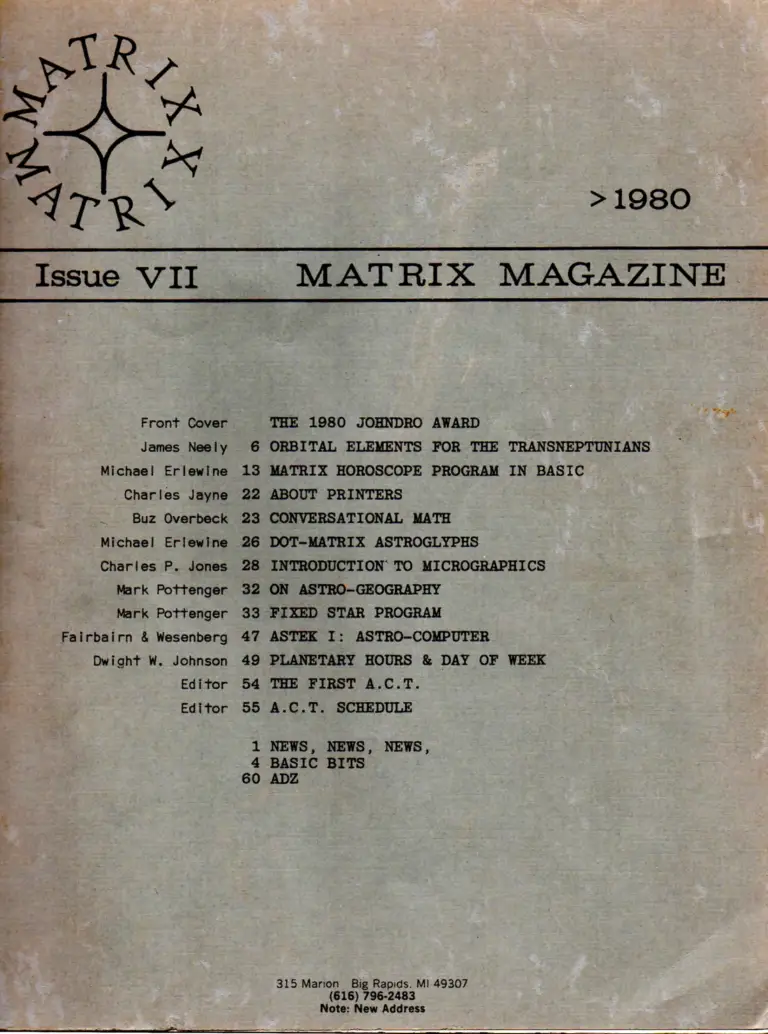
Matrix Magazine Issue VII 1980

Computer Astrology, Astrological Software, and Uranian Astrology. This archival document is a complete issue of Matrix Magazine (Issue VII, 1980), edited by Michael and Margaret Erlewine. The magazine focuses on technical, mathematical, and computer-assisted astrology during the early microcomputer era. Key features include James Neely’s derivation of orbital elements for Transneptunian planets (Cupido, Hades, Zeus, Kronos, Apollon, Admetos, Vulkanus, and Poseidon); Michael Erlewine’s complete BASIC natal horoscope program code; Mark Pottenger’s algorithms and source code for Astro-Geography/AstroCartoGraphy and Fixed Star comparisons; Dwight William Johnson’s mathematical method for computing planetary hours; and an introduction to the hand-held ASTEK I astrological computer. The issue also includes the presentation of the 1980 Johndro Award to Neil F. Michelsen, discussions on micrographics for document storage, dot-matrix custom astrological glyph design, and the complete schedule for the first Astrological Conference on Techniques (A.C.T.).

Table of Contents

Front Cover – THE 1980 JOHNDRO AWARD

Page  1    NEWS, NEWS, NEWS
Page  4    BASIC BITS
Page  6    ORBITAL ELEMENTS FOR THE TRANSNEPTUNIANS – James Neely
Page 13   MATRIX HOROSCPE PROGRAM IN BASIC – Michael Erlewine
Page 22   ABOUT PRINTERS – Charles Jayne
Page 23   CONVERSATIONAL MATH – Buz Overbeck
Page 26   DOT-MATRIX ASTROGLYPHS – Michael Erlewine
Page 32   INTRODUCTION TO MICROGRAPHICS – Charles P. Jones
Page 32   ON ASTRO-GEOGRAPHY – Mark Pottenger
Page 33   FIXED STAR PROGRAM – Mark Pottenger
Page 47   ASTEK I: ASTRO-COMPUTER – Fairbairn & Wesenberg 
Page 49   PLANETARY HOURS & DAY OF WEEK – Dwight G. Johnson
Page 54   THE FIRST A.C.T. – Edito
Page 55   A.C.T. SCHEDULE – Editor
Page 60   ADZ
View

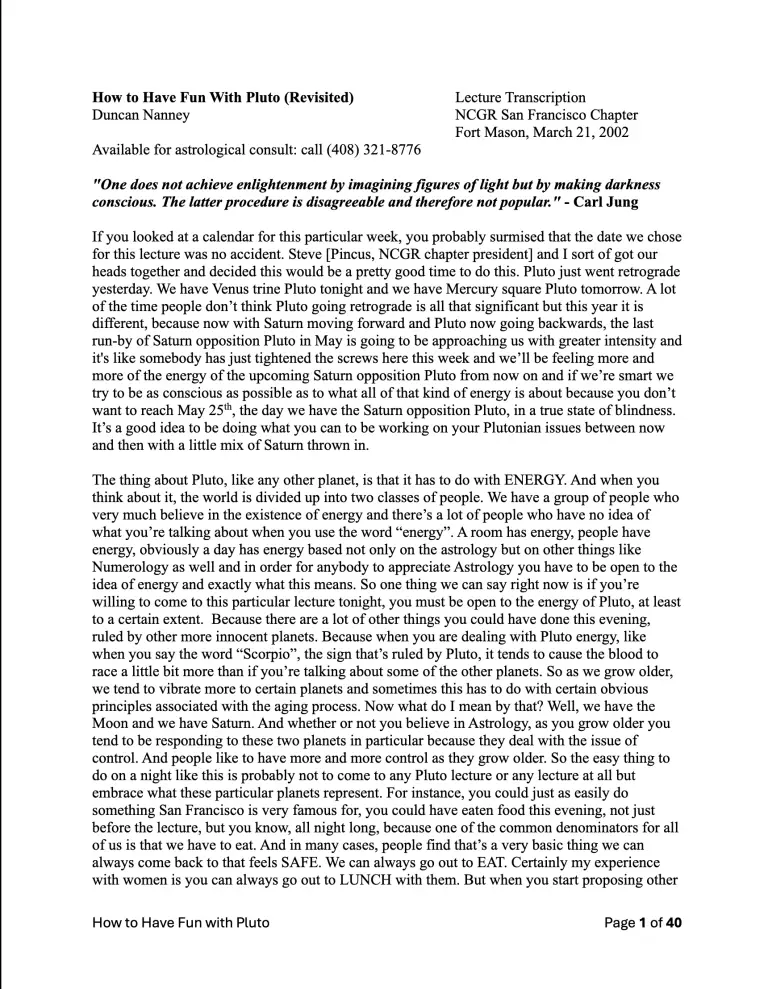
How to Have Fun with Pluto – Duncan Nanney

Plutonian Astrology, Psychological Astrology, and Shadow Work. This archival document is a complete lecture transcript titled “How to Have Fun With Pluto (Revisited)” by Duncan Nanney, delivered at the NCGR San Francisco Chapter at Fort Mason on March 21, 2002. Nanney explores the psychological and experiential dimensions of Pluto energy, contrasting its transformative, taboo-confronting, and intensity-driven nature against the passive safety of Moon, Saturn, and Neptune dynamics. He emphasizes the necessity of bringing repressed shadow material, dark obsessions, mortality, and taboo expressions into conscious awareness rather than suppressing them. The text covers the 2002 Saturn-Pluto opposition and its alignment with planetary eclipses (comparing it to cycles in 1931 and 1965 to 1966), introduces his “Planetville” map, and demonstrates Local Space directional techniques. The lecture features detailed chart delineations for Madonna, Ed Wood Jr., Lenny Bruce, Jack Nicholson, John Holmes, Roman Polanski, Anton LaVey, Ed Gein, and Nanney’s own natal chart.

View

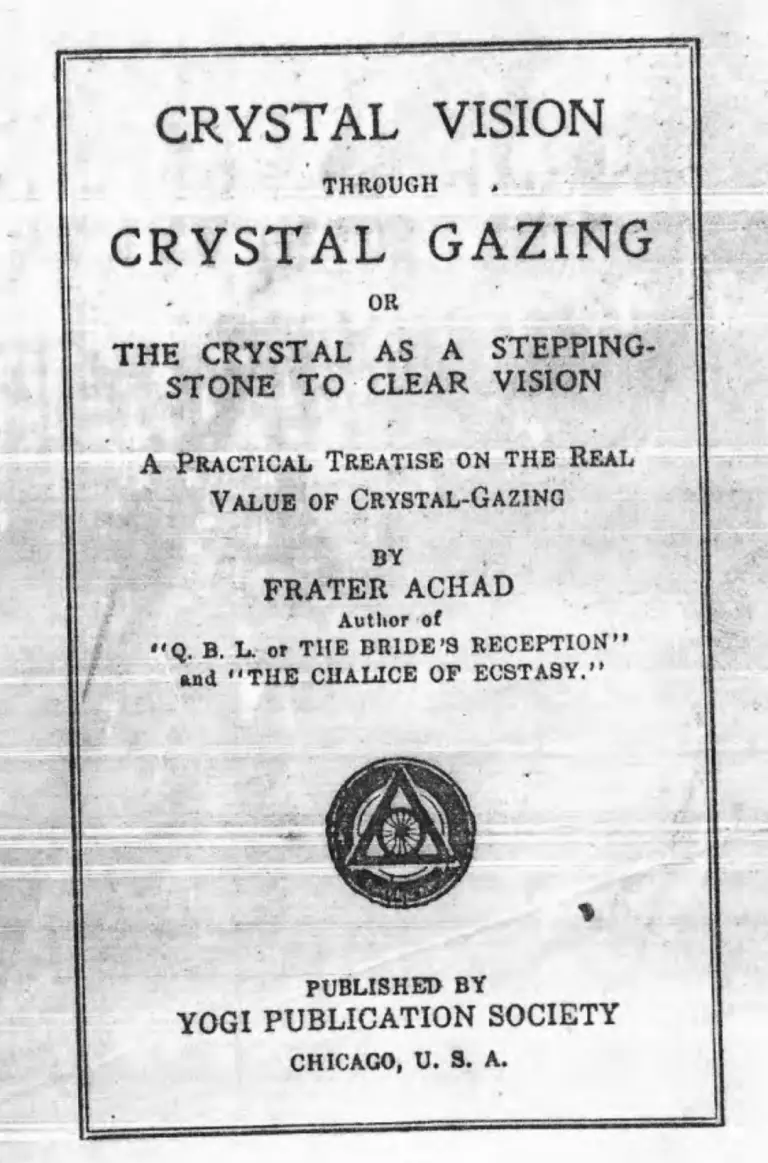
Crystal Visions Through Crystal Gazing by Frater Achad (1923)

“A Practical Treatise on the Real Value of Crystal Gazing”. Missing pages 38-39, 46-47, 80-81. Page 50 partially obscured.

Crystal Gazing, Occult Philosophy, and Thelema. This archival document is a complete digitized monograph titled “Crystal Vision Through Crystal Gazing” by Frater Achad (Charles Stansfeld Jones), published in 1923 by the Yogi Publication Society in Chicago. Achad structures the work into seven chapters that progress from elementary crystal scrying to high-level occult operations and Thelemic cosmology. He details physical and subtle procedures for purifying, consecrating, and initiating a crystal sphere; contrasts modern manufactured glass spheres with natural hexagonal quartz crystals; and examines historical and grimoire methods, including the planetary invocations of Abbot Trithemius of Spanheim (via Francis Barrett) and the Elizabethan Enochian operations of Dr. John Dee and Sir Edward Kelley. The text incorporates excerpts from Achad’s own magical journals as a Neophyte in Aleister Crowley’s A∴A․ (Frater O.M.), featuring astral visions of the 17th Æthyr, an Alchemical salt vision coinciding with the 1914 sinking of the Empress of Ireland, and commentary on Star Consciousness (Khabs) within Liber Legis.

View

Ask A Librarian

Help

Whether you are looking for rare historical texts or trying to locate a specific book nearby, Alexandria iBase offers two primary ways to search. Here is how to choose the right tool for what you need:

The Library Catalogue

Think of this as your global master index.

The Catalogue works just like a traditional library search system, designed to help you locate books and media across the broader astrological landscape.

  • Physical Books: Find out where physical copies of books are held in libraries, archives, or collections near you.

  • Digital Files: Access downloadable or viewable digital editions when available.

  • Best Used For: Standard research, finding specific ISBNs or authors, and tracking down physical items in the real world.

Browse Catalogue

SPECIAL COLLECTIONS

Think of this as Alexandria’s exclusive private vault.

Collections gives you direct access to Alexandria’s own curated archive of rare, proprietary, and historic astrology media.

  • Exclusive Material: Features unique texts, manuscripts, audio recordings, and visual media that are not available anywhere else.

  • Direct Access: Digitized content ready to explore straight from the platform.

  • Best Used For: Deep-dive research, discovering hidden gems, and exploring rare, one-of-a-kind astrological resources.

Browse Special Collections

Cash & In-Kind Donations

Make a one-time or recurring tax deductible cash donation.

Payment options include donating directly with us, PayPal Giving and GoFundMe.

GoFundMe for Charities is registered for tax deductions and has no required processing fees. It does offer the option to tip.

Contact Us