
Home » Special Collections » Heliogram

Heliogram

Newsletter of the NCGR Heliocentric Astrology Special Interest Group (SIG)

Margaret M. Meister, Editor

Newsletter

1 Document(s)

Helio SIG

February 1987-May 1990 (?)

Filters

Filters


See more See less
See more See less
See more See less
See more See less
See more See less
See more See less
See more See less

Sorting

Heliocentric Astrology, Heliogram, NCGR Helio S.I.G., Mundane Astrology, Weather Prediction, Financial Astrology, Asteroids, Fixed Stars, Horary Astrology. This document is the May 1989 issue of the Heliogram, the newsletter of the NCGR Helio S.I.G. Edited by Margaret M. Meister and published with contributions from prominent heliocentric and mundane astrologers, the issue explores the intersections of heliocentric and geocentric astrology, weather forecasting, financial trends, and current world events. Articles delve into the environmental and astrological significance of the Exxon Valdez oil spill, incorporating fixed stars like Spica, Fomalhaut, and the constellation Cetus. Discussions extend to economic forecasts utilizing heliocentric horary charts, planetary alignments involving Mars, Saturn, and Uranus, and the usage of asteroids in mundane prediction. Historical analyses cover figures such as Vincent Wing, examining early heliocentric astrology and Keplerian mechanics. Comprehensive chart data and chronologies, including those for George Bush, nuclear disaster events like Three Mile Island and Chernobyl, and the Emperor Akihito, provide empirical depth to the technical explorations presented throughout the volume.

Issue Highlights:

Articles:
Ask of the Beasts – Diana K. Rosenberg
On File – Margaret M. Meister
Custer Corner: Some Thoughts On Helio – Edith Custer
New and Improved George Bush Chronology – Bill Meridian
Hello, Jupiter! – Barbara May
Elections, Nominations and Things That Go Bump in the Night – Margaret Meister, Edith Custer
Helio in the News – Zipporah Dobyns, Ph.D.
An Implausible Mars-Moon – T. Pat Davis
Emperor Akihito – Doris Greaves
Astrology and the Weather – Part V – Dorothy S. Willis
Doom Forestalled: A Study in Helio Horary – Susan Manuel
Bridge Collapse – Edith Custer
Helio History: Vincent Wing: The First Heliocentric Astrologer? – J. Lee Lehman, Ph.D.

Discussion:
Heliocentric planetary placements and comparative geo/helio charts
Mundane and economic forecasting via heliocentric horary charts
Astrological signatures of the Exxon Valdez oil spill and environmental disasters
Weather forecasting using heliocentric aspects (Venus, Mars, Jupiter, Saturn, Uranus, Neptune)
Historical analysis of heliocentric astronomy and astrology from Kepler to Vincent Wing

Chart data:
Exxon Valdez Oil Spill Chart (March 24, 1989)
Exxon Corporation Foundation Chart (August 10, 1892)
First Sustained Nuclear Reaction (December 2, 1942)
Three Mile Island Nuclear Power Plant Disaster (March 28, 1979)
Chernobyl Nuclear Plant Explosion (April 26, 1986)
Emperor Akihito Natal Chart (December 23, 1933)
Bridge Collapse, Covington, TN (April 1, 1989)
George Bush Natal Chart

Notable contributors:
Diana K. Rosenberg (Astrological zoology and environmental mundane charts)
Edith Custer (Helio Mercury configurations and structural chart observations)
Zipporah Dobyns (Asteroid placements and mundane events)
Susan Manuel (Heliocentric horary and economic predictions)
Dorothy S. Willis (Astrological weather forecasting)
J. Lee Lehman (Historical analysis of heliocentric astrology and Vincent Wing)
Barbara May (Heliocentric Jupiter placements)
Heliocentric Mechanics, Astrometeorology, and Mundane Forecasting. This archival document is Issue No. 3 (Lammas / Mid Leo 1987) of the Heliogram, published by the NCGR Helio S.I.G.. The issue heavily features technical methodologies for integrating geocentric and heliocentric data, alongside rigorous mundane weather tracking. Key contributions include J. Lee Lehman’s statistical exploration of the differences between Geo Mercury (thinking) and Helio Mercury (communicating), Michael Erlewine’s structural breakdown of Helio Archetypes (Yin/Yang, Trine/T-Square), and T. Pat Davis’s mundane analysis of Senator Joseph McCarthy and Queen Elizabeth I. Additional features include Margaret Meister’s retrospective analysis of the 1947 Texas City Explosion, Dot Willis’s weather forecasting for the Autumnal Equinox and late-1987 eclipses, and a spirited debate between NCGR Research Director Michael P. Munkasey and Edith Custer regarding the astronomical logic of mixing heliocentric planets with geocentric house systems.

Issue Highlights

Articles: The Mercury Dilemma – J. Lee Lehman, Ph.D.

Helio Meditations II – Michael Erlewine

A Tribute to Zane B. Stein – T. Pat Davis

Texas City Revisited – Margaret M. Meister

Weather or Not – Dot Willis

Geo vs Helio Mars – T. Patrick Davis

Senator Joseph Raymond McCarthy – T. Pat Davis

Heliocentric: Magnitude of Influence – T. Patrick Davis

Discussions: Geocentric vs. Heliocentric Mercury dynamics The “Helio Challenge”: Debating the validity of mixing Geo houses with Helio planets The August 9, 1987 Supermoon and associated severe weather warnings Upcoming 1988 Saturn/Uranus conjunctions (Geo vs. Helio dates)

Notable contributors: J. Lee Lehman Margaret Meister Michael Erlewine T. Pat Davis Edith Custer Dot Willis Michael P. Munkasey

Chart data: Zane B. Stein Fred Astaire Jackie Gleason Giant Baby Panda Texas City Explosion (Grandcamp & High Flyer) Anita McKeown (“Calamity Jane”) Queen Elizabeth I Senator Joseph Raymond McCarthy 1988 Presidential Candidates (Richard Gebhardt, George Bush, Mario Cuomo, Michael Dukakis, Jack Kemp, Bruce Babbitt, Joseph Biden, Jesse Jackson, Paul Martin Simon)

Heliogram #1 Candlemas 1987

Heliogram, Special Collections

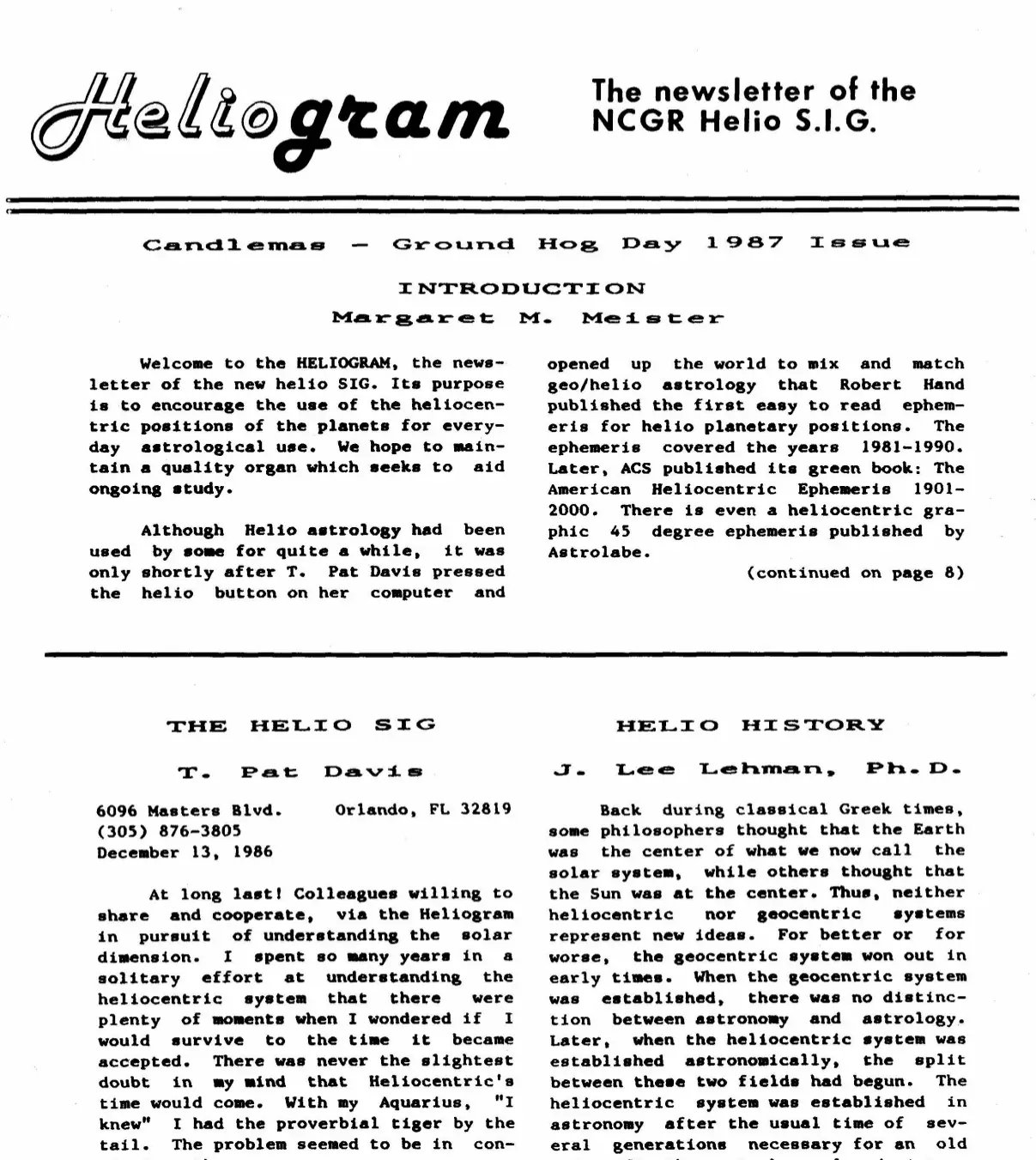
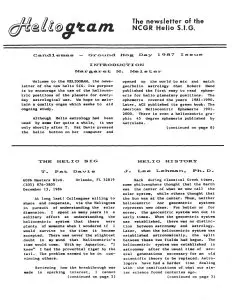
Heliocentric Astrology, Astrometeorology, and Astrological History. This archival document is the inaugural Candlemas / Ground Hog Day 1987 Issue of the Heliogram, the official newsletter of the NCGR Helio Special Interest Group (S.I.G.) edited by Margaret M. Meister. The issue establishes the group’s mission to encourage the everyday use of heliocentric planetary positions and features foundational essays on the history and validity of the heliocentric perspective. Key contributions include J. Lee Lehman’s historical trace of heliocentric concepts from ancient Greece, Phillip Sedgwick’s philosophical essay on the paradigm shifts required to embrace heliocentricism, and Dot Willis’s detailed astrometeorological forecasts using heliocentric alignments to predict extreme weather and seismic events for the 1987 Vernal Equinox and eclipses. Additional features include Edith Custer’s “Custer Corner” discussing Sylvester Stallone’s chart and Supermoon flooding, along with T. Pat Davis advocating for the commercial and analytical integration of helio coordinates.

Issue Highlights

Articles: Introduction – Margaret Meister

The Helio SIG – T. Pat Davis

Helio History – J. Lee Lehman, Ph.D.

Essentiality of Heliocentricism – Phillip Sedgwick

Weather: Vernal Equinox & Eclipses – Dot Willis

Discussions: Sylvester Stallone’s helio chart indicating violent action roles The impact of “Supermoons” on coastal flooding and weather U.S.A. helio chart transits during Reagan’s November 1986 speech Using Helio Mercury in relationship charts and horary astrology

Notable contributors: Margaret Meister T. Pat Davis J. Lee Lehman Edith Custer Phillip Sedgwick Dot Willis Barbara May

Chart data: Sylvester Stallone U.S.A. (Helio with transits) Winter Solstice 1986 (Geo and Helio) Vernal Equinox 1987 (Helio) Annular and Lunar Eclipses 1987

Ask A Librarian

Need assistance with your research or navigating our collection? Our library team is here to help.

Please fill out the form below with details about the topics, authors, or archival materials you are looking for, and one of our librarians will review your query and respond shortly.

Help

Whether you are looking for rare historical texts or trying to locate a specific book nearby, Alexandria iBase offers two primary ways to search. Here is how to choose the right tool for what you need:

The Library Catalogue

Think of this as your global master index.

The Catalogue works just like a traditional library search system, designed to help you locate books and media across the broader astrological landscape.

  • Physical Books: Find out where physical copies of books are held in libraries, archives, or collections near you.

  • Digital Files: Access downloadable or viewable digital editions when available.

  • Best Used For: Standard research, finding specific ISBNs or authors, and tracking down physical items in the real world.

Browse Catalogue

SPECIAL COLLECTIONS

Think of this as Alexandria’s exclusive private vault.

Collections gives you direct access to Alexandria’s own curated archive of rare, proprietary, and historic astrology media.

  • Exclusive Material: Features unique texts, manuscripts, audio recordings, and visual media that are not available anywhere else.

  • Direct Access: Digitized content ready to explore straight from the platform.

  • Best Used For: Deep-dive research, discovering hidden gems, and exploring rare, one-of-a-kind astrological resources.

Browse Special Collections

Cash & In-Kind Donations

Make a one-time or recurring tax deductible cash donation.

Payment options include donating directly with us, PayPal Giving and GoFundMe.

GoFundMe for Charities and PayPal Giving are registered for tax deductions and have no required processing fees. It does offer the option to tip.

Donate

*Subject to 2.5% processing fees

Contact Us

Have a question, feedback, or a inquiry about our archives? We’d love to hear from you. Please fill out the form below with your details and message, and a member of our team will get back to you as soon as possible.

Thank you for reaching out to the Alexandria iBase Project!