
Synastry and Relationship Astrology

A comparative analytical method wherein two or more distinct birth charts are cross-examined to study geometric inter-aspects between individuals. Texts evaluate these charts to model interpersonal dynamics, psychological projection, family systems, and collaborative partnership viability.

Filters

Filters


See more See less
See more See less
See more See less
See more See less
See more See less
See more See less
See more See less

Sorting

Astrology, Mercury Hour, Natal charts, Transits, Progressions, Mundane Astrology, Astro*Carto*Graphy, Chiron, Void of Course Moon, Solar Returns, Uranian astrology, Cosmobiology. This 36th Edition of Mercury Hour (January 1983), edited and published by Edith Custer, is a comprehensive astrological magazine featuring diverse correspondence, extensive theoretical and technical articles, book reviews, conference reports, and in-depth chart delineations. Key themes explored across the publication include life-stage transitions such as the ‘Catch-30’ passage and Uranus age cycles, mundane and political astrology including analyses of nuclear war threats, the Falklands crisis, and the chart of Israel, as well as technical discussions regarding software, heliocentric nodes, house systems, and the accuracy of astrological statistics (such as Gauquelin studies).

Issue Highlights:

Articles:
The Vertex – Jan Popelka
Student’s Section: A Visit to Astrologers in the U.S.A. – Ann Stevens-Patacchiola
The Catch-30 Passage: [28-32], Part III – Bil Tierney
[Uranus age cycle] Part II – Dale Huckeby
Mysterious Neptune, Part II (Marcia Moore’s chart and death) – Manik Chand Jain
Moon Void of Course in the Signs, Part I – Ted George
Is Nuclear War in Our Future? [An Astrological Call to Action] – Virginia Miller
The Pshaw Report – Jayj Jacobs
The Role of the Moon’s Nodes in World Events – Alan Richter
The New Orleans Air Crash of July 1982 – Jeff Jawer
The Effects of Saturn Transits in the Lives of the Pacific Club Members – Dona Shaw
A Royal Baby (Prince William) – Judith Gee
Determining the Winner of a Game – Sophia Mason
The Psychological Patterns of Jesus Christ – Frank Jakubowsky

Discussion:
Astro*Carto*Graphy, geodetic equivalents, and mundane predictions
Astrology hardware and software (Osborne, Astro Star, Matrix software reports)
Sunspot activity and the stock market
Gauquelin studies and statistical analysis
Lindbergh baby kidnapping and Bruno Hauptmann chart analysis
Intruder in the Queen’s Bedroom (Michael Fagan and Elizabeth II charts)
Fraternity for Canadian Astrologers 1st National Conference awards

Chart data:
August Belmont
David Crosby
Richard Dreyfuss
Michael Fagan
Andy Gibb
Bruno Hauptmann
Charley Pride
Victoria Principal
Ronald Reagan
Michael Trestrail
Israel and Partition
United Kingdom

Notable contributors:
Jim Lewis (Astro*Carto*Graphy and Ronald Reagan chart)
Jeff Jawer (First Canadian National Conference)
Barbara Watters (Grand trines and Sex and the Outer Planets)
Tracy Marks (financial compensation for astrologers)
Zane Stein (Chiron research)
Erin Sullivan (astrology of sexuality)
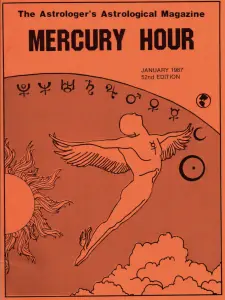
Astrology Community, Mundane Astrology, and Astrology History serve as the primary focus areas of this historical astrological literature. This archival item is the October 1991 issue (70th Edition) of Mercury Hour, “The Astrologer’s Astrological Magazine,” a reader-driven correspondence periodical edited and published by Edith Custer of Lynchburg, Virginia. Structured largely as an open forum of subscriber letters, it documents the working preoccupations of a grassroots American astrological community, with debates over classical versus modern technique, chart-matching blind tests, and the interpretation of stations, midpoints, solar returns, and heliocentric charts. Reflecting its Gulf War moment, the issue features mundane analysis of the Gulf War chart, the USSR’s dissolution, and comparative studies of Saddam Hussein, Jim Jones, and Adolf Hitler; alongside contributions from Ted George, M.J. Makransky, Joyce Wehrman, and Lee Lehman, a memorial for statistical researcher Michel Gauquelin (1928-1991), chart data for figures such as Napoleon and Helen Herron Taft, and period advertisements for early astrological software that capture the field’s transition into desktop computing.

Issue Highlights


Book Review

Working with Astrology by Michael Harding & Charles Harvey – Doris Greaves


Articles

Missing Visa Book – Marie DeLeone

Student’s Corner [the Ascendant] – Annibale F. Verzumo

Jupiter-Neptune, The Celestial Twins, Part I – Ted George

NCGR Conference [report] – Edith Custer

Indications of a Winner *or* Do You Have a Gambling Chart? – Cammille Adams

Planet Watch – Paul O. Hewit

The Natural Disposition, Part II – M.J. Makransky

Michel Gauquelin 1928-1991 – J. Lee Lehman

[USSR charts] Part I – Annibale Verzumo

The Three Amigos, Part II, Conclusion [Saddam Hussein, Jim Jones, Adolph Hitler]– Susan J. Kientz

[Risks of publishing astrological materials] Part II, Conclusion – C. J. Puotinen

Central American Data – M.J. Makransky

Her Proudest Moment [Helen Herron Taft] – T. Patrick Davis

Pluto, Part II, Transpluto – Joyce Wehrman [transcription of talk]

The Gemini Theme, Using the Astrological Language, Part III, Conclusion – Anne Foley

Autumn Equinox September 23, 1991 – Dorothy S. Willis


Discussions

Astrological weather prediction

Solar returns

Chart of Napoleon

Neptune

Gulf War chart

Heliocentric charts

Finding the time of sunrise in birthchart


Chart data

Bonaparte, Napoleon
Taft, Helen Herron
Iraq War
Costa Rica
El Salvador
Guatemala
Honduras
Nicaragua


Notable contributors

Marion March (semi-sextiles)

Lee Lehman (classical astrology techniques; homosexuality & astrology)

Marc Penfield (the astrology of Orlando, FL & Disney World)

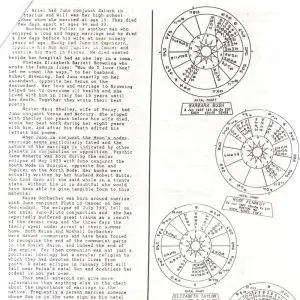
Asteroid Juno, Marriage, Power Struggles, Prominent Figures. This article explores the astrological significance of the asteroid Juno, known in mythology as the wife of Zeus and queen of the gods, focusing on her role in partnerships, marriage, jealousy, fidelity, and power dynamics. The author examines Juno’s orbital cycles, particularly its movements in Capricorn and Aquarius, and analyzes its placement in the natal charts of numerous historical figures, celebrities, and political leaders. The text highlights how prominent women often feature strong Juno placements, connecting the asteroid to public fame through marriage, career support, or notable domestic struggles.

Issue Highlights:

Articles:
JUNO: FIRST LADY OF THE GODS – Frances McEvoy

Discussion:
Astrological significance of the asteroid Juno
Juno’s cycles and stations in Capricorn and Aquarius
Juno in natal charts of political figures and celebrities
Connections between Juno aspects and marriage, divorce, and widowhood

Chart data:
Barbara Bush
Rose Kennedy
Elizabeth Taylor
Eleanor Roosevelt

Notable contributors:
Frances McEvoy (Astrological analysis of the asteroid Juno)

Astrology, Ephemerides, Mundane Forecasts, Predictive Techniques, Chart Rectification, and Esoteric Studies. This issue of Mercury Hour explores a wide array of specialized astrological topics, ranging from generational planetary cycles and weather forecasting to tarot associations and historical chart rectifications. Ann Kreilkamp examines the Uranus/Pluto in Virgo generation (1962–1968), highlighting the revolutionary tendencies and psychological profiles of individuals born during this period. Robert Cole discusses the reliability of economic and meteorological forecasting against statistical probability in ‘The Prediction Game’ and outlines cycles in ‘The Aquarian Agenda’ and ‘The Tenth Aquarian Age.’ Marc Penfield contributes multiple articles analyzing market trends, the Southern States of the Confederacy, county incorporation dates, and the natal chart of Tina Turner (‘Hot Legs from Nutbush’). Other notable contributions include Lew Paxton Price’s study on astrology in the Bible, Dorothy Willis on weather forecasting via Saturn and Uranus transits, Kevin W. Barrett on Sidereal house influences, John H. Roth, Jr. on reinterpreting astrological basics through tarot and equilibrium systems, and Frank Faustino on numerical keys to Einstein’s unified theory. The magazine also features extensive book reviews by Marion March, letters, data exchanges, and discussions surrounding astrological organization politics within the AFA and AFAN.

Issue Highlights:

Articles:
A Flood Warning for New Year’s – Nancy Ray
The Uranus/Pluto in Virgo Generation 1962-68 – Ann Kreilkamp
The Prediction Game – Robert Cole
The Market Goes Up and Down – Marc Penfield
Massacre or Escape? – Marc Penfield
The Aquarian Agenda – Robert Cole
Astrology in the Bible, Part I – Lew Paxton Price
Down to Earth Astrology – Howard Stephen Berg
Reagan’s Real Ascendant, Part I – John Kalus
Astrology & The Weather, Forecasting the Weather – Dorothy Willis
Sidereal Astrology: Influence of the Houses, Part 1 – Kevin W. Barrett
Relationships and Astrology, Part 1 – Klara Henderson
The Southern States of the Confederacy – Marc Penfield
The Counties of America – Marc Penfield
Hot Legs from Nutbush: The Chart of Tina Turner – Marc Heereen Penfield
Reinterpreting the Basics – John H. Roth, Jr.
The Tenth Aquarian Age – Robert Cole
Comments on our Marvelous Solar System – Wendy Hawks
Horoscope Du Jour – T. Patrick Davis

Discussion:
Statistical accuracy of weather and economic forecasting vs. astrology
Uranus/Pluto conjunction generational traits and societal impact
Tarot correspondences with astrological houses and signs
AFA organizational politics and democratic reform
Biblical numerology and tribal configurations in relation to the zodiac

Chart data:
Sunny von Bulow
Eli Cohen
Tina Turner
Ronald Reagan
AFA (American Federation of Astrologers)

Notable contributors:
Marion March (Book Reviews and UAC Report)
Al H. Morrison (Chiron Glyph and Cosmopolitics notes)
Reinhold Ebertin (Cosmopolitics excerpts)
Joylyn Hill (India/Israel mundane analysis and afflicted Moon studies)

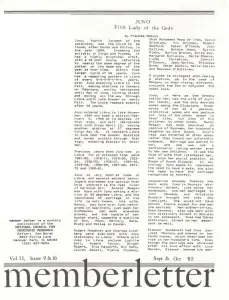
Frances McEvoy Juno First Lady of the Gods V.1 Volume 11 Issue 9 and 10

Juno First Lady of the Gods

Frances McEvoy, Special Collections

Asteroid Astrology, Juno in Natal Charts, Marriage and Relationships. The publication features an in-depth article exploring the astrological significance of the asteroid Juno, the ‘First Lady of the Gods,’ focusing on its orbital characteristics, cycles, and placement in the natal charts of prominent figures. Frances McEvoy details how Juno governs marriage, partnership, jealousy, fidelity, and social standing, noting its 48-year orbital cycle and repeating retrograde patterns in Libra. The text examines numerous historical and celebrity examples, demonstrating how Juno’s aspects to angles, luminaries, and outer planets correlate with marital history, infidelity, fame through marriage, and partnership dynamics.

Issue Highlights:
An exhaustive examination of the asteroid Juno’s placement across multiple charts of famous figures, highlighting its role as a key indicator of marital destiny, relationship style, and domestic partnership patterns.

Articles:
Juno: First Lady of the Gods – Frances McEvoy

Discussion:
Orbital mechanics and recurrence cycles of the asteroid Juno
Juno in Libra and its association with partnership and social recognition
Juno’s aspects to the Sun, Moon, Ascendant, Midheaven, and nodal axis in notable charts
Correlations between Juno placements and marriage, infidelity, widowhood, and divorce

Chart data:
Shah Mohammad Reza of Iran
David Brinkley
Yul Brynner
Robert Redford
Peter O’Toole
Joan Collins
Goldie Hawn
Sylvia Plath
Marlon Brando
Doris Day
Margaret Sullavan
Merle Oberon
Linda Christian
Carroll O’Connor
Jean Harlow
Princess Anne
Peter Duchin
Maria Callan
Maureen O’Sullivan
Ronald Reagan
Nancy Reagan
Jane Wyman
Jacqueline Kennedy Onassis
John Kennedy
Aristotle Onassis
Rose Kennedy
Eleanor Roosevelt
Lucy Mercer
Betty Ford
Gerald Ford
Rosalynn Carter
Jimmy Carter
Cathryn Brant Crosby
Bing Crosby
Princess Grace of Monaco
Clare Booth Luce
Henry R. Luce
Queen Elizabeth II
Prince Philip
Debbie Reynolds
Eddie Fisher
Will Durant
Ariel Durant
Buckminster Fuller
Elizabeth Taylor
Ted Kennedy
John Updike
Joan Sutherland
Richard Bonynge
Elizabeth Barrett Browning
Robert Browning
Mary Shelley
Percy B. Shelley
Jane Roberts
Robert Butts

Notable contributors:
Frances McEvoy (Asteroid Astrology and Juno in relationships)

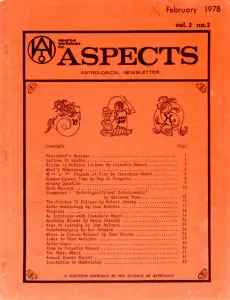
ASPECTS Vol. 3 No 2. Feb 1978

ASPECTS Magazine

Astrology, Aquarius Workshops, Eclipses, Horary, Graphoanalysis, Ingress Charts, Planetary Aspects. This issue of Aspects Astrological Newsletter (Vol. 3, No. 2, February 1978) covers a wide range of advanced and beginner astrological techniques, organizational news, book reviews, and interviews. Highlights include discussions on Uranus and Neptune dynamics, the October 12 eclipse impact, the application of ingress charts for personal forecasting, astro-numerology, and graphoanalysis techniques correlating handwriting slant with emotional responsiveness.

Issue Highlights:
Features extensive reports on conferences, upcoming workshops by prominent astrologers like Isabel Hickey and Gina Ceaglio, presidential messages from Marion D. March, and detailed technical articles exploring natal chart interpretation, house systems, and predictive methods.

Articles:
Review of McEvers Lecture – Cornelia Hansen
Friends or Foes – Constance Mayer
Humano-Cosmic Time – Guy de Penguern
Horary Question – Anonymous
Viewpoint – Astrologer/Client Relationship – Marianne Dunn
The October 12 Eclipse – Robert Jansky
Astro-Numerology – Joan McEvers
An Interview with Constance Mayer – Marion D. March
Building Blocks – Nancy Cassidy
Keys to Learning – Joan McEvers
Graphoanalysis – Sue Johnson
Where is Cousin Melvin? – Jean Graves
Astro-Logic – Anonymous
The Phase Wheel – Anonymous
Annual Dinner Report – Karen McCauley

Discussion:
Using ingress charts for prognostications and personal forecasting
Comparing Uranus and Neptune symbolism and manifestations
Humano-Cosmic Time previewing system based on 11-minute 12-second zodiacal ticks per year of life
Turning the house method in horary and natal charts (‘Every house is a first house’)
The psychological and physiological impacts of solar and lunar eclipses across houses
Graphological analysis of writing slant and emotional styles (FA, AB, BC, CD, DE, E+)

Chart data:
Capricorn Ingress Chart (December 21, 1977)
Horary Chart for Marriage Question (July 5, 1977)

Notable contributors:
Joan McEvers (Ingress charts, astro-numerology, keys to learning)
Constance Mayer (Planetary comparison of Uranus and Neptune)
Robert Jansky (Eclipse analysis and book reviews)
Marianne Dunn (Client-astrologer relationship ethics)
Guy de Penguern (Humano-Cosmic Time system)
Sue Johnson (Graphoanalysis)
Nancy Cassidy (Beginner blocks on Leo)
Jean Graves (Derivative house systems)

Ask A Librarian

Need assistance with your research or navigating our collection? Our library team is here to help.

Please fill out the form below with details about the topics, authors, or archival materials you are looking for, and one of our librarians will review your query and respond shortly.

Help

Whether you are looking for rare historical texts or trying to locate a specific book nearby, Alexandria iBase offers two primary ways to search. Here is how to choose the right tool for what you need:

The Library Catalogue

Think of this as your global master index.

The Catalogue works just like a traditional library search system, designed to help you locate books and media across the broader astrological landscape.

  • Physical Books: Find out where physical copies of books are held in libraries, archives, or collections near you.

  • Digital Files: Access downloadable or viewable digital editions when available.

  • Best Used For: Standard research, finding specific ISBNs or authors, and tracking down physical items in the real world.

Browse Catalogue

SPECIAL COLLECTIONS

Think of this as Alexandria’s exclusive private vault.

Collections gives you direct access to Alexandria’s own curated archive of rare, proprietary, and historic astrology media.

  • Exclusive Material: Features unique texts, manuscripts, audio recordings, and visual media that are not available anywhere else.

  • Direct Access: Digitized content ready to explore straight from the platform.

  • Best Used For: Deep-dive research, discovering hidden gems, and exploring rare, one-of-a-kind astrological resources.

Browse Special Collections

Cash & In-Kind Donations

Make a one-time or recurring tax deductible cash donation.

Payment options include donating directly with us, PayPal Giving and GoFundMe.

GoFundMe for Charities and PayPal Giving are registered for tax deductions and have no required processing fees. It does offer the option to tip.

Donate

*Subject to 2.5% processing fees

Contact Us

Have a question, feedback, or a inquiry about our archives? We’d love to hear from you. Please fill out the form below with your details and message, and a member of our team will get back to you as soon as possible.

Thank you for reaching out to the Alexandria iBase Project!