

Home » Synastry and Relationship Astrology

Synastry and Relationship Astrology

A comparative analytical method wherein two or more distinct birth charts are cross-examined to study geometric inter-aspects between individuals. Texts evaluate these charts to model interpersonal dynamics, psychological projection, family systems, and collaborative partnership viability.

Filters

Filters


See more See less
See more See less
See more See less
See more See less
See more See less
See more See less
See more See less

Sorting

Astrology, Houses, Transits, Reincarnation, Eclipses, Synastry, Numerology. This 13th edition of Mercury House (April 1977) provides a comprehensive collection of astrological discussions, research notes, and reader correspondence. Key topics covered include the interpretation of Saturn in various houses, house systems and critiques of traditional vs. equal house methods, the mechanics of eclipses, chart comparison (synastry), sidereal vs. tropical numbering, and reincarnation past-life regressions mapped through natal charts. Articles explore specialized techniques such as midpoints, deciles and quintiles (minor aspects), and the application of harmonics in chart analysis. The issue also features extensive letters from subscribers detailing personal transits, planetary aspects, and astrological research anomalies.

Issue Highlights:

Articles:
Zodiacal Numbering – Jeff Jawar
Saturn in the Houses (continuation) – Dr. Robert H. Goodrich
Saturn – Marc Penfield
A Key to Relationships [The Art of Chart Comparison] Introduction – Stephen Arroyo
Eclipses (first part in a series) – Ray Merriman
Some Notes on Astrological Research – Ingrid Naiman
Reincarnation – Marc Penfield
The Zodiac of Aspects (first of a two-part series) – Glenda Tomosovich
Astrological Review of an Autobiography [Alone by Admiral Richard E. Byrd] – Prem H. Joshi
The People’s Choice…A Different View of the Next Four Years – Dr. Robert H. Goodrich

Discussion:
Saturn in the 1st and 6th houses
House systems and Gauquelin research
Horoscope of Jesus
Aspects of artistic genius and medical astrology

Chart data:
Bob Dylan
Thor Heyerdahl
OJ Simpson
Omar Sharif
Ethel Kennedy
Jerry Brown
John Dean
Neil A. Armstrong
New York Stock Exchange

Notable contributors:
Marion March (Various topics and responses)
Zip Dobyns (Birthcharts and commentary)
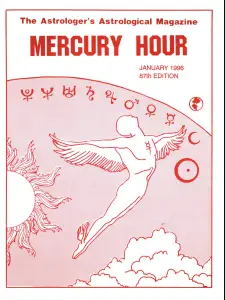
Mundane Astrology, Medical Astrology, and Predictive Astrology. This archival document is the 87th edition of Mercury Hour (January 1996), an astrological community journal edited and published by Edith Custer. The issue features articles, research notes, chart rectifications, software developments, and correspondence among practicing astrologers, including Bil Tierney’s psychological examination of Jupiter, Ed Dearborn’s technical breakdown of the “Translation of Light”, Valerie Vaughan’s defense of predictive astrology, Byron Ross Wahl’s analysis of the Solar Apex Synthetic Method (SASM), and the final installment of Robert “Buz” Myers’ lecture series on Moon-Saturn dynamics. Additionally, the journal covers mundane and political analyses of the O.J. Simpson verdict by John Kalus and Marion March, national chart rectifications for Washington, D.C. by Marc Penfield, insights on Uranus entering Aquarius by Kaye Shinker, medical and genetic commentary by T. Patrick Davis, software updates by Mark Pottenger, and tributes to astrologer Al H. Morrison.

Issue Highlights

Book Reviews
By Edith Custer:
Llewellyn’s 1996 Astrological Pocket Planner
Llewellyn’s Astrological Calendar 1996
Astrology Really Works by The Magi Society – Marc Penfield

Articles
A Look at Jupiter’s Shortcomings – Bil Tierney
Translation of Light – Ed Dearborn
Group Dynamics – Mary K. Creasey
Been There, Done That – Kaye Shinker
[O.J. Simpson verdict] – John Kalus
SASM, Columbus, and Samana Cay – Byron Ross Wahl
1995 Oven Saga – Roberta Strain
Moon/Saturn, Parts 7 and 8 of 8 – Robert “Buz” Myers
Winter Solstice 1995 – Dot Willis
The Art of Self-Defense: Lesson, Fighting at the Level of Your Opponent,
Part 1 of 2 – Valerie Vaughn
Al H. Morrison: Rectification, Poison Data, Genetics – T. Patrick Davis
[obituary & excerpts]
Discussions
Solar returns
O, J, Simpson trial
Chart data
(some incomplete or in question)
Powell, Colin
Washington, D.C.
Notable contributors
Donna Van Toen (various topics)
Mark Pottenger (Progressed MC techniques in software)
Marc Penfield (Chart of the U.S.A.)
Lee Lehman (corrections to Essential Dignities)
Marion March (O. J. Simpson trial, Chaos Theory, Solar Returns)

Pluto, Astrology, Shadow Work, Obsession, Metamorphosis. This lecture transcript from Duncan Nanney provides an unconventional exploration of Pluto, challenging standard astrological interpretations by encouraging the direct, conscious engagement with “forbidden” or taboo aspects of the human experience. Nanney argues that Pluto represents intense energy that, if repressed, manifests as uncontrollable or destructive external forces; conversely, he posits that by consciously confronting one’s “shadow” (obsessions, taboo sexual expressions, and deep-seated fears), an individual can achieve greater psychological integration and metamorphosis. He utilizes a “Planetville” concept—inspired by Rex Bills’ The Rulership Book—to map astrological archetypes onto a city, where Pluto governs the often ignored, “bad” parts of town, which are nonetheless essential to the whole.

Issue Highlights: The document serves as an analytical guide to navigating the 2002 Saturn-Pluto opposition, which the speaker links to broader themes of national security post-9/11 and the necessity for individual inner work. He discusses the difference between Uranus-driven inventiveness and Pluto-driven obsessive inquiry, frequently illustrating his points with film analyses (e.g., Blue Velvet) and personal anecdotes concerning his own “Plutonian” pursuits, including his experiences as a performance artist and in S/M communities. The lecture serves as a workshop in radical self-honesty, demanding that participants acknowledge their own dark desires rather than projecting them onto others or masking them with spiritual platitudes.

Articles:
How to Have Fun with Pluto (Revisited) – Duncan Nanney

Discussion:
The role of the Saturn-Pluto opposition in personal and collective transformation
The necessity of integrating the shadow and forbidden fruits in spiritual growth
The use of Local Space Maps to identify geographic correlations with natal charts
Case studies of celebrities (Madonna, Ed Wood, Jr., Lenny Bruce, Jack Nicholson, John Holmes, Roman Polanski, Anton LaVey, Ed Gein) through the lens of Plutonian energy

Chart data:
Madonna
Ed Wood, Jr.
Lenny Bruce
Jack Nicholson
John Holmes
Duncan Nanney
Roman Polanski
Anton LaVey
Ed Gein

Notable contributors:
Duncan Nanney (Astrological lecture, author of Planetville map)

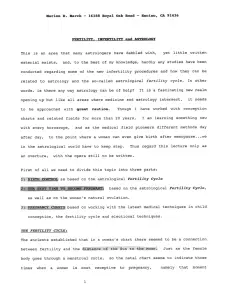
Fertility, Infertility, and Astrology, Astrological Fertility Cycle, Dr. Eugen Jonas, Birth Control, Electional Pregnancy Charts, In Vitro Fertilization, Artificial Insemination, GIFT, ZIFT. Marion D. March explores the intersection of medical procedures and astrological fertility cycles, noting that while the topic needs great caution, the astrological fertility cycle based on the Sun-Moon distance at birth can be remarkably effective for timing pregnancy. The text outlines three main divisions: birth control using the cycle (which March cautions is unreliable), determining the best time to become pregnant via personalized fertility dates and electional rules, and timing pregnancies through modern medical techniques such as artificial insemination and in-vitro fertilization.

Issue Highlights: Comprehensive lecture notes and case studies focusing on the practical application of astrological fertility cycles, detailed computer-generated fertility lists, and step-by-step chart interpretations for a client named Mindy.

Articles:
Fertility, Infertility and Astrology – Marion D. March

Discussion:
The validity and unreliability of astrological birth control
Calculating the fertility cycle based on the Sun-Moon distance from the natal chart
Using electional astrology and lunar aspects for conception and medical implantation
Correlating moon signs with the biological prediction of a baby’s gender
Applying fertility timing to modern medical procedures like IVF, GIFT, and ZIFT

Chart data:
Mikki March Andina (Michele Dia March)
Mindy’s Fertility Charts (#1, #2, #3, #3A, #4, #7, #7A)

Notable contributors:
Marion D. March (Author and Astrologer)
Dr. Eugen Jonas (Czechoslovakian gynecologist and astrologer known for his work on fertility cycles)

Dynamics of Professionalism

Marion D. March, Special Collections

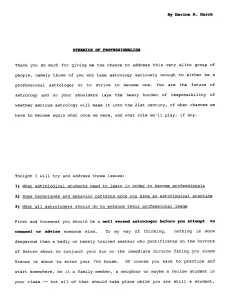
Astrological Ethics, Professional Practice, and Astrological Education. This archival document is a lecture transcript titled “DYNAMICS OF PROFESSIONALISM” by Marion D. March. March addresses three main areas necessary to establish astrology as a respected profession in the 21st century: student education, client consultation practices, and improving public perception. She cautions against amateur astrologers making damaging, fatalistic predictions, emphasizing the need for formal counseling training, boundaries, and compassion without judgment. March details practical consultation standards, including obtaining verified birth data, setting appropriate professional fees to overcome “poverty consciousness” (referencing advice from astrologer Barbara Watters in 1975), maintaining a professional office setting, avoiding jargon, and respecting client privacy. To elevate the field, she advocates separating professional astrology from entertainment (such as 900-numbers and psychic fairs), pursuing university-level degree programs like the Kepler Project, and exploring professional licensing frameworks similar to those used for acupuncturists.

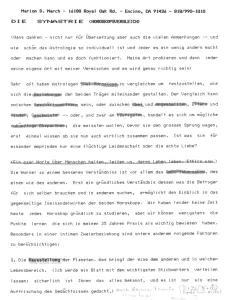
Synastry, Composite Charts, House Placements, Aspects, Midpoints. This instructional material by prominent astrologer Marion D. March covers comprehensive techniques in astrological synastry (Horoskopvergleich) and composite/midpoint charts (Schnittpunktthoroskope). The text details how to analyze house placements of planets between partners, the significance of empty houses, aspect patterns such as T-squares, Grand Crosses, Yods, and Grand Trines, as well as the karmic role of lunar nodes in relationships. Numerous celebrity examples are examined to illustrate these principles, including Prince Rainier and Grace Kelly, Richard Burton and Elizabeth Taylor, John Lennon and Yoko Ono, and Robert and Clara Schumann.

Issue Highlights:
Detailed methodology on comparing two charts, interpreting house overlays, calculating and analyzing composite/midpoint charts, and evaluating planetary configurations (Sun, Moon, Mercury, Venus, Mars, Jupiter, Saturn, Uranus, Neptune, Pluto) within partnership astrology.

Articles:
Die Synastrie (Horoskopvergleich) – Marion D. March
Schnittpunktthoroskope – Marion D. March
Haus Positionen für Synastrie – Marion D. March

Discussion:
House overlays and planetary contacts in synastry
The significance of empty houses activated by a partner
Aspect configurations (T-Square, Yod, Grand Trine, Grand Cross)
Composite and midpoint chart calculation and interpretation
Karmic connections through Lunar Nodes

Chart data:
Prince Rainier
Grace Kelly
Princess Caroline
Prince Albert
Princess Stephanie
Richard Burton
Elizabeth Taylor
John Lennon
Yoko Ono
Robert Schumann
Clara Schumann
Marilyn Monroe
Arthur Miller
Benito Mussolini
Rachele Mussolini
Adolf Hitler
Eva Braun

Notable contributors:
Marion D. March (Astrology, Synastry, and Composite Chart Methodology)

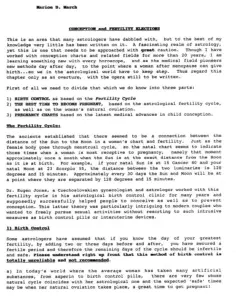
Fertility Astrology, Dr. Eugen Jonas Method, Electional Charts for Conception. Marion D. March provides a detailed guide on utilizing astrological fertility cycles (pioneered by Dr. Eugen Jonas) and electional charts for determining the best times to conceive. The text covers the three main divisions: birth control based on fertility cycles, optimal times for pregnancy based on both astrological fertility cycles and natural ovulation, and pregnancy charts adapted to modern medical procedures like in-vitro fertilization. March discusses practical case studies involving clients like Mindy, Marissa, Sarah, and Jennifer, analyzing the application of lunar aspects, void-of-course moons, and planetary transits in relation to natal charts.

Issue Highlights:

Articles:
Conception and Fertility Elections – Marion D. March

Discussion:
Calculating astrological fertility cycles based on the Sun-Moon phase angle at birth
Electional chart rules for conception focusing on the Moon’s applying aspects
Aligning astrological fertility dates with modern medical fertility treatments and in-vitro procedures

Chart data:
Mindy
Marissa
Sarah
Jennifer

Notable contributors:
Marion D. March (Author and Astrologer)
Dr. Eugen Jonas (Developer of the astrological fertility and birth control cycle)

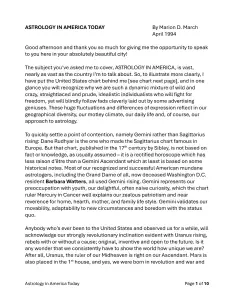
Astrology in America Today (1994)

Marion D. March, Special Collections

Astrology in America Today, Marion D. March, United States Chart, Gemini Ascendant, Uranian Astrology, Local Space, Project Hindsight, Lois Rodden, UAC. Marion D. March presents a comprehensive and sweeping lecture examining the state of astrology in the United States, utilizing a 7 July 1776 chart with Gemini rising and Uranus on the Ascendant as a symbolic reflection of American cultural and astrological traits. March discusses the rich eclecticism of American astrology, serving as a primary testing ground for international techniques and systems such as Midpoints, Uranian Astrology, Dr. Koch’s house systems, and composite charts from Germany, alongside Dane Rudhyar’s psychological insights from France. She details how American astrologers have championed innovations like Local Space (building on Edward Johndro, Charles Jayne, and Michael Erlewine), Heliocentric Astrology (popularized by T. Pat Davis), and Jim Lewis’s Astro*Carto*Graphy. Furthermore, she highlights the monumental work of Project Hindsight in retranslating classical texts, Lois Rodden’s monumental data collection efforts leading to the IDEA database, and the pioneering organizational frameworks of UAC (United Astrology Congress), AFAN, ISAR, and NCGR.

Issue Highlights:

Articles:
Astrology in America Today – Marion D. March

Discussion:
Debate between Gemini versus Sagittarius rising for the United States chart
The influence of computers and databases on astrological research (Lois Rodden, Edwin Steinbrecher, Michel and Françoise Gauquelin)
The professionalization of astrology and resistance to licensing
The intersection of astrology with technology, computers, and the Information Highway

Chart data:
US Chart 7 Gem ASC, July 4, 1776, 2:14 a.m. LMT, Philadelphia, PA

Notable contributors:
Marion D. March (Author / Lecturer)
Barbara Watters (Mundane astrology / Gemini rising usage)
Dane Rudhyar (Astrological philosophies and lunar phases)
Dr. Eugen Jonas (Fertility astrology)
Angel Thompson (Feng Shui and modern applications)
Michael Erlewine (Local Space mathematics and software)
T. Pat Davis (Heliocentric astrology)
Olivia Barclay, Ivy Jacobson, Joan McEvers (Horary astrology revitalization)
Jacob Schwartz (Draconic system)
Robert Hand, Robert Schmidt, Robert Zoller (Project Hindsight translation)
Jim Lewis (Astro*Carto*Graphy)
Lois Rodden (Data collection and birth data categorization)
Edwin Steinbrecher (Biographical research databases)
Neil Michelsen (Computerized ephemerides and research support)

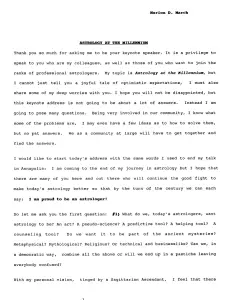
Professionalism, Astrological Standards, Millennium, Cultural Integration. Marion D. March delivers a passionate and challenging keynote address focusing on the state of astrology as the 20th century draws to a close. She raises eleven critical questions regarding the identity, reputation, standards, and future of astrology in a rapidly changing world. March examines external criticisms from scientists like Richard Dawkins, legal and financial controversies, the need for standardized training and testing akin to acupuncture and psychology, and the internal politics of major astrological organizations such as AFA, AFAN, ISAR, and NCGR. She highlights positive milestones including UAC faculty compensation, improved literature, computer advancements, financial research by Arch Crawford and Ray Merriman, the Gauquelins’ statistical research, Project Hindsight, and the unifying power of the Internet.

Issue Highlights:
A keynote address exploring the evolution of astrology, the necessity of professional standards, overcoming poverty consciousness among astrologers, and navigating technological and societal seachanges toward the new millennium.

Articles:
Astrology at the Millennium – Marion D. March

Discussion:
What do astrologers want astrology to be (art, science, predictive tool, helping tool)?
Public perception and attacks from the scientific community.
The need for testing, licensing, and standardized education.
Internal politics and division among astrological organizations.
The validity of astrology and empirical vs. judicial approaches.
The impact of computers, the Internet, and Project Hindsight.
Astrologers’ poverty consciousness and professional compensation.
Cyclical time vs. linear time and the philosophical implications of the upcoming millennium.

Chart data:
N/A

Notable contributors:
Marion D. March (Keynote Speaker)
Nick Campion (Natural vs. Judicial Astrology)
Joan McEvers (Astrology as a tool)
Arch Crawford (Financial Astrology)
Ray Merriman (Financial Astrology)

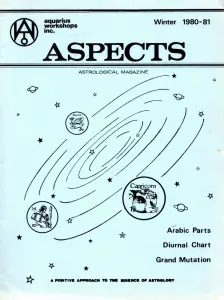
ASPECTS Vol. 6 No. 1 Winter 1980-81 Part 2/2

ASPECTS Magazine, Special Collections

Astrological techniques, horary analysis, Arabic parts, Diurnal charts, and the Grand Mutation of Jupiter and Saturn. This issue of Aspects features extensive technical explorations of predictive and mundane astrology. Robert ‘Buz’ Myers details the calculation and application of Arabic Parts. Marion D. March explores the grand astrological significance of the Jupiter-Saturn conjunction, evaluating its historical impacts and mundane country correlations using Jim Lewis’s Astro*Carto*Graphy. Lenora M. Hill introduces the simplicity and practical application of the Diurnal (daily) Chart, complete with step-by-step mathematical examples, Yod configurations, and transit correlations. Joan McEvers provides insights into numerological pinnacles, while Linda Green investigates Astropalmistry through hand-shape classifications and water-hand patterns. Enrique Linarés introduces the ‘Point of Life’ progression method. Additionally, book reviews by Marion D. March and data columns by Lois Rodden round out the edition.

Issue Highlights:

Articles:
How to Calculate Your Arabic Parts – Robert ‘Buz’ Myers
The Great Jupiter/Saturn Conjunction – Marion D. March
The Diurnal (Daily) Chart – Lenora M. Hill
The Point of Life – Enrique Linarés
Basic Delineation – Marion D. March
Astro-Numerology: The Meanings of the Numbers (Pinnacles) – Joan McEvers
Astropalmistry – Linda Green

Discussion:
Calculating Arabic parts using formula segments
Jupiter-Saturn conjunctions and Grand Mutations entering Air signs
Diurnal chart calculation and activation via house cusps
Point of Life progression calculations
Astrological data corrections and book reviews

Chart data:
Horary Question (8/17/79 8:49 PM PDT, Coeur d’Alene)
Basic Delineation natal chart (3/30/1853 11:00 AM LMT, Zundert, Holland)
Diurnal Chart (June 28, 1980)
Water Hand Natal Horoscope (Figure 2)

Notable contributors:
Robert ‘Buz’ Myers (Arabic Parts)
Marion D. March (Jupiter-Saturn Conjunction & Basic Delineation)
Lenora M. Hill (Diurnal Charts)
Enrique Linarés (Point of Life Progression)
Joan McEvers (Astro-Numerology)
Linda Green (Astropalmistry)
Lois Rodden (Data Column)

Ask A Librarian

Need assistance with your research or navigating our collection? Our library team is here to help.

Please fill out the form below with details about the topics, authors, or archival materials you are looking for, and one of our librarians will review your query and respond shortly.

Help

Whether you are looking for rare historical texts or trying to locate a specific book nearby, Alexandria iBase offers two primary ways to search. Here is how to choose the right tool for what you need:

The Library Catalogue

Think of this as your global master index.

The Catalogue works just like a traditional library search system, designed to help you locate books and media across the broader astrological landscape.

  • Physical Books: Find out where physical copies of books are held in libraries, archives, or collections near you.

  • Digital Files: Access downloadable or viewable digital editions when available.

  • Best Used For: Standard research, finding specific ISBNs or authors, and tracking down physical items in the real world.

Browse Catalogue

SPECIAL COLLECTIONS

Think of this as Alexandria’s exclusive private vault.

Collections gives you direct access to Alexandria’s own curated archive of rare, proprietary, and historic astrology media.

  • Exclusive Material: Features unique texts, manuscripts, audio recordings, and visual media that are not available anywhere else.

  • Direct Access: Digitized content ready to explore straight from the platform.

  • Best Used For: Deep-dive research, discovering hidden gems, and exploring rare, one-of-a-kind astrological resources.

Browse Special Collections

Cash & In-Kind Donations

Make a one-time or recurring tax deductible cash donation.

Payment options include donating directly with us, PayPal Giving and GoFundMe.

GoFundMe for Charities and PayPal Giving are registered for tax deductions and have no required processing fees. It does offer the option to tip.

Donate

*Subject to 2.5% processing fees

Contact Us

Have a question, feedback, or a inquiry about our archives? We’d love to hear from you. Please fill out the form below with your details and message, and a member of our team will get back to you as soon as possible.

Thank you for reaching out to the Alexandria iBase Project!