
Traditional Astrology

A modern umbrella category encompassing pre-modern Western systems (Hellenistic, Arabic/Persian, Medieval, and Renaissance). It is characterized methodologically by reliance on essential and accidental dignities, planetary sect, traditional rulerships, whole sign or quadrant houses, and concrete, observable outcomes rather than psychological internalizations.

Filters

Filters


See more See less
See more See less
See more See less
See more See less
See more See less
See more See less
See more See less

Sorting

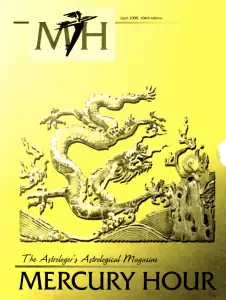
Mundane Astrology, Astrology History, and Astrological Techniques. This archival item is the April 2000 issue (104th Edition) of Mercury Hour, a quarterly astrological magazine edited and published by Edith Custer in Lynchburg, Virginia. Key highlights include Ken Negus’s translation and commentary on Johannes Kepler’s 1608 chart interpretation for Generalissimo Albrecht Wallenstein, Rowena Wall’s astrological profile of media mogul Ted Turner following the Time Warner/AOL merger and his marital separation from Jane Fonda, and Virginia Reyer’s rectified natal and event analysis of Theodore Kaczynski (the Unabomber). The issue also features Susan Manuel’s geo/helio analysis of the Mars Polar Lander mission, Pat Geisler’s essay on professional ethics for practicing astrologers, Joan Titsworth’s overview of esoteric ray astrology, and Mary Downing’s historical reference table of Democratic National Conventions and nominees. Additional contributions document Walt Masters’ mathematical formulas for twelve “House Parts” (Arabic Parts), the 1999 Texas A&M bonfire collapse, out-of-bounds declinations, and chart analyses for prominent political figures including Vladimir Putin, Al Gore, George W. Bush, Bill Bradley, and John McCain.


Issue Highlights 


Articles


“Mouth of the South” Does it Again! [Ted Turner] – Rowena Wall


Kepler as Practicing Astrologer, Translation and Commentary – Ken Negus


Helio Planets: Mars Polar Lander – Susan Manuel


Esoteric Astrology in the World Today – Joan Titsworth


The Aquarian Eclipses of 2000 – Carol Willis


Ted Kaczynski – Virginia Reyer


Democratic National Conventions and Presidential Nominees [table]– Mary Downing


The Ethics of Astrology – Pat Geisler


Tidbits from the Tabloids – Arlene Marcia Nimark


Discussions


The 12 Arabic Parts


Bonfire collapse at Texas A&M (1999)


Declinations/Out-of-Bounds planets


Chart of Camilla Parker-Bowles


The Vertex


Chart data


(some incomplete or in question)


Bradley, Bill


Bush, George H.W.


Gore, Al


Kaczynski, Ted


McCain, John


Putin, Vladimir


Canada


Battle of Toronto (War of 1812)


Bonfire collapse at Texas A&M (1999)


Notable contributors


Marion March (avoiding generalizing in Astrology)
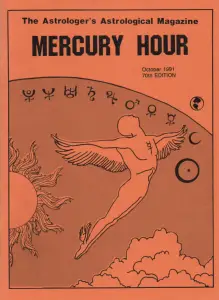
Astrology Community, Mundane Astrology, and Astrology History serve as the primary focus areas of this historical astrological literature. This archival item is the October 1991 issue (70th Edition) of Mercury Hour, “The Astrologer’s Astrological Magazine,” a reader-driven correspondence periodical edited and published by Edith Custer of Lynchburg, Virginia. Structured largely as an open forum of subscriber letters, it documents the working preoccupations of a grassroots American astrological community, with debates over classical versus modern technique, chart-matching blind tests, and the interpretation of stations, midpoints, solar returns, and heliocentric charts. Reflecting its Gulf War moment, the issue features mundane analysis of the Gulf War chart, the USSR’s dissolution, and comparative studies of Saddam Hussein, Jim Jones, and Adolf Hitler; alongside contributions from Ted George, M.J. Makransky, Joyce Wehrman, and Lee Lehman, a memorial for statistical researcher Michel Gauquelin (1928-1991), chart data for figures such as Napoleon and Helen Herron Taft, and period advertisements for early astrological software that capture the field’s transition into desktop computing.

Issue Highlights


Book Review

Working with Astrology by Michael Harding & Charles Harvey – Doris Greaves


Articles

Missing Visa Book – Marie DeLeone

Student’s Corner [the Ascendant] – Annibale F. Verzumo

Jupiter-Neptune, The Celestial Twins, Part I – Ted George

NCGR Conference [report] – Edith Custer

Indications of a Winner *or* Do You Have a Gambling Chart? – Cammille Adams

Planet Watch – Paul O. Hewit

The Natural Disposition, Part II – M.J. Makransky

Michel Gauquelin 1928-1991 – J. Lee Lehman

[USSR charts] Part I – Annibale Verzumo

The Three Amigos, Part II, Conclusion [Saddam Hussein, Jim Jones, Adolph Hitler]– Susan J. Kientz

[Risks of publishing astrological materials] Part II, Conclusion – C. J. Puotinen

Central American Data – M.J. Makransky

Her Proudest Moment [Helen Herron Taft] – T. Patrick Davis

Pluto, Part II, Transpluto – Joyce Wehrman [transcription of talk]

The Gemini Theme, Using the Astrological Language, Part III, Conclusion – Anne Foley

Autumn Equinox September 23, 1991 – Dorothy S. Willis


Discussions

Astrological weather prediction

Solar returns

Chart of Napoleon

Neptune

Gulf War chart

Heliocentric charts

Finding the time of sunrise in birthchart


Chart data

Bonaparte, Napoleon
Taft, Helen Herron
Iraq War
Costa Rica
El Salvador
Guatemala
Honduras
Nicaragua


Notable contributors

Marion March (semi-sextiles)

Lee Lehman (classical astrology techniques; homosexuality & astrology)

Marc Penfield (the astrology of Orlando, FL & Disney World)

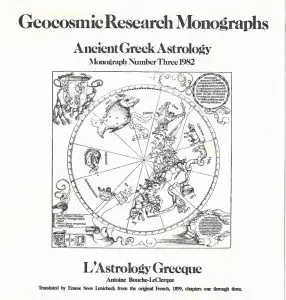
Geocosmic Research Monographs - Ancient Greek Astrology - Monograph Number Three

Ancient Greek Astrology

Geocosmic Research Monographs

Ancient Greek Astrology, Chaldean Astrology, Aristotelianism and Hermeticism in Medieval Astrology. This publication features translations and analytical essays examining the historical foundations of astrology. The first section presents excerpts from Antoine Bouche-LeClerq’s foundational 1899 work ‘L’Astrologie Grecque’, translated by Emese Soos Lenichek, covering precursory philosophies, Chaldean influences, and core doctrines. The second section, authored by Robert Zoller, explores the synthesis of Aristotelian philosophy and Hermeticism in medieval astrological practice, particularly referencing Guido Bonatti’s ‘Liber Astronomiae’, Abu Ma’shar’s contributions, and the epistemological framework uniting the celestial spheres with terrestrial life.

Issue Highlights:
Translation of key chapters from Bouche-LeClerq’s ‘L’Astrologie Grecque’ addressing the physics, determinism, and planetary mechanics of antiquity; an extensive study by Robert Zoller on the deep ties between medieval scholasticism, Aristotelian physics, and Hermetic gnosticism in astrological doctrine.

Articles:
L’Astrologie Grecque (Chapters One through Three) – Antoine Bouche-LeClerq (Translated by Emese Soos Lenichek)
Aristotelianism and Hermeticism in Medieval Astrology – Robert Zoller

Discussion:
The transition from Babylonian and Chaldean observational methods to Hellenistic astrological systems.
The philosophical synthesis of Aristotelian substance, causes, and the celestial prime mover within medieval astrology.
The role of the Corpus Hermeticum, gnosis, and sympathetic magic in medieval and Renaissance esoteric worldviews.

Chart data:
N/A

Notable contributors:
Antoine Bouche-LeClerq (History of Greek Astrology)
Robert Zoller (Medieval Astrology and Hermeticism)
Emese Soos Lenichek (Translation)

Ask A Librarian

Need assistance with your research or navigating our collection? Our library team is here to help.

Please fill out the form below with details about the topics, authors, or archival materials you are looking for, and one of our librarians will review your query and respond shortly.

Help

Whether you are looking for rare historical texts or trying to locate a specific book nearby, Alexandria iBase offers two primary ways to search. Here is how to choose the right tool for what you need:

The Library Catalogue

Think of this as your global master index.

The Catalogue works just like a traditional library search system, designed to help you locate books and media across the broader astrological landscape.

  • Physical Books: Find out where physical copies of books are held in libraries, archives, or collections near you.

  • Digital Files: Access downloadable or viewable digital editions when available.

  • Best Used For: Standard research, finding specific ISBNs or authors, and tracking down physical items in the real world.

Browse Catalogue

SPECIAL COLLECTIONS

Think of this as Alexandria’s exclusive private vault.

Collections gives you direct access to Alexandria’s own curated archive of rare, proprietary, and historic astrology media.

  • Exclusive Material: Features unique texts, manuscripts, audio recordings, and visual media that are not available anywhere else.

  • Direct Access: Digitized content ready to explore straight from the platform.

  • Best Used For: Deep-dive research, discovering hidden gems, and exploring rare, one-of-a-kind astrological resources.

Browse Special Collections

Cash & In-Kind Donations

Make a one-time or recurring tax deductible cash donation.

Payment options include donating directly with us, PayPal Giving and GoFundMe.

GoFundMe for Charities and PayPal Giving are registered for tax deductions and have no required processing fees. It does offer the option to tip.

Donate

*Subject to 2.5% processing fees

Contact Us

Have a question, feedback, or a inquiry about our archives? We’d love to hear from you. Please fill out the form below with your details and message, and a member of our team will get back to you as soon as possible.

Thank you for reaching out to the Alexandria iBase Project!