
Home » Geodetic Equivalents

Geodetic Equivalents

Geodetic Equivalents are systems that map Earth’s geographical longitudes and latitudes directly to the zodiac and houses for mundane forecasting. This technique allows astrologers to erect maps and charts for world events and political entities using terrestrial coordinates.

Filters

Filters


See more See less
See more See less
See more See less
See more See less
See more See less
See more See less
See more See less

Sorting

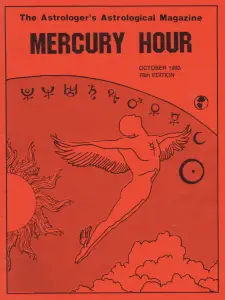
Astrology, Mercury Hour, October 1993, Edith Custer, planetary transits, horary astrology, mundane astrology, death charts, solar returns, heliocentric astrology, asteroids, fixed stars. This issue of Mercury Hour (78th Edition, October 1993), edited by Edith Custer, is a comprehensive astrological journal featuring extensive correspondence, member discussions, and in-depth technical articles. Key topics covered include the twelve-year cycle of Jupiter in Russia, prognostications using eclipse cycles and geodetic equivalents (notably predicting earthquakes in Japan), horary techniques including the judgment of theft and void-of-course moons, and psychological astrology focusing on planetary aspects such as Uranus-Neptune and Pluto’s generational influences. Contributors examine mundane charts of cities and countries, biographical data of prominent public figures, and advanced predictive methods like Diurnal charts and Sidereal Solar Returns.

Issue Highlights

The edition includes detailed book reviews of works by Wendy Hawks, Patrick Curry, and Marc Penfield. Articles range from technical instructional pieces on cardinal signs and houses, heliocentric astrology for beginners, and the mechanics of the Transpluto awakening, to political and historical mundane studies such as Russia’s Jupiter cycle and the founding dates of American cities. Personal reflections, travel anecdotes from NCGR conferences, and exhaustive subscriber correspondence make up a significant portion of the text, highlighting community engagement and collaborative astrological research.

Articles:
Russia and the Twelve-Year Cycle of Jupiter – Ted George
An Astrological Review of “Passages”, Part 4 of 6: The Rooting and Extending Passage [32-35] – Bil Tierney
Student’s Corner, Part 1 of 2 [Cardinal signs and houses] – Annibale F. Verzumo
Founding Dates [American cities], Part 2 of 3 [table] – Marc Penfield
XX Century: The New Arrival of the Christ – Ruben Jungbluth & Nora Portal
Helio for Rookies – Kaye Shinker
Predicted! Japan’s 7.8 Quake – Ann E Parker
Horary Astrology – Olivia Barclay
Birth Chart: City of Jacksonville, FL – Ted George
Autumn Equinox 1993 – Dorothy S. Willis
Introduction to M-13: Spiritual Theory, Part One – Defiance Gregg
Pluto as Power Indicator, Pluto as Generational Guide – Louise Jenkins
A Correct Prediction: The NYC Building Strike of 1991 – Robert Zoller
XXI Century: The Birth of a New Mankind – Ruben Jungbluth
[Uranus-Neptune], Part 2 of 2 – Annibale F. Verzumo
The Transpluto Awakening – Michael & Jeanne Baruch
People in the News – Marc Penfield

Discussion:
Natal ascendant of Rush Limbaugh
CapSolar (Sidereal technique) and Pluto/Moon aspects of violence
Bill Clinton birth time
Chart of Israel
Sideral calculations for Solar Returns

Chart data:
Hoover, J. Edgar
Jackson, Michael
Malcolm X (Little)
Nureyev, Rudolph
Japan earthquake July 1993

Notable contributors:
Lee Lehman (Void of Course Moon; prediction of death)
Carol Lavoie (Nostradamus computer program)
Lois Rodden (time of death charts)
Karen Christino (prediction of death)
Marion March (prediction of death)
Dorothy Kovach (20-year Presidential Curse & the Great Mutation)
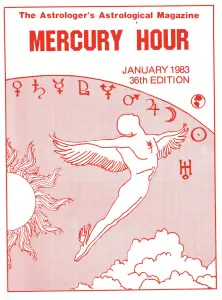
Astrology, Mercury Hour, Natal charts, Transits, Progressions, Mundane Astrology, Astro*Carto*Graphy, Chiron, Void of Course Moon, Solar Returns, Uranian astrology, Cosmobiology. This 36th Edition of Mercury Hour (January 1983), edited and published by Edith Custer, is a comprehensive astrological magazine featuring diverse correspondence, extensive theoretical and technical articles, book reviews, conference reports, and in-depth chart delineations. Key themes explored across the publication include life-stage transitions such as the ‘Catch-30’ passage and Uranus age cycles, mundane and political astrology including analyses of nuclear war threats, the Falklands crisis, and the chart of Israel, as well as technical discussions regarding software, heliocentric nodes, house systems, and the accuracy of astrological statistics (such as Gauquelin studies).

Issue Highlights:

Articles:
The Vertex – Jan Popelka
Student’s Section: A Visit to Astrologers in the U.S.A. – Ann Stevens-Patacchiola
The Catch-30 Passage: [28-32], Part III – Bil Tierney
[Uranus age cycle] Part II – Dale Huckeby
Mysterious Neptune, Part II (Marcia Moore’s chart and death) – Manik Chand Jain
Moon Void of Course in the Signs, Part I – Ted George
Is Nuclear War in Our Future? [An Astrological Call to Action] – Virginia Miller
The Pshaw Report – Jayj Jacobs
The Role of the Moon’s Nodes in World Events – Alan Richter
The New Orleans Air Crash of July 1982 – Jeff Jawer
The Effects of Saturn Transits in the Lives of the Pacific Club Members – Dona Shaw
A Royal Baby (Prince William) – Judith Gee
Determining the Winner of a Game – Sophia Mason
The Psychological Patterns of Jesus Christ – Frank Jakubowsky

Discussion:
Astro*Carto*Graphy, geodetic equivalents, and mundane predictions
Astrology hardware and software (Osborne, Astro Star, Matrix software reports)
Sunspot activity and the stock market
Gauquelin studies and statistical analysis
Lindbergh baby kidnapping and Bruno Hauptmann chart analysis
Intruder in the Queen’s Bedroom (Michael Fagan and Elizabeth II charts)
Fraternity for Canadian Astrologers 1st National Conference awards

Chart data:
August Belmont
David Crosby
Richard Dreyfuss
Michael Fagan
Andy Gibb
Bruno Hauptmann
Charley Pride
Victoria Principal
Ronald Reagan
Michael Trestrail
Israel and Partition
United Kingdom

Notable contributors:
Jim Lewis (Astro*Carto*Graphy and Ronald Reagan chart)
Jeff Jawer (First Canadian National Conference)
Barbara Watters (Grand trines and Sex and the Outer Planets)
Tracy Marks (financial compensation for astrologers)
Zane Stein (Chiron research)
Erin Sullivan (astrology of sexuality)

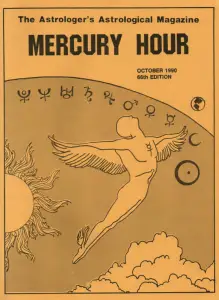
Mundane Astrology, Astrology History, and Astrological Techniques. This archival item is the October 1990 issue (66th Edition) of Mercury Hour, a quarterly astrological magazine edited and published by Edith Custer in Lynchburg, Virginia. Featured articles in this issue include Marc Penfield’s solar chart analysis of Donald Trump and natal study of Greta Garbo, Part I of M.J. Makransky’s series correlating zodiacal degrees with geographical locations and political shifts in Guatemala, Robert Baumgartner’s examination of a Demotic astrological text regarding the Egyptian star Sothis, Joseph S. DeMello’s instructional guide on diurnal charts, Paul Hewitt’s analysis of the 1989 Eastern European revolutions, and T. Pat Davis’s geo-helio study of the 1901 Texas oil discovery at Spindletop. Additional contents include reviews of Alan Oken’s Soul-Centered Astrology and Margaret Millard’s The Genetics of Astrology, weather forecasts by Dot Willis, and historical discussions regarding Tycho Brahe’s birth chart, the Society for the Advancement of Astrology, the 1992 Philippine presidential election, and birth data for figures including Saddam Hussein and Kenneth Branagh.


Issue Highlights


Book Reviews


Soul-Centered Astrology: A key to the expanding Self by Alan Oken – Marguerite dar Boggia


The Genetics of Astrology by Margaret Millard – Teresa Hamilton


Articles


The Great Garbo: Sphinx or Siren? – Marc Penfield


Guatemala, Part I – M.J. Makransky


The Egyptian Sothis in Gemini – A Demotic Astrological Text, Part I – Robert Baumgartner


Saturn, Our Night-Light, Part I – Ann Foley


Living the Hero’s Journey, Part I – Carol Voeth-Lavoie


Diurnal Charts – Joseph D. DeMello


Next Philippine President – Serafin Lanot


Autumn Ingress, September 23, 1990 – Dot Willis


Students Corner: Aspects – Anne Toth


[Essential charts of Chicago], Part I – Sonja Foxe


Saturn Anxiety, Part I – Carole Devine


Donald Trump: His Solar Chart – Marc Penfield


Eastern Europe – The Revolution of 1989, Part I – Paul Hewitt


Texans Discover Oil – T. Pat Davis


Discussions


Ethics of predicting death


Chart of Tycho Brahe


History of the Society for the Advancement of Astrology

Sun sign columns


Polio vaccine/SV-40 virus/AIDS

Warren and Florence Harding


Neptune transit of Capricorn


Chart of San Francisco Astrolocality Page 2 of 2


Chart data
(some incomplete or in question)

Iraq
Kuwait
Saudi Arabia
United Arab Emirates
San Francisco, CA
Common Market/EEC

Brahe, Tycho
Branagh, Kenneth
Griffith, Melanie
Hussein, Saddam
Linares, Enrico
Quayle, Dan
Stuart, Matthew & related charts

Notable contributors

Joe DeMello (the semi-sextile aspect)
Marion March (Joan Quigley’s involvement with the Reagans)
Kay Shinker (solar returns)
Lois Rodden (chart data)
Frances McEvoy (Matthew Stuart/Boston murder case)

Ask A Librarian

Need assistance with your research or navigating our collection? Our library team is here to help.

Please fill out the form below with details about the topics, authors, or archival materials you are looking for, and one of our librarians will review your query and respond shortly.

Help

Whether you are looking for rare historical texts or trying to locate a specific book nearby, Alexandria iBase offers two primary ways to search. Here is how to choose the right tool for what you need:

The Library Catalogue

Think of this as your global master index.

The Catalogue works just like a traditional library search system, designed to help you locate books and media across the broader astrological landscape.

  • Physical Books: Find out where physical copies of books are held in libraries, archives, or collections near you.

  • Digital Files: Access downloadable or viewable digital editions when available.

  • Best Used For: Standard research, finding specific ISBNs or authors, and tracking down physical items in the real world.

Browse Catalogue

SPECIAL COLLECTIONS

Think of this as Alexandria’s exclusive private vault.

Collections gives you direct access to Alexandria’s own curated archive of rare, proprietary, and historic astrology media.

  • Exclusive Material: Features unique texts, manuscripts, audio recordings, and visual media that are not available anywhere else.

  • Direct Access: Digitized content ready to explore straight from the platform.

  • Best Used For: Deep-dive research, discovering hidden gems, and exploring rare, one-of-a-kind astrological resources.

Browse Special Collections

Cash & In-Kind Donations

Make a one-time or recurring tax deductible cash donation.

Payment options include donating directly with us, PayPal Giving and GoFundMe.

GoFundMe for Charities and PayPal Giving are registered for tax deductions and have no required processing fees. It does offer the option to tip.

Donate

*Subject to 2.5% processing fees

Contact Us

Have a question, feedback, or a inquiry about our archives? We’d love to hear from you. Please fill out the form below with your details and message, and a member of our team will get back to you as soon as possible.

Thank you for reaching out to the Alexandria iBase Project!