Applied Astrology

Applied Astrology

Applied Astrology refers to the pragmatic implementation of astrological methodologies to address concrete, real-world problems. Utilizing techniques such as planetary transits, synastry inter-chart comparison, and horary analysis, this approach treats astrological data as an analytical utility rather than a static archetype or spiritual belief system. It encompasses specialized sub-disciplines where astronomical calculations map directly onto practical domains, including psychological self-assessment, vocational planning, electional astrology for organizational timing, and financial astrology for market trend analysis.

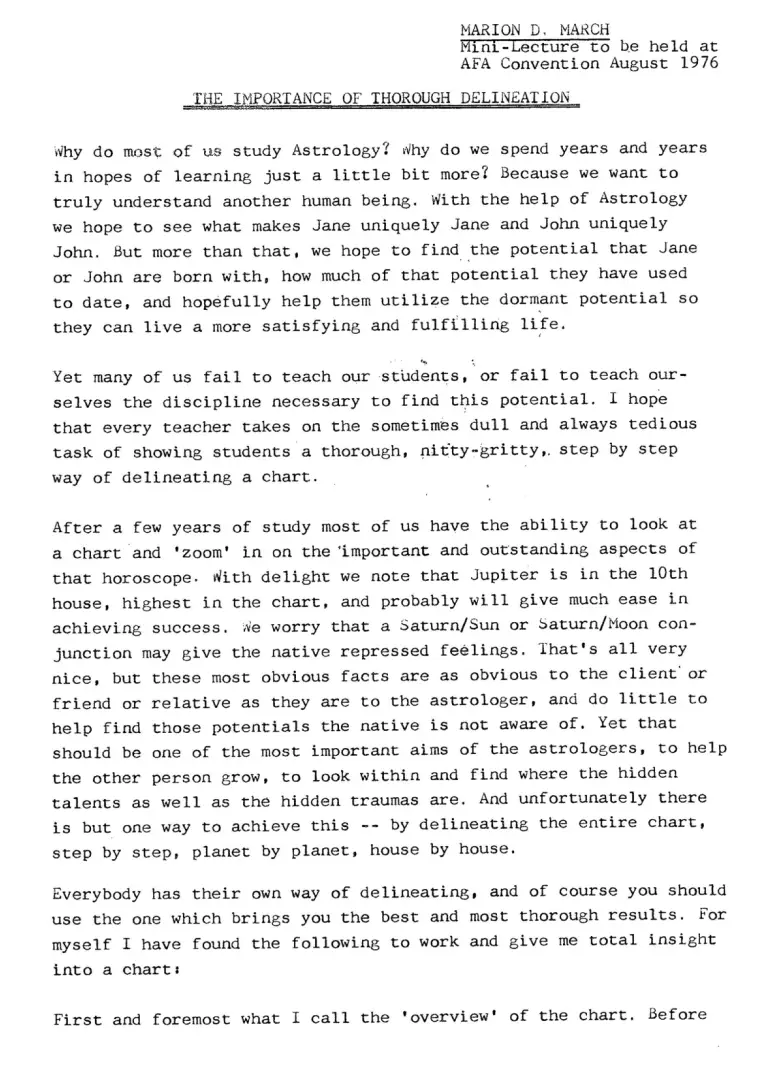
The Importance of Thorough Delineation (1976)

Astrological Chart Analysis, Applied Astrology, and Delineation. This archival document is a mini-lecture transcript titled “THE IMPORTANCE OF THOROUGH DELINEATION” by Marion D. March from the AFA Convention in August 1976. March argues for step-by-step astrological delineation to uncover a person’s hidden potential, unresolved traumas, and dormant talents. She outlines a sequential methodology starting with a structural “overview” (elemental distributions, qualities, house types, dignities, dispositors, and configurations) before dissecting the “heart of the chart” (Sun, Moon, Ascendant) through sign, house, ruler, decanate, and aspect analysis. Additionally, March explains how to navigate chart contradictions, integrate secondary progressions and Solar Arc directions for tracking internal growth, and utilize transits to identify environmental events while emphasizing free will over deterministic prediction.


View

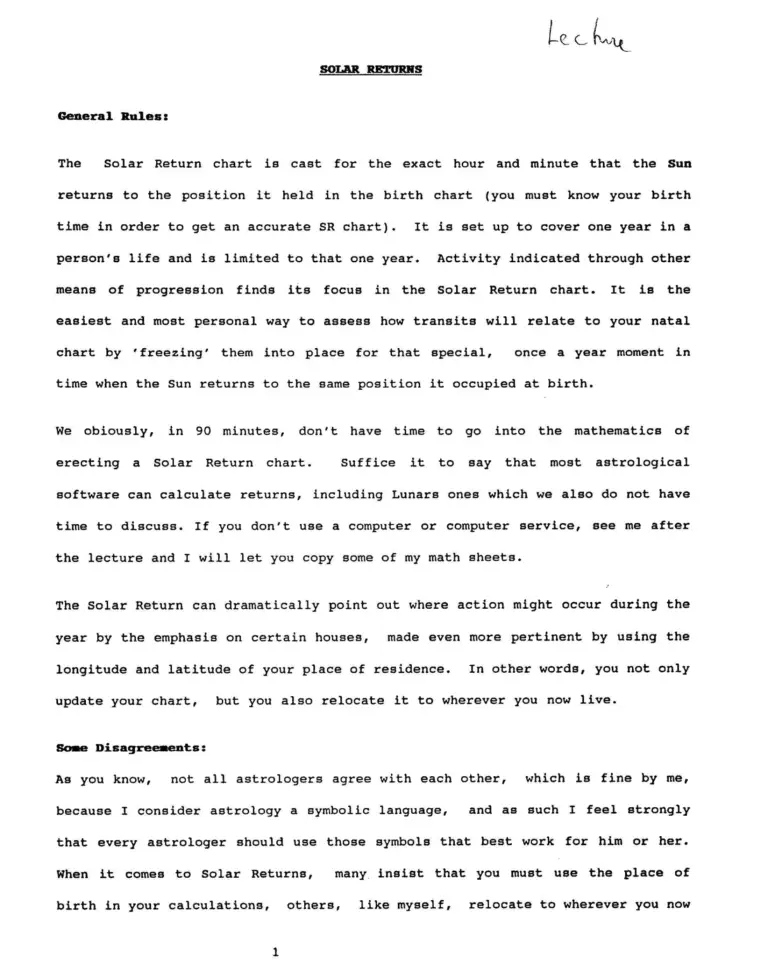
Solar Returns (lecture notes) – revised, with additional notes

Solar Returns, Predictive Astrology, and Applied Astrology. This archival manuscript is a set of revised lecture and instructional notes on Solar Return charts by Marion D. March. March outlines the technical principles and interpretation rules for Solar Returns, which freeze transits for the exact annual moment the Sun returns to its natal position. She advocates calculating the return chart for the individual’s current place of residence rather than their birthplace. The guide details interpretive priorities, including the Solar Return Ascendant, rising planets, the house placement and aspects of the Sun, the natal house coming to the Solar Return Ascendant, and hemispheric or angular distributions. Additionally, March provides specific astrological signatures for predicting major life events, such as marriage, childbirth, career changes, relocations, divorces, and health issues.

View

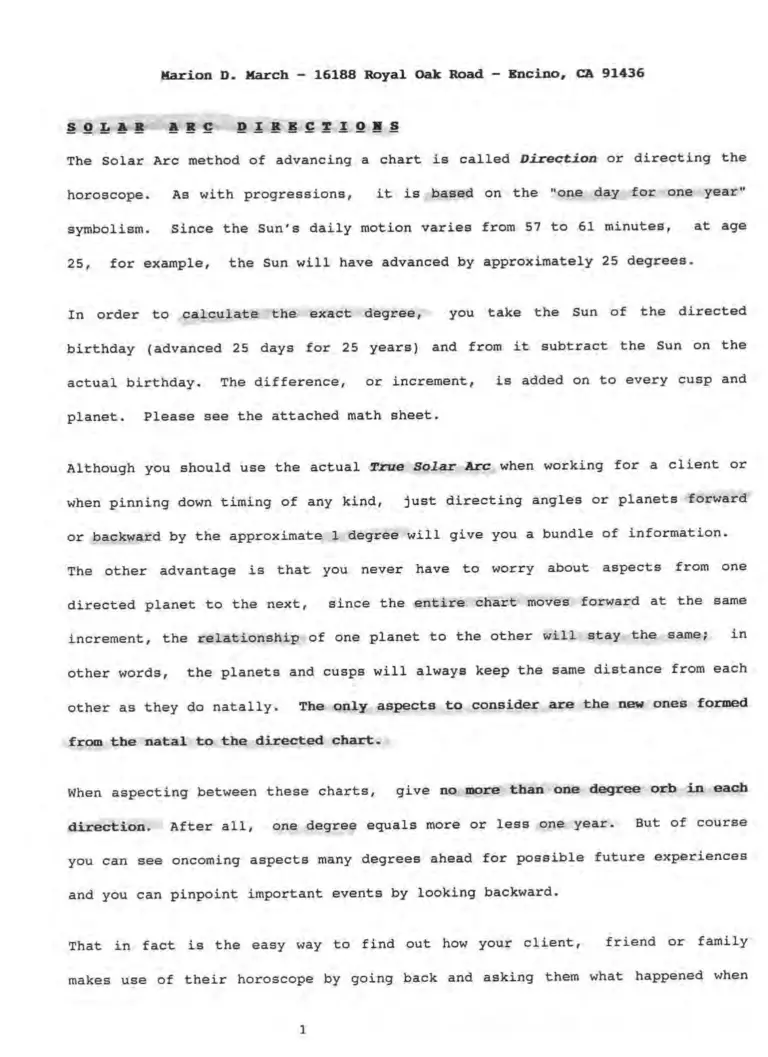
Solar Arc Directions

Solar Arc Directions, Predictive Astrology, and Applied Astrology. This archival document is an instructional reference guide titled “SOLAR ARC DIRECTIONS” by Marion D. March. March outlines the mathematical calculations and practical applications of Solar Arc Directions, secondary progressions, and planetary transits. She distinguishes progressions as internal attitudinal shifts, directions as visible outer developments, and transits as concrete environmental triggers, recommending a combined approach in practice. The text includes step-by-step mathematical instructions for calculating True Solar Arc increments, illustrated by a case study of author Kitty Kelley across key career and life milestones. Additionally, March details planetary orbital speeds and presents a four-quadrant cyclic model structured around the chart angles to track long-term personal and vocational development.

View

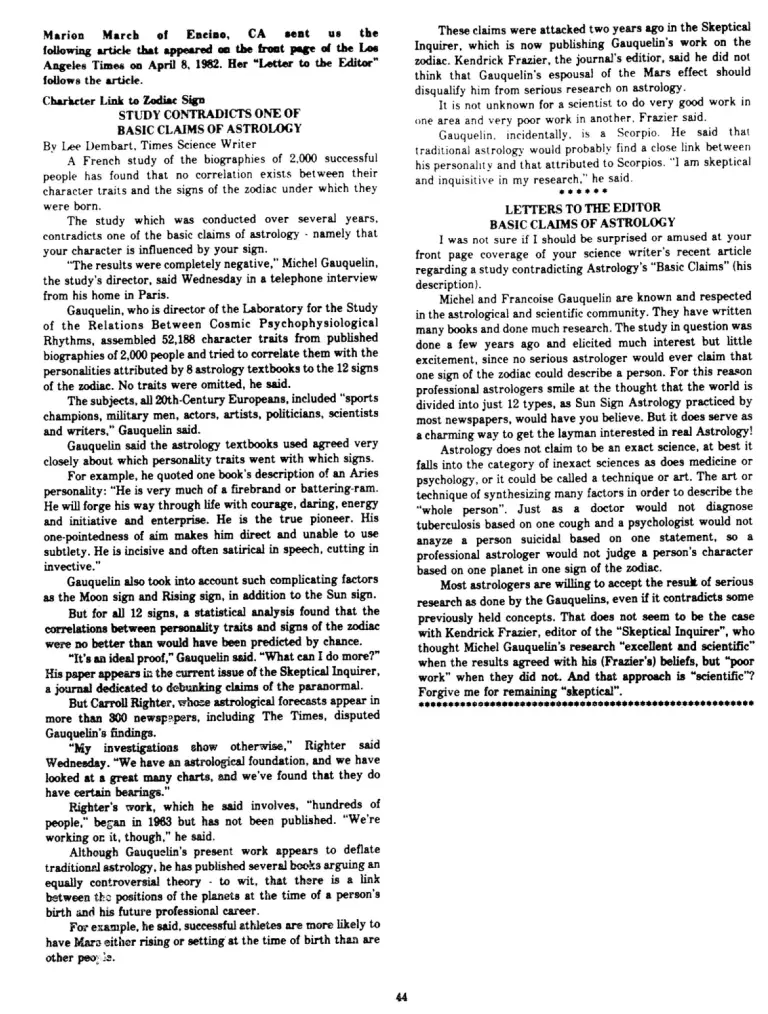
Rebuttal to Astrology Skeptic (1982)

Astrological Research, Applied Astrology, and Skepticism. This archival document features a Los Angeles Times article by Lee Dembart (April 8, 1982) detailing Michel Gauquelin’s statistical study of 2,000 biographies and 52,188 character traits, which found no correlation between personality traits and zodiac signs. The article highlights responses from syndicated astrologer Carroll Righter and Skeptical Inquirer editor Kendrick Frazier. Accompanying the piece is a published rebuttal letter by astrologer Marion D. March. March argues that serious astrological practice evaluates the whole natal chart rather than relying on isolated sun-sign interpretations, and she critiques skeptics for cherry-picking scientific research based on biased outcomes.

View
alexandria ibase astrology library

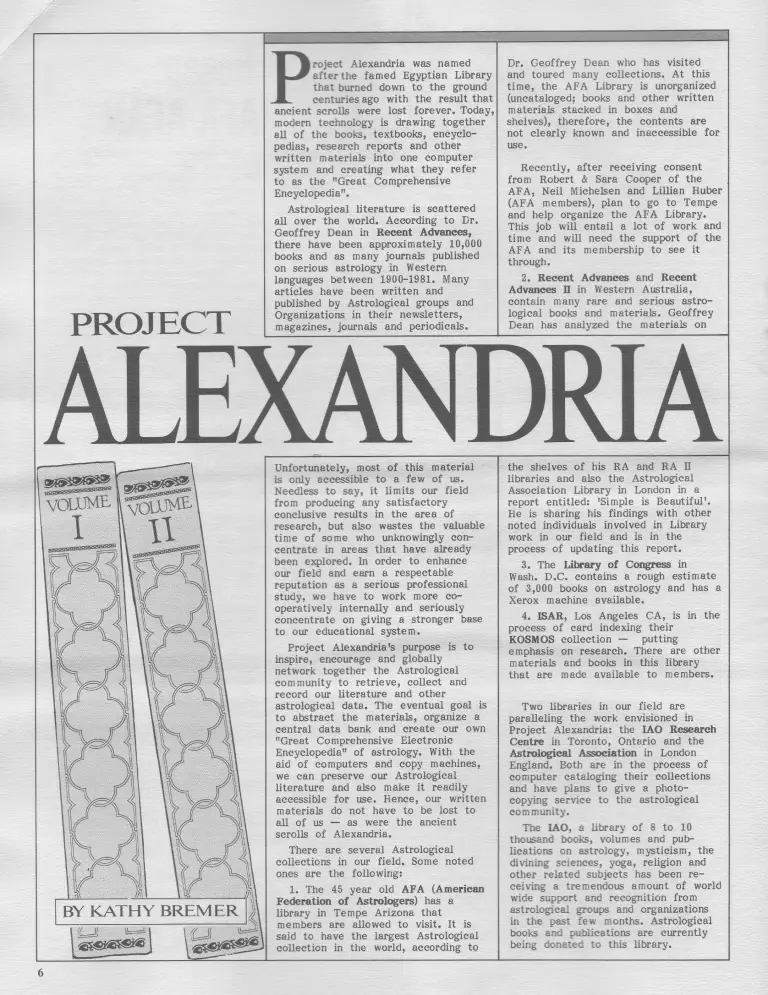
Project Alexandria (1983)

Applied Astrology, Astrological Associations, and Astrological Research. This archival document contains an article titled “PROJECT ALEXANDRIA” by Kathy Bremer, accompanied by an editorial note by Michael Erlewine, published in 1983. The text outlines an AFAN-supported initiative aimed at globally networking the astrological community to collect, digitize, and catalog astrological literature into a centralized data bank and “Great Comprehensive Electronic Encyclopedia”. Bremer reviews key international library collections—including the AFA Library in Arizona, the IAO Research Centre in Toronto, the Astrological Association in London, and ISAR’s database initiatives. Erlewine’s appended note addresses misconceptions regarding the status of the AFA library, presenting insights from Bob Cooper, Lilian Huber, and Neil Michelsen, alongside Michelsen’s proposed plan for a volunteer-led, computer-supported cataloging effort.

View

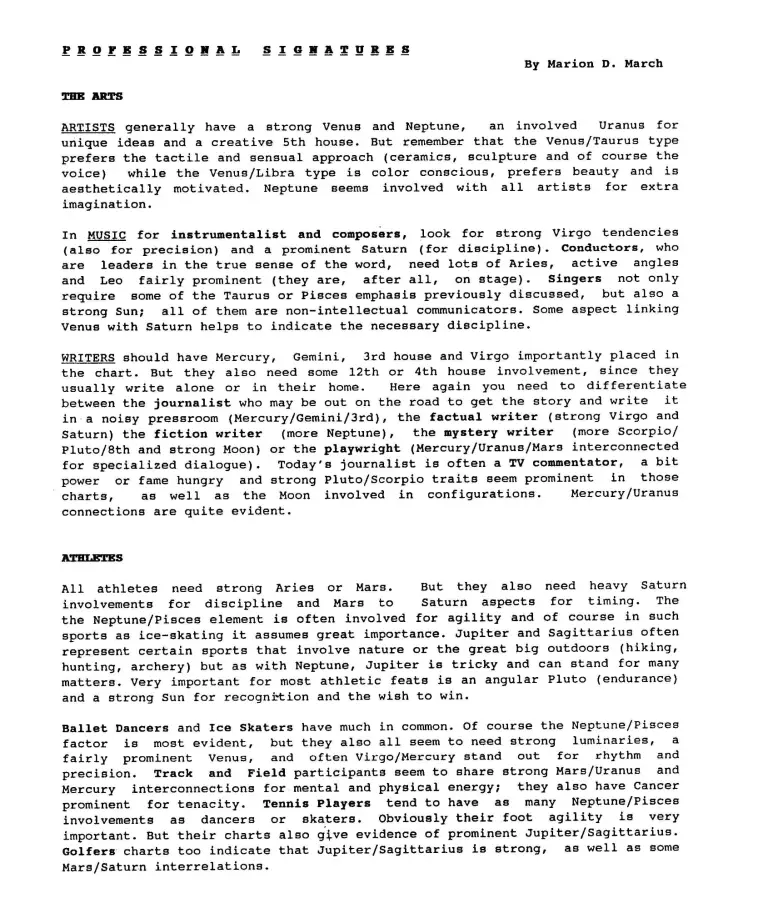
Professional Signatures

Applied Astrology, Astrological Practice, and Career Analysis. This archival document is an instructional reference guide titled “PROFESSIONAL SIGNATURES” by Marion D. March. March outlines specific planetary placement rules, zodiacal emphases, and house dynamics corresponding to various career fields. The text provides vocational indicators across multiple professions, including the arts (visual artists, composers, conductors, singers, and writers), athletics (dancers, skaters, track athletes, tennis players, and golfers), business, legal careers (criminal lawyers, judges, corporate attorneys), religion, medicine (surgeons, pediatricians, nurses, researchers), politics, acting, aviation/spaceflight, and astrology.

View

Ask A Librarian

Help

Whether you are looking for rare historical texts or trying to locate a specific book nearby, Alexandria iBase offers two primary ways to search. Here is how to choose the right tool for what you need:

The Library Catalogue

Think of this as your global master index.

The Catalogue works just like a traditional library search system, designed to help you locate books and media across the broader astrological landscape.

  • Physical Books: Find out where physical copies of books are held in libraries, archives, or collections near you.

  • Digital Files: Access downloadable or viewable digital editions when available.

  • Best Used For: Standard research, finding specific ISBNs or authors, and tracking down physical items in the real world.

Browse Catalogue

SPECIAL COLLECTIONS

Think of this as Alexandria’s exclusive private vault.

Collections gives you direct access to Alexandria’s own curated archive of rare, proprietary, and historic astrology media.

  • Exclusive Material: Features unique texts, manuscripts, audio recordings, and visual media that are not available anywhere else.

  • Direct Access: Digitized content ready to explore straight from the platform.

  • Best Used For: Deep-dive research, discovering hidden gems, and exploring rare, one-of-a-kind astrological resources.

Browse Special Collections

Cash & In-Kind Donations

Make a one-time or recurring tax deductible cash donation.

Payment options include donating directly with us, PayPal Giving and GoFundMe.

GoFundMe for Charities is registered for tax deductions and has no required processing fees. It does offer the option to tip.

Contact Us