
Medical Astrology

Medical Astrology

Medical Astrology refers to the branch of astrology that maps bodily anatomy, organ systems, and physiological vulnerabilities to planetary influences, zodiac signs, and chart houses. Operating on the principle of the Homo Signorum (Zodiac Man), which assigns the 12 signs sequentially from the head (Aries) to the feet (Pisces), this practice analyzes natal placements alongside transit timing to assess constitutional tendencies, potential imbalances, and optimal timing for treatments.

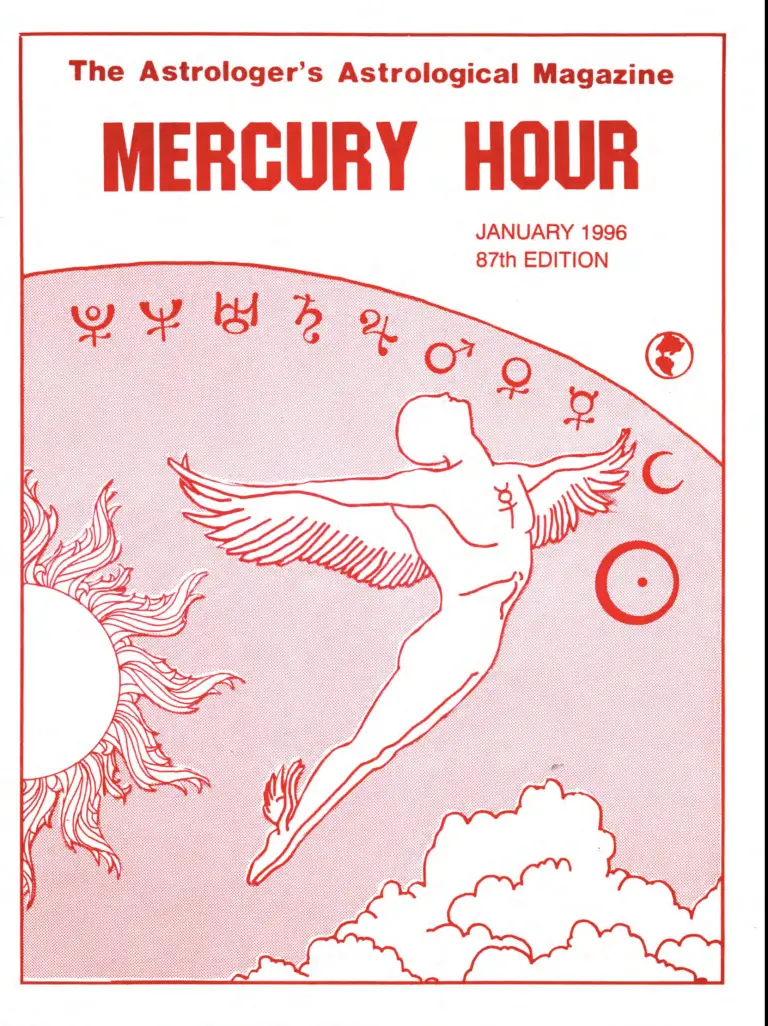
Mercury Hour 87th Edition January 1996

Mundane Astrology, Medical Astrology, and Predictive Astrology. This archival document is the 87th edition of Mercury Hour (January 1996), an astrological community journal edited and published by Edith Custer. The issue features articles, research notes, chart rectifications, software developments, and correspondence among practicing astrologers, including Bil Tierney’s psychological examination of Jupiter, Ed Dearborn’s technical breakdown of the “Translation of Light”, Valerie Vaughan’s defense of predictive astrology, Byron Ross Wahl’s analysis of the Solar Apex Synthetic Method (SASM), and the final installment of Robert “Buz” Myers’ lecture series on Moon-Saturn dynamics. Additionally, the journal covers mundane and political analyses of the O.J. Simpson verdict by John Kalus and Marion March, national chart rectifications for Washington, D.C. by Marc Penfield, insights on Uranus entering Aquarius by Kaye Shinker, medical and genetic commentary by T. Patrick Davis, software updates by Mark Pottenger, and tributes to astrologer Al H. Morrison.

Issue Highlights

Book Reviews
By Edith Custer:
Llewellyn’s 1996 Astrological Pocket Planner
Llewellyn’s Astrological Calendar 1996
Astrology Really Works by The Magi Society – Marc Penfield

Articles
A Look at Jupiter’s Shortcomings – Bil Tierney
Translation of Light – Ed Dearborn
Group Dynamics – Mary K. Creasey
Been There, Done That – Kaye Shinker
[O.J. Simpson verdict] – John Kalus
SASM, Columbus, and Samana Cay – Byron Ross Wahl
1995 Oven Saga – Roberta Strain
Moon/Saturn, Parts 7 and 8 of 8 – Robert “Buz” Myers
Winter Solstice 1995 – Dot Willis
The Art of Self-Defense: Lesson, Fighting at the Level of Your Opponent,
Part 1 of 2 – Valerie Vaughn
Al H. Morrison: Rectification, Poison Data, Genetics – T. Patrick Davis
[obituary & excerpts]
Discussions
Solar returns
O, J, Simpson trial
Chart data
(some incomplete or in question)
Powell, Colin
Washington, D.C.
Notable contributors
Donna Van Toen (various topics)
Mark Pottenger (Progressed MC techniques in software)
Marc Penfield (Chart of the U.S.A.)
Lee Lehman (corrections to Essential Dignities)
Marion March (O. J. Simpson trial, Chaos Theory, Solar Returns)
View

Fertility, Infertility and Astrology (1991)


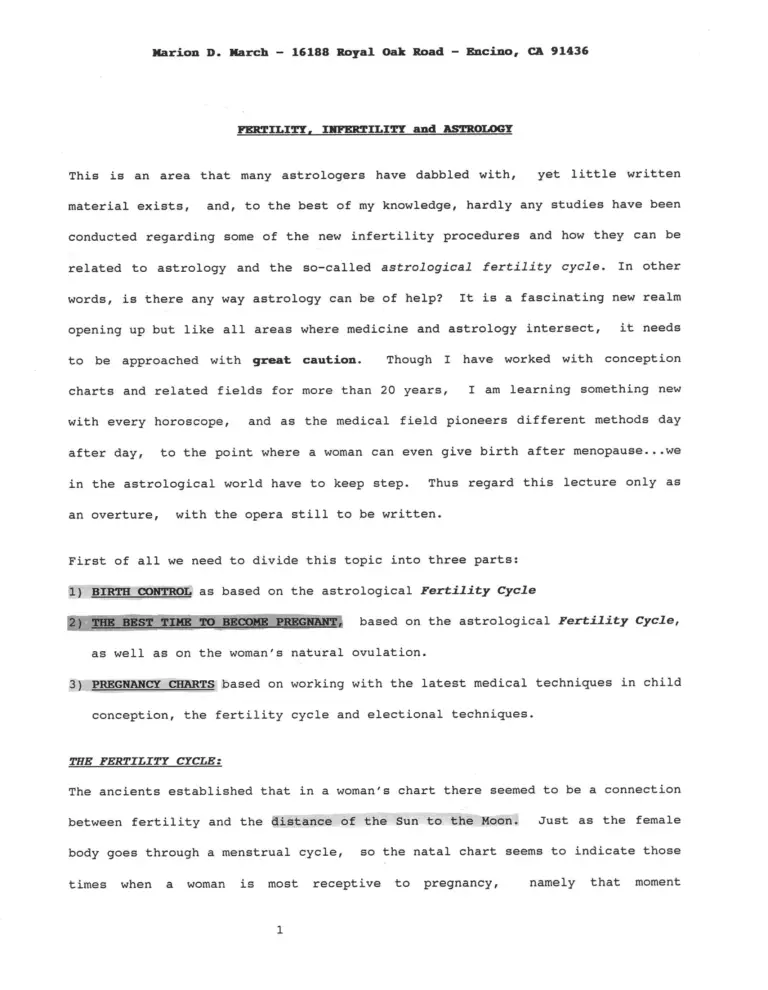
Fertility Astrology, Medical Astrology, Electional Astrology. This archival document is a lecture manuscript titled “FERTILITY, INFERTILITY and ASTROLOGY” by Marion D. March, dated around 1991 to 1996. March expands upon her research into Dr. Eugen Jonas’s lunar-solar fertility cycle and its integration with modern reproductive medicine. She reiterates that astrological fertility cycles are highly unreliable for birth control, but serves as a powerful electional tool for timing pregnancies. The manuscript provides guidelines for electing conception windows based on applying lunar aspects, natal chart distance matching, and managing timing relative to physical ovulation and biological constraints. March addresses assisted reproductive procedures including artificial insemination, in-vitro fertilization (IVF), GIFT, and ZIFT, asserting that the critical electional moment for astrological timing occurs at embryo implantation rather than egg harvesting or fertilization. The text features technical client worksheets, correspondence, case studies, and discussions on gender prediction, lunar sign polarities, and navigating pregnancy complications.

View

Mercury Hour – 103rd Edition – January 2000

Mundane Astrology, Medical Astrology, and Astrological Techniques. This archival item is the January 2000 issue (103rd Edition) of Mercury Hour, a quarterly astrological magazine edited and published by Edith Custer in Lynchburg, Virginia. Key contents include Lorraine Welsh’s article addressing a psychiatric clinic checklist that categorized using astrology alongside mental health pathologies, Virginia Reyer’s examination of the Nodal Barrier trapped configuration across various birth charts, and Rowena Wall’s guide to relocation astrology featuring city charts for Las Vegas and Toronto. The issue features Mary Downing’s eclipse watch report on the January 20 lunar eclipse and February 5 solar eclipse, Arlene Marcia Nimark’s “Tidbits and Obits” column detailing charts for public figures including Placido Domingo, Catfish Hunter, and Lance Armstrong, and Guy de Penguern’s medical astrology study on Chiron keywords and planetary sendings. Additional contributions include reviews of books by Terry Lamb and Bil Tierney, alongside reader discussions on Y2K, solar flares, Chaos Theory, the Bible Code, and chart data for figures such as John F. Kennedy Jr. and Dr. Jack Kevorkian.

Issue Highlights
Book Reviews
By Lorraine Welsh:
Born to be Together: Love, Relationships, Astrology, and the Soul by Terry Lamb
Daily Planetary Guide 2000 by Llewellyn Publications
***
Alive and Well with Uranus by Bil Tierney – Edith Custer
Articles
Fear Abandonment, Use Astrology, Cut Wrist: The faces of prejudice
– Lorraine Welsh
Passport to Good Visiting – Rowena Wall
Trapped Configuration, also called the Nodal Barrier – Virgina Reyer
Tidbits and Obits – Marcia Nimark
Eclipse Watch [Jan 20 and Feb 5, 2000] – Mary Downing
Discussions
August 1999 Eclipse
Chart of Jack Kevorkian
Chaos Theory
War of 1812
Black Moon Lilith
Chart data
(some incomplete or in question)
Armstrong, Lance
Bessete, Carolyn
Bradley, Bill
Cullberg, Birgit
Domingo, Placido
Exner, Judith Campbell
Gore Jr., Al

Hardin, Louis “Moondog”
Hunter, Catfish
Kevorkian, Jack
McCain, John
Mraz, Charles
Mussolini, Benito
Parker Bowles, Camilla

Rimes, LeeAnn
Sarraute, Nathalie
Schoen, Leonard S.
Starr, Ringo
Weill, Kurt

New York City Subway opening
Saturday Night Live (debut)
Las Vegas, Nevada
Toronto, Ontario, Canada
Notable contributors
Bil Tierney (new books in his Alive and Well trilogy)
Marion March (birth data; books on Progressions)

View

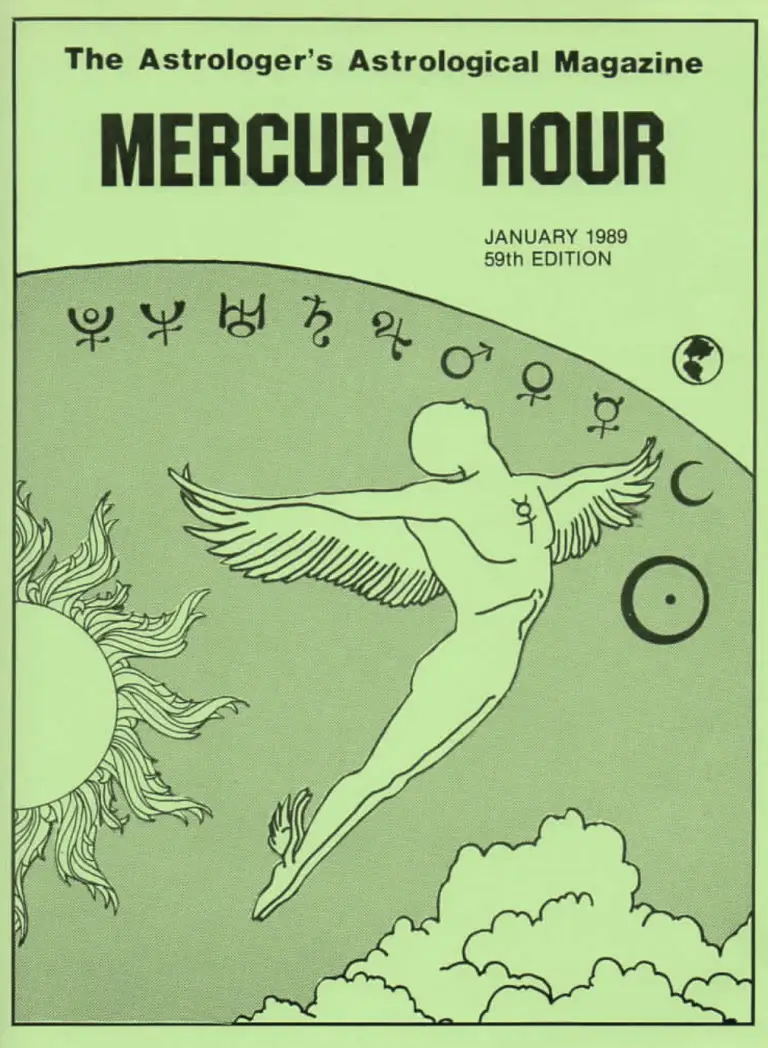
Mercury Hour 59th Edition January 1989

Mundane Astrology, Astrological Techniques, and Medical Astrology. This archival item is the January 1989 issue (59th Edition) of Mercury Hour, a quarterly astrological magazine edited and published by Edith Custer in Lynchburg, Virginia. Key contents include Don Borkowski’s “A Cynic’s Centiloquy” presenting a hundred-point philosophical guide to astrological practice, Edward Dearborn’s application of horary rules to personal event charts, Joyce Wehrman’s key phrases for transiting aspects, and Robert Cole’s critique of astrological counseling. The issue features Carolyn H. Caufman’s investigation into the true birth year and history of Wallis Simpson (Duchess of Windsor), John Kalus’s analysis of Ted Bundy’s “Viper’s Nest” chart pattern, Guy de Penguern’s research on an AIDS/HIV+ oncogene signature, and Marc Penfield’s “Chart Mart” data collection for political figures including George Bush, Michael Dukakis, Lloyd Bentsen, and Mikhail Gorbachev. Additional contributions cover a debate between Michael Munkasey and Dennis Frank over the exact founding moment of the United States, Dorothy S. Willis’s geocentric and heliocentric weather forecasts for the 1988 Winter Solstice, and reader discussions on software reviews, progressions, and local space charts.

Issue Highlights

Book Review

Astrology, The Classic Guide to Understanding Your Horoscope by Ronald C.Davison – Marguerite Dar Boggia

Articles

Salem, or A Cynic’s Centiloquy – Don Borkowski

Horary Techniques Applied to Personal Events – Edward Dearborn

Another Asteroid Turned Comet – Richard A. Kerr [Chiron}

Against Astrological Counseling – Robert Cole

Will the Real Duchess of Windsor Stand Up – Carolyn H. Caufman

Moving to Paradise – Marc Penfield

Joyce’s Key Phrases for Transiting Aspects – Joyce Wehrman

Ted Bundy’s “Viper’s Nest” Chart Pattern – John Kalus

Discussions

Calculating progressions/progressed houses

Speculative chart for Mikhail Gorbachev

Winter Solstice 1988 weather predictions

Charts of the U.S.A.

Scientists/Humanists vs. Astrology

Heliocentric charts

Prenatal eclipse

AIDS/HIV+ oncogene

AFA Las Vegas Convention report

U.S.A. Election 1988

UNOCAL management changes

Chart of Ronald Reagan

Local Space charts

Chart data

(some incomplete or in question)

Gorbachev, Mikhail
Simpson, Wallis

Individuals involved in Jack the Ripper case

Carmel, CA

Pacific Grove, CA

U.S. Constitution

Marx Penfield’s Chart Mart charts

Crane, Cheryl
Crockett, Davy
Hepburn, Katherine
Shearer, Norma

Windsor, Duchess of (wife of Edward VIII)

Bentsen, Lloyd
Borge, Victor
Burton, Richard
Bush, George
Dukakis, Kitty
Dukakis, Michael
Holmes, John
Quigley, Joan

Notable contributors

Michael Munkasey (Chart of the U.S.A.)

Al H. Morrison (Neptune aspects; shamanism; timing of horary questions)

Jim Lewis (1988 U.S.A. election)

Marion March (C-Sections; Chiron; chart of Jesse Jackson)

View

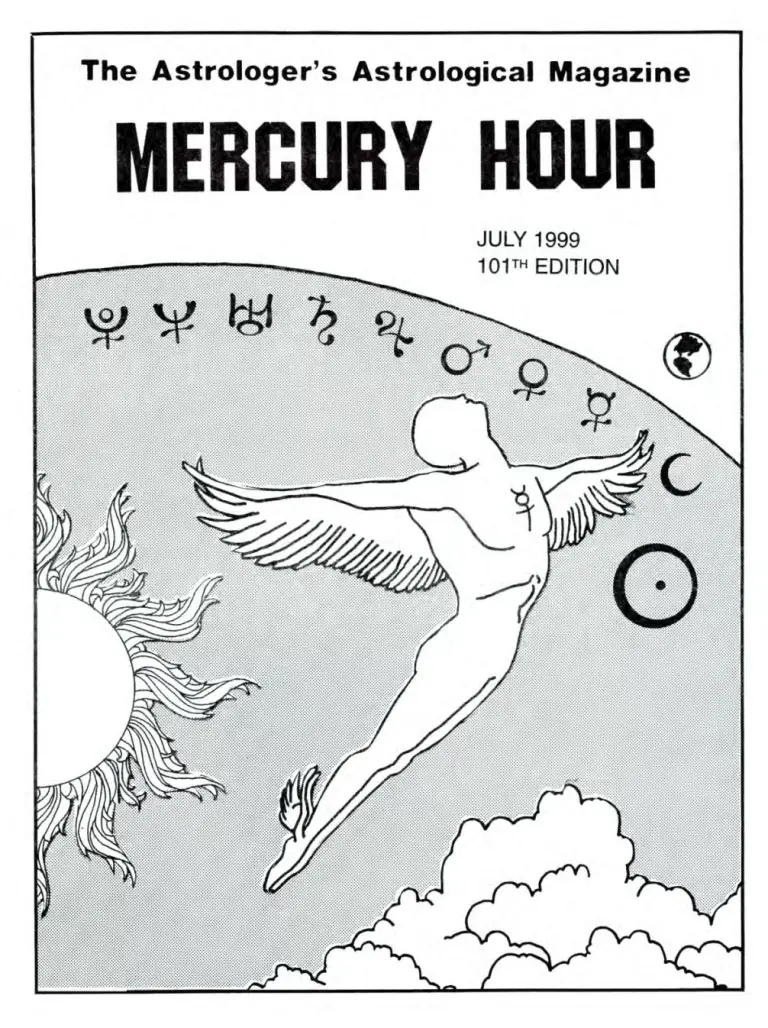
Mercury Hour 101st Edition (A) July 1999

Medical Astrology, Mundane Astrology, and Astrological Technique. This archival item is the July 1999 issue (101st Edition) of Mercury Hour, an astrological periodical edited and published quarterly by Edith Custer in Lynchburg, Virginia. Featured contributions include the second installment of Guy de Penguern’s course on 21st-century medical astrology focusing on genetic predispositions to cancer and amino acids, Virginia A. Reyer’s technical guide to calculating and interpreting the Vertex/Anti-Vertex axis alongside a chart analysis of Jack Kevorkian, Mark Pottenger’s mathematical correction regarding the Equation of Time and Local Apparent Time in computer software, and excerpts from Robert P. Blaschke’s treatise on progressions. Additional community discussions cover out-of-bounds planets, solar return methodologies, debates on geographic versus geocentric latitude, and classifications of the three distinct Liliths (Dark Moon, Asteroid, and Black Moon). The issue also preserves mundane astrological commentary on late-1990s events, including the Kosovo conflict and Slobodan Milosevic’s birth data, Y2K software preparedness, the August 1999 Fixed Grand Cross eclipse, and verification efforts regarding natal data for the Columbine High School shooting perpetrators.

Issue Highlights 

Articles

21st Century Medical Astrology Course, Part 2 of 3 – Guy de Penguern [extract]

The Case of the Clock Dial – Mark Pottenger

Jack Kevorkian, Part 2 of 2 – Virginia A. Reyer

“Mutable Dilemma”: Do You Mean Apparent? [Apparent vs. Mean Time]

– Mark Pottenger

Discussions

Chart of Bill Clinton

The three Liliths

Astrology & fertility

Solar returns

August 1999 Grand Cross & eclipse

The Vertex

The true “Blue Moon”

Charles Keating event/diurnal chart

Declinations/out-of-bounds planets

Equation of Time in chart calculations

Geocentric vs. heliocentric latitude

Chart data

(some incomplete or in question)

Harris, Eric

Hussein, Saddam

Klebold, Dylan

Milosevic, Slobodan

Nicholson, Jack 

Notable contributors

Marion March (astrology & fertility)

Robert Blaschke (Astrology: A Language of Life; Volume I – Progressions [excerpt])

View

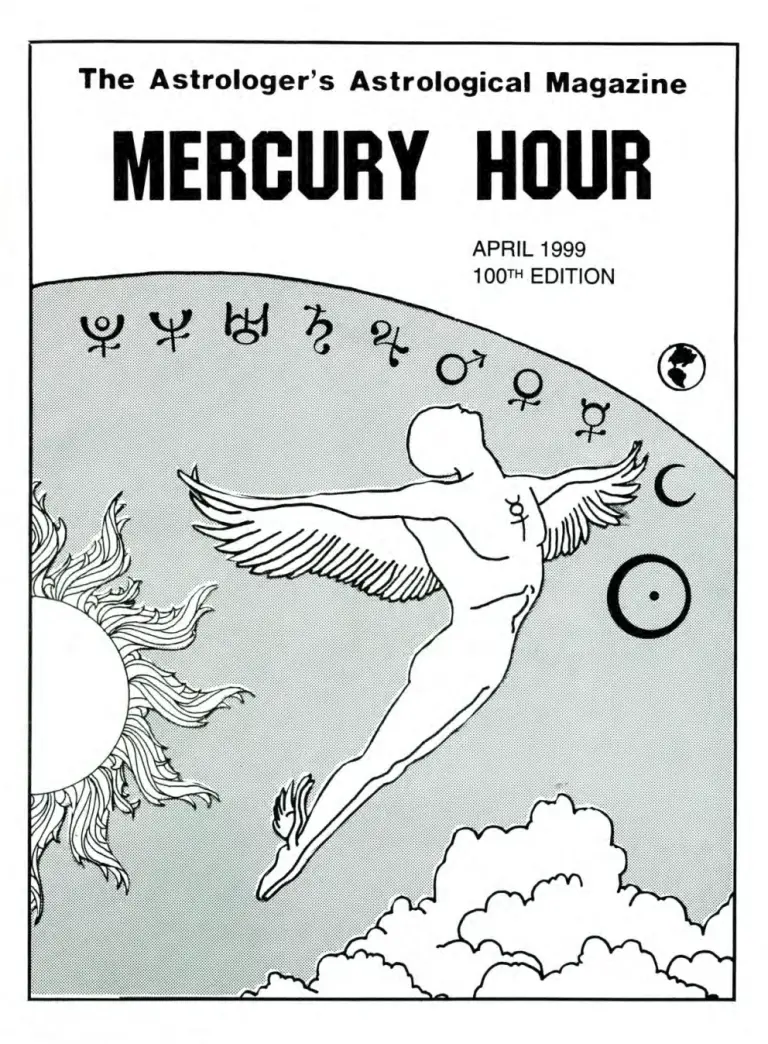
Mercury Hour 100th Edition April 1999

Medical Astrology, Mundane Astrology, and Fixed Stars serve as the primary focus areas of this historical astrological literature. This archival item is the April 1999 issue (100th Edition) of Mercury Hour, a long-running quarterly astrological magazine edited and published by Edith Custer in Lynchburg, Virginia. The issue highlights the first installment of Guy de Penguern’s course on 21st-century medical astrology and genetic astrophysics, a review of Enrique Linares’s A Scientific Approach to the Metaphysics of Astrology by Marguerite dar Boggia, Virginia A. Reyer’s study on fixed stars and health, and Dorothy J. Sarka’s examination of the I Ching. Additionally, the issue documents extensive reader discussions on political horoscopes and current events, including the Bill Clinton impeachment, Y2K software predictions, the 1999 Israeli election, and natal chart data for prominent figures such as Jesse Ventura and Ehud Barak.

Issue Highlights

Book Review

A Scientific Approach to the Metaphysics of Astrology by Enrique Linares

– Marguerite der Boggia

Articles

21st Century Medical Astrology Course, Part 1 of 3 – Guy de Penguern [extract]

Fixed Stars, Part 2 of 2 – Virgina A. Reyer

The Hidden Code of the I Ching – Dorothy J. Sarka

Discussions

Ken Starr/Bill Clinton impeachment

Chart of Bill ClintonU.S. Declaration of Independence
W.H. Chaney/Jack London

Astro-Twins (examples)

Asteroid rulership/association

Moon Out-of-Bounds

Israel election 1999

Y2K

August 1999 Grand Cross eclipse

August 1998 eclipse effect on Russia

Sun/Moon angle and conception

Chart data

(some incomplete or in question)

Barak, Ehud

Bush, George

Chaney, William

Hand, Rob

Jayne, Charles

Keller, Helen

Netanyahu, Benjamin

Rose, Buddy “Playboy”

Ventura, Jesse

Russia

Notable contributors

Marion March (various topics)

View

Ask A Librarian

Help

Whether you are looking for rare historical texts or trying to locate a specific book nearby, Alexandria iBase offers two primary ways to search. Here is how to choose the right tool for what you need:

The Library Catalogue

Think of this as your global master index.

The Catalogue works just like a traditional library search system, designed to help you locate books and media across the broader astrological landscape.

  • Physical Books: Find out where physical copies of books are held in libraries, archives, or collections near you.

  • Digital Files: Access downloadable or viewable digital editions when available.

  • Best Used For: Standard research, finding specific ISBNs or authors, and tracking down physical items in the real world.

Browse Catalogue

SPECIAL COLLECTIONS

Think of this as Alexandria’s exclusive private vault.

Collections gives you direct access to Alexandria’s own curated archive of rare, proprietary, and historic astrology media.

  • Exclusive Material: Features unique texts, manuscripts, audio recordings, and visual media that are not available anywhere else.

  • Direct Access: Digitized content ready to explore straight from the platform.

  • Best Used For: Deep-dive research, discovering hidden gems, and exploring rare, one-of-a-kind astrological resources.

Browse Special Collections

Cash & In-Kind Donations

Make a one-time or recurring tax deductible cash donation.

Payment options include donating directly with us, PayPal Giving and GoFundMe.

GoFundMe for Charities is registered for tax deductions and has no required processing fees. It does offer the option to tip.

Contact Us