Mundane Astrology

Mundane Astrology

Mundane Astrology refers to the branch of astrology dedicated to forecasting world events, politics, nations, socio-economic trends, and natural phenomena rather than individual human lives. Named from the Latin mundus (world), this practice analyzes national birth charts, ingress charts, eclipses, and outer-planet cycles to assess shifts in global power, financial markets, public health, and societal movements.

The Great Jupiter-Saturn Conjunction (1980)

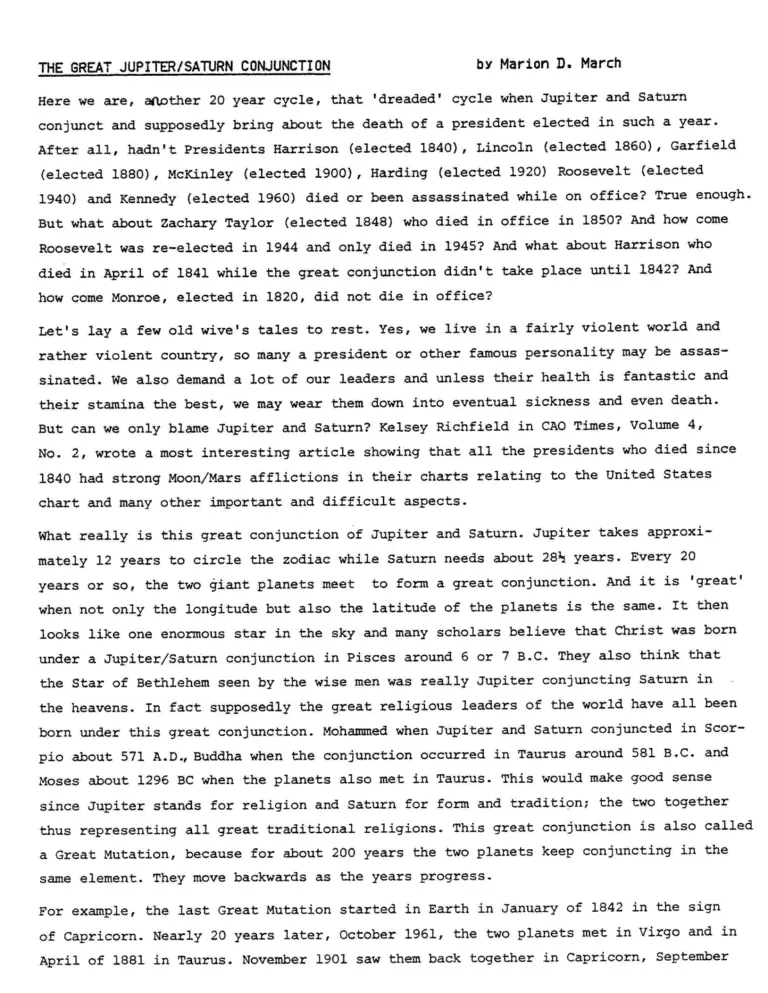
Jupiter-Saturn Conjunction, Mundane Astrology, and Timing Techniques. This archival document is an analytical study titled “THE GREAT JUPITER/SATURN CONJUNCTION” by Marion D. March. March examines the historical, political, and cultural significance of the 20-year Jupiter-Saturn conjunction cycle and the 200-year elemental transitions known as Great Mutations. She analyzes the 1980 to 1981 triple conjunction in Libra as a transitional bridge from Earth element cycles to Air element cycles, outlining its long-term societal, technological, and economic implications. The text includes an international reference table cross-referencing natal chart aspects and angular placements for 168 independent nations and world leaders, supplemented by Jim Lewis’s AstroCartoGraphy maps to track global planetary influences. 


View

Mundane Lessons

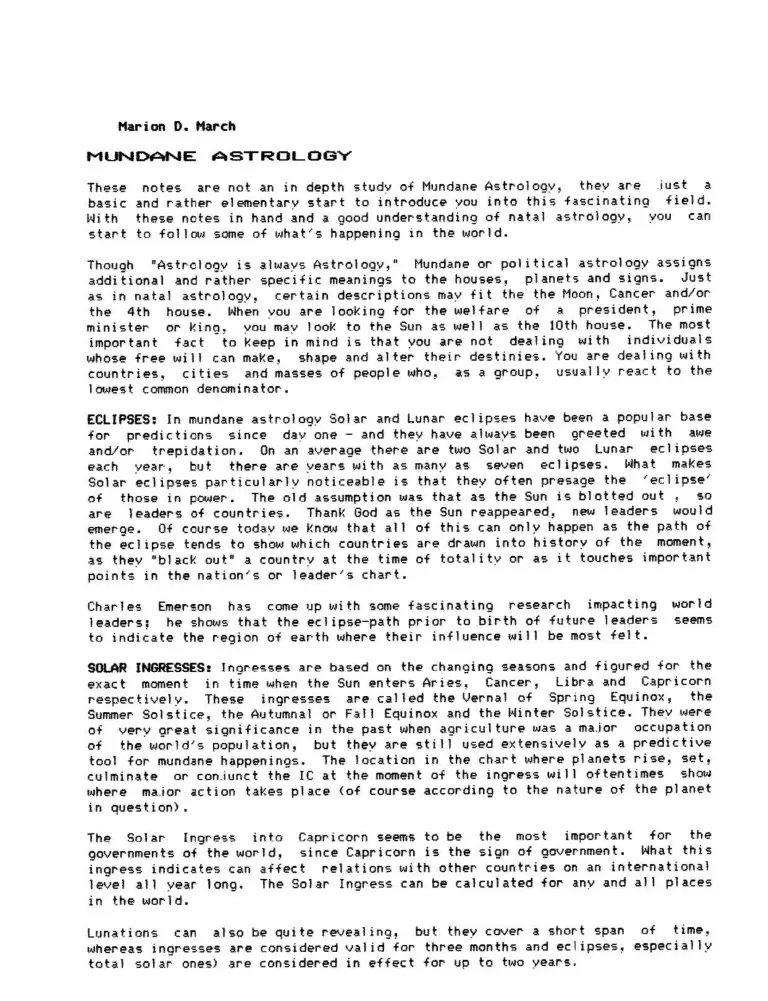
Mundane Astrology, Political Astrology, and Predictive Astrology. This archival document is an introductory reference guide titled “MUNDANE ASTROLOGY” by Marion D. March. March details the principles and interpretive rules of political and mundane astrology, which applies astrological symbolism to nations, cities, and mass populations rather than individuals. She outlines key predictive timing frameworks, including Solar and Lunar eclipses, Lunations, and Solar Ingresses—highlighting the Capricorn Ingress as particularly critical for world governments and international relations. The text provides extensive, specialized mundane definitions for all twelve astrological houses, the ten primary planetary bodies, and the twelve zodiac signs. March categorizes their specific applications across political structures, economic indicators, societal movements, agricultural conditions, international diplomacy, labor relations, intelligence agencies, and meteorological phenomena.

View

Mercury Hour Magazine 13th Edition April 1977

Synastry, Mundane Astrology, and Astrological Research. This archival document is the 13th Edition of Mercury Hour (April 1977), an open-forum astrological journal edited and published by Edith Custer. The issue features technical articles, research methodologies, chart comparisons, and correspondence among practicing astrologers. Key contributions include Stephen Arroyo’s introductory guide to synastry and planetary house overlays, Dr. Robert H. Goodrich’s analysis of Saturn in the 7th and 8th houses alongside an electional and mundane evaluation of the 1976 U.S. presidential election, Ray Merriman’s series on pre-natal and transiting solar eclipses, Ingrid Naiman’s critical review of statistical controls in medical astrology and cancer research, and Jeff Jawer’s system of zodiacal numbering. Additional features include Marc Penfield’s essays on Saturn delays and past-life indicators, Glenda Tomosovich’s framework for aspect dynamics, Prem H. Joshi’s astrological review of Admiral Richard E. Byrd’s autobiography Alone, Joseph Goodavage’s rebuttal to scientific skeptics regarding time-twin statistics, and ongoing discussions surrounding proposed natal charts for Jesus.

Issue Highlights

Articles:
Zodiacal Numbering – Jeff Jawar

Saturn in the Houses
 (continuation) – Dr. Robert H. Goodrich Saturn
– Marc Penfield

A Key to Relationships
 [The Art of Chart Comparison]- Introduction
– Stephen Arroyo

Eclipses
 – Ray Merriman (first part in a series)

Some Notes on Astrological Research
 – Ingrid Naiman Reincarnation
– Marc Penfield

The Zodiac of Aspects
 (first of a two-part series) – Glenda Tomosovich

Astrological Review of an Autobiography
 [Alone by Admiral Richard E. Byrd]
– Prem H. Joshi

The People’s Choice…A Different View of the Next Four Years

– Dr. Robert H. Goodrich

Discussions:

Saturn in the 1st and 6th houses
House systems
Horoscope of Jesus
Aspects of artistic genius

Notable contributors:
Marion March (various topics)
Zip Dobyns (various birthcharts)

Chart data:
(some in complete or in question)

Bob Dylan
Thor Heyerdahl
OJ Simpson
Omar Sharif
Ethel Kennedy
Jerry Brown (birth time only)

View

Mercury Hour Magazine – 4th Edition January 1975

House Systems, Mundane Astrology, and Astrological Techniques. This archival document is the 4th Edition of Mercury Hour (January 1975), an open-forum astrological journal edited and published by Edith Custer. The issue brings together prominent mid-20th-century astrologers to debate chart construction techniques, planetary rulerships, sensitive mathematical points, and practical counseling philosophies. Key technical contributions include Michael Munkasey’s classification of 23 house systems and introduction of the Arcturan system, Dr. James T. Hayes’s critique of cause-and-effect determinism and traditional dignities, Ivy M. G. Jacobson’s guide to L. Edward Johndro’s Birth Locality Charts, Inge Aach’s demonstration of 90-degree dial midpoint analysis using Henry Kissinger’s chart, and Ruth Dewey’s research on the Vertex. Additional discussions cover Carl Payne Tobey’s Astrology of Inner Space, Stephen Arroyo on Mars in Scorpio medical correlations, Zip Dobyns’s announcement of International Astrological Abstracts, and Isabel Hickey’s biographical account of her spiritual astrological practice.

Issue Highlights

Articles:

House Systems – Michael Munkasey

Four Questionable Practices of Astrologers – Dr. James T. Hayes

Excerpt from Foundation of the Astrological Chart – Ivy Jacobson (Johndro Locality Charts)

The Cosmic Structure – Inge Aach (continuation of the Cosmobiology Series)

The Vertex (series continuation) – Ruth Dewey

Discussion:

Carl Payne Tobey’s Astrology of Inner Space (various contributors)

Chart data:

(some in question or incomplete)

Gerald Ford
Muhammed Ali
James Dean
Marlon Brando
Clark Gable
Henry Kissinger

Notable contributors:

Stephen Arroyo (Mars in Scorpio; Polarity Therapy)

Zip Dobyns (formation of International Astrological Abstracts – IAA)

Isabel Hickey (short bio & involvement in astrology)

View

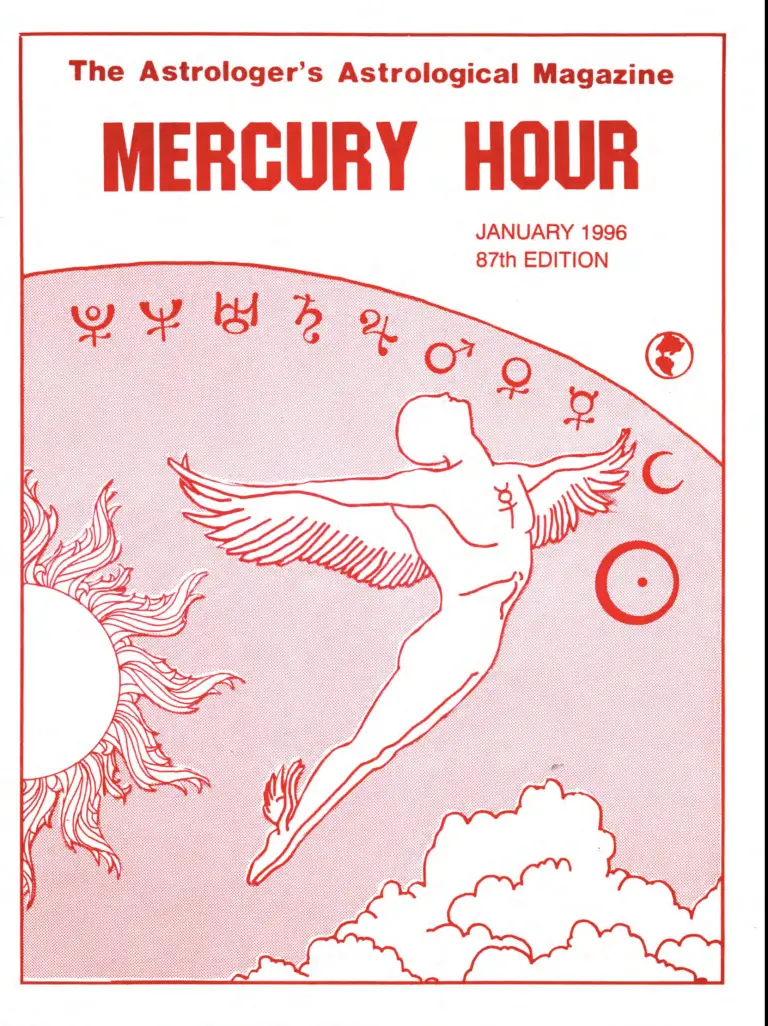
Mercury Hour 87th Edition January 1996

Mundane Astrology, Medical Astrology, and Predictive Astrology. This archival document is the 87th edition of Mercury Hour (January 1996), an astrological community journal edited and published by Edith Custer. The issue features articles, research notes, chart rectifications, software developments, and correspondence among practicing astrologers, including Bil Tierney’s psychological examination of Jupiter, Ed Dearborn’s technical breakdown of the “Translation of Light”, Valerie Vaughan’s defense of predictive astrology, Byron Ross Wahl’s analysis of the Solar Apex Synthetic Method (SASM), and the final installment of Robert “Buz” Myers’ lecture series on Moon-Saturn dynamics. Additionally, the journal covers mundane and political analyses of the O.J. Simpson verdict by John Kalus and Marion March, national chart rectifications for Washington, D.C. by Marc Penfield, insights on Uranus entering Aquarius by Kaye Shinker, medical and genetic commentary by T. Patrick Davis, software updates by Mark Pottenger, and tributes to astrologer Al H. Morrison.

Issue Highlights

Book Reviews
By Edith Custer:
Llewellyn’s 1996 Astrological Pocket Planner
Llewellyn’s Astrological Calendar 1996
Astrology Really Works by The Magi Society – Marc Penfield

Articles
A Look at Jupiter’s Shortcomings – Bil Tierney
Translation of Light – Ed Dearborn
Group Dynamics – Mary K. Creasey
Been There, Done That – Kaye Shinker
[O.J. Simpson verdict] – John Kalus
SASM, Columbus, and Samana Cay – Byron Ross Wahl
1995 Oven Saga – Roberta Strain
Moon/Saturn, Parts 7 and 8 of 8 – Robert “Buz” Myers
Winter Solstice 1995 – Dot Willis
The Art of Self-Defense: Lesson, Fighting at the Level of Your Opponent,
Part 1 of 2 – Valerie Vaughn
Al H. Morrison: Rectification, Poison Data, Genetics – T. Patrick Davis
[obituary & excerpts]
Discussions
Solar returns
O, J, Simpson trial
Chart data
(some incomplete or in question)
Powell, Colin
Washington, D.C.
Notable contributors
Donna Van Toen (various topics)
Mark Pottenger (Progressed MC techniques in software)
Marc Penfield (Chart of the U.S.A.)
Lee Lehman (corrections to Essential Dignities)
Marion March (O. J. Simpson trial, Chaos Theory, Solar Returns)

View

House Meanings for Organizational Charts

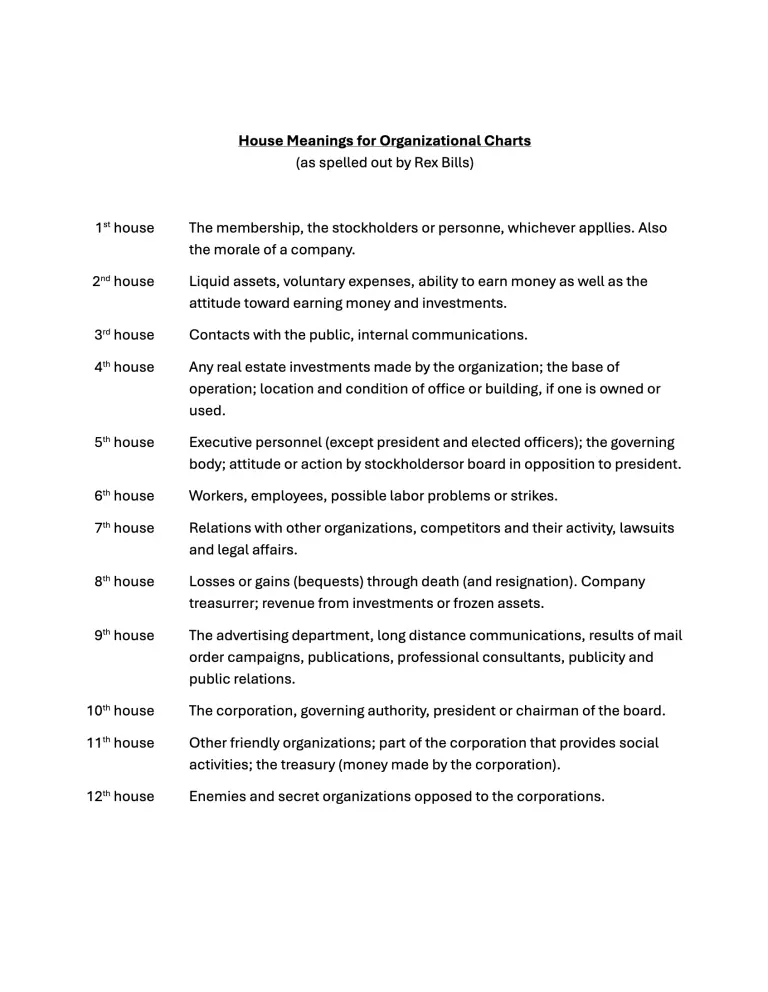
Business Astrology, Mundane Astrology, and Houses. This archival document is a concise reference guide titled “House Meanings for Organizational Charts” based on the work of Rex E. Bills. The sheet delineates specific corporate and institutional definitions for each of the twelve astrological houses. It assigns distinct corporate functions to houses: the 1st for membership morale and personnel, 2nd for liquid assets, 3rd for internal communications and public contacts, 4th for physical facilities and real estate, 5th for executive governance and board-president relations, 6th for workers and labor relations, 7th for competitors and legal affairs, 8th for corporate treasure and frozen assets, 9th for advertising, publicity, and public relations, 10th for executive leadership and corporate authority, 11th for treasury revenues and allied groups, and 12th for hidden opposition or hostile entities.

View

Astrology in America Today (1994)

US Astrology, Astrological Techniques, and Mundane Astrology. This archival document is a lecture transcript titled “Astrology in America Today” delivered by Marion D. March in April 1994. March analyzes the state of American astrology through the lens of the U.S. Gemini Ascendant national horoscope. She explores how the diverse, eclectic American mindset fosters innovation in techniques—ranging from midpoints, local space, heliocentric astrology, and Horary revival to computerized databases (IDEA, Steinbrecher), financial astrology, and historical translations (Project Hindsight). Additionally, she details the impact of technology, 900-numbers, experiential astrology, conference models (UAC), and systemic industry challenges, including lack of standardized certification, resistance to licensing, legal restrictions across local jurisdictions, and practitioner “poverty consciousness.”

View

Mercury Hour 53rd Edition April 1987

Mundane Astrology, Predictive Astrology, and Astrology History. This archival item is the April 1987 issue (53rd Edition) of Mercury Hour, a quarterly magazine edited by Edith Custer and Jewell Cook-Fahey in Lynchburg, Virginia. Key contents include Dorothy Willis’s astro-meteorological forecasts for the 1987 Vernal Equinox, Ann Kreilkamp’s analysis of the Saturn-Uranus conjunction in Sagittarius, and Sigvard Mahlerdam’s study of the Aztec Tonalpohualli prophecy calendar. Additional features include Marc Penfield’s chart rectifications for U.S. historical events and San Francisco tragedies, Stephen Brown’s analysis of the Hiroshima atomic bombing, Charlotte Tuton’s speculative chart for Sunny Von Bulow using the Wynn Key Cycle method, book reviews by Marion March, technical columns by Ted George and Howard Stephen Berg, an exchange between Thomas G. Shanks and Jack F. Chandu on international time data, and birth chart data for figures in the Iran-Contra scandal.

[Note: this issue is missing pages 31-32, which, according to the index, was an
advertisement for the Seven Hills Astrology Conference.]
Issue Highlights
Book Reviews
By Marion March
Your Fertile Hours – Emily Faugno
The Book of Houses – Robert Cole
Life Clock, Volume II – Bruno and Louise Huber
The Twelve Healers of the Zodiac, The Astrology Handbook of the Bach Flower
Remedies – Peter Damian
The Art of Chart Interpretation – Tracy Marks
Astrological Megatrends 1996 – Edward J. Kluska
Your Greatest Strength – Grant Lewi
***
A Graphic Ephemeris of Sensitive Degrees – Eleanor Bach by Rochelle Gordon
Delineation of Progression – Sophia Mason by Jorja Brentwood
Articles
Astrology and the Weather, Vernal Equinox 1987 – Dorothy Willis
Unreliable Data in “The International Atlas” – Thomas G. Shanks [from Jack F.
Chandu]
Saturn/Uranus in Sagittarius: Conceptual Repatterning – Ann Kreilkamp
TONALPOHUALLI, The Prophecy Calendar of the Aztecs, Part I – Sigvard Mahlerdam
The Heart Center Library – Michael Erlewine
Art and Astrology – Ellen Price
Prospects for a Golden Age – E. Alan Meece
Astrology and the Weather, Forecasting the Weather – Dorothy Willis
Sideral Astrology: Influence of the Houses, Part II – Keven W. Barrett
Relationships and Astrology, Part II – Klara Henderson [Reprinted from “Astrology”]
Tragedies in San Francisco – Marc Penfield
The World’s Biggest Franchise – Marc Penfield
Tourette Syndrome, A Bewitching Disease – Ted George
Down to Earth Astrology [statistics]– Howard Stephen Berg [column]
Astrological Bible Quotes – Elizabeth McCumsey
The Progressed Horoscope of the United States of America, Part I – Marc Penfield
Hiroshima – Stephen Brown
The Language of Astrology – Mindy Krupp
Page 1 of 2

Articles (continued from previous page)
Sunny Von Bulow’s Chart, A Modest Speculative Proposal and The Wynn Key Cycle
Formula, A Valuable Predictive Tool – Charlotte Tuton
Numerology and the Names of Cities – Marc Penfield
Reagan’s Real Ascendant?, Part II – John Kalus
Reinterpreting the Basics, Part II – John H. Roth, Jr.
Lunar Notes – Wendy Hawks
Astrology in Brazil – Jeff Jawer
Discussions
First of the year Ephemeris for the Christian Era.
Astrological correspondences of chemical elements, glands, health conditions.
Neptune.
Eli Cohen, Israeli spy.
Astrological weather forecasting in the Southern Hemisphere.
Mass/serial killers.
The Pymander and Hermes-Thoth.
AFA/AFAN controversy.
Chart data
(some incomplete or in question)
Casey, William
McFarlane, Robert
Meese, Edwin
Poindexter, John
Regan, Donald T.
Schultz, George
Weinberger, Casper W.
(above charts related to Iran-Contra
scandal)
Iacocca, Lido
Knight, Ted
Lennox, Annie

Savitch, Jessica (correction)
Marc Penfield’s Chart Mart charts
Bergman, Ingrid
Eklund, Britt
Garbo, Greta
Shepherd, Cybil
Castro, Fidel
Boyd, Malcolm
Stuyvesant, Peter
City of Los Angeles

Notable contributors
Joylyn Hill (Neptune/Tarot-astrology correspondences.)
Marion March and Lillian Huber (Critique of AFA column “Basic Horoscope
Interpretation” and rebuttal from Dorothy B. Maass.)

View

Mercury Hour 47th Edition October 1985

Astrological Techniques, Astrology History, and Mundane Astrology. This archival item is the October 1985 issue (47th Edition) of Mercury Hour, a quarterly magazine edited by Edith Custer and Jewell Fahey in Lynchburg, Virginia. Key contents include technical articles such as John F. Gay, III’s guide to calculating house cusps and astronomical coordinates using scientific calculators, Joan McEvers’s second installment on interpreting Lunar Returns, and Dorothy Willis’s foundational rules for astro-meteorology. Mundane and historical pieces feature Marc Penfield’s chart rectifications for Russia’s 1917 Bolshevik Revolution and the “Chart Mart” data collection, Fran Rosen’s explorations of the Kabbalistic Tree of Life and Tarot symbolism, and Gilbert Navarro’s definition of horary astrology. Additional contributions include reviews by Marion March, reports on the 7 Hills Astrological Conference, an analysis of the 1985 Bradford football stadium fire by Olivia Barclay, and reader discussions surrounding topics such as ethics, licensing, house systems, and birth data for figures like Ronald Reagan, Mikhail Gorbachev, and Mary Baker Eddy.

Issue Highlights

Book Reviews

By Marion March:

Celestial Psychology: An Astrological Guide to Growth and Transformation by Doris A. Hebel

Astrochemistry: A Study of Metal-Planet Affinities by Nick Kellerstrom

Instant Astrology by Mary Orser, Rick and Glory Brightfield

The Astrology of Deep Space by Philip Sedgwick

Spiritual Astrology: A Layperson’s Guide to Self-Unfoldment by Jan Spiller

The Practice and Profession of Astrology by Stephen Arroyo

Birth Pattern Psychology by Tamise Van Pelt

The Astrological Prayer Book by Alda Marian Jangl
***
Your Key to Astrology [book plus] Astrological Key Cards: Planets, Signs, Houses, Aspects by Bill Hansen – Edith Custer

Articles

Astrology and the Weather – Dorothy Willis

Lunar Return Notes, Part II – Joan McEvers

Calculation Without Tables of the Julian Day & Century, Obliquity of the Ecliptic, MC, ASC, and Houses, Part I – John F. Gay, III

The Tree of Life: An Overview – Fran Rosen

Astrological Hall of Fame Awards – Fraternity for Canadian Astrologers [2nd National Conference]

Along the Tarot Path – Fran Rosen

How I Survived my Pluto Square Pluto and Other Transits – Carol Hemingway

The Luscher Color Test, A Symbolic Testing Model – Zan Key

Observations on Astrology, Original & Borrowed – John F. Gay, III

I’m Mad at You!!!! – Mary Ellen Glass

The Horoscope of Russia – Marc Penfield

Chart Mart – Marc Penfield

A Trip Round the Hawaiian Zodiac, Part II – Cheryl Niggle

Astrology and the Weather: Forecasting the Weather, Part I – Dorothy Willis

Horary Astrology: A Definition – Gilbert Navarro

The Business Cycle, Part II – Bill Hansen

Neptune, The Collective Fantasy, and Popular Music – Amy Franco

The Mystery of the Chinese Zodiac, Now Revealed for the First Time – Frank Hampton

The Qualities of Time, Part I – Tundra Wind

Discussions

Astrology, licensure, & ethics

Quadrant house systems vs. Equal Houses

Radix-based Tarot technique

Natal location in Return chart

Birth time of Ronald Reagan

Seven Hill Astrological Conference [reports]

Mercury retrograde

Chart data

(some incomplete or in question)

(see next page for Marc Penfield’s Chart Mart charts)

Anderson, Loni
Benetar, Haley (daughter of Pat Benetar)
Bowie, David
Eddy, Mary Baker
Eisenhower, Melanie (daughter of Julie Nixon and David Eisenhower)
Gorbachev, Mikhail
Jagger, Elizabeth (daughter of Mick Jagger and Jerri Hall)
Kennedy III Robert F.
Morgan, Vicki
Neves, Tancredo
Pace, Canio and Thomas (cross-year twins)
Reagan, Ronald
Schwab, Loluis and Leona (cross-year twins)
Spielberg, Max (son of Steven Spielberg and Amy Irving)Vaughn, Sarah

Frustaci sextuplets
Czar Nicholas II
Prince Henry

Air India 747 jetliner crash
Christian Science Church
Formation of the Soviet Union
Founding of Tel Aviv
Halley’s Comet return
Live Aid Concert 1985

Notable contributors

Joylyn Hill (Chart of Israel, chart of Robert E. Lee, the nature of Venus)

Olivia Barclay (astrological signature of fires and explosions)

Misty Kuceris (7 Hills Conference)

Robert Pelletier (7 Hills Conference)

Zane Stein (Solstice points, Sabian symbols)

Erin Sullivan (Mercury retrograde)

Michael and Margaret Erlewine (Matrix Heart Center)

Eleanor Bach (Marc Edmond Jones Award)

Lee Lehman (Kundalini and asteroid Sappho)
View

Mercury Hour – 103rd Edition – January 2000

Mundane Astrology, Medical Astrology, and Astrological Techniques. This archival item is the January 2000 issue (103rd Edition) of Mercury Hour, a quarterly astrological magazine edited and published by Edith Custer in Lynchburg, Virginia. Key contents include Lorraine Welsh’s article addressing a psychiatric clinic checklist that categorized using astrology alongside mental health pathologies, Virginia Reyer’s examination of the Nodal Barrier trapped configuration across various birth charts, and Rowena Wall’s guide to relocation astrology featuring city charts for Las Vegas and Toronto. The issue features Mary Downing’s eclipse watch report on the January 20 lunar eclipse and February 5 solar eclipse, Arlene Marcia Nimark’s “Tidbits and Obits” column detailing charts for public figures including Placido Domingo, Catfish Hunter, and Lance Armstrong, and Guy de Penguern’s medical astrology study on Chiron keywords and planetary sendings. Additional contributions include reviews of books by Terry Lamb and Bil Tierney, alongside reader discussions on Y2K, solar flares, Chaos Theory, the Bible Code, and chart data for figures such as John F. Kennedy Jr. and Dr. Jack Kevorkian.

Issue Highlights
Book Reviews
By Lorraine Welsh:
Born to be Together: Love, Relationships, Astrology, and the Soul by Terry Lamb
Daily Planetary Guide 2000 by Llewellyn Publications
***
Alive and Well with Uranus by Bil Tierney – Edith Custer
Articles
Fear Abandonment, Use Astrology, Cut Wrist: The faces of prejudice
– Lorraine Welsh
Passport to Good Visiting – Rowena Wall
Trapped Configuration, also called the Nodal Barrier – Virgina Reyer
Tidbits and Obits – Marcia Nimark
Eclipse Watch [Jan 20 and Feb 5, 2000] – Mary Downing
Discussions
August 1999 Eclipse
Chart of Jack Kevorkian
Chaos Theory
War of 1812
Black Moon Lilith
Chart data
(some incomplete or in question)
Armstrong, Lance
Bessete, Carolyn
Bradley, Bill
Cullberg, Birgit
Domingo, Placido
Exner, Judith Campbell
Gore Jr., Al

Hardin, Louis “Moondog”
Hunter, Catfish
Kevorkian, Jack
McCain, John
Mraz, Charles
Mussolini, Benito
Parker Bowles, Camilla

Rimes, LeeAnn
Sarraute, Nathalie
Schoen, Leonard S.
Starr, Ringo
Weill, Kurt

New York City Subway opening
Saturday Night Live (debut)
Las Vegas, Nevada
Toronto, Ontario, Canada
Notable contributors
Bil Tierney (new books in his Alive and Well trilogy)
Marion March (birth data; books on Progressions)

View

Ask A Librarian

Help

Whether you are looking for rare historical texts or trying to locate a specific book nearby, Alexandria iBase offers two primary ways to search. Here is how to choose the right tool for what you need:

The Library Catalogue

Think of this as your global master index.

The Catalogue works just like a traditional library search system, designed to help you locate books and media across the broader astrological landscape.

  • Physical Books: Find out where physical copies of books are held in libraries, archives, or collections near you.

  • Digital Files: Access downloadable or viewable digital editions when available.

  • Best Used For: Standard research, finding specific ISBNs or authors, and tracking down physical items in the real world.

Browse Catalogue

SPECIAL COLLECTIONS

Think of this as Alexandria’s exclusive private vault.

Collections gives you direct access to Alexandria’s own curated archive of rare, proprietary, and historic astrology media.

  • Exclusive Material: Features unique texts, manuscripts, audio recordings, and visual media that are not available anywhere else.

  • Direct Access: Digitized content ready to explore straight from the platform.

  • Best Used For: Deep-dive research, discovering hidden gems, and exploring rare, one-of-a-kind astrological resources.

Browse Special Collections

Cash & In-Kind Donations

Make a one-time or recurring tax deductible cash donation.

Payment options include donating directly with us, PayPal Giving and GoFundMe.

GoFundMe for Charities is registered for tax deductions and has no required processing fees. It does offer the option to tip.

Contact Us