Timing Techniques

Timing Techniques

Timing Techniques refers to the collection of astrological methodologies used to determine when specific events, psychological shifts, or life developments are most likely to manifest. Ranging from ancient Hellenistic predictive systems to modern psychological frameworks, this domain encompasses predictive tools such as transits, secondary progressions, solar arc directions, annual profections, primary directions, and return charts to track time cycles and chart activation periods across an individual’s lifetime.

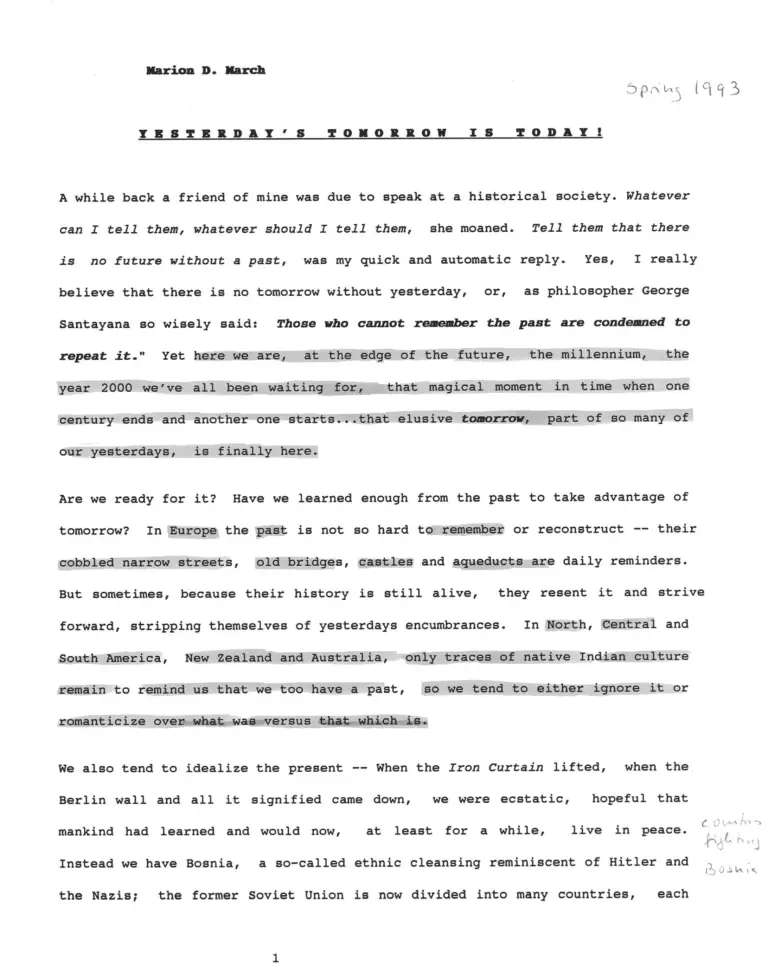
Yesterday’s Tomorrow is Today (1993)

Electional Astrology, Astrological Practice, and Timing Techniques. This archival manuscript contains the text of a lecture titled “YESTERDAY’S TOMORROW IS TODAY!” by Marion D. March (1993). March reflects on the evolution of modern astrology, evaluating how the integration of psychological principles and computing technology has transformed traditional chart interpretation. She cautions astrologers against completely discarding foundational methods, advocating for the integration of traditional timing techniques—such as electional and horary astrology—alongside modern psychological models. Additionally, March outlines upcoming societal and economic shifts, referencing the transitional outer planet transits of Uranus, Neptune, and Pluto heading into the late 1990s and 21st century.


View

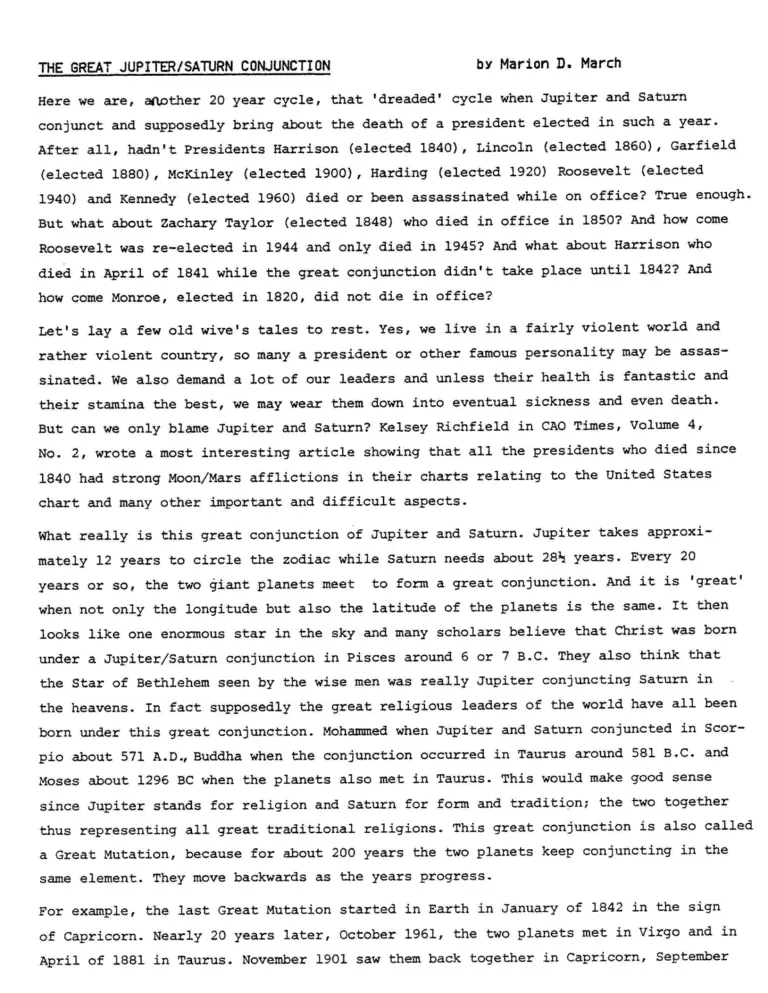
The Great Jupiter-Saturn Conjunction (1980)

Jupiter-Saturn Conjunction, Mundane Astrology, and Timing Techniques. This archival document is an analytical study titled “THE GREAT JUPITER/SATURN CONJUNCTION” by Marion D. March. March examines the historical, political, and cultural significance of the 20-year Jupiter-Saturn conjunction cycle and the 200-year elemental transitions known as Great Mutations. She analyzes the 1980 to 1981 triple conjunction in Libra as a transitional bridge from Earth element cycles to Air element cycles, outlining its long-term societal, technological, and economic implications. The text includes an international reference table cross-referencing natal chart aspects and angular placements for 168 independent nations and world leaders, supplemented by Jim Lewis’s AstroCartoGraphy maps to track global planetary influences. 


View

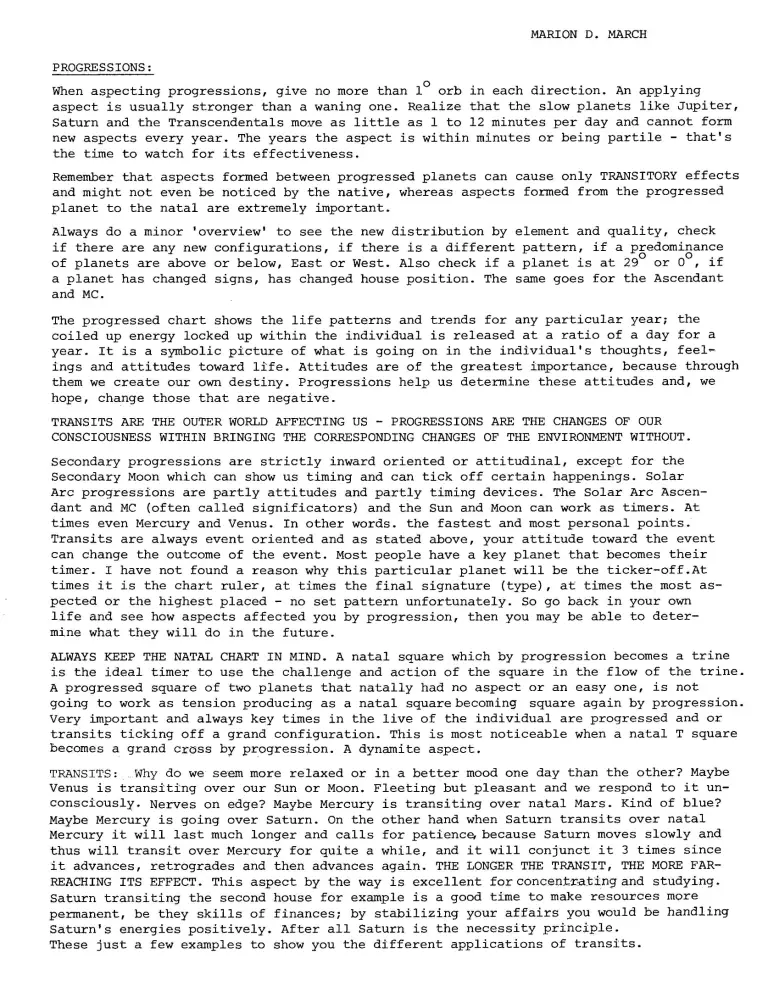
Progressions, Solar Arcs, and Transits (One-Page Summary)

Predictive Astrology, Timing Techniques, and Astrological Practice. This archival document is a one-page instructional guide titled “PROGRESSIONS, SOLAR ARCS, AND TRANSITS” by Marion D. March. March synthesizes the core operational differences between secondary progressions, solar arc directions, and transits. She defines transits as external environmental forces, secondary progressions as shifts in internal consciousness and attitude, and solar arcs as hybrid tools reflecting both psychological shifts and timing events. The sheet covers practical calculation guidelines, including a strict $1^\circ$ orb for progressions, checking critical $0^\circ$ and $29^\circ$ degrees, evaluating sign and house shifts, and prioritizing aspects formed between progressed planets and the natal chart over progressed-to-progressed aspects. Additionally, March details the activation of natal configurations (such as a natal T-Square resolving into a progressed Grand Cross) and explains the duration and impact of transits.

View

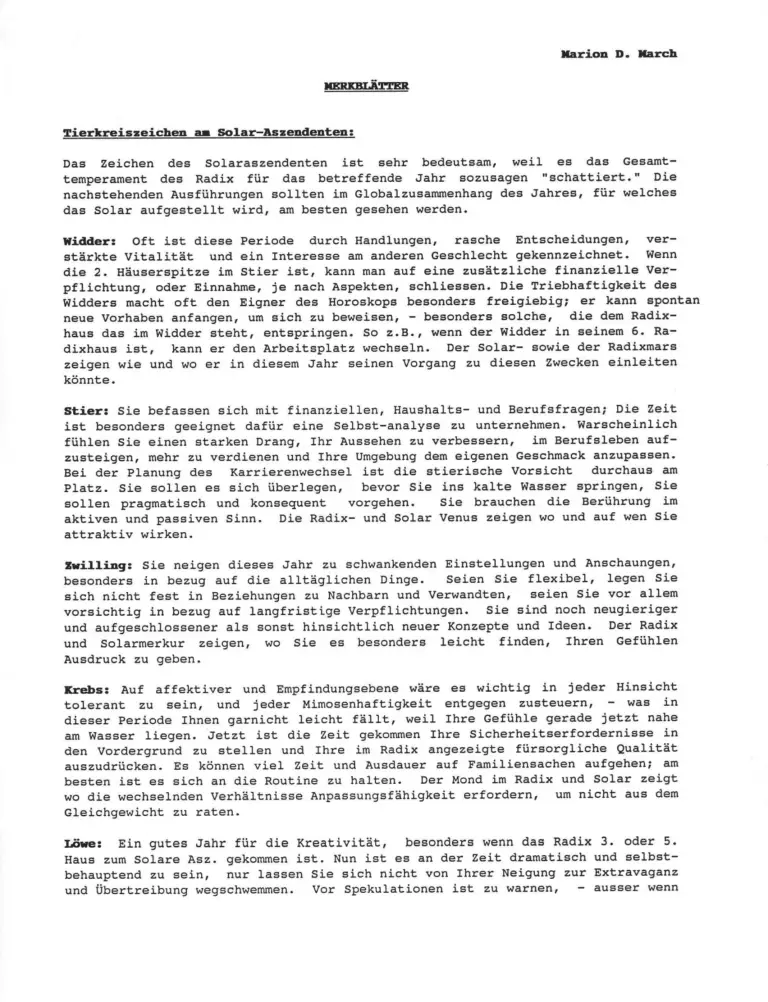
PLANETEN UM DEN SOLARAZENDENTEN & SOLARE

Solar Returns, Predictive Astrology, Timing Techniques. This German-language instructional manuscript titled “SOLARE” by Marion D. March provides a guide to interpreting Solar Return charts. March explains the core mechanics of Solar Returns, which cast an annual snapshot when the transiting Sun returns to its precise natal position, emphasizing the importance of calculating the return for the individual’s current place of residence. The text outlines interpretive criteria including zodiac signs on the Solar Ascendant, the placement of the Solar Ascendant ruler across natal and solar houses, planets positioned near the Solar Ascendant, house placements of the Sun and Moon, and hemispheric distribution of planets. Additionally, March provides criteria for predicting specific life events such as career changes, relocations, marriages, divorces, pregnancies, and financial shifts, illustrated alongside technical Solar Return worksheets and case studies for figures including Luciano Pavarotti, Ernest Hemingway, Pablo Picasso, Boris Becker, and Hermann Hesse.

View

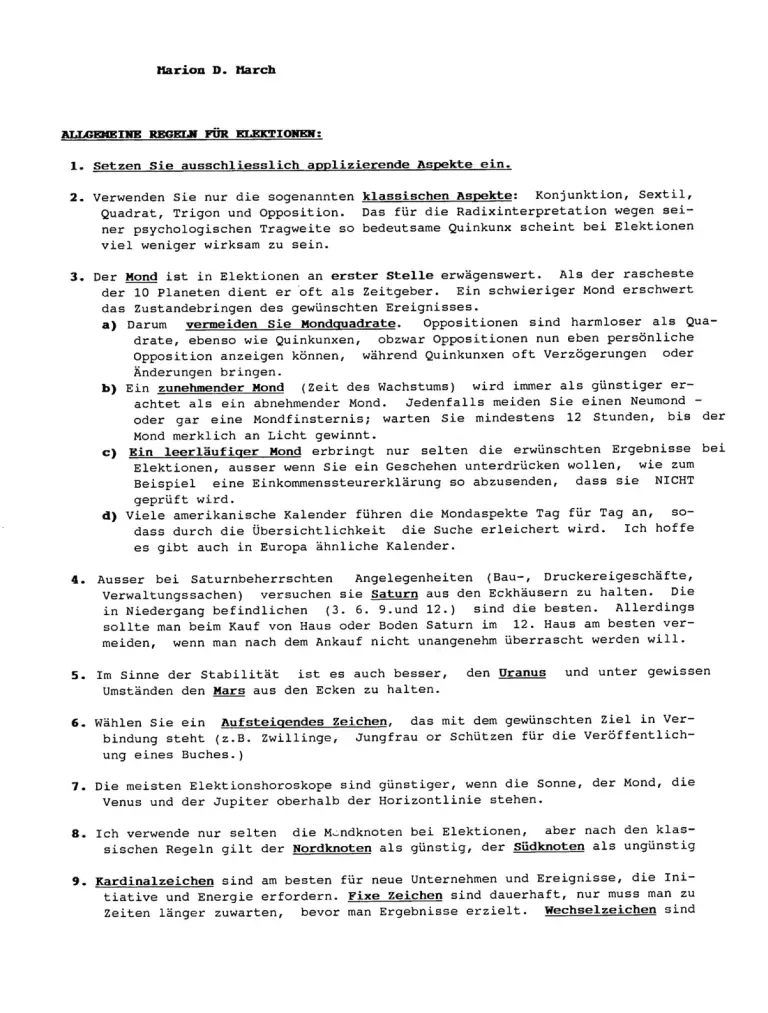
ELEKTIONEN

German

Electional Astrology, Timing Techniques, Event Charts. This German-language archival document is an instructional guide titled “ELEKTIONEN” (Electional Astrology) by Marion D. March. March outlines foundational rules for choosing auspicious timing for major life events, emphasizing applying lunar aspects, waxing Moons, avoiding void-of-course conditions, and keeping malefic planets out of angular houses. She discusses planetary rulerships (including modern applications for Uranus, Neptune, and Pluto), retrograde planets, intercepted signs, and the use of the Part of Fortune. The manuscript presents specific electional criteria and worked case examples for marriage, home relocation, real estate purchases and sales, corporate launches, organizational horoscopes (incorporating Rex Bills’ house definitions), and vehicle purchases (including a Rolls-Royce transaction).

View

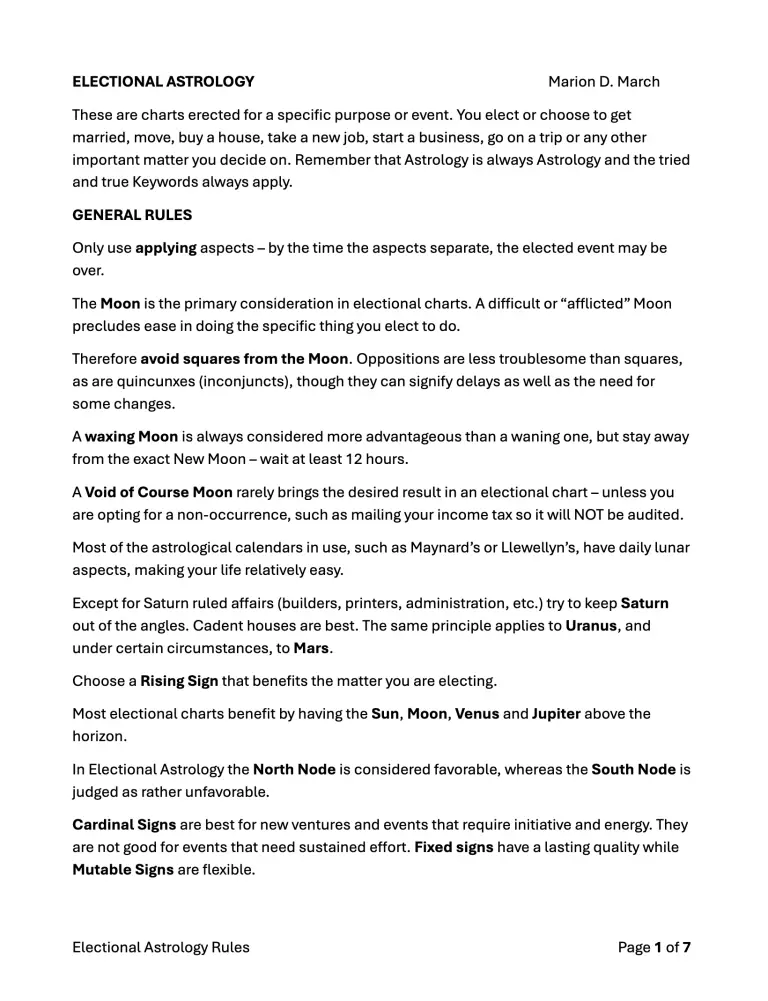
Electional Astrology Rules

Electional Astrology, Astrological Timing Techniques, and Event Charts. This archival document is an instructional reference guide titled “ELECTIONAL ASTROLOGY” by Marion D. March. March presents a comprehensive framework of rules for selecting optimal timing to initiate significant life decisions and events. She outlines core foundational rules, such as prioritizing applying lunar aspects, favoring waxing Moons over waning ones, avoiding void of course Moons, and positioning benefics (Jupiter and Venus) above the horizon while managing Saturn and Uranus in angular houses. The manuscript details specialized criteria for specific scenarios, including marriage, moving into a home, purchasing vehicles or real estate, commencing lawsuits, scheduling surgery, and launching a business or corporation. March emphasizes that while the electional chart acts as the birth chart for an event and takes temporary precedence over a client’s natal chart, astrologers must maintain realistic expectations as no chart can be completely flawless.

View

Ask A Librarian

Help

Whether you are looking for rare historical texts or trying to locate a specific book nearby, Alexandria iBase offers two primary ways to search. Here is how to choose the right tool for what you need:

The Library Catalogue

Think of this as your global master index.

The Catalogue works just like a traditional library search system, designed to help you locate books and media across the broader astrological landscape.

  • Physical Books: Find out where physical copies of books are held in libraries, archives, or collections near you.

  • Digital Files: Access downloadable or viewable digital editions when available.

  • Best Used For: Standard research, finding specific ISBNs or authors, and tracking down physical items in the real world.

Browse Catalogue

SPECIAL COLLECTIONS

Think of this as Alexandria’s exclusive private vault.

Collections gives you direct access to Alexandria’s own curated archive of rare, proprietary, and historic astrology media.

  • Exclusive Material: Features unique texts, manuscripts, audio recordings, and visual media that are not available anywhere else.

  • Direct Access: Digitized content ready to explore straight from the platform.

  • Best Used For: Deep-dive research, discovering hidden gems, and exploring rare, one-of-a-kind astrological resources.

Browse Special Collections

Cash & In-Kind Donations

Make a one-time or recurring tax deductible cash donation.

Payment options include donating directly with us, PayPal Giving and GoFundMe.

GoFundMe for Charities is registered for tax deductions and has no required processing fees. It does offer the option to tip.

Contact Us