
Pluto

Pluto

Pluto refers to the outermost major trans-Saturnian celestial body in astrological practice, functioning as the primary archetype of transformation, power dynamics, regeneration, and the unconscious underworld. Associated with the sign Scorpio in modern systems, Pluto governs cathartic evolutionary cycles, psychological purging, taboos, shadow integration, and systemic rebirth by dismantling obsolete structures to expose fundamental truths and facilitate deep personal or collective restructuring.

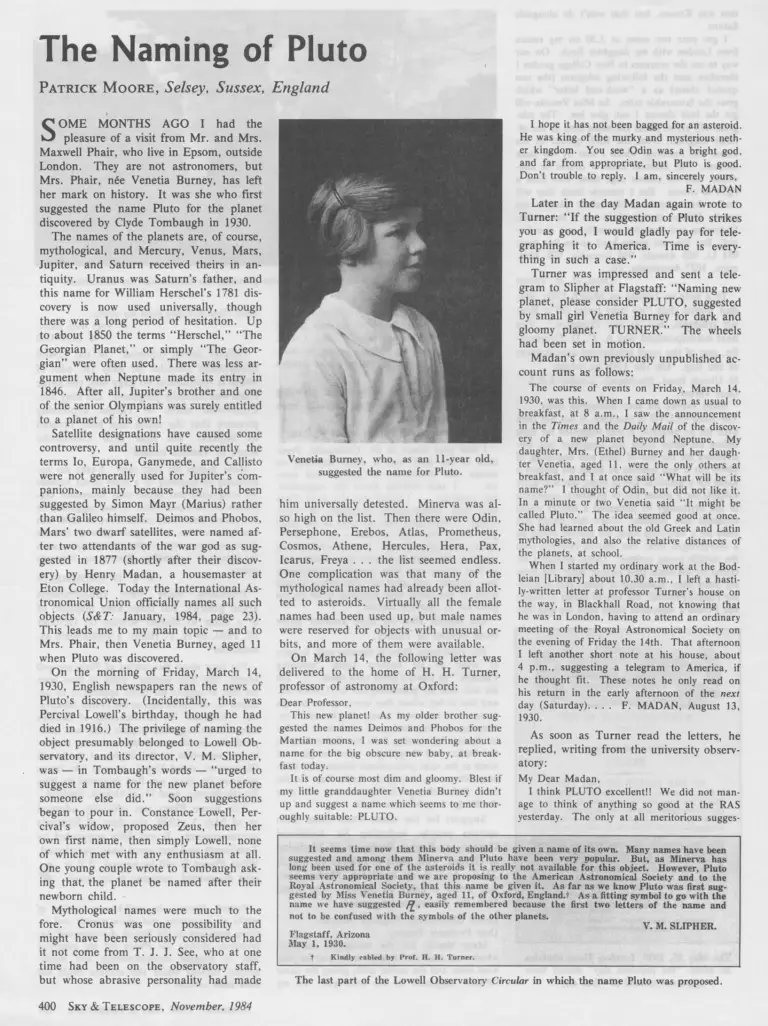
The Naming of Pluto (1984)

From Sky & Telescope, November 1984

History of Astronomy, Planetary Naming, and Pluto. This archival document is an article titled “THE NAMING OF PLUTO” by Patrick Moore, published in Sky & Telescope in November 1984. The text documents the historical account of how the planet Pluto received its name following its discovery by Clyde Tombaugh in 1930. Moore details how 11-year-old Venetia Burney of Oxford, England, suggested the name “Pluto” during a breakfast conversation with her grandfather, Falconer Madan, who passed the proposal to Oxford astronomy professor H. H. Turner. The article traces the correspondence, telegrams, and official actions between Turner, A. C. D. Crommelin, and Lowell Observatory director V. M. Slipher, leading to the official adoption of the name Pluto on May 1, 1930.
View

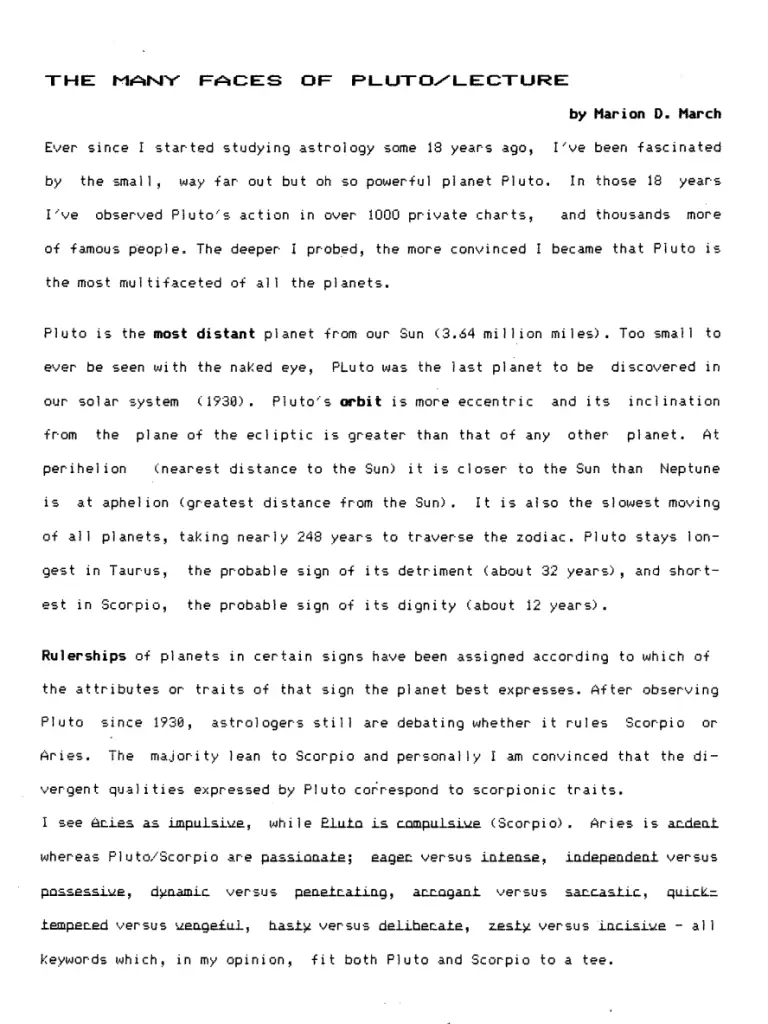
The Many Faces of Pluto (ca. 1983)

Pluto, Astrological Practice, and Delineation. This archival document is a lecture paper titled “THE MANY FACES OF PLUTO” by Marion D. March (ca. 1983). March presents a comprehensive analysis of the planet Pluto, exploring its astronomical discovery, glyph variations, mythological origins, and psychological manifestations. She examines Pluto’s core thematic expressions, including power, transformation, secretiveness, financial wealth, and intense desire natures, while analyzing how Plutonian energy operates through all twelve astrological houses and zodiac signs. The document features practical natal chart examples, historical sign transits, and specific delineations detailing Pluto’s impact on personal character, psychological integration, and collective generational trends.

View

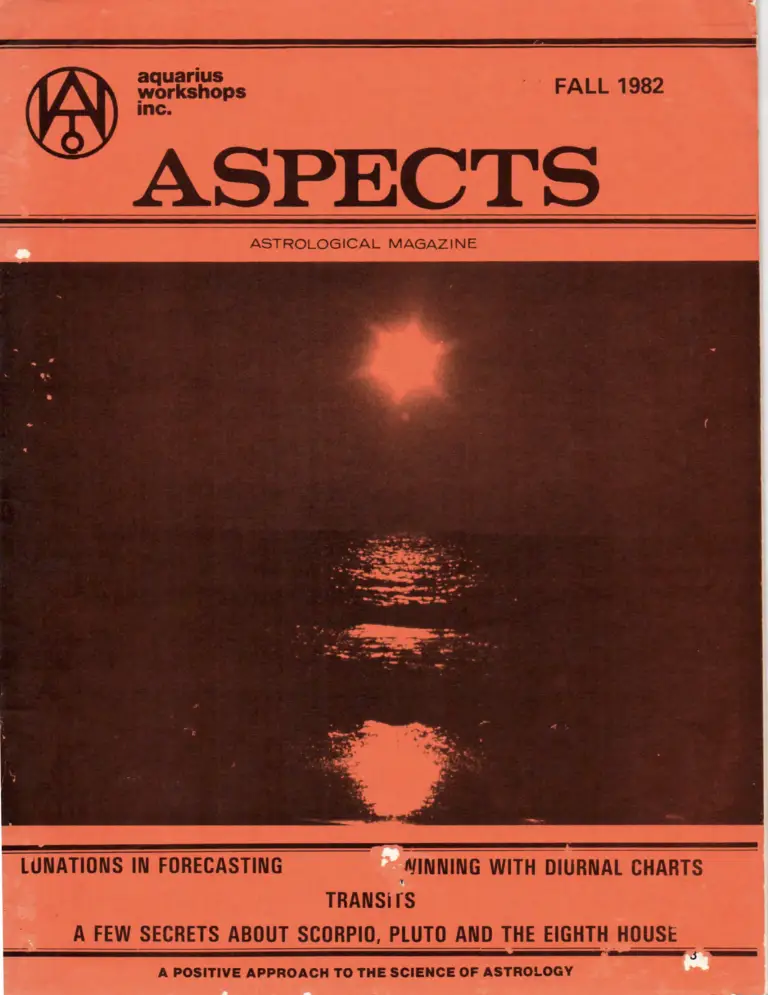
ASPECTS Vol 7 No 4 Fall 1982

Astrological Techniques, Pluto, and Predictive Astrology. This archival item is the Fall 1982 issue (Vol. 7, No. 4) of Aspects, a quarterly magazine published by Aquarius Workshops, Inc. in Encino, California. Featured articles include Jeff Jawer’s exploration of Scorpio, Pluto, and the eighth house as principles of transformation and collective change, Sophia Mason’s guide to electional timing and financial forecasting using diurnal charts, Angel Thompson’s framework for delineating transits, and Marwayne Leipzig’s study on incorporating lunations into predictive work. Additional contents include Judy Johns Tonyan’s Libra Ingress mundane analysis, Marion March’s overview of Prince William’s natal chart, Lois Rodden’s data column indexing Motion Picture Academy Award winners, educational columns by Joan McEvers and Nancy Cassidy, and book reviews.

View

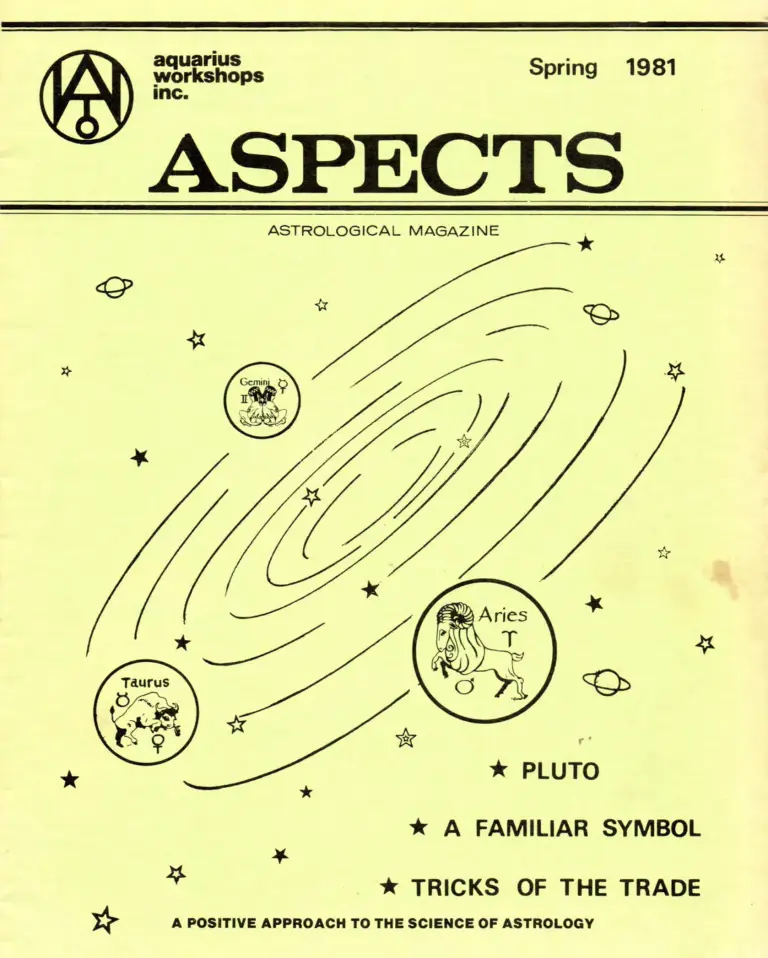
ASPECTS Vol 6 No 2 Spring 1982

Pluto, Evolutionary Astrology, and Professional Astrology. This archival item is the Spring 1981 issue (Vol. 6, No. 2) of Aspects, a quarterly magazine published by Aquarius Workshops, Inc. in Encino, California. Featured articles include Robert Carl Jansky’s analysis of the astrological symbol for the Sun as a cell-like semi-permeable membrane regulating personal space, Jeff Green’s study on Pluto as the evolutionary cause of incarnation and its relationship to the lunar nodes, and Robert Glasscock’s practical guide to professional chart consultation techniques. Additional contents include Judy Johns’s Aries Ingress mundane forecasts, Lois Rodden’s birth data collection for female sports champions, educational columns by Joan McEvers and Nancy Cassidy, book reviews, and an interview with astrologer Angela Gallo.

View

Ask A Librarian

Help

Whether you are looking for rare historical texts or trying to locate a specific book nearby, Alexandria iBase offers two primary ways to search. Here is how to choose the right tool for what you need:

The Library Catalogue

Think of this as your global master index.

The Catalogue works just like a traditional library search system, designed to help you locate books and media across the broader astrological landscape.

  • Physical Books: Find out where physical copies of books are held in libraries, archives, or collections near you.

  • Digital Files: Access downloadable or viewable digital editions when available.

  • Best Used For: Standard research, finding specific ISBNs or authors, and tracking down physical items in the real world.

Browse Catalogue

SPECIAL COLLECTIONS

Think of this as Alexandria’s exclusive private vault.

Collections gives you direct access to Alexandria’s own curated archive of rare, proprietary, and historic astrology media.

  • Exclusive Material: Features unique texts, manuscripts, audio recordings, and visual media that are not available anywhere else.

  • Direct Access: Digitized content ready to explore straight from the platform.

  • Best Used For: Deep-dive research, discovering hidden gems, and exploring rare, one-of-a-kind astrological resources.

Browse Special Collections

Cash & In-Kind Donations

Make a one-time or recurring tax deductible cash donation.

Payment options include donating directly with us, PayPal Giving and GoFundMe.

GoFundMe for Charities is registered for tax deductions and has no required processing fees. It does offer the option to tip.

Contact Us