
Home » Sun Sign Astrology

Sun Sign Astrology

Sun Sign Astrology is a popularized branch of the discipline that focuses exclusively on the zodiacal position of the Sun at the moment of an individual’s birth to determine personality archetypes. By categorizing the human experience into twelve distinct solar signs, this approach provides a simplified framework for astrological interpretation that is widely accessible to the general public. While it serves as a common entry point for those new to the field, professional astrologers often distinguish it from comprehensive natal chart analysis, which incorporates the complex interplay of planetary placements, house positions, and geometric aspects.

Filters

Filters


See more See less
See more See less
See more See less
See more See less
See more See less
See more See less
See more See less

Sorting

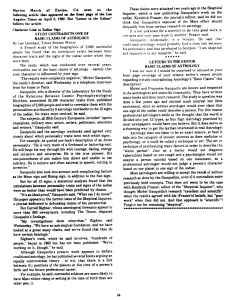
Astrological Research, Statistical Analysis, Skepticism, and Professional Practice. This document presents a debate between the scientific community and the astrological community regarding the validity of Sun Sign astrology. It centers on a study by Michel Gauquelin, who statistically analyzed biographies of 2,000 successful individuals to determine if personality traits correlated with their Sun signs. The study concluded that such correlations were non-existent, a finding that appeared in the Skeptical Inquirer.

The synthesis highlights the friction between the reductionist approach of Sun sign pop-astrology and the holistic, interpretive nature of professional astrological practice. While Gauquelin’s research challenged the claims of popular astrology, it is noted that serious astrologers generally do not define a person by a single sign, viewing it instead as an art or technique requiring synthesis of various planetary factors—similar to medical or psychological diagnostics. The text also touches upon Gauquelin’s controversial ‘Mars effect’ theory, which posits a link between planetary positions at birth and professional outcomes.

Issue Highlights:

Articles:
Study Contradicts One of Basic Claims of Astrology – Lee Dembart
Letters to the Editor: Basic Claims of Astrology – Anonymous (submitted by Marion March)

Discussion:
Scientific skepticism vs. astrological theory
The limitations of Sun sign astrology
Statistical analysis of birth charts and biographies
Professional astrology as an art or synthesis of multiple factors

Chart data:
Michel Gauquelin (Scorpio)
Carroll Righter (Astrologer)

Notable contributors:
Michel Gauquelin (Statistical Research)
Carroll Righter (Astrological Foundation research)
Kendrick Frazier (Editor, Skeptical Inquirer)
Marion March (Contributor/Letter provider)
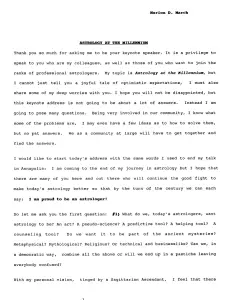
Professionalism, Astrological Standards, Millennium, Cultural Integration. Marion D. March delivers a passionate and challenging keynote address focusing on the state of astrology as the 20th century draws to a close. She raises eleven critical questions regarding the identity, reputation, standards, and future of astrology in a rapidly changing world. March examines external criticisms from scientists like Richard Dawkins, legal and financial controversies, the need for standardized training and testing akin to acupuncture and psychology, and the internal politics of major astrological organizations such as AFA, AFAN, ISAR, and NCGR. She highlights positive milestones including UAC faculty compensation, improved literature, computer advancements, financial research by Arch Crawford and Ray Merriman, the Gauquelins’ statistical research, Project Hindsight, and the unifying power of the Internet.

Issue Highlights:
A keynote address exploring the evolution of astrology, the necessity of professional standards, overcoming poverty consciousness among astrologers, and navigating technological and societal seachanges toward the new millennium.

Articles:
Astrology at the Millennium – Marion D. March

Discussion:
What do astrologers want astrology to be (art, science, predictive tool, helping tool)?
Public perception and attacks from the scientific community.
The need for testing, licensing, and standardized education.
Internal politics and division among astrological organizations.
The validity of astrology and empirical vs. judicial approaches.
The impact of computers, the Internet, and Project Hindsight.
Astrologers’ poverty consciousness and professional compensation.
Cyclical time vs. linear time and the philosophical implications of the upcoming millennium.

Chart data:
N/A

Notable contributors:
Marion D. March (Keynote Speaker)
Nick Campion (Natural vs. Judicial Astrology)
Joan McEvers (Astrology as a tool)
Arch Crawford (Financial Astrology)
Ray Merriman (Financial Astrology)

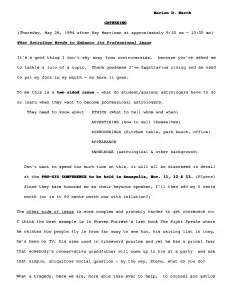
Professional Astrology, Ethics, Licensing, Education, Public Image. In this transcript of a presentation given on Thursday, May 26, 1994, prominent astrologer Marion D. March addresses the crucial topic of what astrology needs to do to enhance its professional image. March outlines a two-sided issue facing the astrological community: what students and amateurs must learn before turning professional (encompassing ethics, advertising, surroundings, appearance, and broad knowledge), and the broader sociological and psychological challenges faced by established professionals like Steven Forrest, who grapple with public disclosure and societal perceptions. She dives deeply into four major controversies: poverty consciousness and charging appropriately for astrological services, the negative public perception fueled by sun sign astrology and 900-number psychics, the necessity of academic degrees and university representation through projects like Kepler, and the controversial topic of professional licensing inspired by lawyer Jim Turner’s work with acupuncturists.

Issue Highlights:

Articles:
What Astrology Needs to Enhance its Professional Image – Marion D. March

Discussion:
Poverty consciousness among astrologers and the necessity of charging fees
Public perception, sun sign astrology, 900 numbers, and psychic fairs
The need for academic degrees, university representation, and the Kepler project
Professional licensing, self-regulation, and comparisons to the acupuncture profession

Chart data:
N/A
N/A

Notable contributors:
Marion D. March (Keynote speaker discussing professional standards and ethics)

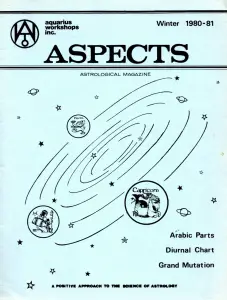
ASPECTS Vol. 6 No. 1 Winter 1980-1 Part 1/2

ASPECTS Magazine, Special Collections

Arabic Parts, Grand Mutation, Fifth House, Sextiles. This issue of Aspects astrological magazine delivers an extensive exploration of foundational and advanced astrological techniques, featuring detailed instructional breakdowns and conference updates. Robert ‘Buz’ Myers provides a comprehensive guide on calculating and interpreting ten key Arabic Parts (including the Part of Fortune, Love, Passion, Increases, Fate, Catastrophe, Treachery, and Organization) through the twelve houses and signs. Marion D. March analyzes the monumental Great Jupiter/Saturn Conjunction and the Capricorn Ingress Chart for December 1980, discussing world consciousness shifts and the transition into the Air trigon. Additionally, Lenora M. Hill examines the Diurnal (Daily) Chart, Enrique Linarés writes on the Point of Life, Joan McEvers breaks down the symbolism of the Fifth House in her ‘Keys to Learning’ series, and Nancy Cassidy details the harmonious exchange of energy found in Sextiles.

Issue Highlights: Conference reports cover SWAC 1980, the upcoming Astrology World-Congress 1981 in Zurich, and the First Metaphysical Congress. Regular columns include Letters to the Editor, President’s Message by Roberta Fueyo, What’s Happening, Book Reviews, and Lois Rodden’s Data Column.

Articles:
How to Calculate Your Arabic Parts – Robert ‘Buz’ Myers
The Great Jupiter/Saturn Conjunction – Marion D. March
The Diurnal (Daily) Chart – Lenora M. Hill
The Point of Life – Enrique Linarés
Keys to Learning: Fifth House – Joan McEvers
Building Blocks: Sextiles – Nancy Cassidy
Capricorn Ingress – Judy Johns

Discussion:
Calculation and house interpretation of Arabic Parts
Astrological shifts during the Jupiter/Saturn conjunction in Libra
Practical applications of diurnal charts and secondary progressions
Creative and psychological significations of the Fifth House
Harmonious energy exchanges through Sextile aspects

Chart data:
Capricorn Ingress Chart (December 21, 1980, Washington, D.C.)
Sample calculation chart for Arabic Parts (October 28, 1975, Encino, CA)

Notable contributors:
Robert ‘Buz’ Myers (Arabic Parts)
Marion D. March (Great Jupiter/Saturn Conjunction)
Joan McEvers (Fifth House mechanics)
Nancy Cassidy (Sextiles)
Lenora M. Hill (Diurnal Charts)

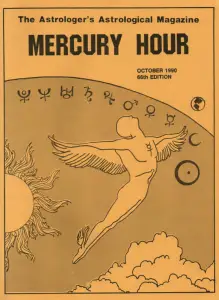
Mundane Astrology, Astrology History, and Astrological Techniques. This archival item is the October 1990 issue (66th Edition) of Mercury Hour, a quarterly astrological magazine edited and published by Edith Custer in Lynchburg, Virginia. Featured articles in this issue include Marc Penfield’s solar chart analysis of Donald Trump and natal study of Greta Garbo, Part I of M.J. Makransky’s series correlating zodiacal degrees with geographical locations and political shifts in Guatemala, Robert Baumgartner’s examination of a Demotic astrological text regarding the Egyptian star Sothis, Joseph S. DeMello’s instructional guide on diurnal charts, Paul Hewitt’s analysis of the 1989 Eastern European revolutions, and T. Pat Davis’s geo-helio study of the 1901 Texas oil discovery at Spindletop. Additional contents include reviews of Alan Oken’s Soul-Centered Astrology and Margaret Millard’s The Genetics of Astrology, weather forecasts by Dot Willis, and historical discussions regarding Tycho Brahe’s birth chart, the Society for the Advancement of Astrology, the 1992 Philippine presidential election, and birth data for figures including Saddam Hussein and Kenneth Branagh.


Issue Highlights


Book Reviews


Soul-Centered Astrology: A key to the expanding Self by Alan Oken – Marguerite dar Boggia


The Genetics of Astrology by Margaret Millard – Teresa Hamilton


Articles


The Great Garbo: Sphinx or Siren? – Marc Penfield


Guatemala, Part I – M.J. Makransky


The Egyptian Sothis in Gemini – A Demotic Astrological Text, Part I – Robert Baumgartner


Saturn, Our Night-Light, Part I – Ann Foley


Living the Hero’s Journey, Part I – Carol Voeth-Lavoie


Diurnal Charts – Joseph D. DeMello


Next Philippine President – Serafin Lanot


Autumn Ingress, September 23, 1990 – Dot Willis


Students Corner: Aspects – Anne Toth


[Essential charts of Chicago], Part I – Sonja Foxe


Saturn Anxiety, Part I – Carole Devine


Donald Trump: His Solar Chart – Marc Penfield


Eastern Europe – The Revolution of 1989, Part I – Paul Hewitt


Texans Discover Oil – T. Pat Davis


Discussions


Ethics of predicting death


Chart of Tycho Brahe


History of the Society for the Advancement of Astrology

Sun sign columns


Polio vaccine/SV-40 virus/AIDS

Warren and Florence Harding


Neptune transit of Capricorn


Chart of San Francisco Astrolocality Page 2 of 2


Chart data
(some incomplete or in question)

Iraq
Kuwait
Saudi Arabia
United Arab Emirates
San Francisco, CA
Common Market/EEC

Brahe, Tycho
Branagh, Kenneth
Griffith, Melanie
Hussein, Saddam
Linares, Enrico
Quayle, Dan
Stuart, Matthew & related charts

Notable contributors

Joe DeMello (the semi-sextile aspect)
Marion March (Joan Quigley’s involvement with the Reagans)
Kay Shinker (solar returns)
Lois Rodden (chart data)
Frances McEvoy (Matthew Stuart/Boston murder case)

Ask A Librarian

Need assistance with your research or navigating our collection? Our library team is here to help.

Please fill out the form below with details about the topics, authors, or archival materials you are looking for, and one of our librarians will review your query and respond shortly.

Help

Whether you are looking for rare historical texts or trying to locate a specific book nearby, Alexandria iBase offers two primary ways to search. Here is how to choose the right tool for what you need:

The Library Catalogue

Think of this as your global master index.

The Catalogue works just like a traditional library search system, designed to help you locate books and media across the broader astrological landscape.

  • Physical Books: Find out where physical copies of books are held in libraries, archives, or collections near you.

  • Digital Files: Access downloadable or viewable digital editions when available.

  • Best Used For: Standard research, finding specific ISBNs or authors, and tracking down physical items in the real world.

Browse Catalogue

SPECIAL COLLECTIONS

Think of this as Alexandria’s exclusive private vault.

Collections gives you direct access to Alexandria’s own curated archive of rare, proprietary, and historic astrology media.

  • Exclusive Material: Features unique texts, manuscripts, audio recordings, and visual media that are not available anywhere else.

  • Direct Access: Digitized content ready to explore straight from the platform.

  • Best Used For: Deep-dive research, discovering hidden gems, and exploring rare, one-of-a-kind astrological resources.

Browse Special Collections

Cash & In-Kind Donations

Make a one-time or recurring tax deductible cash donation.

Payment options include donating directly with us, PayPal Giving and GoFundMe.

GoFundMe for Charities and PayPal Giving are registered for tax deductions and have no required processing fees. It does offer the option to tip.

Donate

*Subject to 2.5% processing fees

Contact Us

Have a question, feedback, or a inquiry about our archives? We’d love to hear from you. Please fill out the form below with your details and message, and a member of our team will get back to you as soon as possible.

Thank you for reaching out to the Alexandria iBase Project!