
Home » Sextile » Page 2

Sextile

Sextile is a major astrological aspect representing a harmonious 60-degree relationship between two or more celestial points, typically separated by two zodiac signs of compatible elements. Traditionally classified as a soft and favorable aspect, the sextil facilitates a flowing, cooperative exchange of energy that encourages opportunity, talent development, and constructive potential without the intense friction of a square or opposition. In chart interpretation, it highlights areas where an individual can easily apply their resources and creative abilities through conscious effort and cooperation.

Filters

Filters


See more See less
See more See less
See more See less
See more See less
See more See less
See more See less
See more See less

Sorting

ASPECTS Vol. 6 No. 1 Winter 1980-81 Part 2/2

ASPECTS Magazine, Special Collections

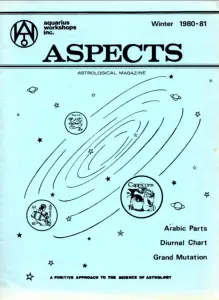
Astrological techniques, horary analysis, Arabic parts, Diurnal charts, and the Grand Mutation of Jupiter and Saturn. This issue of Aspects features extensive technical explorations of predictive and mundane astrology. Robert ‘Buz’ Myers details the calculation and application of Arabic Parts. Marion D. March explores the grand astrological significance of the Jupiter-Saturn conjunction, evaluating its historical impacts and mundane country correlations using Jim Lewis’s Astro*Carto*Graphy. Lenora M. Hill introduces the simplicity and practical application of the Diurnal (daily) Chart, complete with step-by-step mathematical examples, Yod configurations, and transit correlations. Joan McEvers provides insights into numerological pinnacles, while Linda Green investigates Astropalmistry through hand-shape classifications and water-hand patterns. Enrique Linarés introduces the ‘Point of Life’ progression method. Additionally, book reviews by Marion D. March and data columns by Lois Rodden round out the edition.

Issue Highlights:

Articles:
How to Calculate Your Arabic Parts – Robert ‘Buz’ Myers
The Great Jupiter/Saturn Conjunction – Marion D. March
The Diurnal (Daily) Chart – Lenora M. Hill
The Point of Life – Enrique Linarés
Basic Delineation – Marion D. March
Astro-Numerology: The Meanings of the Numbers (Pinnacles) – Joan McEvers
Astropalmistry – Linda Green

Discussion:
Calculating Arabic parts using formula segments
Jupiter-Saturn conjunctions and Grand Mutations entering Air signs
Diurnal chart calculation and activation via house cusps
Point of Life progression calculations
Astrological data corrections and book reviews

Chart data:
Horary Question (8/17/79 8:49 PM PDT, Coeur d’Alene)
Basic Delineation natal chart (3/30/1853 11:00 AM LMT, Zundert, Holland)
Diurnal Chart (June 28, 1980)
Water Hand Natal Horoscope (Figure 2)

Notable contributors:
Robert ‘Buz’ Myers (Arabic Parts)
Marion D. March (Jupiter-Saturn Conjunction & Basic Delineation)
Lenora M. Hill (Diurnal Charts)
Enrique Linarés (Point of Life Progression)
Joan McEvers (Astro-Numerology)
Linda Green (Astropalmistry)
Lois Rodden (Data Column)
ASPECTS Vol. 6 No. 1 Winter 1980-1 Part 1/2

ASPECTS Magazine, Special Collections

Arabic Parts, Grand Mutation, Fifth House, Sextiles. This issue of Aspects astrological magazine delivers an extensive exploration of foundational and advanced astrological techniques, featuring detailed instructional breakdowns and conference updates. Robert ‘Buz’ Myers provides a comprehensive guide on calculating and interpreting ten key Arabic Parts (including the Part of Fortune, Love, Passion, Increases, Fate, Catastrophe, Treachery, and Organization) through the twelve houses and signs. Marion D. March analyzes the monumental Great Jupiter/Saturn Conjunction and the Capricorn Ingress Chart for December 1980, discussing world consciousness shifts and the transition into the Air trigon. Additionally, Lenora M. Hill examines the Diurnal (Daily) Chart, Enrique Linarés writes on the Point of Life, Joan McEvers breaks down the symbolism of the Fifth House in her ‘Keys to Learning’ series, and Nancy Cassidy details the harmonious exchange of energy found in Sextiles.

Issue Highlights: Conference reports cover SWAC 1980, the upcoming Astrology World-Congress 1981 in Zurich, and the First Metaphysical Congress. Regular columns include Letters to the Editor, President’s Message by Roberta Fueyo, What’s Happening, Book Reviews, and Lois Rodden’s Data Column.

Articles:
How to Calculate Your Arabic Parts – Robert ‘Buz’ Myers
The Great Jupiter/Saturn Conjunction – Marion D. March
The Diurnal (Daily) Chart – Lenora M. Hill
The Point of Life – Enrique Linarés
Keys to Learning: Fifth House – Joan McEvers
Building Blocks: Sextiles – Nancy Cassidy
Capricorn Ingress – Judy Johns

Discussion:
Calculation and house interpretation of Arabic Parts
Astrological shifts during the Jupiter/Saturn conjunction in Libra
Practical applications of diurnal charts and secondary progressions
Creative and psychological significations of the Fifth House
Harmonious energy exchanges through Sextile aspects

Chart data:
Capricorn Ingress Chart (December 21, 1980, Washington, D.C.)
Sample calculation chart for Arabic Parts (October 28, 1975, Encino, CA)

Notable contributors:
Robert ‘Buz’ Myers (Arabic Parts)
Marion D. March (Great Jupiter/Saturn Conjunction)
Joan McEvers (Fifth House mechanics)
Nancy Cassidy (Sextiles)
Lenora M. Hill (Diurnal Charts)

Arabic Parts, Lunar Nodes, Karmic Astrology, Chart Interpretation, Part of Fortune, Part of Spirit, The Web. In this address given to the Astrology Buff Club on February 15, 1973, Marion March explores the deeper psychological and karmic layers of the horoscope beyond standard sun-sign and basic natal chart delineations. Critiquing superficial newspaper forecasts, March discusses how accurate birth times and precise house calculations unlock core personality traits, while lunar nodes and specialized Arabic parts reveal unconscious patterns, past-life tendencies, and future spiritual evolution. Drawing on the philosophies of Dane Rudhyar and Isabel Hickey, March contrasts the comfortable habits of the South Node with the developmental challenge of the North Node, and reinterprets the formulas for the Part of Fortune, Part of Spirit, and a unique Arabic part known as ‘The Web’ taught by Irma Norman.

Issue Highlights:

Articles:
Address to the Astrology Buff Club – Marion March
Some Arabic Points and Their Deeper Meanings – Marion March

Discussion:
Differentiating solar charts from precise natal horoscopes
Psychological interpretation of the Lunar Nodes (North and South Nodes)
Reinterpreting the Part of Fortune (Pars Fortuna) and Part of Spirit
The Web Arabic Part and identifying psychological traps based on house placement
Using tight orbs for Arabic part aspects (maximum 3-degree orb)

Chart data:
N/A

Notable contributors:
Marion March (Author and lecturer)
Dane Rudhyar (Evolutionary and archetypal philosophy)
Isabel Hickey (Lunar nodes and subconscious patterns)
Ronald C. Davison (Planetary distribution relative to the lunar nodes)
Sydney Omarr (Newspaper astrological forecasts comparison)
Irma Norman (Originator of ‘The Web’ Arabic part)

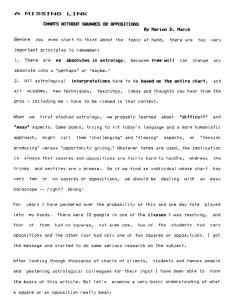
Charts Without Squares or Oppositions, Aspect Deficiencies, Natal Imbalances, Evolutionary Astrology. In this detailed astrological study titled ‘A Missing Link: Charts Without Squares or Oppositions,’ Marion D. March explores the profound implications of birth charts that lack challenging aspects like squares and oppositions. March challenges the common astrological assumption that charts devoid of hard aspects represent ‘easy’ or uncomplicated lives. Through the analysis of elemental balances, aspect patterns (such as see-saw, bowl, fan, and tripod), unaspected planets, and lacking modalities or houses, she demonstrates how individuals with squareless or oppositionless charts frequently struggle with self-awareness, conflict resolution, and internal drive. Without the natural tension of squares to prompt action or oppositions to foster awareness of the ‘other,’ natives often resort to avoidance, projection, or internalizing stress, which can manifest as chronic physical ailments, phobias, or psychological difficulties.

The text extensively examines various specific natal charts of both clients and renowned figures to illustrate how chart deficiencies manifest in real life. March analyzes how individuals compensate for missing elements, such as a lack of water, air, or earth, and how unaspected planets or single focal points in bucket patterns direct the native’s life path. She emphasizes that while progressions and transits can activate these points over time, understanding the innate lack of impetus allows astrologers to provide effective psychological and astrological guidance to help clients harness the strengths inherent in their unique configurations.

Issue Highlights:

Articles:
A Missing Link: Charts Without Squares or Oppositions – Marion D. March

Discussion:
Interpreting charts lacking squares or oppositions
The psychological impact of unaspected planets and missing elements
Using chart patterns and progressions to understand developmental crises
Case studies of famous artists, actors, and individuals navigating squareless charts

Chart data:
Chart I (Jan 31, 1919)
Chart II (Mar 7, 1921)
Georges Braque (May 9, 1882)
Chart III (Dec 3, 1918)
Margaret Sullavan (May 16, 1919)
Marlene Dietrich (Dec 27, 1901)
Chart IV (June 30, 1943)
Chart V (July 1, 1924)
Chart VI (Apr 18, 1928)
Vincent Van Gogh (Mar 30, 1853)
Fanny Brice (Oct 29, 1891)
Montgomery Clift (Oct 17, 1920)

Notable contributors:
Marion D. March (Author)

Frances McEvoy Juno First Lady of the Gods V.1 Volume 11 Issue 9 and 10

Juno First Lady of the Gods

Frances McEvoy, Special Collections

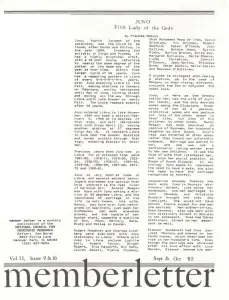
Asteroid Astrology, Juno in Natal Charts, Marriage and Relationships. The publication features an in-depth article exploring the astrological significance of the asteroid Juno, the ‘First Lady of the Gods,’ focusing on its orbital characteristics, cycles, and placement in the natal charts of prominent figures. Frances McEvoy details how Juno governs marriage, partnership, jealousy, fidelity, and social standing, noting its 48-year orbital cycle and repeating retrograde patterns in Libra. The text examines numerous historical and celebrity examples, demonstrating how Juno’s aspects to angles, luminaries, and outer planets correlate with marital history, infidelity, fame through marriage, and partnership dynamics.

Issue Highlights:
An exhaustive examination of the asteroid Juno’s placement across multiple charts of famous figures, highlighting its role as a key indicator of marital destiny, relationship style, and domestic partnership patterns.

Articles:
Juno: First Lady of the Gods – Frances McEvoy

Discussion:
Orbital mechanics and recurrence cycles of the asteroid Juno
Juno in Libra and its association with partnership and social recognition
Juno’s aspects to the Sun, Moon, Ascendant, Midheaven, and nodal axis in notable charts
Correlations between Juno placements and marriage, infidelity, widowhood, and divorce

Chart data:
Shah Mohammad Reza of Iran
David Brinkley
Yul Brynner
Robert Redford
Peter O’Toole
Joan Collins
Goldie Hawn
Sylvia Plath
Marlon Brando
Doris Day
Margaret Sullavan
Merle Oberon
Linda Christian
Carroll O’Connor
Jean Harlow
Princess Anne
Peter Duchin
Maria Callan
Maureen O’Sullivan
Ronald Reagan
Nancy Reagan
Jane Wyman
Jacqueline Kennedy Onassis
John Kennedy
Aristotle Onassis
Rose Kennedy
Eleanor Roosevelt
Lucy Mercer
Betty Ford
Gerald Ford
Rosalynn Carter
Jimmy Carter
Cathryn Brant Crosby
Bing Crosby
Princess Grace of Monaco
Clare Booth Luce
Henry R. Luce
Queen Elizabeth II
Prince Philip
Debbie Reynolds
Eddie Fisher
Will Durant
Ariel Durant
Buckminster Fuller
Elizabeth Taylor
Ted Kennedy
John Updike
Joan Sutherland
Richard Bonynge
Elizabeth Barrett Browning
Robert Browning
Mary Shelley
Percy B. Shelley
Jane Roberts
Robert Butts

Notable contributors:
Frances McEvoy (Asteroid Astrology and Juno in relationships)

ASPECTS Vol. 6 No. 1 Winter 1980-1

ASPECTS Magazine

Astrological Techniques, Arabic Parts, Mundane Astrology. This issue of ASPECTS magazine provides a deep dive into advanced astrological applications, specifically focusing on the interpretation and calculation of Arabic Parts and the impact of the Great Mutation (Jupiter-Saturn conjunction). The technical content is complemented by foundational series columns, such as Joan McEvers’ exploration of the 5th House and Nancy Cassidy’s analysis of sextile aspects. These articles bridge the gap between abstract mathematical derivations and practical, house-by-house interpretations of human experience and psychological drives.

Issue Highlights

The magazine documents the transition into a new astrological era marked by the shift of Jupiter-Saturn conjunctions from Earth signs to the Air element, specifically referencing the 1980 conjunction in Libra. It also serves as a chronicle of the burgeoning astrological community in the early 1980s, highlighting the South-Western Astrology Conference (SWAC) of 1980, upcoming conferences in Zurich, and the general professionalization of the field through organizations like Aquarius Workshops, Inc.

Articles:
How To Calculate Your Arabic Parts – Robert ‘Buz’ Myers
The Great Jupiter/Saturn Conjunction – Marion D. March
The Diurnal (Daily) Chart – Lenora M. Hill
The Point of Life – Enrique Linarés
Keys to Learning (5th House) – Joan McEvers
Building Blocks (Sextiles) – Nancy Cassidy
Capricorn Ingress – Judy Johns

Discussion:
The transition from Earth to Air element in major planetary conjunctions
Calculation and interpretation of 10 specific Arabic Parts across 12 houses
The professional development of astrology in educational and conference settings

Chart data:
10/28/75, 1:24 pm PST, Encino, CA
12/21/1980, 11:56:00 EST, Washington, DC

Notable contributors:
Robert ‘Buz’ Myers (Arabic Parts)
Marion D. March (Mundane Astrology/Conjunctions)
Joan McEvers (Astrological Education)

Geocosmic Research Monographs - Ancient Greek Astrology - Monograph Number Three

Ancient Greek Astrology

Geocosmic Research Monographs

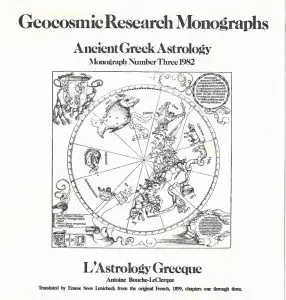
Ancient Greek Astrology, Chaldean Astrology, Aristotelianism and Hermeticism in Medieval Astrology. This publication features translations and analytical essays examining the historical foundations of astrology. The first section presents excerpts from Antoine Bouche-LeClerq’s foundational 1899 work ‘L’Astrologie Grecque’, translated by Emese Soos Lenichek, covering precursory philosophies, Chaldean influences, and core doctrines. The second section, authored by Robert Zoller, explores the synthesis of Aristotelian philosophy and Hermeticism in medieval astrological practice, particularly referencing Guido Bonatti’s ‘Liber Astronomiae’, Abu Ma’shar’s contributions, and the epistemological framework uniting the celestial spheres with terrestrial life.

Issue Highlights:
Translation of key chapters from Bouche-LeClerq’s ‘L’Astrologie Grecque’ addressing the physics, determinism, and planetary mechanics of antiquity; an extensive study by Robert Zoller on the deep ties between medieval scholasticism, Aristotelian physics, and Hermetic gnosticism in astrological doctrine.

Articles:
L’Astrologie Grecque (Chapters One through Three) – Antoine Bouche-LeClerq (Translated by Emese Soos Lenichek)
Aristotelianism and Hermeticism in Medieval Astrology – Robert Zoller

Discussion:
The transition from Babylonian and Chaldean observational methods to Hellenistic astrological systems.
The philosophical synthesis of Aristotelian substance, causes, and the celestial prime mover within medieval astrology.
The role of the Corpus Hermeticum, gnosis, and sympathetic magic in medieval and Renaissance esoteric worldviews.

Chart data:
N/A

Notable contributors:
Antoine Bouche-LeClerq (History of Greek Astrology)
Robert Zoller (Medieval Astrology and Hermeticism)
Emese Soos Lenichek (Translation)

Ask A Librarian

Need assistance with your research or navigating our collection? Our library team is here to help.

Please fill out the form below with details about the topics, authors, or archival materials you are looking for, and one of our librarians will review your query and respond shortly.

Help

Whether you are looking for rare historical texts or trying to locate a specific book nearby, Alexandria iBase offers two primary ways to search. Here is how to choose the right tool for what you need:

The Library Catalogue

Think of this as your global master index.

The Catalogue works just like a traditional library search system, designed to help you locate books and media across the broader astrological landscape.

  • Physical Books: Find out where physical copies of books are held in libraries, archives, or collections near you.

  • Digital Files: Access downloadable or viewable digital editions when available.

  • Best Used For: Standard research, finding specific ISBNs or authors, and tracking down physical items in the real world.

Browse Catalogue

SPECIAL COLLECTIONS

Think of this as Alexandria’s exclusive private vault.

Collections gives you direct access to Alexandria’s own curated archive of rare, proprietary, and historic astrology media.

  • Exclusive Material: Features unique texts, manuscripts, audio recordings, and visual media that are not available anywhere else.

  • Direct Access: Digitized content ready to explore straight from the platform.

  • Best Used For: Deep-dive research, discovering hidden gems, and exploring rare, one-of-a-kind astrological resources.

Browse Special Collections

Cash & In-Kind Donations

Make a one-time or recurring tax deductible cash donation.

Payment options include donating directly with us, PayPal Giving and GoFundMe.

GoFundMe for Charities and PayPal Giving are registered for tax deductions and have no required processing fees. It does offer the option to tip.

Donate

*Subject to 2.5% processing fees

Contact Us

Have a question, feedback, or a inquiry about our archives? We’d love to hear from you. Please fill out the form below with your details and message, and a member of our team will get back to you as soon as possible.

Thank you for reaching out to the Alexandria iBase Project!