
Home » Vertex / Anti-Vertex

Vertex / Anti-Vertex

The Vertex is an astronomical point representing the western intersection of the ecliptic and the Prime Vertical, with the Anti-Vertex at the eastern intersection. In astrological practice, these are treated as secondary Descendant/Ascendant axes, heavily associated with fated encounters, compulsive psychological drives, and unavoidable external circumstances.

Filters

Filters


See more See less
See more See less
See more See less
See more See less
See more See less
See more See less
See more See less

Sorting

House Systems, Mundane Astrology, and Astrological Techniques. This archival document is the 4th Edition of Mercury Hour (January 1975), an open-forum astrological journal edited and published by Edith Custer. The issue brings together prominent mid-20th-century astrologers to debate chart construction techniques, planetary rulerships, sensitive mathematical points, and practical counseling philosophies. Key technical contributions include Michael Munkasey’s classification of 23 house systems and introduction of the Arcturan system, Dr. James T. Hayes’s critique of cause-and-effect determinism and traditional dignities, Ivy M. G. Jacobson’s guide to L. Edward Johndro’s Birth Locality Charts, Inge Aach’s demonstration of 90-degree dial midpoint analysis using Henry Kissinger’s chart, and Ruth Dewey’s research on the Vertex. Additional discussions cover Carl Payne Tobey’s Astrology of Inner Space, Stephen Arroyo on Mars in Scorpio medical correlations, Zip Dobyns’s announcement of International Astrological Abstracts, and Isabel Hickey’s biographical account of her spiritual astrological practice.

Issue Highlights

Articles:

House Systems – Michael Munkasey

Four Questionable Practices of Astrologers – Dr. James T. Hayes

Excerpt from Foundation of the Astrological Chart – Ivy Jacobson (Johndro Locality Charts)

The Cosmic Structure – Inge Aach (continuation of the Cosmobiology Series)

The Vertex (series continuation) – Ruth Dewey

Discussion:

Carl Payne Tobey’s Astrology of Inner Space (various contributors)

Chart data:

(some in question or incomplete)

Gerald Ford
Muhammed Ali
James Dean
Marlon Brando
Clark Gable
Henry Kissinger

Notable contributors:

Stephen Arroyo (Mars in Scorpio; Polarity Therapy)

Zip Dobyns (formation of International Astrological Abstracts – IAA)

Isabel Hickey (short bio & involvement in astrology)
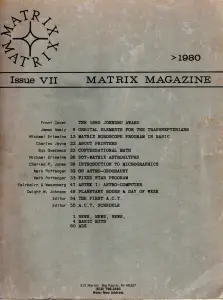
Computerized Astrology, Astrological Programming, A.C.T. Conference, Trans-Neptunian Planets. This issue of Matrix Magazine serves as a bridge between early computing technology and professional astrological practice. It focuses heavily on the technical application of microcomputers (Commodore PET, Apple II, TRS-80) to astrological research, offering BASIC programming code for chart calculations, orbital elements for Trans-Neptunian planets (Cupido, Hades, Zeus, Kronos, Apollon, Admetos, Vulkan, Poseidon), and instructions for printer-based astroglyph generation. The magazine also introduces the “ASTEK I,” a specialized astrological computer, and discusses the use of microfilm for archival astrological data storage.

Issue Highlights:
The 1980 Johndro Award is presented to Neil F. Michelsen for his pioneering work in computer-assisted ephemerides and astrological software. The issue also provides a comprehensive schedule for the first Astrological Conference on Techniques (A.C.T.) held in New Orleans, covering a wide array of research topics from planetary cycles to rectifiction methods.

Articles:
Orbital Elements for the Transneptunians – James Neely
Matrix Horoscope Program in BASIC – Michael Erlewine
Conversational Math – Buz Overbeck
Dot-Matrix Astroglyphs – Michael Erlewine
Introduction to Micrographics – Charles Paul Jones
On Astro-Geography – Mark Pottenger
Fixed Star Program – Mark Pottenger
ASTEK I: Astro-Computer – Fairbairn & Wesenberg
Planetary Hours & Day of Week – Dwight W. Johnson

Discussion:
Application of BASIC programming in natal astrology
Technical specifications and history of the ASTEK I calculator
Astro-Geography and meridian contacts
Statistical analysis of astrological data
Microfilm implementation for astrological libraries
Planetary rulers and the day of the week

Chart data:
Michael Erlewine (Born 7/18/1941, 4:03 PM EST, Lancaster, PA)

Notable contributors:
Michael Erlewine (Editor/Computing), James Neely (Orbital elements/programming), Mark Pottenger (Fixed star programming), Charles Jayne (Conference/Techniques advice), Buz Overbeck (Conversational math)

Mundane Astrology, Financial Astrology, and Astrology History. This archival item is the October 1999 issue (101st Edition B) of Mercury Hour, a quarterly astrological magazine edited and published by Edith Custer in Lynchburg, Virginia. Key contents include Bill Meridian’s review of Ron Howland’s A Chronology of American Charts alongside his article on “Shared Degree Areas” in planetary stock trading, Rowena Wall’s analysis of Y2K “Millennium Madness”, and Mary Downing’s eclipse watch report on Saros 145. The issue features the conclusion of Guy de Penguern’s 21st Century Medical Astrology Course focusing on cardiopathy, Arlene Nimark’s “Tidbits & Obits” covering Kurt Weill, the “Mercury Mets,” and the Littleton shooting birth data, and Virginia Reyer’s reference guide to Vertex signs. Additional contributions cover reader discussions on Out-of-Bounds planets, solar returns, the Bible Code, Druidic numerology, and chart analyses for John F. Kennedy Jr. and King Abdullah of Jordan.


Issue Highlights


Book Review

A Chronology of American Charts by Ron Howland – Bill Meridian


Articles

Tidbits & Obits – Arlene Nimark

Y2K Millenium Madness – Rowena Wall

Planetary Stock Trading: Shared Degree Areas – Bill Meridian

21st Century Medical Astrology Course, Part 3 of 3 [extract] – Guy de Penguern

Eclipse Watch [Saros 145] – Mary Downing

Vertex Signs – Virginia Reyer


Discussions

Out-of-Bounds planets

Columbine shooters

Leap years

Solar Returns

Asteroids Hidalgo, Pandora, Lilith

Druidic numerology

Chart of JFK, Jr.

The Bible Code

Solar storms/solar peak


Chart data

Abdullah, King of Jordan

Kennedy Jr., John F.

Nunavut (Canada)


Notable contributors

Roberta Strain (Royal Fixed Stars)

Marion March (fertility & astrology)

Mundane Astrology, Astrology History, and Astrological Techniques. This archival item is the April 2000 issue (104th Edition) of Mercury Hour, a quarterly astrological magazine edited and published by Edith Custer in Lynchburg, Virginia. Key highlights include Ken Negus’s translation and commentary on Johannes Kepler’s 1608 chart interpretation for Generalissimo Albrecht Wallenstein, Rowena Wall’s astrological profile of media mogul Ted Turner following the Time Warner/AOL merger and his marital separation from Jane Fonda, and Virginia Reyer’s rectified natal and event analysis of Theodore Kaczynski (the Unabomber). The issue also features Susan Manuel’s geo/helio analysis of the Mars Polar Lander mission, Pat Geisler’s essay on professional ethics for practicing astrologers, Joan Titsworth’s overview of esoteric ray astrology, and Mary Downing’s historical reference table of Democratic National Conventions and nominees. Additional contributions document Walt Masters’ mathematical formulas for twelve “House Parts” (Arabic Parts), the 1999 Texas A&M bonfire collapse, out-of-bounds declinations, and chart analyses for prominent political figures including Vladimir Putin, Al Gore, George W. Bush, Bill Bradley, and John McCain.


Issue Highlights 


Articles


“Mouth of the South” Does it Again! [Ted Turner] – Rowena Wall


Kepler as Practicing Astrologer, Translation and Commentary – Ken Negus


Helio Planets: Mars Polar Lander – Susan Manuel


Esoteric Astrology in the World Today – Joan Titsworth


The Aquarian Eclipses of 2000 – Carol Willis


Ted Kaczynski – Virginia Reyer


Democratic National Conventions and Presidential Nominees [table]– Mary Downing


The Ethics of Astrology – Pat Geisler


Tidbits from the Tabloids – Arlene Marcia Nimark


Discussions


The 12 Arabic Parts


Bonfire collapse at Texas A&M (1999)


Declinations/Out-of-Bounds planets


Chart of Camilla Parker-Bowles


The Vertex


Chart data


(some incomplete or in question)


Bradley, Bill


Bush, George H.W.


Gore, Al


Kaczynski, Ted


McCain, John


Putin, Vladimir


Canada


Battle of Toronto (War of 1812)


Bonfire collapse at Texas A&M (1999)


Notable contributors


Marion March (avoiding generalizing in Astrology)

Astrology, Mercury Hour, Natal charts, Transits, Progressions, Mundane Astrology, Astro*Carto*Graphy, Chiron, Void of Course Moon, Solar Returns, Uranian astrology, Cosmobiology. This 36th Edition of Mercury Hour (January 1983), edited and published by Edith Custer, is a comprehensive astrological magazine featuring diverse correspondence, extensive theoretical and technical articles, book reviews, conference reports, and in-depth chart delineations. Key themes explored across the publication include life-stage transitions such as the ‘Catch-30’ passage and Uranus age cycles, mundane and political astrology including analyses of nuclear war threats, the Falklands crisis, and the chart of Israel, as well as technical discussions regarding software, heliocentric nodes, house systems, and the accuracy of astrological statistics (such as Gauquelin studies).

Issue Highlights:

Articles:
The Vertex – Jan Popelka
Student’s Section: A Visit to Astrologers in the U.S.A. – Ann Stevens-Patacchiola
The Catch-30 Passage: [28-32], Part III – Bil Tierney
[Uranus age cycle] Part II – Dale Huckeby
Mysterious Neptune, Part II (Marcia Moore’s chart and death) – Manik Chand Jain
Moon Void of Course in the Signs, Part I – Ted George
Is Nuclear War in Our Future? [An Astrological Call to Action] – Virginia Miller
The Pshaw Report – Jayj Jacobs
The Role of the Moon’s Nodes in World Events – Alan Richter
The New Orleans Air Crash of July 1982 – Jeff Jawer
The Effects of Saturn Transits in the Lives of the Pacific Club Members – Dona Shaw
A Royal Baby (Prince William) – Judith Gee
Determining the Winner of a Game – Sophia Mason
The Psychological Patterns of Jesus Christ – Frank Jakubowsky

Discussion:
Astro*Carto*Graphy, geodetic equivalents, and mundane predictions
Astrology hardware and software (Osborne, Astro Star, Matrix software reports)
Sunspot activity and the stock market
Gauquelin studies and statistical analysis
Lindbergh baby kidnapping and Bruno Hauptmann chart analysis
Intruder in the Queen’s Bedroom (Michael Fagan and Elizabeth II charts)
Fraternity for Canadian Astrologers 1st National Conference awards

Chart data:
August Belmont
David Crosby
Richard Dreyfuss
Michael Fagan
Andy Gibb
Bruno Hauptmann
Charley Pride
Victoria Principal
Ronald Reagan
Michael Trestrail
Israel and Partition
United Kingdom

Notable contributors:
Jim Lewis (Astro*Carto*Graphy and Ronald Reagan chart)
Jeff Jawer (First Canadian National Conference)
Barbara Watters (Grand trines and Sex and the Outer Planets)
Tracy Marks (financial compensation for astrologers)
Zane Stein (Chiron research)
Erin Sullivan (astrology of sexuality)

Mercury Hour 101st Edition (A) July 1999

Mercury Hour Magazine, Special Collections

Medical Astrology, Mundane Astrology, and Astrological Technique. This archival item is the July 1999 issue (101st Edition) of Mercury Hour, an astrological periodical edited and published quarterly by Edith Custer in Lynchburg, Virginia. Featured contributions include the second installment of Guy de Penguern’s course on 21st-century medical astrology focusing on genetic predispositions to cancer and amino acids, Virginia A. Reyer’s technical guide to calculating and interpreting the Vertex/Anti-Vertex axis alongside a chart analysis of Jack Kevorkian, Mark Pottenger’s mathematical correction regarding the Equation of Time and Local Apparent Time in computer software, and excerpts from Robert P. Blaschke’s treatise on progressions. Additional community discussions cover out-of-bounds planets, solar return methodologies, debates on geographic versus geocentric latitude, and classifications of the three distinct Liliths (Dark Moon, Asteroid, and Black Moon). The issue also preserves mundane astrological commentary on late-1990s events, including the Kosovo conflict and Slobodan Milosevic’s birth data, Y2K software preparedness, the August 1999 Fixed Grand Cross eclipse, and verification efforts regarding natal data for the Columbine High School shooting perpetrators.


Issue Highlights 


Articles

21st Century Medical Astrology Course, Part 2 of 3 – Guy de Penguern [extract]

The Case of the Clock Dial – Mark Pottenger

Jack Kevorkian, Part 2 of 2 – Virginia A. Reyer

“Mutable Dilemma”: Do You Mean Apparent? [Apparent vs. Mean Time]

– Mark Pottenger


Discussions

Chart of Bill Clinton

The three Liliths

Astrology & fertility

Solar returns

August 1999 Grand Cross & eclipse

The Vertex

The true “Blue Moon”

Charles Keating event/diurnal chart

Declinations/out-of-bounds planets

Equation of Time in chart calculations

Geocentric vs. heliocentric latitude


Chart data

Harris, Eric

Hussein, Saddam

Klebold, Dylan

Milosevic, Slobodan

Nicholson, Jack 


Notable contributors

Marion March (astrology & fertility)

Robert Blaschke (Astrology: A Language of Life; Volume I – Progressions [excerpt])

Ask A Librarian

Need assistance with your research or navigating our collection? Our library team is here to help.

Please fill out the form below with details about the topics, authors, or archival materials you are looking for, and one of our librarians will review your query and respond shortly.

Help

Whether you are looking for rare historical texts or trying to locate a specific book nearby, Alexandria iBase offers two primary ways to search. Here is how to choose the right tool for what you need:

The Library Catalogue

Think of this as your global master index.

The Catalogue works just like a traditional library search system, designed to help you locate books and media across the broader astrological landscape.

  • Physical Books: Find out where physical copies of books are held in libraries, archives, or collections near you.

  • Digital Files: Access downloadable or viewable digital editions when available.

  • Best Used For: Standard research, finding specific ISBNs or authors, and tracking down physical items in the real world.

Browse Catalogue

SPECIAL COLLECTIONS

Think of this as Alexandria’s exclusive private vault.

Collections gives you direct access to Alexandria’s own curated archive of rare, proprietary, and historic astrology media.

  • Exclusive Material: Features unique texts, manuscripts, audio recordings, and visual media that are not available anywhere else.

  • Direct Access: Digitized content ready to explore straight from the platform.

  • Best Used For: Deep-dive research, discovering hidden gems, and exploring rare, one-of-a-kind astrological resources.

Browse Special Collections

Cash & In-Kind Donations

Make a one-time or recurring tax deductible cash donation.

Payment options include donating directly with us, PayPal Giving and GoFundMe.

GoFundMe for Charities and PayPal Giving are registered for tax deductions and have no required processing fees. It does offer the option to tip.

Donate

*Subject to 2.5% processing fees

Contact Us

Have a question, feedback, or a inquiry about our archives? We’d love to hear from you. Please fill out the form below with your details and message, and a member of our team will get back to you as soon as possible.

Thank you for reaching out to the Alexandria iBase Project!