
Home » Rob Hand

Rob Hand

Filters

Filters


See more See less
See more See less
See more See less
See more See less
See more See less
See more See less
See more See less

Sorting

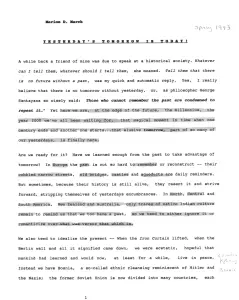
Astrology, History, Synchronicity, Evolution, and Traditional Techniques. This article serves as a reflective discourse on the evolution of astrology as the professional community approaches the turn of the millennium. Marion D. March argues that modern astrology should not entirely discard traditional wisdom in its quest to incorporate psychological insights. She highlights the necessity of balancing new, empowered approaches—which emphasize personal choice and free will—with historical techniques such as Horary and Electional astrology. March posits that true progress involves integrating the past to form the future, rather than treating ancient methods as mere fatalism.

The author discusses the shifting role of planetary archetypes, noting that as consciousness expands, our perception of planets like Saturn and Pluto evolves. She advocates for the use of Horary and Electional astrology as practical tools for empowerment, arguing that choosing an optimal moment for a venture is a demonstration of agency rather than deterministic surrender. Furthermore, she explores the broader cultural context of the 1990s, including the socio-economic impacts of technological change, the decline of rigid paradigms, and the anticipation of major outer planet transits, specifically the ingress of Uranus into Aquarius and Pluto into Sagittarius.

Issue Highlights:

Articles:
Yesterday’s Tomorrow Is Today! – Marion D. March

Discussion:
The synthesis of traditional and modern astrological techniques
The evolution of Saturn and Pluto archetypes in modern astrology
The impact of technological and societal shifts on the role of the astrologer
The philosophical divide between linear and cyclical views of time
The relevance of Electional and Horary astrology in the modern era

Chart data:
N/A

Notable contributors:
George Santayana (Philosophical context)
Carl Gustav Jung (Collective Unconscious)
Joseph Campbell (Myths and archetypes)
Steven Forest (The stigma of being an astrologer)
Christian Borup (Revival of Horary astrology)
Joan McEvers (Collaborator on Electional/Horary books)
Michel Gauquelin (Paradigm definitions)
Rob Hand (Research into old wisdom/Project Hindsight)
The Many Faces of Pluto (ca. 1983)

Marion D. March, Special Collections

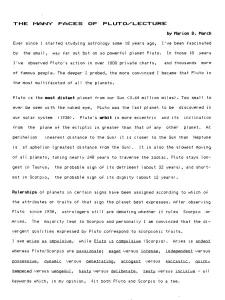
Pluto, Astrology, Mythology, Generational Planets, House Placements, Transits. This extensive lecture by Marion D. March explores the multifaceted nature of Pluto in astrology, detailing its astronomical uniqueness, diverse historical glyphs, and deep roots in Greek and Roman mythology. The text covers Pluto’s manifestations through wealth, the unseen, sexuality, power, and transformation, bridging ancient archetypes with modern psychological and mundane astrology. Special attention is given to the collective unconscious as viewed through outer planets, alongside practical examples of Pluto transits and its placement through the twelve houses and zodiac signs.

Issue Highlights:
The Many Faces of Pluto / Lecture – Marion D. March

Articles:
The Many Faces of Pluto/Lecture – Marion D. March
Mythologisches – Fritz Gehre

Discussion:
Pluto’s astronomical characteristics and orbital peculiarities
Debates on Pluto’s rulership (Scorpio vs. Aries)
Historical analysis of Pluto’s glyphs and mythological origins (Hades, Persephone, Tantalus)
Pluto’s connection to atomic energy, plutonium, and the collective unconscious
Pluto through the twelve houses and signs of the zodiac

Chart data:
Gov. Brown
H. Kissinger
George Sand
Goethe
J.P. Getty
R. Browning
C. Jung
Robert Kennedy
W. Churchill
Lee Bailey
Krishnamurti
Charles Manson
Angela Davis
Edgar Bergen
Louis Pasteur
Earl Warren
Spencer Tracy
B. Baruch
Adelle Davis
Oliver Wendell Holmes
Emerson
Ted Kennedy
Gandhi
Gershwin
Charles Lindberg
de Gaulle
Hitler
Jackie Onassis
Isabel Hickey
Nelson Rockefeller
F.D. Roosevelt
Thomas Mann
Tallulah Bankhead
Karl Marx
Richard Nixon
Sigmund Freud
Ernest Hemingway
Pablo Picasso
Lyndon Johnson
Albert Einstein
Mme. Curie
Marilyn Monroe
Patty Hearst
Muhammad Ali
Dr. Charles Mayo

Notable contributors:
Marion D. March (Author and Astrologer)
Isabel Hickey (Astrology and Symbolism)
Liz Greene (Outer Planets and Collective Unconscious)
Fritz Gehre (Mythology)

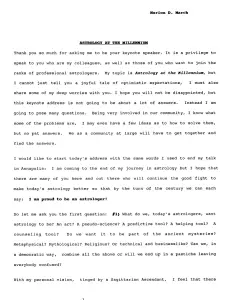
Professionalism, Astrological Standards, Millennium, Cultural Integration. Marion D. March delivers a passionate and challenging keynote address focusing on the state of astrology as the 20th century draws to a close. She raises eleven critical questions regarding the identity, reputation, standards, and future of astrology in a rapidly changing world. March examines external criticisms from scientists like Richard Dawkins, legal and financial controversies, the need for standardized training and testing akin to acupuncture and psychology, and the internal politics of major astrological organizations such as AFA, AFAN, ISAR, and NCGR. She highlights positive milestones including UAC faculty compensation, improved literature, computer advancements, financial research by Arch Crawford and Ray Merriman, the Gauquelins’ statistical research, Project Hindsight, and the unifying power of the Internet.

Issue Highlights:
A keynote address exploring the evolution of astrology, the necessity of professional standards, overcoming poverty consciousness among astrologers, and navigating technological and societal seachanges toward the new millennium.

Articles:
Astrology at the Millennium – Marion D. March

Discussion:
What do astrologers want astrology to be (art, science, predictive tool, helping tool)?
Public perception and attacks from the scientific community.
The need for testing, licensing, and standardized education.
Internal politics and division among astrological organizations.
The validity of astrology and empirical vs. judicial approaches.
The impact of computers, the Internet, and Project Hindsight.
Astrologers’ poverty consciousness and professional compensation.
Cyclical time vs. linear time and the philosophical implications of the upcoming millennium.

Chart data:
N/A

Notable contributors:
Marion D. March (Keynote Speaker)
Nick Campion (Natural vs. Judicial Astrology)
Joan McEvers (Astrology as a tool)
Arch Crawford (Financial Astrology)
Ray Merriman (Financial Astrology)

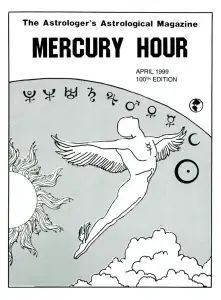
Medical Astrology, Mundane Astrology, and Fixed Stars serve as the primary focus areas of this historical astrological literature. This archival item is the April 1999 issue (100th Edition) of Mercury Hour, a long-running quarterly astrological magazine edited and published by Edith Custer in Lynchburg, Virginia. The issue highlights the first installment of Guy de Penguern’s course on 21st-century medical astrology and genetic astrophysics, a review of Enrique Linares’s A Scientific Approach to the Metaphysics of Astrology by Marguerite dar Boggia, Virginia A. Reyer’s study on fixed stars and health, and Dorothy J. Sarka’s examination of the I Ching. Additionally, the issue documents extensive reader discussions on political horoscopes and current events, including the Bill Clinton impeachment, Y2K software predictions, the 1999 Israeli election, and natal chart data for prominent figures such as Jesse Ventura and Ehud Barak.


Issue Highlights

Book Review

A Scientific Approach to the Metaphysics of Astrology by Enrique Linares

– Marguerite der Boggia


Articles

21st Century Medical Astrology Course, Part 1 of 3 – Guy de Penguern [extract]

Fixed Stars, Part 2 of 2 – Virgina A. Reyer

The Hidden Code of the I Ching – Dorothy J. Sarka


Discussions

Ken Starr/Bill Clinton impeachment

Chart of Bill ClintonU.S. Declaration of Independence

W.H. Chaney/Jack London

Astro-Twins (examples)

Asteroid rulership/association

Moon Out-of-Bounds

Israel election 1999

Y2K

August 1999 Grand Cross eclipse

August 1998 eclipse effect on Russia

Sun/Moon angle and conception


Chart data

Barak, Ehud

Bush, George

Chaney, William

Hand, Rob

Jayne, Charles

Keller, Helen

Netanyahu, Benjamin

Rose, Buddy “Playboy”

Ventura, Jesse

Russia


Notable contributors

Marion March (various topics)


Ask A Librarian

Need assistance with your research or navigating our collection? Our library team is here to help.

Please fill out the form below with details about the topics, authors, or archival materials you are looking for, and one of our librarians will review your query and respond shortly.

Help

Whether you are looking for rare historical texts or trying to locate a specific book nearby, Alexandria iBase offers two primary ways to search. Here is how to choose the right tool for what you need:

The Library Catalogue

Think of this as your global master index.

The Catalogue works just like a traditional library search system, designed to help you locate books and media across the broader astrological landscape.

  • Physical Books: Find out where physical copies of books are held in libraries, archives, or collections near you.

  • Digital Files: Access downloadable or viewable digital editions when available.

  • Best Used For: Standard research, finding specific ISBNs or authors, and tracking down physical items in the real world.

Browse Catalogue

SPECIAL COLLECTIONS

Think of this as Alexandria’s exclusive private vault.

Collections gives you direct access to Alexandria’s own curated archive of rare, proprietary, and historic astrology media.

  • Exclusive Material: Features unique texts, manuscripts, audio recordings, and visual media that are not available anywhere else.

  • Direct Access: Digitized content ready to explore straight from the platform.

  • Best Used For: Deep-dive research, discovering hidden gems, and exploring rare, one-of-a-kind astrological resources.

Browse Special Collections

Cash & In-Kind Donations

Make a one-time or recurring tax deductible cash donation.

Payment options include donating directly with us, PayPal Giving and GoFundMe.

GoFundMe for Charities and PayPal Giving are registered for tax deductions and have no required processing fees. It does offer the option to tip.

Donate

*Subject to 2.5% processing fees

Contact Us

Have a question, feedback, or a inquiry about our archives? We’d love to hear from you. Please fill out the form below with your details and message, and a member of our team will get back to you as soon as possible.

Thank you for reaching out to the Alexandria iBase Project!