

Marion D. March

The Marion D. March Collection features selected articles, original papers, and instructional lecture notes from co-founder of Aquarius Workshops and co-author of the landmark The Only Way to Learn Astrology series. Celebrated for her systematic teaching methods and practical approach, March’s work spans fundamental chart calculation, predictive techniques, synastry, and electional astrology. This archival gathering provides an invaluable look into the educational methodology and analytical insights of one of the 20th century’s premier astrological educators.

Marion D. March

Various

32 Document(s)

Various

1923-2001

Marion D March

Filters

Filters


See more See less
See more See less
See more See less
See more See less
See more See less
See more See less
See more See less

Sorting

Sexual Potential in the Horoscope, Psychological Variables, Archetypes, Astrological Indicators of Sexuality. This detailed astrological lecture and analysis by Marion D. March explores the expressions of sexual potential within the natal chart, moving beyond surface interpretations to analyze the whole personality. March examines the fundamental meanings of the 5th and 8th houses, planetary influences (Mars, Venus, Pluto, Neptune, Uranus, Mercury, Saturn, Jupiter, Sun, and Moon), and mythological underpinnings such as the archetypes of Venus/Aphrodite, Mars/Ares, and Pluto/Hades. The text features in-depth case studies and natal chart analyses of prominent figures including Marilyn Monroe, Xaviera Hollander, David Bowie, Richard Pryor, Frank Sinatra, Marlene Dietrich, Tennessee Williams, and Gertrude Stein, illustrating how complex configurations, T-squares, and planetary combinations manifest in intimate lives, sexual expression, and public images. Additionally, the lecture addresses homosexuality and bisexuality through astrological indicators and includes a lighthearted numerological ‘Astro-test’ by G.G. Stoctay, PhD, to score sex drive based on planetary placements.

Issue Highlights:
Detailed exploration of sexual dynamics, house significators (5th and 8th houses), planetary aspects relating to intimacy and drive, mythological context of sexual archetypes, and extensive chart examples of celebrities.

Articles:
Die Ausdrucksebenen des sexuellen Potential im Horoskop – Marion D. March

Discussion:
The 5th House and romantic/sexual attitude
The 8th House as an indicator of effective sexual performance
Planetary significators of sex drive, intimacy, and fantasy (Mars, Venus, Pluto, Neptune, Uranus)
Mythological roots of Venus, Mars, and Pluto
Astrological indicators of homosexuality and bisexuality
Case studies of celebrities and their complex psychological and sexual configurations
Stoctay’s Astro-test for evaluating the strength of the sex drive

Chart data:
Marilyn Monroe
Xaviera Hollander
David Bowie
Richard Pryor
Frank Sinatra
Marlene Dietrich
Thomas Lanier ‘Tennessee’ Williams
Gertrude Stein

Notable contributors:
Marion D. March (Author)
Joan McEvers (Co-creator/Chart source reference)
G.G. Stoctay (Astro-test creator)
Marion D. March, Electional Astrology, Horary Astrology, Future of Astrology, Turning to the Past for Future Wisdom. In this thoughtful essay, prominent astrologer Marion D. March reflects on the transition from the 20th century into the new millennium, examining how astrologers must reclaim traditional techniques while embracing modern psychological insights. She discusses the danger of throwing out the past in pursuit of entirely modern psychological or New Age frameworks, advocating instead for a synthesis of ancient practices such as electional astrology (Zeitwahlhoroskop) and horary astrology with contemporary astrological counseling. March draws on historical milestones, societal changes in Europe and globally, and the outer planets (Uranus, Neptune, and Pluto) to chart a course for the evolution of astrology in the 21st century.

March elaborates on her personal transition toward electional astrology, noting how utilizing electional charts for film production schedules yielded tangible success and two Academy Awards for a client. She critiques the historical rejection of traditional methods and urges practitioners to overcome the stigma of fatalism. Furthermore, she explores mundane shifts, such as upcoming ingresses of Uranus and Neptune into Aquarius and Pluto into Sagittarius, linking them to cultural transformations, the re-emergence of ancient modalities like Feng-Shui and the I-Ching, and the ongoing dialogue between science, religion, and astrology.

Issue Highlights:

Articles:
Das Jetzt als Zukunft der Vergangenheit – Marion D. March

Discussion:
Integrating traditional electional and horary techniques with modern psychological astrology
The evolution of outer planet symbolism (Saturn, Uranus, Neptune, Pluto) and their sign ingresses
Overcoming public and religious skepticism towards astrology
Reclaiming ancient wisdom and cultural heritage (Feng-Shui, I-Ching) for the 21st century

Chart data:
N/A

Notable contributors:
Marion D. March (Author and Astrologer)
Christian Borup (Electional and Horary Astrology)
Steven Forrest (Discussion of astrological public reception)

Fertility Astrology, Dr. Eugen Jonas Method, Electional Charts for Conception. Marion D. March provides a detailed guide on utilizing astrological fertility cycles (pioneered by Dr. Eugen Jonas) and electional charts for determining the best times to conceive. The text covers the three main divisions: birth control based on fertility cycles, optimal times for pregnancy based on both astrological fertility cycles and natural ovulation, and pregnancy charts adapted to modern medical procedures like in-vitro fertilization. March discusses practical case studies involving clients like Mindy, Marissa, Sarah, and Jennifer, analyzing the application of lunar aspects, void-of-course moons, and planetary transits in relation to natal charts.

Issue Highlights:

Articles:
Conception and Fertility Elections – Marion D. March

Discussion:
Calculating astrological fertility cycles based on the Sun-Moon phase angle at birth
Electional chart rules for conception focusing on the Moon’s applying aspects
Aligning astrological fertility dates with modern medical fertility treatments and in-vitro procedures

Chart data:
Mindy
Marissa
Sarah
Jennifer

Notable contributors:
Marion D. March (Author and Astrologer)
Dr. Eugen Jonas (Developer of the astrological fertility and birth control cycle)

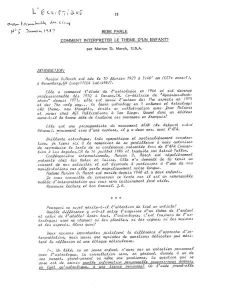
Child astrology, natal interpretation, family dynamics, birth charts. This article by Marion D. March explores the unique methodology and ethical considerations required when interpreting the astrological birth chart of a child or baby. Unlike adult consultations, child astrology involves communicating with parents or third parties regarding potential, hereditary factors, and the environment without dictating a fixed destiny. March discusses the importance of looking at squares and oppositions as potential for growth, analyzes planetary signatures, elements, and house placements, and presents several detailed case studies with charts including Mikki, Bolly, Prince William, Tina, and Linda.

Issue Highlights:

Articles:
Comment interpreter le theme d’un enfant? – Marion D. March

Discussion:
Interpreting children’s natal charts
Ethical considerations in parental consultations
The role of hard aspects (squares and oppositions) in childhood development
The influence of family environment and heredity on natal potential

Chart data:
Mikki (March 6, 1951, Los Angeles, CA)
Bolly (July 10, 1977, Zurich, Switzerland)
Prince William of England (June 21, 1982, London, UK)
Tina (June 3, 1974, Phoenix, AZ)
Linda (August 5, 1951, Buffalo, NY)

Notable contributors:
Marion D. March (Author and international lecturer on child astrology and psychological approaches)

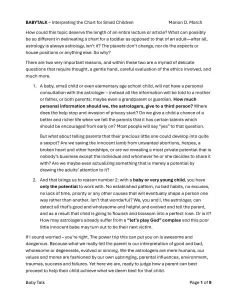
Child Astrology, Ethics in Consultation, Chart Interpretation for Toddlers and Youths. Marion D. March explores the profound ethical and practical responsibilities involved when astrologers delineate charts for infants, toddlers, and small children. Rather than consulting directly with the individual, the astrologer speaks to parents, guardians, or grandparents, raising critical questions regarding privacy, potential versus actualization, and the danger of falling into a “let’s play God” complex. March stresses that a child’s chart reveals potential, not a fixed destiny, and warns against imposing the astrologer’s or parents’ personal biases upon the developing mind. The text examines the psychological value of stress and squares in a chart as crucial catalysts for personal growth, resilience, and independence rather than purely negative omens.

Issue Highlights:
Detailed chart delineations for several children (Mikki, Bolly, Tina, and Linda), alongside the royal chart of Prince William of England, demonstrating how similar ascendants (such as Sagittarius) manifest entirely different personalities based on planetary configurations, aspects, and family dynamics. March also details her personal practice methodology, including client data sheets, recording sessions, and written addendums for young children.

Articles:
BABYTALK – Interpreting the Chart for Small Children – Marion D. March

Discussion:
Ethics of third-party consultations and child privacy
The psychological function of squares and stress in personal development
Yods, T-squares, and mutual reception in youth horoscopes
Evaluating sibling dynamics and birth timing through transits and progressions
Cultural, ethnic, and religious backgrounds affecting child-rearing expectations
Astrological indicators for legal careers, communication talents, and artistic inclinations

Chart data:
Mikki 
Bolly
Prince William of England
Tina 
Linda

Notable contributors:
Marion D. March (Author and Astrologer)

Astrology Terms German and English

Marion D. March, Special Collections

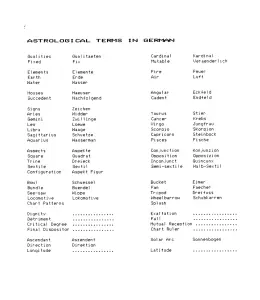
Astrological Terms in German, Qualities, Elements, Houses, Signs, Aspects, Chart Patterns, Dignities, Ascendant, Solar Arc. This document provides a comprehensive bilingual reference guide translating core astrological terminology from English into German. It covers fundamental structural components of astrology, including the zodiac qualities (Cardinal, Fixed, Mutable), elemental classifications (Fire, Earth, Air, Water), house types (Angular, Succedent, Cadent), and the complete set of twelve zodiac signs from Aries to Pisces. Furthermore, the text systematically translates major and minor aspects (Conjunction, Square, Opposition, Trine, Inconjunct, Sextile, Semi-sextile), planetary configurations, and specific Marc Jones chart patterns such as Bowl, Bundle, See-saw, Locomotive, Bucket, Fan, Tripod, Wheelbarrow, and Splash. Essential astrological conditions including dignity, detriment, exaltation, fall, critical degree, mutual reception, and final dispositor are also mapped, alongside structural chart points like the Ascendant, Direction, Longitude, Latitude, and Solar Arc (Sonnenbogen).

Issue Highlights:

Articles:
N/A – N/A

Discussion:
Translation of astrological terms from English to German
Zodiac signs, elements, and qualities in German
Aspects and chart patterns terminology

Chart data:
N/A

Notable contributors:
Marion D. March

Astrology in America Today (1994)

Marion D. March, Special Collections

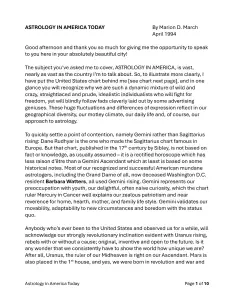
Astrology in America Today, Marion D. March, United States Chart, Gemini Ascendant, Uranian Astrology, Local Space, Project Hindsight, Lois Rodden, UAC. Marion D. March presents a comprehensive and sweeping lecture examining the state of astrology in the United States, utilizing a 7 July 1776 chart with Gemini rising and Uranus on the Ascendant as a symbolic reflection of American cultural and astrological traits. March discusses the rich eclecticism of American astrology, serving as a primary testing ground for international techniques and systems such as Midpoints, Uranian Astrology, Dr. Koch’s house systems, and composite charts from Germany, alongside Dane Rudhyar’s psychological insights from France. She details how American astrologers have championed innovations like Local Space (building on Edward Johndro, Charles Jayne, and Michael Erlewine), Heliocentric Astrology (popularized by T. Pat Davis), and Jim Lewis’s Astro*Carto*Graphy. Furthermore, she highlights the monumental work of Project Hindsight in retranslating classical texts, Lois Rodden’s monumental data collection efforts leading to the IDEA database, and the pioneering organizational frameworks of UAC (United Astrology Congress), AFAN, ISAR, and NCGR.

Issue Highlights:

Articles:
Astrology in America Today – Marion D. March

Discussion:
Debate between Gemini versus Sagittarius rising for the United States chart
The influence of computers and databases on astrological research (Lois Rodden, Edwin Steinbrecher, Michel and Françoise Gauquelin)
The professionalization of astrology and resistance to licensing
The intersection of astrology with technology, computers, and the Information Highway

Chart data:
US Chart 7 Gem ASC, July 4, 1776, 2:14 a.m. LMT, Philadelphia, PA

Notable contributors:
Marion D. March (Author / Lecturer)
Barbara Watters (Mundane astrology / Gemini rising usage)
Dane Rudhyar (Astrological philosophies and lunar phases)
Dr. Eugen Jonas (Fertility astrology)
Angel Thompson (Feng Shui and modern applications)
Michael Erlewine (Local Space mathematics and software)
T. Pat Davis (Heliocentric astrology)
Olivia Barclay, Ivy Jacobson, Joan McEvers (Horary astrology revitalization)
Jacob Schwartz (Draconic system)
Robert Hand, Robert Schmidt, Robert Zoller (Project Hindsight translation)
Jim Lewis (Astro*Carto*Graphy)
Lois Rodden (Data collection and birth data categorization)
Edwin Steinbrecher (Biographical research databases)
Neil Michelsen (Computerized ephemerides and research support)

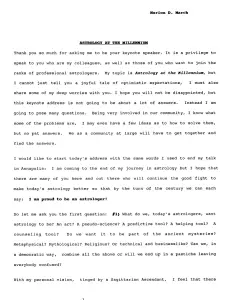
Professionalism, Astrological Standards, Millennium, Cultural Integration. Marion D. March delivers a passionate and challenging keynote address focusing on the state of astrology as the 20th century draws to a close. She raises eleven critical questions regarding the identity, reputation, standards, and future of astrology in a rapidly changing world. March examines external criticisms from scientists like Richard Dawkins, legal and financial controversies, the need for standardized training and testing akin to acupuncture and psychology, and the internal politics of major astrological organizations such as AFA, AFAN, ISAR, and NCGR. She highlights positive milestones including UAC faculty compensation, improved literature, computer advancements, financial research by Arch Crawford and Ray Merriman, the Gauquelins’ statistical research, Project Hindsight, and the unifying power of the Internet.

Issue Highlights:
A keynote address exploring the evolution of astrology, the necessity of professional standards, overcoming poverty consciousness among astrologers, and navigating technological and societal seachanges toward the new millennium.

Articles:
Astrology at the Millennium – Marion D. March

Discussion:
What do astrologers want astrology to be (art, science, predictive tool, helping tool)?
Public perception and attacks from the scientific community.
The need for testing, licensing, and standardized education.
Internal politics and division among astrological organizations.
The validity of astrology and empirical vs. judicial approaches.
The impact of computers, the Internet, and Project Hindsight.
Astrologers’ poverty consciousness and professional compensation.
Cyclical time vs. linear time and the philosophical implications of the upcoming millennium.

Chart data:
N/A

Notable contributors:
Marion D. March (Keynote Speaker)
Nick Campion (Natural vs. Judicial Astrology)
Joan McEvers (Astrology as a tool)
Arch Crawford (Financial Astrology)
Ray Merriman (Financial Astrology)

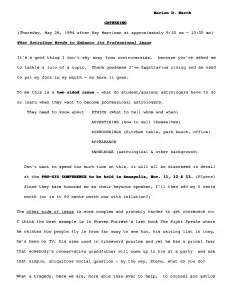
Professional Astrology, Ethics, Licensing, Education, Public Image. In this transcript of a presentation given on Thursday, May 26, 1994, prominent astrologer Marion D. March addresses the crucial topic of what astrology needs to do to enhance its professional image. March outlines a two-sided issue facing the astrological community: what students and amateurs must learn before turning professional (encompassing ethics, advertising, surroundings, appearance, and broad knowledge), and the broader sociological and psychological challenges faced by established professionals like Steven Forrest, who grapple with public disclosure and societal perceptions. She dives deeply into four major controversies: poverty consciousness and charging appropriately for astrological services, the negative public perception fueled by sun sign astrology and 900-number psychics, the necessity of academic degrees and university representation through projects like Kepler, and the controversial topic of professional licensing inspired by lawyer Jim Turner’s work with acupuncturists.

Issue Highlights:

Articles:
What Astrology Needs to Enhance its Professional Image – Marion D. March

Discussion:
Poverty consciousness among astrologers and the necessity of charging fees
Public perception, sun sign astrology, 900 numbers, and psychic fairs
The need for academic degrees, university representation, and the Kepler project
Professional licensing, self-regulation, and comparisons to the acupuncture profession

Chart data:
N/A
N/A

Notable contributors:
Marion D. March (Keynote speaker discussing professional standards and ethics)

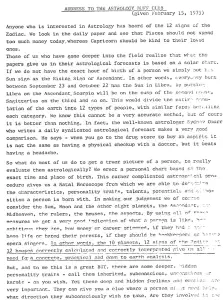
Arabic Parts, Lunar Nodes, Karmic Astrology, Chart Interpretation, Part of Fortune, Part of Spirit, The Web. In this address given to the Astrology Buff Club on February 15, 1973, Marion March explores the deeper psychological and karmic layers of the horoscope beyond standard sun-sign and basic natal chart delineations. Critiquing superficial newspaper forecasts, March discusses how accurate birth times and precise house calculations unlock core personality traits, while lunar nodes and specialized Arabic parts reveal unconscious patterns, past-life tendencies, and future spiritual evolution. Drawing on the philosophies of Dane Rudhyar and Isabel Hickey, March contrasts the comfortable habits of the South Node with the developmental challenge of the North Node, and reinterprets the formulas for the Part of Fortune, Part of Spirit, and a unique Arabic part known as ‘The Web’ taught by Irma Norman.

Issue Highlights:

Articles:
Address to the Astrology Buff Club – Marion March
Some Arabic Points and Their Deeper Meanings – Marion March

Discussion:
Differentiating solar charts from precise natal horoscopes
Psychological interpretation of the Lunar Nodes (North and South Nodes)
Reinterpreting the Part of Fortune (Pars Fortuna) and Part of Spirit
The Web Arabic Part and identifying psychological traps based on house placement
Using tight orbs for Arabic part aspects (maximum 3-degree orb)

Chart data:
N/A

Notable contributors:
Marion March (Author and lecturer)
Dane Rudhyar (Evolutionary and archetypal philosophy)
Isabel Hickey (Lunar nodes and subconscious patterns)
Ronald C. Davison (Planetary distribution relative to the lunar nodes)
Sydney Omarr (Newspaper astrological forecasts comparison)
Irma Norman (Originator of ‘The Web’ Arabic part)

Ask A Librarian

Need assistance with your research or navigating our collection? Our library team is here to help.

Please fill out the form below with details about the topics, authors, or archival materials you are looking for, and one of our librarians will review your query and respond shortly.

Help

Whether you are looking for rare historical texts or trying to locate a specific book nearby, Alexandria iBase offers two primary ways to search. Here is how to choose the right tool for what you need:

The Library Catalogue

Think of this as your global master index.

The Catalogue works just like a traditional library search system, designed to help you locate books and media across the broader astrological landscape.

  • Physical Books: Find out where physical copies of books are held in libraries, archives, or collections near you.

  • Digital Files: Access downloadable or viewable digital editions when available.

  • Best Used For: Standard research, finding specific ISBNs or authors, and tracking down physical items in the real world.

Browse Catalogue

SPECIAL COLLECTIONS

Think of this as Alexandria’s exclusive private vault.

Collections gives you direct access to Alexandria’s own curated archive of rare, proprietary, and historic astrology media.

  • Exclusive Material: Features unique texts, manuscripts, audio recordings, and visual media that are not available anywhere else.

  • Direct Access: Digitized content ready to explore straight from the platform.

  • Best Used For: Deep-dive research, discovering hidden gems, and exploring rare, one-of-a-kind astrological resources.

Browse Special Collections

Cash & In-Kind Donations

Make a one-time or recurring tax deductible cash donation.

Payment options include donating directly with us, PayPal Giving and GoFundMe.

GoFundMe for Charities and PayPal Giving are registered for tax deductions and have no required processing fees. It does offer the option to tip.

Donate

*Subject to 2.5% processing fees

Contact Us

Have a question, feedback, or a inquiry about our archives? We’d love to hear from you. Please fill out the form below with your details and message, and a member of our team will get back to you as soon as possible.

Thank you for reaching out to the Alexandria iBase Project!