Home » Astrocartography (Astro-Mapping)

Astrocartography (Astro-Mapping)

A modern astrological cartography technique formalized by Jim Lewis that projects a natal or event chart onto a terrestrial world map. By plotting the global longitude and latitude lines where planets occupied the four primary angles (Ascendant, Descendant, Midheaven, and Imum Coeli) at the exact moment of birth, it delineates the psychological and experiential impact of specific geographic relocations.

Filters

Filters


See more See less
See more See less
See more See less
See more See less
See more See less
See more See less
See more See less

Sorting

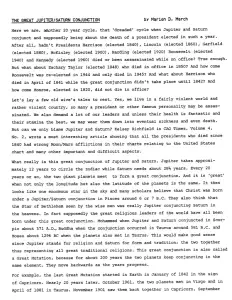
Mundane Astrology, Jupiter-Saturn Conjunctions, Great Mutation. This article provides a comprehensive exploration of the 20-year cycle of Jupiter/Saturn conjunctions, often referred to as a “Great Mutation.” The author discusses the historical folklore regarding the deaths of U.S. presidents elected in conjunction years, debunking it by referencing more complex astrological factors like Moon/Mars afflictions and difficult aspects in national charts. The text details the transition from Earth-sign to Air-sign cycles, specifically the movement into Libra in 1980-1981 and eventually Aquarius in 2020, forecasting a shift toward intellectual, social, and humanitarian themes.

The synthesis includes a deep dive into the 1980-1981 triple conjunction occurring in Libra. The author utilizes the Astro*Carto*Graphy method, invented by Jim Lewis, to analyze the impact of these planetary alignments on global nations, focusing on angularity and planetary aspects to the charts of independent nations and their leaders. The text highlights how specific countries, including the U.S., France, the USSR, and Turkey, have the conjunction on their angles, suggesting heightened influence or unpredictability for those regions.

Issue Highlights:

Articles:
The Great Jupiter/Saturn Conjunction – Marion D. March
Astro*Carto*Graphy – Jim Lewis

Discussion:
Mundane astrological forecasting
The impact of Great Mutation cycles on global politics and economics
Utilizing national constitutions for birth charts
Geopolitical analysis using Astro*Carto*Graphy

Chart data:
United States
USSR
France
Turkey
Various national charts based on constitutional dates

Notable contributors:
Marion D. March (Author/Astrological analysis)
Jim Lewis (Astro*Carto*Graphy technique developer)
Johanna Koch (Data collection)
Bette Travis (Data collection)
Angel Thompson (Data collection)

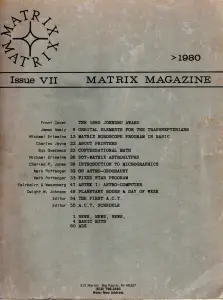
Computerized Astrology, Astrological Programming, A.C.T. Conference, Trans-Neptunian Planets. This issue of Matrix Magazine serves as a bridge between early computing technology and professional astrological practice. It focuses heavily on the technical application of microcomputers (Commodore PET, Apple II, TRS-80) to astrological research, offering BASIC programming code for chart calculations, orbital elements for Trans-Neptunian planets (Cupido, Hades, Zeus, Kronos, Apollon, Admetos, Vulkan, Poseidon), and instructions for printer-based astroglyph generation. The magazine also introduces the “ASTEK I,” a specialized astrological computer, and discusses the use of microfilm for archival astrological data storage.

Issue Highlights:
The 1980 Johndro Award is presented to Neil F. Michelsen for his pioneering work in computer-assisted ephemerides and astrological software. The issue also provides a comprehensive schedule for the first Astrological Conference on Techniques (A.C.T.) held in New Orleans, covering a wide array of research topics from planetary cycles to rectifiction methods.

Articles:
Orbital Elements for the Transneptunians – James Neely
Matrix Horoscope Program in BASIC – Michael Erlewine
Conversational Math – Buz Overbeck
Dot-Matrix Astroglyphs – Michael Erlewine
Introduction to Micrographics – Charles Paul Jones
On Astro-Geography – Mark Pottenger
Fixed Star Program – Mark Pottenger
ASTEK I: Astro-Computer – Fairbairn & Wesenberg
Planetary Hours & Day of Week – Dwight W. Johnson

Discussion:
Application of BASIC programming in natal astrology
Technical specifications and history of the ASTEK I calculator
Astro-Geography and meridian contacts
Statistical analysis of astrological data
Microfilm implementation for astrological libraries
Planetary rulers and the day of the week

Chart data:
Michael Erlewine (Born 7/18/1941, 4:03 PM EST, Lancaster, PA)

Notable contributors:
Michael Erlewine (Editor/Computing), James Neely (Orbital elements/programming), Mark Pottenger (Fixed star programming), Charles Jayne (Conference/Techniques advice), Buz Overbeck (Conversational math)

Pluto, Astrology, Shadow Work, Obsession, Metamorphosis. This lecture transcript from Duncan Nanney provides an unconventional exploration of Pluto, challenging standard astrological interpretations by encouraging the direct, conscious engagement with “forbidden” or taboo aspects of the human experience. Nanney argues that Pluto represents intense energy that, if repressed, manifests as uncontrollable or destructive external forces; conversely, he posits that by consciously confronting one’s “shadow” (obsessions, taboo sexual expressions, and deep-seated fears), an individual can achieve greater psychological integration and metamorphosis. He utilizes a “Planetville” concept—inspired by Rex Bills’ The Rulership Book—to map astrological archetypes onto a city, where Pluto governs the often ignored, “bad” parts of town, which are nonetheless essential to the whole.

Issue Highlights: The document serves as an analytical guide to navigating the 2002 Saturn-Pluto opposition, which the speaker links to broader themes of national security post-9/11 and the necessity for individual inner work. He discusses the difference between Uranus-driven inventiveness and Pluto-driven obsessive inquiry, frequently illustrating his points with film analyses (e.g., Blue Velvet) and personal anecdotes concerning his own “Plutonian” pursuits, including his experiences as a performance artist and in S/M communities. The lecture serves as a workshop in radical self-honesty, demanding that participants acknowledge their own dark desires rather than projecting them onto others or masking them with spiritual platitudes.

Articles:
How to Have Fun with Pluto (Revisited) – Duncan Nanney

Discussion:
The role of the Saturn-Pluto opposition in personal and collective transformation
The necessity of integrating the shadow and forbidden fruits in spiritual growth
The use of Local Space Maps to identify geographic correlations with natal charts
Case studies of celebrities (Madonna, Ed Wood, Jr., Lenny Bruce, Jack Nicholson, John Holmes, Roman Polanski, Anton LaVey, Ed Gein) through the lens of Plutonian energy

Chart data:
Madonna
Ed Wood, Jr.
Lenny Bruce
Jack Nicholson
John Holmes
Duncan Nanney
Roman Polanski
Anton LaVey
Ed Gein

Notable contributors:
Duncan Nanney (Astrological lecture, author of Planetville map)

Astrology in America Today (1994)

Marion D. March, Special Collections

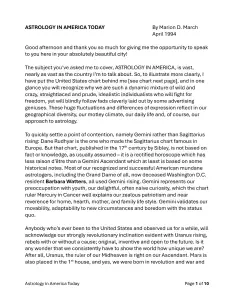
Astrology in America Today, Marion D. March, United States Chart, Gemini Ascendant, Uranian Astrology, Local Space, Project Hindsight, Lois Rodden, UAC. Marion D. March presents a comprehensive and sweeping lecture examining the state of astrology in the United States, utilizing a 7 July 1776 chart with Gemini rising and Uranus on the Ascendant as a symbolic reflection of American cultural and astrological traits. March discusses the rich eclecticism of American astrology, serving as a primary testing ground for international techniques and systems such as Midpoints, Uranian Astrology, Dr. Koch’s house systems, and composite charts from Germany, alongside Dane Rudhyar’s psychological insights from France. She details how American astrologers have championed innovations like Local Space (building on Edward Johndro, Charles Jayne, and Michael Erlewine), Heliocentric Astrology (popularized by T. Pat Davis), and Jim Lewis’s Astro*Carto*Graphy. Furthermore, she highlights the monumental work of Project Hindsight in retranslating classical texts, Lois Rodden’s monumental data collection efforts leading to the IDEA database, and the pioneering organizational frameworks of UAC (United Astrology Congress), AFAN, ISAR, and NCGR.

Issue Highlights:

Articles:
Astrology in America Today – Marion D. March

Discussion:
Debate between Gemini versus Sagittarius rising for the United States chart
The influence of computers and databases on astrological research (Lois Rodden, Edwin Steinbrecher, Michel and Françoise Gauquelin)
The professionalization of astrology and resistance to licensing
The intersection of astrology with technology, computers, and the Information Highway

Chart data:
US Chart 7 Gem ASC, July 4, 1776, 2:14 a.m. LMT, Philadelphia, PA

Notable contributors:
Marion D. March (Author / Lecturer)
Barbara Watters (Mundane astrology / Gemini rising usage)
Dane Rudhyar (Astrological philosophies and lunar phases)
Dr. Eugen Jonas (Fertility astrology)
Angel Thompson (Feng Shui and modern applications)
Michael Erlewine (Local Space mathematics and software)
T. Pat Davis (Heliocentric astrology)
Olivia Barclay, Ivy Jacobson, Joan McEvers (Horary astrology revitalization)
Jacob Schwartz (Draconic system)
Robert Hand, Robert Schmidt, Robert Zoller (Project Hindsight translation)
Jim Lewis (Astro*Carto*Graphy)
Lois Rodden (Data collection and birth data categorization)
Edwin Steinbrecher (Biographical research databases)
Neil Michelsen (Computerized ephemerides and research support)

ASPECTS Vol. 6 No. 1 Winter 1980-81 Part 2/2

ASPECTS Magazine, Special Collections

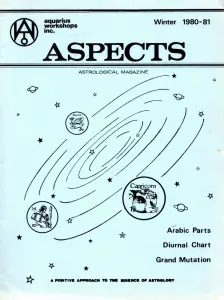
Astrological techniques, horary analysis, Arabic parts, Diurnal charts, and the Grand Mutation of Jupiter and Saturn. This issue of Aspects features extensive technical explorations of predictive and mundane astrology. Robert ‘Buz’ Myers details the calculation and application of Arabic Parts. Marion D. March explores the grand astrological significance of the Jupiter-Saturn conjunction, evaluating its historical impacts and mundane country correlations using Jim Lewis’s Astro*Carto*Graphy. Lenora M. Hill introduces the simplicity and practical application of the Diurnal (daily) Chart, complete with step-by-step mathematical examples, Yod configurations, and transit correlations. Joan McEvers provides insights into numerological pinnacles, while Linda Green investigates Astropalmistry through hand-shape classifications and water-hand patterns. Enrique Linarés introduces the ‘Point of Life’ progression method. Additionally, book reviews by Marion D. March and data columns by Lois Rodden round out the edition.

Issue Highlights:

Articles:
How to Calculate Your Arabic Parts – Robert ‘Buz’ Myers
The Great Jupiter/Saturn Conjunction – Marion D. March
The Diurnal (Daily) Chart – Lenora M. Hill
The Point of Life – Enrique Linarés
Basic Delineation – Marion D. March
Astro-Numerology: The Meanings of the Numbers (Pinnacles) – Joan McEvers
Astropalmistry – Linda Green

Discussion:
Calculating Arabic parts using formula segments
Jupiter-Saturn conjunctions and Grand Mutations entering Air signs
Diurnal chart calculation and activation via house cusps
Point of Life progression calculations
Astrological data corrections and book reviews

Chart data:
Horary Question (8/17/79 8:49 PM PDT, Coeur d’Alene)
Basic Delineation natal chart (3/30/1853 11:00 AM LMT, Zundert, Holland)
Diurnal Chart (June 28, 1980)
Water Hand Natal Horoscope (Figure 2)

Notable contributors:
Robert ‘Buz’ Myers (Arabic Parts)
Marion D. March (Jupiter-Saturn Conjunction & Basic Delineation)
Lenora M. Hill (Diurnal Charts)
Enrique Linarés (Point of Life Progression)
Joan McEvers (Astro-Numerology)
Linda Green (Astropalmistry)
Lois Rodden (Data Column)

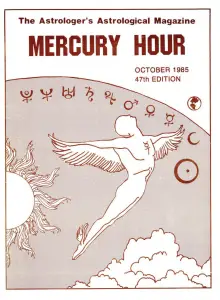
Astrological Techniques, Astrology History, and Mundane Astrology. This archival item is the October 1985 issue (47th Edition) of Mercury Hour, a quarterly magazine edited by Edith Custer and Jewell Fahey in Lynchburg, Virginia. Key contents include technical articles such as John F. Gay, III’s guide to calculating house cusps and astronomical coordinates using scientific calculators, Joan McEvers’s second installment on interpreting Lunar Returns, and Dorothy Willis’s foundational rules for astro-meteorology. Mundane and historical pieces feature Marc Penfield’s chart rectifications for Russia’s 1917 Bolshevik Revolution and the “Chart Mart” data collection, Fran Rosen’s explorations of the Kabbalistic Tree of Life and Tarot symbolism, and Gilbert Navarro’s definition of horary astrology. Additional contributions include reviews by Marion March, reports on the 7 Hills Astrological Conference, an analysis of the 1985 Bradford football stadium fire by Olivia Barclay, and reader discussions surrounding topics such as ethics, licensing, house systems, and birth data for figures like Ronald Reagan, Mikhail Gorbachev, and Mary Baker Eddy.


Issue Highlights


Book Reviews

By Marion March:

Celestial Psychology: An Astrological Guide to Growth and Transformation by Doris A. Hebel

Astrochemistry: A Study of Metal-Planet Affinities by Nick Kellerstrom

Instant Astrology by Mary Orser, Rick and Glory Brightfield

The Astrology of Deep Space by Philip Sedgwick

Spiritual Astrology: A Layperson’s Guide to Self-Unfoldment by Jan Spiller

The Practice and Profession of Astrology by Stephen Arroyo

Birth Pattern Psychology by Tamise Van Pelt

The Astrological Prayer Book by Alda Marian Jangl
Your Key to Astrology [book plus] Astrological Key Cards: Planets, Signs, Houses, Aspects by Bill Hansen – Edith Custer


Articles

Astrology and the Weather – Dorothy Willis

Lunar Return Notes, Part II – Joan McEvers

Calculation Without Tables of the Julian Day & Century, Obliquity of the Ecliptic, MC, ASC, and Houses, Part I – John F. Gay, III

The Tree of Life: An Overview – Fran Rosen

Astrological Hall of Fame Awards – Fraternity for Canadian Astrologers [2nd National Conference]

Along the Tarot Path – Fran Rosen

How I Survived my Pluto Square Pluto and Other Transits – Carol Hemingway

The Luscher Color Test, A Symbolic Testing Model – Zan Key

Observations on Astrology, Original & Borrowed – John F. Gay, III

I’m Mad at You!!!! – Mary Ellen Glass

The Horoscope of Russia – Marc Penfield

Chart Mart – Marc Penfield

A Trip Round the Hawaiian Zodiac, Part II – Cheryl Niggle

Astrology and the Weather: Forecasting the Weather, Part I – Dorothy Willis

Horary Astrology: A Definition – Gilbert Navarro

The Business Cycle, Part II – Bill Hansen

Neptune, The Collective Fantasy, and Popular Music – Amy Franco

The Mystery of the Chinese Zodiac, Now Revealed for the First Time – Frank Hampton

The Qualities of Time, Part I – Tundra Wind


Discussions

Astrology, licensure, & ethics

Quadrant house systems vs. Equal Houses

Radix-based Tarot technique

Natal location in Return chart

Birth time of Ronald Reagan

Seven Hill Astrological Conference [reports]

Mercury retrograde


Chart data

Anderson, Loni
Benetar, Haley (daughter of Pat Benetar)
Bowie, David
Eddy, Mary Baker
Eisenhower, Melanie (daughter of Julie Nixon and David Eisenhower)
Gorbachev, Mikhail
Jagger, Elizabeth (daughter of Mick Jagger and Jerri Hall)
Kennedy III Robert F.
Morgan, Vicki
Neves, Tancredo
Pace, Canio and Thomas (cross-year twins)
Reagan, Ronald
Schwab, Loluis and Leona (cross-year twins)
Spielberg, Max (son of Steven Spielberg and Amy Irving)Vaughn, Sarah

Frustaci sextuplets
Czar Nicholas II
Prince Henry

Air India 747 jetliner crash
Christian Science Church
Formation of the Soviet Union
Founding of Tel Aviv
Halley’s Comet return
Live Aid Concert 1985


Notable contributors

Joylyn Hill (Chart of Israel, chart of Robert E. Lee, the nature of Venus)

Olivia Barclay (astrological signature of fires and explosions)

Misty Kuceris (7 Hills Conference)

Robert Pelletier (7 Hills Conference)

Zane Stein (Solstice points, Sabian symbols)

Erin Sullivan (Mercury retrograde)

Michael and Margaret Erlewine (Matrix Heart Center)

Eleanor Bach (Marc Edmond Jones Award)

Lee Lehman (Kundalini and asteroid Sappho)
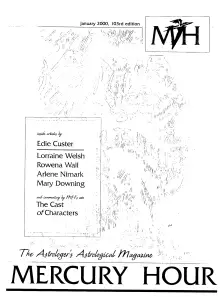
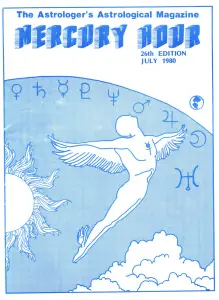
Mundane Astrology, Medical Astrology, and Astrological Techniques. This archival item is the January 2000 issue (103rd Edition) of Mercury Hour, a quarterly astrological magazine edited and published by Edith Custer in Lynchburg, Virginia. Key contents include Lorraine Welsh’s article addressing a psychiatric clinic checklist that categorized using astrology alongside mental health pathologies, Virginia Reyer’s examination of the Nodal Barrier trapped configuration across various birth charts, and Rowena Wall’s guide to relocation astrology featuring city charts for Las Vegas and Toronto. The issue features Mary Downing’s eclipse watch report on the January 20 lunar eclipse and February 5 solar eclipse, Arlene Marcia Nimark’s “Tidbits and Obits” column detailing charts for public figures including Placido Domingo, Catfish Hunter, and Lance Armstrong, and Guy de Penguern’s medical astrology study on Chiron keywords and planetary sendings. Additional contributions include reviews of books by Terry Lamb and Bil Tierney, alongside reader discussions on Y2K, solar flares, Chaos Theory, the Bible Code, and chart data for figures such as John F. Kennedy Jr. and Dr. Jack Kevorkian.


Issue Highlights
Book Reviews
By Lorraine Welsh:
Born to be Together: Love, Relationships, Astrology, and the Soul by Terry Lamb
Daily Planetary Guide 2000 by Llewellyn Publications
***
Alive and Well with Uranus by Bil Tierney – Edith Custer
Articles
Fear Abandonment, Use Astrology, Cut Wrist: The faces of prejudice
– Lorraine Welsh
Passport to Good Visiting – Rowena Wall
Trapped Configuration, also called the Nodal Barrier – Virgina Reyer
Tidbits and Obits – Marcia Nimark
Eclipse Watch [Jan 20 and Feb 5, 2000] – Mary Downing
Discussions
August 1999 Eclipse
Chart of Jack Kevorkian
Chaos Theory
War of 1812
Black Moon Lilith
Chart data
(some incomplete or in question)
Armstrong, Lance
Bessete, Carolyn
Bradley, Bill
Cullberg, Birgit
Domingo, Placido
Exner, Judith Campbell
Gore Jr., Al


Hardin, Louis “Moondog”
Hunter, Catfish
Kevorkian, Jack
McCain, John
Mraz, Charles
Mussolini, Benito
Parker Bowles, Camilla


Rimes, LeeAnn
Sarraute, Nathalie
Schoen, Leonard S.
Starr, Ringo
Weill, Kurt


New York City Subway opening
Saturday Night Live (debut)
Las Vegas, Nevada
Toronto, Ontario, Canada
Notable contributors
Bil Tierney (new books in his Alive and Well trilogy)
Marion March (birth data; books on Progressions)

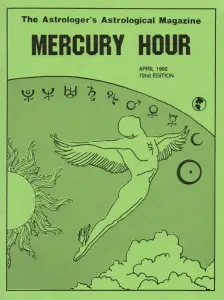
Astrology, Horary, House Systems, Synastry, and Transits. This edition of Mercury Hour features extensive reader discussions and technical articles covering various astrological branches. Topics include an exploration of planetary speeds and Kepler’s theories by Donald E. Byrne, declination and out-of-bounds planets by Gilbert Navarro, synastry and musical charts comparing John Lennon, Paul McCartney, Richard Nixon, and Yoko Ono by Dianne Lawson, as well as a concluding critique of the Koch House System by M. J. Makransky. Additional articles cover astrolocality mapping variants, Russian history and charts by Annibale F. Verzumo, Vernal Equinox charts, I Ching trigrams, and book reviews covering computer software, house development, and planetary stations.

Issue Highlights:

Articles:
Where is Vulcan & Nemesis? Part I – Donald E. Byrne
John Lennon and Paul McCartney, Richard Nixon, and Yoko Ono – Dianne Lawson
The Last Word on the Koch House System and Further Critique of the Koch House System, Part II, Conclusion – M. J. Makransky
Precession of the Equinox – Donald E. Byrne
How to Make Astrology Pay From A-Z, Part II, Conclusion – Adze Mixxe
Variant Forms of Astrolocality Mapping, Part I – M. J. Makransky
[Russia] Part III, Conclusion – Annibale F. Verzumo
Vernal Equinox March 20, 1992 – Dorothy S. Willis
Corrections: The Book of World Horoscopes – Nicholas Campion
I Ching: The Trigrams-Fu Hai Arrangement – Dorothy J. Sarka

Discussion:
Transpluto/Pluto Square 1991 – 1993
December 21, 1991 lunar eclipse
Secondary progressions
CSICOP and Humanistic astrology
Antichrist and Judgement Day discussions
Gulf War charts and Horary missing articles

Chart data:
Bill Clinton
Paul Keating
John Lennon
Paul McCartney
Richard Nixon
Yoko Ono
Paul Tsongas

Notable contributors:
Marion March (problematic astrological terminology)
Gilbert Navarro (declination)
Lee Lehman (humanism and CSICOP)
Diana Rosenberg (Jeffrey Dahmer chart)
Edith Custer (defending astrology)

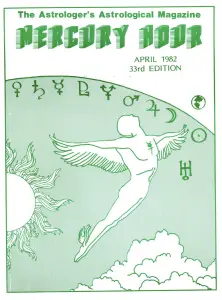
Astrological Research, Midpoints, Mundane Astrology. This issue of Mercury Hour serves as a dynamic forum for technical and philosophical astrological discourse during the early 1980s. The magazine balances detailed technical research—such as midpoint analysis, heliocentric vs. geocentric chart comparison, and mundane astrology applied to political events (e.g., the situation in Lebanon and Poland)—with active reader correspondence. A significant portion of the content is dedicated to challenging mainstream perceptions of astrology, exploring the intersection of psychology and astrology, and critiquing the rapidly emerging field of computerized chart calculation.

Issue Highlights:

Articles:
Chart Mart – Marc Penfield
Tragedy at Tanque Verde Falls: A Case for Midpoints – Barbara May
Khomeini’s Days Are Numbered – Manik Chand Jain
Mercury – Erin Sullivan
An Astrological Review of Passages (by Gail Sheedy) – Bil Tierney
Astrology vs. Psychology: A Minor Dilemma for the 80’s – Stanley Kustesky

Discussion:
Astrological research on incest
Astrological birth control (human and equine)
Ayatollah Khomeini
Pluto transits
Heliocentric astrology
Charts of Israel
Chart of Ronald Reagan
Astro*Carto*Graphy
Crash of AirFlorida Jet, Jan 13, 1982

Chart data:
Lucille Ball, John Lennon, Elvis Presley, Harvey Milk, Dan White, Pope John Paul II, Ronald Reagan, Ayatollah Khomeini

Notable contributors:
Zane Stein (eclipses, quincunxes, Association for Studying Chiron)
Michael Erlewine (Heliocentric astrology)
Al H. Morrison (Void-of-Course Moon)
Erin Sullivan (diverse astrological topics)

Mundane Astrology, Astrology History, and Astrological Techniques. This archival item is the April 1985 issue (14th Extra Edition) of Mercury Hour, a quarterly astrological magazine edited and published by Edith Custer in Lynchburg, Virginia. Featured articles include Raul Davila’s comparative study of published birth times for Ronald Reagan, Judy Goodwin’s research on name etymology in “The Astro-Punology of Names,” Marc Penfield’s chart analysis of the State of Israel, and T. Patrick Davis’s survey of geocentric and heliocentric Mars-to-Moon aspects alongside historical charts of the 1941 Pearl Harbor attack. Additional contributions cover Mary Mackenzie’s application of John H. Nelson’s heliocentric radio propagation forecasting methods, Judith Gee’s analysis of the 1939 Hitler-Stalin Pact, Marion March’s commentary on planetary configurations, and Joylyn Hill’s reflections on Atlantis. The issue also preserves community discussions regarding Gauquelin’s “Mars Effect,” astrological triggers for agoraphobia, forensic chart analyses of the Lindbergh baby kidnapping, and legal regulations surrounding professional astrology.


Issue Highlights

Book Review:

Relationships & Life Cycles, Modern Dimensions of Astrology by Stephen Arroyo – Rochelle Gordon


Articles:

Saturn Through the Signs – Bil Tierney

Crisis in the Near East – Gregg Castellucci

Chiron and Group Fusion – Tom McNamara

The Discovery of the Asteroids – Joylyn Hill

In the Winter of our Discontent – Marc Robertson (Jupiter-Saturn cycles)

Pluto (Part III) – R.C. Davison


Discussions:

AFA Conventions

Void of Course Moon

Ted Bundy

Inherited family traits


Chart data:

Ali, Mohammad
Anderson, John B.
Bergen, Candice
Crawford, Joan
Jones, Jim
Israel


Notable contributors:

Marion March (Fiji conference)

Lois Rodden (notes on chart data)

Jim Lewis (notes on A*C*G* maps of US Presidential candidates)

Lee Lehman (research on astrology & homosexuality)

Ask A Librarian

Need assistance with your research or navigating our collection? Our library team is here to help.

Please fill out the form below with details about the topics, authors, or archival materials you are looking for, and one of our librarians will review your query and respond shortly.

Help

Whether you are looking for rare historical texts or trying to locate a specific book nearby, Alexandria iBase offers two primary ways to search. Here is how to choose the right tool for what you need:

The Library Catalogue

Think of this as your global master index.

The Catalogue works just like a traditional library search system, designed to help you locate books and media across the broader astrological landscape.

  • Physical Books: Find out where physical copies of books are held in libraries, archives, or collections near you.

  • Digital Files: Access downloadable or viewable digital editions when available.

  • Best Used For: Standard research, finding specific ISBNs or authors, and tracking down physical items in the real world.

Browse Catalogue

SPECIAL COLLECTIONS

Think of this as Alexandria’s exclusive private vault.

Collections gives you direct access to Alexandria’s own curated archive of rare, proprietary, and historic astrology media.

  • Exclusive Material: Features unique texts, manuscripts, audio recordings, and visual media that are not available anywhere else.

  • Direct Access: Digitized content ready to explore straight from the platform.

  • Best Used For: Deep-dive research, discovering hidden gems, and exploring rare, one-of-a-kind astrological resources.

Browse Special Collections

Cash & In-Kind Donations

Make a one-time or recurring tax deductible cash donation.

Payment options include donating directly with us, PayPal Giving and GoFundMe.

GoFundMe for Charities and PayPal Giving are registered for tax deductions and have no required processing fees. It does offer the option to tip.

Donate

*Subject to 2.5% processing fees

Contact Us

Have a question, feedback, or a inquiry about our archives? We’d love to hear from you. Please fill out the form below with your details and message, and a member of our team will get back to you as soon as possible.

Thank you for reaching out to the Alexandria iBase Project!