
Home » Astrological Archiving

Astrological Archiving

The systematic collection, preservation, digitization, and cataloging of historical and contemporary astrological literature, periodicals, and research data to ensure long-term accessibility for the astrological community.

Filters

Filters


See more See less
See more See less
See more See less
See more See less
See more See less
See more See less
See more See less

Sorting

Project Alexandria, Astrological Librarianship, Data Preservation, AFA Library, IAO Research Centre. This document introduces “Project Alexandria,” a collaborative effort designed to create a “Great Comprehensive Encyclopedia” of astrological literature. The initiative aims to centralize fragmented astrological knowledge through modern computing and database systems, ensuring that historical and contemporary research is preserved, cataloged, and made accessible to the global astrological community. The text highlights the critical issue of scattered, disorganized, or inaccessible astrological collections, specifically citing the American Federation of Astrologers (AFA) library in Tempe and the International Astrological Organization (IAO) in Toronto as key subjects for remediation.

The synthesis emphasizes the necessity of cooperative action among professional organizations to overcome the physical and logistical hurdles of library management. It details the disorganized state of prominent archives, the efforts of volunteers like Neil Michelsen and Lilian Huber to bring structure to these collections, and the growing reliance on “data-base” projects like those piloted by MATRIX to track astrological events and historical chronologies. The project’s ultimate goal is to move beyond the limitation of physical, geographically restricted access by utilizing technology to create a universal, searchable repository.

Issue Highlights:

Articles:
Project Alexandria – Kathy Bremer
Editor’s Note: A clarification on the AFA library status – Uncredited

Discussion:
Digital cataloging of astrological literature
Organization of the AFA library in Tempe
The IAO Research Centre’s role in networking libraries
Data-base creation for historical astrological records

Chart data:
None mentioned.

Notable contributors:
Kathy Bremer (Author of Project Alexandria proposal)
Geoffrey Dean (Researcher on astrological statistics and bibliography)
Neil Michelsen (AFA member involved in library organization)
Lilian Huber (Volunteer for library assessment)
Bob Cooper (AFA liaison)

Astrology, Houses, Transits, Reincarnation, Eclipses, Synastry, Numerology. This 13th edition of Mercury House (April 1977) provides a comprehensive collection of astrological discussions, research notes, and reader correspondence. Key topics covered include the interpretation of Saturn in various houses, house systems and critiques of traditional vs. equal house methods, the mechanics of eclipses, chart comparison (synastry), sidereal vs. tropical numbering, and reincarnation past-life regressions mapped through natal charts. Articles explore specialized techniques such as midpoints, deciles and quintiles (minor aspects), and the application of harmonics in chart analysis. The issue also features extensive letters from subscribers detailing personal transits, planetary aspects, and astrological research anomalies.

Issue Highlights:

Articles:
Zodiacal Numbering – Jeff Jawar
Saturn in the Houses (continuation) – Dr. Robert H. Goodrich
Saturn – Marc Penfield
A Key to Relationships [The Art of Chart Comparison] Introduction – Stephen Arroyo
Eclipses (first part in a series) – Ray Merriman
Some Notes on Astrological Research – Ingrid Naiman
Reincarnation – Marc Penfield
The Zodiac of Aspects (first of a two-part series) – Glenda Tomosovich
Astrological Review of an Autobiography [Alone by Admiral Richard E. Byrd] – Prem H. Joshi
The People’s Choice…A Different View of the Next Four Years – Dr. Robert H. Goodrich

Discussion:
Saturn in the 1st and 6th houses
House systems and Gauquelin research
Horoscope of Jesus
Aspects of artistic genius and medical astrology

Chart data:
Bob Dylan
Thor Heyerdahl
OJ Simpson
Omar Sharif
Ethel Kennedy
Jerry Brown
John Dean
Neil A. Armstrong
New York Stock Exchange

Notable contributors:
Marion March (Various topics and responses)
Zip Dobyns (Birthcharts and commentary)

Pluto, Astrology, Shadow Work, Obsession, Metamorphosis. This lecture transcript from Duncan Nanney provides an unconventional exploration of Pluto, challenging standard astrological interpretations by encouraging the direct, conscious engagement with “forbidden” or taboo aspects of the human experience. Nanney argues that Pluto represents intense energy that, if repressed, manifests as uncontrollable or destructive external forces; conversely, he posits that by consciously confronting one’s “shadow” (obsessions, taboo sexual expressions, and deep-seated fears), an individual can achieve greater psychological integration and metamorphosis. He utilizes a “Planetville” concept—inspired by Rex Bills’ The Rulership Book—to map astrological archetypes onto a city, where Pluto governs the often ignored, “bad” parts of town, which are nonetheless essential to the whole.

Issue Highlights: The document serves as an analytical guide to navigating the 2002 Saturn-Pluto opposition, which the speaker links to broader themes of national security post-9/11 and the necessity for individual inner work. He discusses the difference between Uranus-driven inventiveness and Pluto-driven obsessive inquiry, frequently illustrating his points with film analyses (e.g., Blue Velvet) and personal anecdotes concerning his own “Plutonian” pursuits, including his experiences as a performance artist and in S/M communities. The lecture serves as a workshop in radical self-honesty, demanding that participants acknowledge their own dark desires rather than projecting them onto others or masking them with spiritual platitudes.

Articles:
How to Have Fun with Pluto (Revisited) – Duncan Nanney

Discussion:
The role of the Saturn-Pluto opposition in personal and collective transformation
The necessity of integrating the shadow and forbidden fruits in spiritual growth
The use of Local Space Maps to identify geographic correlations with natal charts
Case studies of celebrities (Madonna, Ed Wood, Jr., Lenny Bruce, Jack Nicholson, John Holmes, Roman Polanski, Anton LaVey, Ed Gein) through the lens of Plutonian energy

Chart data:
Madonna
Ed Wood, Jr.
Lenny Bruce
Jack Nicholson
John Holmes
Duncan Nanney
Roman Polanski
Anton LaVey
Ed Gein

Notable contributors:
Duncan Nanney (Astrological lecture, author of Planetville map)

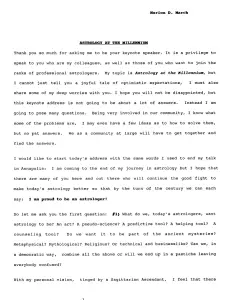
Professionalism, Astrological Standards, Millennium, Cultural Integration. Marion D. March delivers a passionate and challenging keynote address focusing on the state of astrology as the 20th century draws to a close. She raises eleven critical questions regarding the identity, reputation, standards, and future of astrology in a rapidly changing world. March examines external criticisms from scientists like Richard Dawkins, legal and financial controversies, the need for standardized training and testing akin to acupuncture and psychology, and the internal politics of major astrological organizations such as AFA, AFAN, ISAR, and NCGR. She highlights positive milestones including UAC faculty compensation, improved literature, computer advancements, financial research by Arch Crawford and Ray Merriman, the Gauquelins’ statistical research, Project Hindsight, and the unifying power of the Internet.

Issue Highlights:
A keynote address exploring the evolution of astrology, the necessity of professional standards, overcoming poverty consciousness among astrologers, and navigating technological and societal seachanges toward the new millennium.

Articles:
Astrology at the Millennium – Marion D. March

Discussion:
What do astrologers want astrology to be (art, science, predictive tool, helping tool)?
Public perception and attacks from the scientific community.
The need for testing, licensing, and standardized education.
Internal politics and division among astrological organizations.
The validity of astrology and empirical vs. judicial approaches.
The impact of computers, the Internet, and Project Hindsight.
Astrologers’ poverty consciousness and professional compensation.
Cyclical time vs. linear time and the philosophical implications of the upcoming millennium.

Chart data:
N/A

Notable contributors:
Marion D. March (Keynote Speaker)
Nick Campion (Natural vs. Judicial Astrology)
Joan McEvers (Astrology as a tool)
Arch Crawford (Financial Astrology)
Ray Merriman (Financial Astrology)

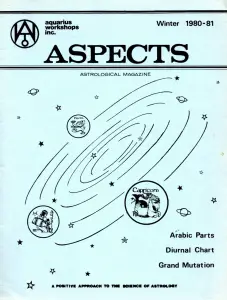
ASPECTS Vol. 6 No. 1 Winter 1980-1 Part 1/2

ASPECTS Magazine, Special Collections

Arabic Parts, Grand Mutation, Fifth House, Sextiles. This issue of Aspects astrological magazine delivers an extensive exploration of foundational and advanced astrological techniques, featuring detailed instructional breakdowns and conference updates. Robert ‘Buz’ Myers provides a comprehensive guide on calculating and interpreting ten key Arabic Parts (including the Part of Fortune, Love, Passion, Increases, Fate, Catastrophe, Treachery, and Organization) through the twelve houses and signs. Marion D. March analyzes the monumental Great Jupiter/Saturn Conjunction and the Capricorn Ingress Chart for December 1980, discussing world consciousness shifts and the transition into the Air trigon. Additionally, Lenora M. Hill examines the Diurnal (Daily) Chart, Enrique Linarés writes on the Point of Life, Joan McEvers breaks down the symbolism of the Fifth House in her ‘Keys to Learning’ series, and Nancy Cassidy details the harmonious exchange of energy found in Sextiles.

Issue Highlights: Conference reports cover SWAC 1980, the upcoming Astrology World-Congress 1981 in Zurich, and the First Metaphysical Congress. Regular columns include Letters to the Editor, President’s Message by Roberta Fueyo, What’s Happening, Book Reviews, and Lois Rodden’s Data Column.

Articles:
How to Calculate Your Arabic Parts – Robert ‘Buz’ Myers
The Great Jupiter/Saturn Conjunction – Marion D. March
The Diurnal (Daily) Chart – Lenora M. Hill
The Point of Life – Enrique Linarés
Keys to Learning: Fifth House – Joan McEvers
Building Blocks: Sextiles – Nancy Cassidy
Capricorn Ingress – Judy Johns

Discussion:
Calculation and house interpretation of Arabic Parts
Astrological shifts during the Jupiter/Saturn conjunction in Libra
Practical applications of diurnal charts and secondary progressions
Creative and psychological significations of the Fifth House
Harmonious energy exchanges through Sextile aspects

Chart data:
Capricorn Ingress Chart (December 21, 1980, Washington, D.C.)
Sample calculation chart for Arabic Parts (October 28, 1975, Encino, CA)

Notable contributors:
Robert ‘Buz’ Myers (Arabic Parts)
Marion D. March (Great Jupiter/Saturn Conjunction)
Joan McEvers (Fifth House mechanics)
Nancy Cassidy (Sextiles)
Lenora M. Hill (Diurnal Charts)

Vesta: Keeper of the Flame (1994)

Frances McEvoy, Special Collections

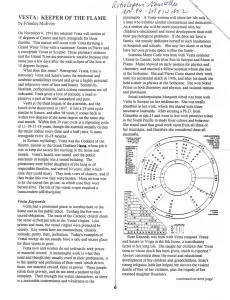
Asteroid Vesta, Grand Trine, Natal Astrological Analysis, Confinement and Solitude, Birth Data. This issue features an in-depth astrological analysis of the asteroid Vesta by Frances McEvoy, framed by Vesta’s November 1994 station at 10 degrees Cancer forming a Grand Water Trine with Saturn in Pisces and Venus in Scorpio. McEvoy explores Vesta’s 29-year cycle, its mythological roots as the Goddess of the Hearth, and its archetypal keywords such as commitment, chastity, solitude, purity, duty, perfection, and transcendent self-discipline. The article delineates how Vesta operates in both male and female charts, highlighting themes of dedicated work, privacy, and inner strength.

The study examines numerous chart examples illustrating Vesta’s impact on public service, science, art, and personal sacrifice. Detailed case studies include Marie Curie, Margaret Mead, Maria Montessori, Anne Frank, Sister Francesca Cabrini, Saint Therese of Lisieux, Queen Victoria, Grace Kelly, Jerry Brown, David Souter, Yassar Arafat, Oliver North, Angela Davis, Betty Friedan, Helen Keller, Michel Gauquelin, Bobby Fischer, and major classical composers like Bach, Mozart, Schubert, and Chopin. Themes of confinement, religious devotion, political zealotry, and intellectual immersion are thoroughly traced through Vesta’s aspects and house placements.

Additionally, Lorraine Welsh presents “The Data Base,” providing precise birth data for political candidates and public figures of the period, including Mitt Romney, Joe Malone, Paul Cellucci, and Pope John Paul II. An informational announcement for Robert Hand’s instructional classes on Traditional Western, Renaissance, and Hellenistic astrology is also included.

Issue Highlights:

Articles:
VESTA: KEEPER OF THE FLAME – Frances McEvoy
The Data Base – Lorraine Welsh

Discussion:
Vesta cycle and astronomical station patterns
Vesta in psychological, natal, and mundane astrology
Confinement, solitude, and religious devotion in chart analysis
Verified birth data for political candidates and notable figures
Instruction in Hellenistic and Renaissance traditional astrology

Chart data:
Maria Montessori
Yassar Arafat
Helen Keller
Mitt Romney
Joe Malone
Paul Cellucci
Pope John Paul II (Karol Wojtyla)

Notable contributors:
Frances McEvoy (Vesta: Keeper of the Flame)
Lorraine Welsh (The Data Base)
Robert Hand (Traditional Astrology Classes)

Mundane Astrology, Predictive Astrology, and Astrology History. This archival item is the October 1994 issue (82nd Edition) of Mercury Hour, a quarterly astrological magazine edited and published by Edith Custer in Lynchburg, Virginia. Key contents include Part 1 of Robert Zoller’s four-part series on Guido Bonatti and medieval European astrological literature, Van K. Golay’s mundane assessment of the “Soviet Power” regime and its post-1987 transformation, and Marc Penfield’s astrological analysis of natural disasters in California alongside chart profiles for Rodney King and O.J. Simpson. The issue features extensive coverage and reader discussions surrounding the O.J. Simpson murder case, featuring chart analyses and comparisons by T. Pat Davis, Karen Christino, Jim Haynes, Joseph S. deMello, John Somoza, and Edith Custer. Additional contributions include Dorothy Willis’s weather predictions for the 1994 Autumn Equinox, book reviews by Rose D. Owen, Edith Custer, Marc Penfield, and Ann Requa, and community discussions on solar return timing, death indicators, house representations of parents, and software/computer developments.


Issue Highlights


Book Reviews

The Eagle and the Lark (A Textbook of Predictive Astrology) by Bernadette Brady

– Rose D. Owen

Forecasting – Backward & Forward by Bruce Hammerslough

– [two reviews] Edith Custer and Marc Penfield

A History of Western Astrology by Jim Tester – Ann Requa


Articles

Crisis Alert [California natural disasters] – Marc Penfield

Autumn Equinox 1994 – Dorothy Willis

“Soviet Power” Dead or Alive? – Van K. Golay

Guido Bonatti and the Spread of Astrological Literature in Mediaeval Europe,

Sive, Pro Astrologica per se Studiendo, Part 1 of 4 – Robert Zoller

People [Rodney King; O.J. Simpson] – Marc Penfield


Discussions

O.J. Simpson case

Neptune

Transiting Saturn in Pisces (1994)

Timing in solar return charts

Locating death in a chart

House representation of parents

Bill Clinton/Whitewater


Chart data

Simpson, O.J.

O.J. Simpson case lawyers:

Cowlings, A.C.

Dershowitz, Alan

Lerner, Mark

Shapiro, Robert

Bundy, Ted

Candy, John

King, Rodney

Klaas, Polly

Davis, Richard Allen (abductor of Polly Klaas)

Los Angeles, CA (City & County)


Notable contributors

Carole Devine (astrological counseling; timing in solar returns)

Karen Christino (O.J. Simpson)

Lois Rodden (Michael Jackson birth time; continuation of chart after death)

Marion March (challenging aspects)

Astrology, Horary, House Systems, Synastry, and Transits. This edition of Mercury Hour features extensive reader discussions and technical articles covering various astrological branches. Topics include an exploration of planetary speeds and Kepler’s theories by Donald E. Byrne, declination and out-of-bounds planets by Gilbert Navarro, synastry and musical charts comparing John Lennon, Paul McCartney, Richard Nixon, and Yoko Ono by Dianne Lawson, as well as a concluding critique of the Koch House System by M. J. Makransky. Additional articles cover astrolocality mapping variants, Russian history and charts by Annibale F. Verzumo, Vernal Equinox charts, I Ching trigrams, and book reviews covering computer software, house development, and planetary stations.

Issue Highlights:

Articles:
Where is Vulcan & Nemesis? Part I – Donald E. Byrne
John Lennon and Paul McCartney, Richard Nixon, and Yoko Ono – Dianne Lawson
The Last Word on the Koch House System and Further Critique of the Koch House System, Part II, Conclusion – M. J. Makransky
Precession of the Equinox – Donald E. Byrne
How to Make Astrology Pay From A-Z, Part II, Conclusion – Adze Mixxe
Variant Forms of Astrolocality Mapping, Part I – M. J. Makransky
[Russia] Part III, Conclusion – Annibale F. Verzumo
Vernal Equinox March 20, 1992 – Dorothy S. Willis
Corrections: The Book of World Horoscopes – Nicholas Campion
I Ching: The Trigrams-Fu Hai Arrangement – Dorothy J. Sarka

Discussion:
Transpluto/Pluto Square 1991 – 1993
December 21, 1991 lunar eclipse
Secondary progressions
CSICOP and Humanistic astrology
Antichrist and Judgement Day discussions
Gulf War charts and Horary missing articles

Chart data:
Bill Clinton
Paul Keating
John Lennon
Paul McCartney
Richard Nixon
Yoko Ono
Paul Tsongas

Notable contributors:
Marion March (problematic astrological terminology)
Gilbert Navarro (declination)
Lee Lehman (humanism and CSICOP)
Diana Rosenberg (Jeffrey Dahmer chart)
Edith Custer (defending astrology)

Astrology, Horary, Mundane, Chart Techniques, Software, Ethics. This edition of Mercury Hour features an eclectic collection of letters, articles, and discussions from the astrological community of the late 1980s. Key technical discussions focus on the application of horary techniques to personal events, the validity of progressions versus transits, the use of heliocentric charts, the debate surrounding psychological counseling by astrologers, and methods for calculating progressed angles. Several contributors engage in a lively back-and-forth regarding the “True Time” of the U.S. founding, with specific arguments favoring the July 4th, 1776 date.

Issue Highlights:
The issue serves as a forum for various professional and amateur astrologers to share research, personal anecdotes, and technical feedback on software and methodology. Notable articles explore the potential “Viper’s Nest” chart pattern in relation to criminals like Ted Bundy, the debate against professional astrological counseling, and techniques for natal chart rectification using historical and event-based data. Much of the content is shaped by the editor’s return to the magazine, establishing a welcoming space for community debate, software reviews, and the sharing of “Chart Mart” data.

Articles:
Salem, or A Cynic’s Centiloquy – Don Borkowski
Horary Techniques Applied to Personal Events – Edward Dearborn
Another Asteroid Turned Comet (Chiron) – Richard A. Kerr
Against Astrological Counseling – Robert Cole
Will the Real Duchess of Windsor Stand Up – Carolyn H. Caufman
Moving to Paradise – Marc Penfield
Joyce’s Key Phrases for Transiting Aspects – Joyce Wehrman
Ted Bundy’s “Viper’s Nest” Chart Pattern – John Kalus

Discussion:
Calculating progressions and progressed houses
Speculative charts for Mikhail Gorbachev and U.S. historical events
Weather predictions based on Winter Solstice and planetary alignments
The ethics of professional astrological counseling
Use of heliocentric versus geocentric charts

Chart data:
Mikhail Gorbachev
Wallis Simpson
Cheryl Crane
Davy Crockett
Katherine Hepburn
George Bush
Michael and Kitty Dukakis
Joan Quigley

Notable contributors:
Michael Munkasey (Chart of the U.S.A.)
Al H. Morrison (Neptune aspects; shamanism; horary timing)
Jim Lewis (1988 U.S.A. election)
Marion March (C-Sections; Chiron; Jesse Jackson)

Mundane Astrology, Astrological History, and Astrological Techniques. This archival item is the July 1984 issue (42nd Edition) of Mercury Hour, a quarterly astrological magazine edited and published by Edith Custer in Lynchburg, Virginia. Key contents include legal and advocacy discussions surrounding the municipal “fortune telling” arrests of astrologers in San Jose and Los Angeles, alongside the organizational development of the Astrological Network (AFAN) and its relationship with the American Federation of Astrologers (AFA). The issue features articles such as Danni Herman’s “An Astrological Anatomy of Behavior,” Ted George’s exploration of “Paragon” (a proposed satellite of Mercury), Jack Fertig’s compilation of AIDS case data, and Marc Penfield’s “Chart Mart” containing extensive birth data for public figures and speculative horoscopes for historical events. Additional contributions cover reviews of books by Linda Carbone, Liz Greene, Stephen Arroyo, and Barry Lynes, as well as reader discussions on karma, heliocentric planetary applications, and chart data for figures such as Ronald Reagan, George Bush, and Jesse Jackson.


Issue Highlights 


Book Reviews


Interpreting Your Retrograde Planets by Linda Carbone – Marion March


The Jupiter/Saturn Conference Lectures by Liz Greene and Stephen Arroyo – Marion March


Astroeconomics: The Union of Astrology and Economics by Barry Lynes – Marguerite Dar Boggia


The Astrology of Choice by Roy Alexander – Carolyn Dodson


The Cosmic Informer by Robert Pelletier and Leonard Cataldo – Edith Custer


Articles


An Astrological Anatomy of Behavior, Part IIB – Danni Herman


Paragon, the Twin of Mercury – Ted George


IAO Research Center News – Robin Armstrong (President)


Houses – Marc Penfield


Uranian Astrology – Penny Bertucelli


Neptune – Terri Kerins


AIDS Data – Jack Fertig


Creativity – Defiance Gregg


AFA/AFAN – Jeff Jawer


Astrology and the Law – Angel Thompson


Magic, Madness, and a Cancer Stellium – Amy M. Franco


Astrology and its Implications for Education of the Gifted – Lynette Nygaard


Astrology Now – Bonnie Parker [Humanistic Astrology]


Discussions


Karma and reincarnation


Charts of Ronald Reagan and George Bush


1984 Korean airliner shooting


Chart of Kansas City


San Jose, CA and Los Angeles, CA “Fortune Telling” legal cases


Chiron


Charts of USA and American Civil War


Taurus degrees


Chart data


(some incomplete or in question)           

(Marc Penfield’s Chart Mart appended)


Andropov, Yuri
Diamond, Neil
Glenn, John
Jackson, Jesse
Olivier, Lawrence
Westmoreland, William
Williams, Tennessee


Foundation of Russia


Notable contributors


Al H. Morrison
Marion March


Additional Chart Data 


From Chart Mart – Marc Penfield


“Some more from Gauquelin’s new book on American birthdata:”


Annenberg, Walter
Banks, Ernie
Black, Karen
Browning, John
Cage, John
Davis, Miles
Chandler, Otis
Felker, Clay
Fleischer, Leon
Gibson, Althea
Greene, Joe
Grier, Roosevelt
Hirsch, Elroy
Hutton, Lauren
Janov, Arthur
Jones, Jack
Jurgensen, Sonny
Kahn, Madeline
Lawrence, Carol
Lopez, Nancy
McCambridge, Mercedes
Maris, Roger
Martin, Billy
Masters, Wm. H.
Moore, Terry
Naber, John
Patchen, Kenneth
Patterson, Floyd
Poston, Tom
Rigby, Cathy
Salinger, Pierre
Schorer, Mark
Simon, William
Simone, Nina
Summer, Donna
Valenti, Jack
Warwick, Dionne
Williams, Cindy
Williams, Ted


Additional charts from Penfield:


Cruise, Tom
Daltry, Roger
Fairchild, Morgan
Hepburn, Audrey
Holmes, John
Keynes, John Maynard
Koestler, Arthur
Lupino, Ida
Mandrell, Barbara
Moore, Dudley
Newton-John, Olivia
Roberts, Xavier
Sanders, Col. Harlan
Savalas, Telly
Stewart, Rod
Updike, John


Mehmet Ali Agca
(speculative chart) 


Vancouver, BC

Ask A Librarian

Need assistance with your research or navigating our collection? Our library team is here to help.

Please fill out the form below with details about the topics, authors, or archival materials you are looking for, and one of our librarians will review your query and respond shortly.

Help

Whether you are looking for rare historical texts or trying to locate a specific book nearby, Alexandria iBase offers two primary ways to search. Here is how to choose the right tool for what you need:

The Library Catalogue

Think of this as your global master index.

The Catalogue works just like a traditional library search system, designed to help you locate books and media across the broader astrological landscape.

  • Physical Books: Find out where physical copies of books are held in libraries, archives, or collections near you.

  • Digital Files: Access downloadable or viewable digital editions when available.

  • Best Used For: Standard research, finding specific ISBNs or authors, and tracking down physical items in the real world.

Browse Catalogue

SPECIAL COLLECTIONS

Think of this as Alexandria’s exclusive private vault.

Collections gives you direct access to Alexandria’s own curated archive of rare, proprietary, and historic astrology media.

  • Exclusive Material: Features unique texts, manuscripts, audio recordings, and visual media that are not available anywhere else.

  • Direct Access: Digitized content ready to explore straight from the platform.

  • Best Used For: Deep-dive research, discovering hidden gems, and exploring rare, one-of-a-kind astrological resources.

Browse Special Collections

Cash & In-Kind Donations

Make a one-time or recurring tax deductible cash donation.

Payment options include donating directly with us, PayPal Giving and GoFundMe.

GoFundMe for Charities and PayPal Giving are registered for tax deductions and have no required processing fees. It does offer the option to tip.

Donate

*Subject to 2.5% processing fees

Contact Us

Have a question, feedback, or a inquiry about our archives? We’d love to hear from you. Please fill out the form below with your details and message, and a member of our team will get back to you as soon as possible.

Thank you for reaching out to the Alexandria iBase Project!