
Home » Historical Astrology

Historical Astrology

Historical Astrology is a specialized branch of mundane astrology that investigates past historical epochs, geopolitical shifts, and societal transformations through the lens of planetary cycles and grand alignments. By examining long-term configurations such as outer planet conjunctions within specific zodiacal signs, practitioners correlate celestial mechanics with documented earthly events to discern recurring historical patterns. This approach bridges astrological symbolism with historiography, offering a methodological framework to evaluate how major cosmic movements synchronize with the rise and fall of civilizations.

Filters

Filters


See more See less
See more See less
See more See less
See more See less
See more See less
See more See less
See more See less

Sorting

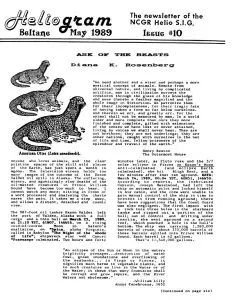
Heliocentric Astrology, Heliogram, NCGR Helio S.I.G., Mundane Astrology, Weather Prediction, Financial Astrology, Asteroids, Fixed Stars, Horary Astrology. This document is the May 1989 issue of the Heliogram, the newsletter of the NCGR Helio S.I.G. Edited by Margaret M. Meister and published with contributions from prominent heliocentric and mundane astrologers, the issue explores the intersections of heliocentric and geocentric astrology, weather forecasting, financial trends, and current world events. Articles delve into the environmental and astrological significance of the Exxon Valdez oil spill, incorporating fixed stars like Spica, Fomalhaut, and the constellation Cetus. Discussions extend to economic forecasts utilizing heliocentric horary charts, planetary alignments involving Mars, Saturn, and Uranus, and the usage of asteroids in mundane prediction. Historical analyses cover figures such as Vincent Wing, examining early heliocentric astrology and Keplerian mechanics. Comprehensive chart data and chronologies, including those for George Bush, nuclear disaster events like Three Mile Island and Chernobyl, and the Emperor Akihito, provide empirical depth to the technical explorations presented throughout the volume.

Issue Highlights:

Articles:
Ask of the Beasts – Diana K. Rosenberg
On File – Margaret M. Meister
Custer Corner: Some Thoughts On Helio – Edith Custer
New and Improved George Bush Chronology – Bill Meridian
Hello, Jupiter! – Barbara May
Elections, Nominations and Things That Go Bump in the Night – Margaret Meister, Edith Custer
Helio in the News – Zipporah Dobyns, Ph.D.
An Implausible Mars-Moon – T. Pat Davis
Emperor Akihito – Doris Greaves
Astrology and the Weather – Part V – Dorothy S. Willis
Doom Forestalled: A Study in Helio Horary – Susan Manuel
Bridge Collapse – Edith Custer
Helio History: Vincent Wing: The First Heliocentric Astrologer? – J. Lee Lehman, Ph.D.

Discussion:
Heliocentric planetary placements and comparative geo/helio charts
Mundane and economic forecasting via heliocentric horary charts
Astrological signatures of the Exxon Valdez oil spill and environmental disasters
Weather forecasting using heliocentric aspects (Venus, Mars, Jupiter, Saturn, Uranus, Neptune)
Historical analysis of heliocentric astronomy and astrology from Kepler to Vincent Wing

Chart data:
Exxon Valdez Oil Spill Chart (March 24, 1989)
Exxon Corporation Foundation Chart (August 10, 1892)
First Sustained Nuclear Reaction (December 2, 1942)
Three Mile Island Nuclear Power Plant Disaster (March 28, 1979)
Chernobyl Nuclear Plant Explosion (April 26, 1986)
Emperor Akihito Natal Chart (December 23, 1933)
Bridge Collapse, Covington, TN (April 1, 1989)
George Bush Natal Chart

Notable contributors:
Diana K. Rosenberg (Astrological zoology and environmental mundane charts)
Edith Custer (Helio Mercury configurations and structural chart observations)
Zipporah Dobyns (Asteroid placements and mundane events)
Susan Manuel (Heliocentric horary and economic predictions)
Dorothy S. Willis (Astrological weather forecasting)
J. Lee Lehman (Historical analysis of heliocentric astrology and Vincent Wing)
Barbara May (Heliocentric Jupiter placements)
The Naming of Pluto (1984)

General Astrology Articles

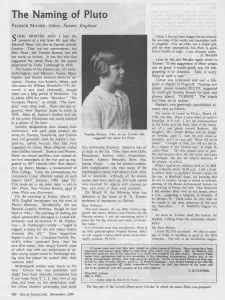
Astronomy, History, Mythology, Pluto, Naming. This historical article details the fascinating story behind how the planet Pluto received its name, following its discovery by Clyde Tombaugh in 1930. Patrick Moore recounts the crucial role played by Venetia Burney, an 11-year-old girl from Oxford, England, who suggested the name Pluto based on the Roman god of the underworld. The text weaves together correspondence, historical records, and personal accounts from prominent figures of the era such as H.H. Turner, V.M. Slipher, and A.C. Crommelin, illustrating how the suggestion made its way from an ordinary breakfast table conversation to the Lowell Observatory and official international adoption.

Issue Highlights:

Articles:
The Naming of Pluto – Patrick Moore

Discussion:
Discovery of Planet X and Pluto
Historical correspondence regarding planetary nomenclature

Chart data:
Clyde Tombaugh
Venetia Burney

Notable contributors:
Patrick Moore (Author)
Venetia Burney (Suggester of the name Pluto)
H.H. Turner (Professor of Astronomy at Oxford)
V.M. Slipher (Astronomer at Lowell Observatory)

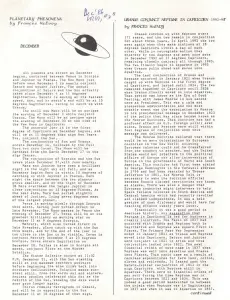
Planetary Phenomena, Uranus Conjunct Neptune in Capricorn, Historical Mundane Astrology. This detailed astrological and historical analysis by Frances McEvoy explores the upcoming conjunction of Uranus and Neptune in Capricorn (1992-1995) and compares it extensively with the historical Uranus-Neptune conjunction of 1821-1828. The author examines planetary movements for December 1986, including planetary aspects, ingresses, and general phenomena. The main focus is a deep dive into mundane astrology, examining how the Uranus-Neptune conjunction in Capricorn correlates with major societal, industrial, and political shifts, such as the Monroe Doctrine, the rise of the working class, utopian socialism, Robert Owen’s experiments, and significant architectural and literary movements.

Issue Highlights:
Detailed astrological ephemeris data for December 1986 and an exhaustive historical correlation of the Uranus-Neptune conjunction in Capricorn, looking ahead to the 1992-1995 alignment.

Articles:
Planetary Phenomena – Frances McEvoy
Uranus Conjunct Neptune in Capricorn 1992-95 – Frances McEvoy

Discussion:
Planetary movements for December 1986
Historical analysis of the 1821-1828 Uranus-Neptune conjunction in Capricorn
Mundane astrological effects on labor, industry, and social reform
Architectural revivals and romanticism during Uranus-Neptune cycles

Chart data:
N/A

Notable contributors:
Frances McEvoy (Astrological and historical analysis)

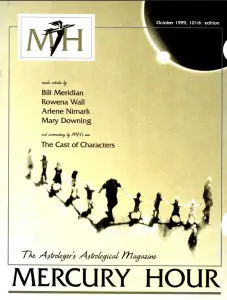
Mundane Astrology, Financial Astrology, and Astrology History. This archival item is the October 1999 issue (101st Edition B) of Mercury Hour, a quarterly astrological magazine edited and published by Edith Custer in Lynchburg, Virginia. Key contents include Bill Meridian’s review of Ron Howland’s A Chronology of American Charts alongside his article on “Shared Degree Areas” in planetary stock trading, Rowena Wall’s analysis of Y2K “Millennium Madness”, and Mary Downing’s eclipse watch report on Saros 145. The issue features the conclusion of Guy de Penguern’s 21st Century Medical Astrology Course focusing on cardiopathy, Arlene Nimark’s “Tidbits & Obits” covering Kurt Weill, the “Mercury Mets,” and the Littleton shooting birth data, and Virginia Reyer’s reference guide to Vertex signs. Additional contributions cover reader discussions on Out-of-Bounds planets, solar returns, the Bible Code, Druidic numerology, and chart analyses for John F. Kennedy Jr. and King Abdullah of Jordan.


Issue Highlights


Book Review

A Chronology of American Charts by Ron Howland – Bill Meridian


Articles

Tidbits & Obits – Arlene Nimark

Y2K Millenium Madness – Rowena Wall

Planetary Stock Trading: Shared Degree Areas – Bill Meridian

21st Century Medical Astrology Course, Part 3 of 3 [extract] – Guy de Penguern

Eclipse Watch [Saros 145] – Mary Downing

Vertex Signs – Virginia Reyer


Discussions

Out-of-Bounds planets

Columbine shooters

Leap years

Solar Returns

Asteroids Hidalgo, Pandora, Lilith

Druidic numerology

Chart of JFK, Jr.

The Bible Code

Solar storms/solar peak


Chart data

Abdullah, King of Jordan

Kennedy Jr., John F.

Nunavut (Canada)


Notable contributors

Roberta Strain (Royal Fixed Stars)

Marion March (fertility & astrology)

Mundane Astrology, Predictive Astrology, and Astrology History. This archival item is the October 1994 issue (82nd Edition) of Mercury Hour, a quarterly astrological magazine edited and published by Edith Custer in Lynchburg, Virginia. Key contents include Part 1 of Robert Zoller’s four-part series on Guido Bonatti and medieval European astrological literature, Van K. Golay’s mundane assessment of the “Soviet Power” regime and its post-1987 transformation, and Marc Penfield’s astrological analysis of natural disasters in California alongside chart profiles for Rodney King and O.J. Simpson. The issue features extensive coverage and reader discussions surrounding the O.J. Simpson murder case, featuring chart analyses and comparisons by T. Pat Davis, Karen Christino, Jim Haynes, Joseph S. deMello, John Somoza, and Edith Custer. Additional contributions include Dorothy Willis’s weather predictions for the 1994 Autumn Equinox, book reviews by Rose D. Owen, Edith Custer, Marc Penfield, and Ann Requa, and community discussions on solar return timing, death indicators, house representations of parents, and software/computer developments.


Issue Highlights


Book Reviews

The Eagle and the Lark (A Textbook of Predictive Astrology) by Bernadette Brady

– Rose D. Owen

Forecasting – Backward & Forward by Bruce Hammerslough

– [two reviews] Edith Custer and Marc Penfield

A History of Western Astrology by Jim Tester – Ann Requa


Articles

Crisis Alert [California natural disasters] – Marc Penfield

Autumn Equinox 1994 – Dorothy Willis

“Soviet Power” Dead or Alive? – Van K. Golay

Guido Bonatti and the Spread of Astrological Literature in Mediaeval Europe,

Sive, Pro Astrologica per se Studiendo, Part 1 of 4 – Robert Zoller

People [Rodney King; O.J. Simpson] – Marc Penfield


Discussions

O.J. Simpson case

Neptune

Transiting Saturn in Pisces (1994)

Timing in solar return charts

Locating death in a chart

House representation of parents

Bill Clinton/Whitewater


Chart data

Simpson, O.J.

O.J. Simpson case lawyers:

Cowlings, A.C.

Dershowitz, Alan

Lerner, Mark

Shapiro, Robert

Bundy, Ted

Candy, John

King, Rodney

Klaas, Polly

Davis, Richard Allen (abductor of Polly Klaas)

Los Angeles, CA (City & County)


Notable contributors

Carole Devine (astrological counseling; timing in solar returns)

Karen Christino (O.J. Simpson)

Lois Rodden (Michael Jackson birth time; continuation of chart after death)

Marion March (challenging aspects)

Astrological Techniques, Mundane Astrology, Historical Research. This 79th edition of Mercury Hour (January 1994) functions as a dynamic forum for practitioners to share research, personal experiences, and technical debates. A major focus throughout the issue is on natal chart rectification, the debate over house systems (specifically Lavagnini, Morinus, and Placidus/Koch), and the practical application of planetary transits and progressions to mundane events, such as the Israel-PLO accord, the Clinton presidency, and the Michael Jackson investigations. The issue also features a heavy emphasis on early American astrological history, with Robert Zoller exploring how astrology was utilized and viewed in pre-1860 American colonies and academic settings.

Technical discussions extend to specialized methodologies, including the evaluation of “accidental ascendants,” the use of Chaos Theory and septile aspects, and reviews of foundational translations like Paulus Alexandrinus. Contributors wrestle with the philosophical and ethical dimensions of the craft, debating whether astrology can be considered “from the devil” or if it serves as a valid system for psychological understanding and life navigation. The publication serves as a nexus for the community, highlighting professional conferences, software reviews (such as Matrix Software), and the ongoing efforts of Project Hindsight to recover ancient techniques.

Issue Highlights:
Articles:
Winter Solstice [1993] – Dorothy Willis
Introduction to M-13: Spiritual Theory, Part II, Conclusion – Defiance Gregg
Will Daniel Day-Lewis Get an Oscar? – Barbara Dunn
Is Astrology “From the Devil?” – Carole Devine
Open Letter of Complaint re the UAC Conference – Dorothy Martin
More Founding Dates, Part 3, Conclusion – Marc Penfield
Student Corner Rewrite [hemispheres of the chart] – Joseph S. DeMello
Student’s Corner, Part 2 of 2 [7th & 10th houses] – Annibale F. Verzumo
American Astrology Prior to 1860 – Robert Zoller
An Astrological Review of Passages, Part 5 of 6 – Bil Tierney
Computers – Joseph S. de Mello
A Review of Project Hindsight’s First Translation: Paulus Alexandrinus, Introductory Matters – Michele C. McKee

Discussion:
Lavagnini house system
Chart of Michael Jackson
Chart of Bill Clinton
Astrology & crime-solving
Evangeline Adams “accidental ascendant” technique
Chart of Baltimore, MD
Coming earth changes/polarity shift
U.S. Presidents & Chinese astrology
Universal Number/Chaos Theory/septile aspect
J. Edgar Hoover
Age of Aquarius

Chart data:
Henry, Patrick
Jackson, Michael
Koresh, David
Baltimore, MD
Israel/recognition of PLO

Notable contributors:
Lois Rodden (Bill Clinton and David Koresh birth charts, chart ratings)
Karen Christino (Saturn Return)
Marion March (Tropical vs. Sidereal)

Astrology, Mercury Hour, October 1993, Edith Custer, planetary transits, horary astrology, mundane astrology, death charts, solar returns, heliocentric astrology, asteroids, fixed stars. This issue of Mercury Hour (78th Edition, October 1993), edited by Edith Custer, is a comprehensive astrological journal featuring extensive correspondence, member discussions, and in-depth technical articles. Key topics covered include the twelve-year cycle of Jupiter in Russia, prognostications using eclipse cycles and geodetic equivalents (notably predicting earthquakes in Japan), horary techniques including the judgment of theft and void-of-course moons, and psychological astrology focusing on planetary aspects such as Uranus-Neptune and Pluto’s generational influences. Contributors examine mundane charts of cities and countries, biographical data of prominent public figures, and advanced predictive methods like Diurnal charts and Sidereal Solar Returns.

Issue Highlights

The edition includes detailed book reviews of works by Wendy Hawks, Patrick Curry, and Marc Penfield. Articles range from technical instructional pieces on cardinal signs and houses, heliocentric astrology for beginners, and the mechanics of the Transpluto awakening, to political and historical mundane studies such as Russia’s Jupiter cycle and the founding dates of American cities. Personal reflections, travel anecdotes from NCGR conferences, and exhaustive subscriber correspondence make up a significant portion of the text, highlighting community engagement and collaborative astrological research.

Articles:
Russia and the Twelve-Year Cycle of Jupiter – Ted George
An Astrological Review of “Passages”, Part 4 of 6: The Rooting and Extending Passage [32-35] – Bil Tierney
Student’s Corner, Part 1 of 2 [Cardinal signs and houses] – Annibale F. Verzumo
Founding Dates [American cities], Part 2 of 3 [table] – Marc Penfield
XX Century: The New Arrival of the Christ – Ruben Jungbluth & Nora Portal
Helio for Rookies – Kaye Shinker
Predicted! Japan’s 7.8 Quake – Ann E Parker
Horary Astrology – Olivia Barclay
Birth Chart: City of Jacksonville, FL – Ted George
Autumn Equinox 1993 – Dorothy S. Willis
Introduction to M-13: Spiritual Theory, Part One – Defiance Gregg
Pluto as Power Indicator, Pluto as Generational Guide – Louise Jenkins
A Correct Prediction: The NYC Building Strike of 1991 – Robert Zoller
XXI Century: The Birth of a New Mankind – Ruben Jungbluth
[Uranus-Neptune], Part 2 of 2 – Annibale F. Verzumo
The Transpluto Awakening – Michael & Jeanne Baruch
People in the News – Marc Penfield

Discussion:
Natal ascendant of Rush Limbaugh
CapSolar (Sidereal technique) and Pluto/Moon aspects of violence
Bill Clinton birth time
Chart of Israel
Sideral calculations for Solar Returns

Chart data:
Hoover, J. Edgar
Jackson, Michael
Malcolm X (Little)
Nureyev, Rudolph
Japan earthquake July 1993

Notable contributors:
Lee Lehman (Void of Course Moon; prediction of death)
Carol Lavoie (Nostradamus computer program)
Lois Rodden (time of death charts)
Karen Christino (prediction of death)
Marion March (prediction of death)
Dorothy Kovach (20-year Presidential Curse & the Great Mutation)

Astrology, Horary, House Systems, Synastry, and Transits. This edition of Mercury Hour features extensive reader discussions and technical articles covering various astrological branches. Topics include an exploration of planetary speeds and Kepler’s theories by Donald E. Byrne, declination and out-of-bounds planets by Gilbert Navarro, synastry and musical charts comparing John Lennon, Paul McCartney, Richard Nixon, and Yoko Ono by Dianne Lawson, as well as a concluding critique of the Koch House System by M. J. Makransky. Additional articles cover astrolocality mapping variants, Russian history and charts by Annibale F. Verzumo, Vernal Equinox charts, I Ching trigrams, and book reviews covering computer software, house development, and planetary stations.

Issue Highlights:

Articles:
Where is Vulcan & Nemesis? Part I – Donald E. Byrne
John Lennon and Paul McCartney, Richard Nixon, and Yoko Ono – Dianne Lawson
The Last Word on the Koch House System and Further Critique of the Koch House System, Part II, Conclusion – M. J. Makransky
Precession of the Equinox – Donald E. Byrne
How to Make Astrology Pay From A-Z, Part II, Conclusion – Adze Mixxe
Variant Forms of Astrolocality Mapping, Part I – M. J. Makransky
[Russia] Part III, Conclusion – Annibale F. Verzumo
Vernal Equinox March 20, 1992 – Dorothy S. Willis
Corrections: The Book of World Horoscopes – Nicholas Campion
I Ching: The Trigrams-Fu Hai Arrangement – Dorothy J. Sarka

Discussion:
Transpluto/Pluto Square 1991 – 1993
December 21, 1991 lunar eclipse
Secondary progressions
CSICOP and Humanistic astrology
Antichrist and Judgement Day discussions
Gulf War charts and Horary missing articles

Chart data:
Bill Clinton
Paul Keating
John Lennon
Paul McCartney
Richard Nixon
Yoko Ono
Paul Tsongas

Notable contributors:
Marion March (problematic astrological terminology)
Gilbert Navarro (declination)
Lee Lehman (humanism and CSICOP)
Diana Rosenberg (Jeffrey Dahmer chart)
Edith Custer (defending astrology)

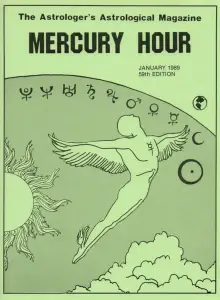
Astrology, Horary, Mundane, Chart Techniques, Software, Ethics. This edition of Mercury Hour features an eclectic collection of letters, articles, and discussions from the astrological community of the late 1980s. Key technical discussions focus on the application of horary techniques to personal events, the validity of progressions versus transits, the use of heliocentric charts, the debate surrounding psychological counseling by astrologers, and methods for calculating progressed angles. Several contributors engage in a lively back-and-forth regarding the “True Time” of the U.S. founding, with specific arguments favoring the July 4th, 1776 date.

Issue Highlights:
The issue serves as a forum for various professional and amateur astrologers to share research, personal anecdotes, and technical feedback on software and methodology. Notable articles explore the potential “Viper’s Nest” chart pattern in relation to criminals like Ted Bundy, the debate against professional astrological counseling, and techniques for natal chart rectification using historical and event-based data. Much of the content is shaped by the editor’s return to the magazine, establishing a welcoming space for community debate, software reviews, and the sharing of “Chart Mart” data.

Articles:
Salem, or A Cynic’s Centiloquy – Don Borkowski
Horary Techniques Applied to Personal Events – Edward Dearborn
Another Asteroid Turned Comet (Chiron) – Richard A. Kerr
Against Astrological Counseling – Robert Cole
Will the Real Duchess of Windsor Stand Up – Carolyn H. Caufman
Moving to Paradise – Marc Penfield
Joyce’s Key Phrases for Transiting Aspects – Joyce Wehrman
Ted Bundy’s “Viper’s Nest” Chart Pattern – John Kalus

Discussion:
Calculating progressions and progressed houses
Speculative charts for Mikhail Gorbachev and U.S. historical events
Weather predictions based on Winter Solstice and planetary alignments
The ethics of professional astrological counseling
Use of heliocentric versus geocentric charts

Chart data:
Mikhail Gorbachev
Wallis Simpson
Cheryl Crane
Davy Crockett
Katherine Hepburn
George Bush
Michael and Kitty Dukakis
Joan Quigley

Notable contributors:
Michael Munkasey (Chart of the U.S.A.)
Al H. Morrison (Neptune aspects; shamanism; horary timing)
Jim Lewis (1988 U.S.A. election)
Marion March (C-Sections; Chiron; Jesse Jackson)

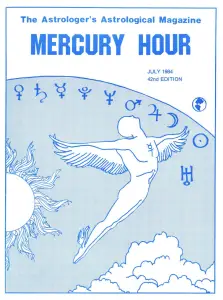
Mundane Astrology, Astrological History, and Astrological Techniques. This archival item is the July 1984 issue (42nd Edition) of Mercury Hour, a quarterly astrological magazine edited and published by Edith Custer in Lynchburg, Virginia. Key contents include legal and advocacy discussions surrounding the municipal “fortune telling” arrests of astrologers in San Jose and Los Angeles, alongside the organizational development of the Astrological Network (AFAN) and its relationship with the American Federation of Astrologers (AFA). The issue features articles such as Danni Herman’s “An Astrological Anatomy of Behavior,” Ted George’s exploration of “Paragon” (a proposed satellite of Mercury), Jack Fertig’s compilation of AIDS case data, and Marc Penfield’s “Chart Mart” containing extensive birth data for public figures and speculative horoscopes for historical events. Additional contributions cover reviews of books by Linda Carbone, Liz Greene, Stephen Arroyo, and Barry Lynes, as well as reader discussions on karma, heliocentric planetary applications, and chart data for figures such as Ronald Reagan, George Bush, and Jesse Jackson.


Issue Highlights 


Book Reviews


Interpreting Your Retrograde Planets by Linda Carbone – Marion March


The Jupiter/Saturn Conference Lectures by Liz Greene and Stephen Arroyo – Marion March


Astroeconomics: The Union of Astrology and Economics by Barry Lynes – Marguerite Dar Boggia


The Astrology of Choice by Roy Alexander – Carolyn Dodson


The Cosmic Informer by Robert Pelletier and Leonard Cataldo – Edith Custer


Articles


An Astrological Anatomy of Behavior, Part IIB – Danni Herman


Paragon, the Twin of Mercury – Ted George


IAO Research Center News – Robin Armstrong (President)


Houses – Marc Penfield


Uranian Astrology – Penny Bertucelli


Neptune – Terri Kerins


AIDS Data – Jack Fertig


Creativity – Defiance Gregg


AFA/AFAN – Jeff Jawer


Astrology and the Law – Angel Thompson


Magic, Madness, and a Cancer Stellium – Amy M. Franco


Astrology and its Implications for Education of the Gifted – Lynette Nygaard


Astrology Now – Bonnie Parker [Humanistic Astrology]


Discussions


Karma and reincarnation


Charts of Ronald Reagan and George Bush


1984 Korean airliner shooting


Chart of Kansas City


San Jose, CA and Los Angeles, CA “Fortune Telling” legal cases


Chiron


Charts of USA and American Civil War


Taurus degrees


Chart data


(some incomplete or in question)           

(Marc Penfield’s Chart Mart appended)


Andropov, Yuri
Diamond, Neil
Glenn, John
Jackson, Jesse
Olivier, Lawrence
Westmoreland, William
Williams, Tennessee


Foundation of Russia


Notable contributors


Al H. Morrison
Marion March


Additional Chart Data 


From Chart Mart – Marc Penfield


“Some more from Gauquelin’s new book on American birthdata:”


Annenberg, Walter
Banks, Ernie
Black, Karen
Browning, John
Cage, John
Davis, Miles
Chandler, Otis
Felker, Clay
Fleischer, Leon
Gibson, Althea
Greene, Joe
Grier, Roosevelt
Hirsch, Elroy
Hutton, Lauren
Janov, Arthur
Jones, Jack
Jurgensen, Sonny
Kahn, Madeline
Lawrence, Carol
Lopez, Nancy
McCambridge, Mercedes
Maris, Roger
Martin, Billy
Masters, Wm. H.
Moore, Terry
Naber, John
Patchen, Kenneth
Patterson, Floyd
Poston, Tom
Rigby, Cathy
Salinger, Pierre
Schorer, Mark
Simon, William
Simone, Nina
Summer, Donna
Valenti, Jack
Warwick, Dionne
Williams, Cindy
Williams, Ted


Additional charts from Penfield:


Cruise, Tom
Daltry, Roger
Fairchild, Morgan
Hepburn, Audrey
Holmes, John
Keynes, John Maynard
Koestler, Arthur
Lupino, Ida
Mandrell, Barbara
Moore, Dudley
Newton-John, Olivia
Roberts, Xavier
Sanders, Col. Harlan
Savalas, Telly
Stewart, Rod
Updike, John


Mehmet Ali Agca
(speculative chart) 


Vancouver, BC

Ask A Librarian

Need assistance with your research or navigating our collection? Our library team is here to help.

Please fill out the form below with details about the topics, authors, or archival materials you are looking for, and one of our librarians will review your query and respond shortly.

Help

Whether you are looking for rare historical texts or trying to locate a specific book nearby, Alexandria iBase offers two primary ways to search. Here is how to choose the right tool for what you need:

The Library Catalogue

Think of this as your global master index.

The Catalogue works just like a traditional library search system, designed to help you locate books and media across the broader astrological landscape.

  • Physical Books: Find out where physical copies of books are held in libraries, archives, or collections near you.

  • Digital Files: Access downloadable or viewable digital editions when available.

  • Best Used For: Standard research, finding specific ISBNs or authors, and tracking down physical items in the real world.

Browse Catalogue

SPECIAL COLLECTIONS

Think of this as Alexandria’s exclusive private vault.

Collections gives you direct access to Alexandria’s own curated archive of rare, proprietary, and historic astrology media.

  • Exclusive Material: Features unique texts, manuscripts, audio recordings, and visual media that are not available anywhere else.

  • Direct Access: Digitized content ready to explore straight from the platform.

  • Best Used For: Deep-dive research, discovering hidden gems, and exploring rare, one-of-a-kind astrological resources.

Browse Special Collections

Cash & In-Kind Donations

Make a one-time or recurring tax deductible cash donation.

Payment options include donating directly with us, PayPal Giving and GoFundMe.

GoFundMe for Charities and PayPal Giving are registered for tax deductions and have no required processing fees. It does offer the option to tip.

Donate

*Subject to 2.5% processing fees

Contact Us

Have a question, feedback, or a inquiry about our archives? We’d love to hear from you. Please fill out the form below with your details and message, and a member of our team will get back to you as soon as possible.

Thank you for reaching out to the Alexandria iBase Project!