
Home » Statistical Astrology

Statistical Astrology

A research-oriented branch of astrology that applies quantitative methodologies and data analysis to test astrological theories against population samples.

Filters

Filters


See more See less
See more See less
See more See less
See more See less
See more See less
See more See less
See more See less

Sorting

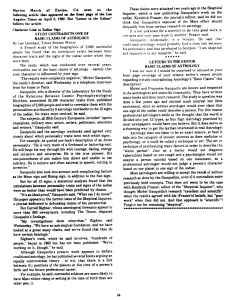
Astrological Research, Statistical Analysis, Skepticism, and Professional Practice. This document presents a debate between the scientific community and the astrological community regarding the validity of Sun Sign astrology. It centers on a study by Michel Gauquelin, who statistically analyzed biographies of 2,000 successful individuals to determine if personality traits correlated with their Sun signs. The study concluded that such correlations were non-existent, a finding that appeared in the Skeptical Inquirer.

The synthesis highlights the friction between the reductionist approach of Sun sign pop-astrology and the holistic, interpretive nature of professional astrological practice. While Gauquelin’s research challenged the claims of popular astrology, it is noted that serious astrologers generally do not define a person by a single sign, viewing it instead as an art or technique requiring synthesis of various planetary factors—similar to medical or psychological diagnostics. The text also touches upon Gauquelin’s controversial ‘Mars effect’ theory, which posits a link between planetary positions at birth and professional outcomes.

Issue Highlights:

Articles:
Study Contradicts One of Basic Claims of Astrology – Lee Dembart
Letters to the Editor: Basic Claims of Astrology – Anonymous (submitted by Marion March)

Discussion:
Scientific skepticism vs. astrological theory
The limitations of Sun sign astrology
Statistical analysis of birth charts and biographies
Professional astrology as an art or synthesis of multiple factors

Chart data:
Michel Gauquelin (Scorpio)
Carroll Righter (Astrologer)

Notable contributors:
Michel Gauquelin (Statistical Research)
Carroll Righter (Astrological Foundation research)
Kendrick Frazier (Editor, Skeptical Inquirer)
Marion March (Contributor/Letter provider)
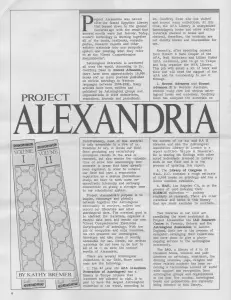

Project Alexandria, Astrological Librarianship, Data Preservation, AFA Library, IAO Research Centre. This document introduces “Project Alexandria,” a collaborative effort designed to create a “Great Comprehensive Encyclopedia” of astrological literature. The initiative aims to centralize fragmented astrological knowledge through modern computing and database systems, ensuring that historical and contemporary research is preserved, cataloged, and made accessible to the global astrological community. The text highlights the critical issue of scattered, disorganized, or inaccessible astrological collections, specifically citing the American Federation of Astrologers (AFA) library in Tempe and the International Astrological Organization (IAO) in Toronto as key subjects for remediation.

The synthesis emphasizes the necessity of cooperative action among professional organizations to overcome the physical and logistical hurdles of library management. It details the disorganized state of prominent archives, the efforts of volunteers like Neil Michelsen and Lilian Huber to bring structure to these collections, and the growing reliance on “data-base” projects like those piloted by MATRIX to track astrological events and historical chronologies. The project’s ultimate goal is to move beyond the limitation of physical, geographically restricted access by utilizing technology to create a universal, searchable repository.

Issue Highlights:

Articles:
Project Alexandria – Kathy Bremer
Editor’s Note: A clarification on the AFA library status – Uncredited

Discussion:
Digital cataloging of astrological literature
Organization of the AFA library in Tempe
The IAO Research Centre’s role in networking libraries
Data-base creation for historical astrological records

Chart data:
None mentioned.

Notable contributors:
Kathy Bremer (Author of Project Alexandria proposal)
Geoffrey Dean (Researcher on astrological statistics and bibliography)
Neil Michelsen (AFA member involved in library organization)
Lilian Huber (Volunteer for library assessment)
Bob Cooper (AFA liaison)

Astrology, Houses, Transits, Reincarnation, Eclipses, Synastry, Numerology. This 13th edition of Mercury House (April 1977) provides a comprehensive collection of astrological discussions, research notes, and reader correspondence. Key topics covered include the interpretation of Saturn in various houses, house systems and critiques of traditional vs. equal house methods, the mechanics of eclipses, chart comparison (synastry), sidereal vs. tropical numbering, and reincarnation past-life regressions mapped through natal charts. Articles explore specialized techniques such as midpoints, deciles and quintiles (minor aspects), and the application of harmonics in chart analysis. The issue also features extensive letters from subscribers detailing personal transits, planetary aspects, and astrological research anomalies.

Issue Highlights:

Articles:
Zodiacal Numbering – Jeff Jawar
Saturn in the Houses (continuation) – Dr. Robert H. Goodrich
Saturn – Marc Penfield
A Key to Relationships [The Art of Chart Comparison] Introduction – Stephen Arroyo
Eclipses (first part in a series) – Ray Merriman
Some Notes on Astrological Research – Ingrid Naiman
Reincarnation – Marc Penfield
The Zodiac of Aspects (first of a two-part series) – Glenda Tomosovich
Astrological Review of an Autobiography [Alone by Admiral Richard E. Byrd] – Prem H. Joshi
The People’s Choice…A Different View of the Next Four Years – Dr. Robert H. Goodrich

Discussion:
Saturn in the 1st and 6th houses
House systems and Gauquelin research
Horoscope of Jesus
Aspects of artistic genius and medical astrology

Chart data:
Bob Dylan
Thor Heyerdahl
OJ Simpson
Omar Sharif
Ethel Kennedy
Jerry Brown
John Dean
Neil A. Armstrong
New York Stock Exchange

Notable contributors:
Marion March (Various topics and responses)
Zip Dobyns (Birthcharts and commentary)

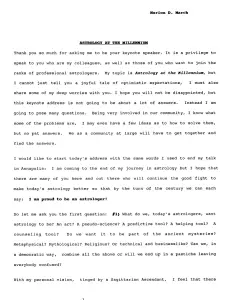
Professionalism, Astrological Standards, Millennium, Cultural Integration. Marion D. March delivers a passionate and challenging keynote address focusing on the state of astrology as the 20th century draws to a close. She raises eleven critical questions regarding the identity, reputation, standards, and future of astrology in a rapidly changing world. March examines external criticisms from scientists like Richard Dawkins, legal and financial controversies, the need for standardized training and testing akin to acupuncture and psychology, and the internal politics of major astrological organizations such as AFA, AFAN, ISAR, and NCGR. She highlights positive milestones including UAC faculty compensation, improved literature, computer advancements, financial research by Arch Crawford and Ray Merriman, the Gauquelins’ statistical research, Project Hindsight, and the unifying power of the Internet.

Issue Highlights:
A keynote address exploring the evolution of astrology, the necessity of professional standards, overcoming poverty consciousness among astrologers, and navigating technological and societal seachanges toward the new millennium.

Articles:
Astrology at the Millennium – Marion D. March

Discussion:
What do astrologers want astrology to be (art, science, predictive tool, helping tool)?
Public perception and attacks from the scientific community.
The need for testing, licensing, and standardized education.
Internal politics and division among astrological organizations.
The validity of astrology and empirical vs. judicial approaches.
The impact of computers, the Internet, and Project Hindsight.
Astrologers’ poverty consciousness and professional compensation.
Cyclical time vs. linear time and the philosophical implications of the upcoming millennium.

Chart data:
N/A

Notable contributors:
Marion D. March (Keynote Speaker)
Nick Campion (Natural vs. Judicial Astrology)
Joan McEvers (Astrology as a tool)
Arch Crawford (Financial Astrology)
Ray Merriman (Financial Astrology)

Astrology, Mercury Hour, October 1993, Edith Custer, planetary transits, horary astrology, mundane astrology, death charts, solar returns, heliocentric astrology, asteroids, fixed stars. This issue of Mercury Hour (78th Edition, October 1993), edited by Edith Custer, is a comprehensive astrological journal featuring extensive correspondence, member discussions, and in-depth technical articles. Key topics covered include the twelve-year cycle of Jupiter in Russia, prognostications using eclipse cycles and geodetic equivalents (notably predicting earthquakes in Japan), horary techniques including the judgment of theft and void-of-course moons, and psychological astrology focusing on planetary aspects such as Uranus-Neptune and Pluto’s generational influences. Contributors examine mundane charts of cities and countries, biographical data of prominent public figures, and advanced predictive methods like Diurnal charts and Sidereal Solar Returns.

Issue Highlights

The edition includes detailed book reviews of works by Wendy Hawks, Patrick Curry, and Marc Penfield. Articles range from technical instructional pieces on cardinal signs and houses, heliocentric astrology for beginners, and the mechanics of the Transpluto awakening, to political and historical mundane studies such as Russia’s Jupiter cycle and the founding dates of American cities. Personal reflections, travel anecdotes from NCGR conferences, and exhaustive subscriber correspondence make up a significant portion of the text, highlighting community engagement and collaborative astrological research.

Articles:
Russia and the Twelve-Year Cycle of Jupiter – Ted George
An Astrological Review of “Passages”, Part 4 of 6: The Rooting and Extending Passage [32-35] – Bil Tierney
Student’s Corner, Part 1 of 2 [Cardinal signs and houses] – Annibale F. Verzumo
Founding Dates [American cities], Part 2 of 3 [table] – Marc Penfield
XX Century: The New Arrival of the Christ – Ruben Jungbluth & Nora Portal
Helio for Rookies – Kaye Shinker
Predicted! Japan’s 7.8 Quake – Ann E Parker
Horary Astrology – Olivia Barclay
Birth Chart: City of Jacksonville, FL – Ted George
Autumn Equinox 1993 – Dorothy S. Willis
Introduction to M-13: Spiritual Theory, Part One – Defiance Gregg
Pluto as Power Indicator, Pluto as Generational Guide – Louise Jenkins
A Correct Prediction: The NYC Building Strike of 1991 – Robert Zoller
XXI Century: The Birth of a New Mankind – Ruben Jungbluth
[Uranus-Neptune], Part 2 of 2 – Annibale F. Verzumo
The Transpluto Awakening – Michael & Jeanne Baruch
People in the News – Marc Penfield

Discussion:
Natal ascendant of Rush Limbaugh
CapSolar (Sidereal technique) and Pluto/Moon aspects of violence
Bill Clinton birth time
Chart of Israel
Sideral calculations for Solar Returns

Chart data:
Hoover, J. Edgar
Jackson, Michael
Malcolm X (Little)
Nureyev, Rudolph
Japan earthquake July 1993

Notable contributors:
Lee Lehman (Void of Course Moon; prediction of death)
Carol Lavoie (Nostradamus computer program)
Lois Rodden (time of death charts)
Karen Christino (prediction of death)
Marion March (prediction of death)
Dorothy Kovach (20-year Presidential Curse & the Great Mutation)

Mundane Astrology, Astrological History, and Astrological Techniques. This archival item is the July 1984 issue (42nd Edition) of Mercury Hour, a quarterly astrological magazine edited and published by Edith Custer in Lynchburg, Virginia. Key contents include legal and advocacy discussions surrounding the municipal “fortune telling” arrests of astrologers in San Jose and Los Angeles, alongside the organizational development of the Astrological Network (AFAN) and its relationship with the American Federation of Astrologers (AFA). The issue features articles such as Danni Herman’s “An Astrological Anatomy of Behavior,” Ted George’s exploration of “Paragon” (a proposed satellite of Mercury), Jack Fertig’s compilation of AIDS case data, and Marc Penfield’s “Chart Mart” containing extensive birth data for public figures and speculative horoscopes for historical events. Additional contributions cover reviews of books by Linda Carbone, Liz Greene, Stephen Arroyo, and Barry Lynes, as well as reader discussions on karma, heliocentric planetary applications, and chart data for figures such as Ronald Reagan, George Bush, and Jesse Jackson.


Issue Highlights 


Book Reviews


Interpreting Your Retrograde Planets by Linda Carbone – Marion March


The Jupiter/Saturn Conference Lectures by Liz Greene and Stephen Arroyo – Marion March


Astroeconomics: The Union of Astrology and Economics by Barry Lynes – Marguerite Dar Boggia


The Astrology of Choice by Roy Alexander – Carolyn Dodson


The Cosmic Informer by Robert Pelletier and Leonard Cataldo – Edith Custer


Articles


An Astrological Anatomy of Behavior, Part IIB – Danni Herman


Paragon, the Twin of Mercury – Ted George


IAO Research Center News – Robin Armstrong (President)


Houses – Marc Penfield


Uranian Astrology – Penny Bertucelli


Neptune – Terri Kerins


AIDS Data – Jack Fertig


Creativity – Defiance Gregg


AFA/AFAN – Jeff Jawer


Astrology and the Law – Angel Thompson


Magic, Madness, and a Cancer Stellium – Amy M. Franco


Astrology and its Implications for Education of the Gifted – Lynette Nygaard


Astrology Now – Bonnie Parker [Humanistic Astrology]


Discussions


Karma and reincarnation


Charts of Ronald Reagan and George Bush


1984 Korean airliner shooting


Chart of Kansas City


San Jose, CA and Los Angeles, CA “Fortune Telling” legal cases


Chiron


Charts of USA and American Civil War


Taurus degrees


Chart data


(some incomplete or in question)           

(Marc Penfield’s Chart Mart appended)


Andropov, Yuri
Diamond, Neil
Glenn, John
Jackson, Jesse
Olivier, Lawrence
Westmoreland, William
Williams, Tennessee


Foundation of Russia


Notable contributors


Al H. Morrison
Marion March


Additional Chart Data 


From Chart Mart – Marc Penfield


“Some more from Gauquelin’s new book on American birthdata:”


Annenberg, Walter
Banks, Ernie
Black, Karen
Browning, John
Cage, John
Davis, Miles
Chandler, Otis
Felker, Clay
Fleischer, Leon
Gibson, Althea
Greene, Joe
Grier, Roosevelt
Hirsch, Elroy
Hutton, Lauren
Janov, Arthur
Jones, Jack
Jurgensen, Sonny
Kahn, Madeline
Lawrence, Carol
Lopez, Nancy
McCambridge, Mercedes
Maris, Roger
Martin, Billy
Masters, Wm. H.
Moore, Terry
Naber, John
Patchen, Kenneth
Patterson, Floyd
Poston, Tom
Rigby, Cathy
Salinger, Pierre
Schorer, Mark
Simon, William
Simone, Nina
Summer, Donna
Valenti, Jack
Warwick, Dionne
Williams, Cindy
Williams, Ted


Additional charts from Penfield:


Cruise, Tom
Daltry, Roger
Fairchild, Morgan
Hepburn, Audrey
Holmes, John
Keynes, John Maynard
Koestler, Arthur
Lupino, Ida
Mandrell, Barbara
Moore, Dudley
Newton-John, Olivia
Roberts, Xavier
Sanders, Col. Harlan
Savalas, Telly
Stewart, Rod
Updike, John


Mehmet Ali Agca
(speculative chart) 


Vancouver, BC

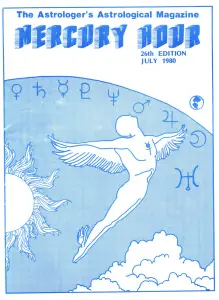
Astrological Research, Midpoints, Mundane Astrology. This issue of Mercury Hour serves as a dynamic forum for technical and philosophical astrological discourse during the early 1980s. The magazine balances detailed technical research—such as midpoint analysis, heliocentric vs. geocentric chart comparison, and mundane astrology applied to political events (e.g., the situation in Lebanon and Poland)—with active reader correspondence. A significant portion of the content is dedicated to challenging mainstream perceptions of astrology, exploring the intersection of psychology and astrology, and critiquing the rapidly emerging field of computerized chart calculation.

Issue Highlights:

Articles:
Chart Mart – Marc Penfield
Tragedy at Tanque Verde Falls: A Case for Midpoints – Barbara May
Khomeini’s Days Are Numbered – Manik Chand Jain
Mercury – Erin Sullivan
An Astrological Review of Passages (by Gail Sheedy) – Bil Tierney
Astrology vs. Psychology: A Minor Dilemma for the 80’s – Stanley Kustesky

Discussion:
Astrological research on incest
Astrological birth control (human and equine)
Ayatollah Khomeini
Pluto transits
Heliocentric astrology
Charts of Israel
Chart of Ronald Reagan
Astro*Carto*Graphy
Crash of AirFlorida Jet, Jan 13, 1982

Chart data:
Lucille Ball, John Lennon, Elvis Presley, Harvey Milk, Dan White, Pope John Paul II, Ronald Reagan, Ayatollah Khomeini

Notable contributors:
Zane Stein (eclipses, quincunxes, Association for Studying Chiron)
Michael Erlewine (Heliocentric astrology)
Al H. Morrison (Void-of-Course Moon)
Erin Sullivan (diverse astrological topics)

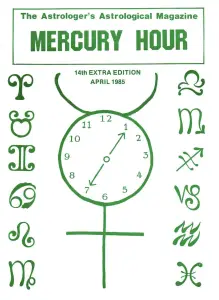
Mundane Astrology, Astrology History, and Astrological Techniques. This archival item is the April 1985 issue (14th Extra Edition) of Mercury Hour, a quarterly astrological magazine edited and published by Edith Custer in Lynchburg, Virginia. Featured articles include Raul Davila’s comparative study of published birth times for Ronald Reagan, Judy Goodwin’s research on name etymology in “The Astro-Punology of Names,” Marc Penfield’s chart analysis of the State of Israel, and T. Patrick Davis’s survey of geocentric and heliocentric Mars-to-Moon aspects alongside historical charts of the 1941 Pearl Harbor attack. Additional contributions cover Mary Mackenzie’s application of John H. Nelson’s heliocentric radio propagation forecasting methods, Judith Gee’s analysis of the 1939 Hitler-Stalin Pact, Marion March’s commentary on planetary configurations, and Joylyn Hill’s reflections on Atlantis. The issue also preserves community discussions regarding Gauquelin’s “Mars Effect,” astrological triggers for agoraphobia, forensic chart analyses of the Lindbergh baby kidnapping, and legal regulations surrounding professional astrology.


Issue Highlights

Book Review:

Relationships & Life Cycles, Modern Dimensions of Astrology by Stephen Arroyo – Rochelle Gordon


Articles:

Saturn Through the Signs – Bil Tierney

Crisis in the Near East – Gregg Castellucci

Chiron and Group Fusion – Tom McNamara

The Discovery of the Asteroids – Joylyn Hill

In the Winter of our Discontent – Marc Robertson (Jupiter-Saturn cycles)

Pluto (Part III) – R.C. Davison


Discussions:

AFA Conventions

Void of Course Moon

Ted Bundy

Inherited family traits


Chart data:

Ali, Mohammad
Anderson, John B.
Bergen, Candice
Crawford, Joan
Jones, Jim
Israel


Notable contributors:

Marion March (Fiji conference)

Lois Rodden (notes on chart data)

Jim Lewis (notes on A*C*G* maps of US Presidential candidates)

Lee Lehman (research on astrology & homosexuality)


Mundane Astrology, Astrology History, and Astrological Techniques. This archival item is the April 1985 issue (14th Extra Edition) of Mercury Hour, a quarterly astrological magazine edited and published by Edith Custer in Lynchburg, Virginia. Featured articles include Raul Davila’s comparative study of published birth times for Ronald Reagan, Judy Goodwin’s research on name etymology in “The Astro-Punology of Names,” Marc Penfield’s chart analysis of the State of Israel, and T. Patrick Davis’s survey of geocentric and heliocentric Mars-to-Moon aspects alongside historical charts of the 1941 Pearl Harbor attack. Additional contributions cover Mary Mackenzie’s application of John H. Nelson’s heliocentric radio propagation forecasting methods, Judith Gee’s analysis of the 1939 Hitler-Stalin Pact, Marion March’s commentary on planetary configurations, and Joylyn Hill’s reflections on Atlantis. The issue also preserves community discussions regarding Gauquelin’s “Mars Effect,” astrological triggers for agoraphobia, forensic chart analyses of the Lindbergh baby kidnapping, and legal regulations surrounding professional astrology.


Issue Highlights


Articles

Published Birthtimes for Ronald Reagan – Raul Davila

Sampling of the Research from the Astro-Punology of Names – Judy Goodwin

The State of Israel – Marc Penfield

Geo & Helio Mars-to-Moon Aspects in 150 Charts – T. Patrick Davis

Excerpts From Letters to Michael Erlewine – John McCormick

The Basic Meaning of Configurations – Marion March

Atlantis and Astrology – Joylyn Hill


Discussions

Gauquelin’s “Mars effect”

Astrological triggers for agoraphobia

Commentary on Marion March’s “The Many Faces of Pluto”

John H. Nelson’s heliocentric planetary aspects & ham radio operation

Pearl Harbor attack

Birth of Astrology


Chart data

Cuomo, Mario
Duncan, Isadora
Gacy, John Wayne
Liddell, Alice (daughter of Lewis Carroll)
Mondale, Walter
Sepeda, Loren Faith (abducted child & related charts) Spungen, Nancy

AFA (Sideral/Lavagnini Houses)

Pact between Hitler and Stalin, Aug 1939

Pearl Harbor attack, Dec 1941

State of Israel

Weizman-Peres Agreement, Tel Aviv, Aug 1984


Notable contributors

Mark Melton (scientific method in astrological research)

Marc Penfield (birthtime/rectification of chart of Ronald Reagan; numerological axioms of the American Presidents)

Al H. Morrison (house systems; natal Moon void-of course; astrology and the federal Dictionary of Occupational Terms)

Ivy Goldstein-Jacobs (brief non-astrological piece on the escalation of medication)

Zane Stein (Halley’s Comet; Chiron; beginning of the Aquarian Age; rulership of body parts)


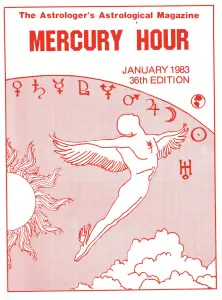
Astrology, Mercury Hour, Natal charts, Transits, Progressions, Mundane Astrology, Astro*Carto*Graphy, Chiron, Void of Course Moon, Solar Returns, Uranian astrology, Cosmobiology. This 36th Edition of Mercury Hour (January 1983), edited and published by Edith Custer, is a comprehensive astrological magazine featuring diverse correspondence, extensive theoretical and technical articles, book reviews, conference reports, and in-depth chart delineations. Key themes explored across the publication include life-stage transitions such as the ‘Catch-30’ passage and Uranus age cycles, mundane and political astrology including analyses of nuclear war threats, the Falklands crisis, and the chart of Israel, as well as technical discussions regarding software, heliocentric nodes, house systems, and the accuracy of astrological statistics (such as Gauquelin studies).

Issue Highlights:

Articles:
The Vertex – Jan Popelka
Student’s Section: A Visit to Astrologers in the U.S.A. – Ann Stevens-Patacchiola
The Catch-30 Passage: [28-32], Part III – Bil Tierney
[Uranus age cycle] Part II – Dale Huckeby
Mysterious Neptune, Part II (Marcia Moore’s chart and death) – Manik Chand Jain
Moon Void of Course in the Signs, Part I – Ted George
Is Nuclear War in Our Future? [An Astrological Call to Action] – Virginia Miller
The Pshaw Report – Jayj Jacobs
The Role of the Moon’s Nodes in World Events – Alan Richter
The New Orleans Air Crash of July 1982 – Jeff Jawer
The Effects of Saturn Transits in the Lives of the Pacific Club Members – Dona Shaw
A Royal Baby (Prince William) – Judith Gee
Determining the Winner of a Game – Sophia Mason
The Psychological Patterns of Jesus Christ – Frank Jakubowsky

Discussion:
Astro*Carto*Graphy, geodetic equivalents, and mundane predictions
Astrology hardware and software (Osborne, Astro Star, Matrix software reports)
Sunspot activity and the stock market
Gauquelin studies and statistical analysis
Lindbergh baby kidnapping and Bruno Hauptmann chart analysis
Intruder in the Queen’s Bedroom (Michael Fagan and Elizabeth II charts)
Fraternity for Canadian Astrologers 1st National Conference awards

Chart data:
August Belmont
David Crosby
Richard Dreyfuss
Michael Fagan
Andy Gibb
Bruno Hauptmann
Charley Pride
Victoria Principal
Ronald Reagan
Michael Trestrail
Israel and Partition
United Kingdom

Notable contributors:
Jim Lewis (Astro*Carto*Graphy and Ronald Reagan chart)
Jeff Jawer (First Canadian National Conference)
Barbara Watters (Grand trines and Sex and the Outer Planets)
Tracy Marks (financial compensation for astrologers)
Zane Stein (Chiron research)
Erin Sullivan (astrology of sexuality)

Ask A Librarian

Need assistance with your research or navigating our collection? Our library team is here to help.

Please fill out the form below with details about the topics, authors, or archival materials you are looking for, and one of our librarians will review your query and respond shortly.

Help

Whether you are looking for rare historical texts or trying to locate a specific book nearby, Alexandria iBase offers two primary ways to search. Here is how to choose the right tool for what you need:

The Library Catalogue

Think of this as your global master index.

The Catalogue works just like a traditional library search system, designed to help you locate books and media across the broader astrological landscape.

  • Physical Books: Find out where physical copies of books are held in libraries, archives, or collections near you.

  • Digital Files: Access downloadable or viewable digital editions when available.

  • Best Used For: Standard research, finding specific ISBNs or authors, and tracking down physical items in the real world.

Browse Catalogue

SPECIAL COLLECTIONS

Think of this as Alexandria’s exclusive private vault.

Collections gives you direct access to Alexandria’s own curated archive of rare, proprietary, and historic astrology media.

  • Exclusive Material: Features unique texts, manuscripts, audio recordings, and visual media that are not available anywhere else.

  • Direct Access: Digitized content ready to explore straight from the platform.

  • Best Used For: Deep-dive research, discovering hidden gems, and exploring rare, one-of-a-kind astrological resources.

Browse Special Collections

Cash & In-Kind Donations

Make a one-time or recurring tax deductible cash donation.

Payment options include donating directly with us, PayPal Giving and GoFundMe.

GoFundMe for Charities and PayPal Giving are registered for tax deductions and have no required processing fees. It does offer the option to tip.

Donate

*Subject to 2.5% processing fees

Contact Us

Have a question, feedback, or a inquiry about our archives? We’d love to hear from you. Please fill out the form below with your details and message, and a member of our team will get back to you as soon as possible.

Thank you for reaching out to the Alexandria iBase Project!