
Home » Ceres

Ceres

The largest asteroid (and designated dwarf planet) in the main asteroid belt, discovered in 1801. In astrological literature, Ceres is analyzed as an archetypal significator of maternal care, agricultural rhythms, ecological cycles, grief, and the psychological mechanics of nourishment and bodily sustenance.

Filters

Filters


See more See less
See more See less
See more See less
See more See less
See more See less
See more See less
See more See less

Sorting

Heliocentric Mechanics, Astrometeorology, and Mundane Forecasting. This archival document is Issue No. 3 (Lammas / Mid Leo 1987) of the Heliogram, published by the NCGR Helio S.I.G.. The issue heavily features technical methodologies for integrating geocentric and heliocentric data, alongside rigorous mundane weather tracking. Key contributions include J. Lee Lehman’s statistical exploration of the differences between Geo Mercury (thinking) and Helio Mercury (communicating), Michael Erlewine’s structural breakdown of Helio Archetypes (Yin/Yang, Trine/T-Square), and T. Pat Davis’s mundane analysis of Senator Joseph McCarthy and Queen Elizabeth I. Additional features include Margaret Meister’s retrospective analysis of the 1947 Texas City Explosion, Dot Willis’s weather forecasting for the Autumnal Equinox and late-1987 eclipses, and a spirited debate between NCGR Research Director Michael P. Munkasey and Edith Custer regarding the astronomical logic of mixing heliocentric planets with geocentric house systems.

Issue Highlights

Articles: The Mercury Dilemma – J. Lee Lehman, Ph.D.

Helio Meditations II – Michael Erlewine

A Tribute to Zane B. Stein – T. Pat Davis

Texas City Revisited – Margaret M. Meister

Weather or Not – Dot Willis

Geo vs Helio Mars – T. Patrick Davis

Senator Joseph Raymond McCarthy – T. Pat Davis

Heliocentric: Magnitude of Influence – T. Patrick Davis

Discussions: Geocentric vs. Heliocentric Mercury dynamics The “Helio Challenge”: Debating the validity of mixing Geo houses with Helio planets The August 9, 1987 Supermoon and associated severe weather warnings Upcoming 1988 Saturn/Uranus conjunctions (Geo vs. Helio dates)

Notable contributors: J. Lee Lehman Margaret Meister Michael Erlewine T. Pat Davis Edith Custer Dot Willis Michael P. Munkasey

Chart data: Zane B. Stein Fred Astaire Jackie Gleason Giant Baby Panda Texas City Explosion (Grandcamp & High Flyer) Anita McKeown (“Calamity Jane”) Queen Elizabeth I Senator Joseph Raymond McCarthy 1988 Presidential Candidates (Richard Gebhardt, George Bush, Mario Cuomo, Michael Dukakis, Jack Kemp, Bruce Babbitt, Joseph Biden, Jesse Jackson, Paul Martin Simon)
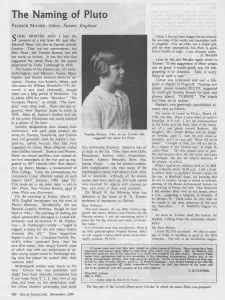
The Naming of Pluto (1984)

General Astrology Articles

Astronomy, History, Mythology, Pluto, Naming. This historical article details the fascinating story behind how the planet Pluto received its name, following its discovery by Clyde Tombaugh in 1930. Patrick Moore recounts the crucial role played by Venetia Burney, an 11-year-old girl from Oxford, England, who suggested the name Pluto based on the Roman god of the underworld. The text weaves together correspondence, historical records, and personal accounts from prominent figures of the era such as H.H. Turner, V.M. Slipher, and A.C. Crommelin, illustrating how the suggestion made its way from an ordinary breakfast table conversation to the Lowell Observatory and official international adoption.

Issue Highlights:

Articles:
The Naming of Pluto – Patrick Moore

Discussion:
Discovery of Planet X and Pluto
Historical correspondence regarding planetary nomenclature

Chart data:
Clyde Tombaugh
Venetia Burney

Notable contributors:
Patrick Moore (Author)
Venetia Burney (Suggester of the name Pluto)
H.H. Turner (Professor of Astronomy at Oxford)
V.M. Slipher (Astronomer at Lowell Observatory)

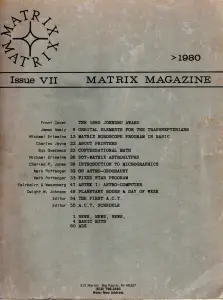
Computerized Astrology, Astrological Programming, A.C.T. Conference, Trans-Neptunian Planets. This issue of Matrix Magazine serves as a bridge between early computing technology and professional astrological practice. It focuses heavily on the technical application of microcomputers (Commodore PET, Apple II, TRS-80) to astrological research, offering BASIC programming code for chart calculations, orbital elements for Trans-Neptunian planets (Cupido, Hades, Zeus, Kronos, Apollon, Admetos, Vulkan, Poseidon), and instructions for printer-based astroglyph generation. The magazine also introduces the “ASTEK I,” a specialized astrological computer, and discusses the use of microfilm for archival astrological data storage.

Issue Highlights:
The 1980 Johndro Award is presented to Neil F. Michelsen for his pioneering work in computer-assisted ephemerides and astrological software. The issue also provides a comprehensive schedule for the first Astrological Conference on Techniques (A.C.T.) held in New Orleans, covering a wide array of research topics from planetary cycles to rectifiction methods.

Articles:
Orbital Elements for the Transneptunians – James Neely
Matrix Horoscope Program in BASIC – Michael Erlewine
Conversational Math – Buz Overbeck
Dot-Matrix Astroglyphs – Michael Erlewine
Introduction to Micrographics – Charles Paul Jones
On Astro-Geography – Mark Pottenger
Fixed Star Program – Mark Pottenger
ASTEK I: Astro-Computer – Fairbairn & Wesenberg
Planetary Hours & Day of Week – Dwight W. Johnson

Discussion:
Application of BASIC programming in natal astrology
Technical specifications and history of the ASTEK I calculator
Astro-Geography and meridian contacts
Statistical analysis of astrological data
Microfilm implementation for astrological libraries
Planetary rulers and the day of the week

Chart data:
Michael Erlewine (Born 7/18/1941, 4:03 PM EST, Lancaster, PA)

Notable contributors:
Michael Erlewine (Editor/Computing), James Neely (Orbital elements/programming), Mark Pottenger (Fixed star programming), Charles Jayne (Conference/Techniques advice), Buz Overbeck (Conversational math)

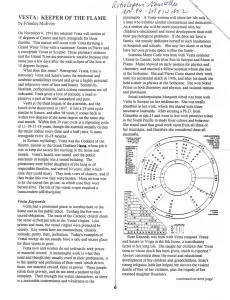
Vesta: Keeper of the Flame (1994)

Frances McEvoy, Special Collections

Asteroid Vesta, Grand Trine, Natal Astrological Analysis, Confinement and Solitude, Birth Data. This issue features an in-depth astrological analysis of the asteroid Vesta by Frances McEvoy, framed by Vesta’s November 1994 station at 10 degrees Cancer forming a Grand Water Trine with Saturn in Pisces and Venus in Scorpio. McEvoy explores Vesta’s 29-year cycle, its mythological roots as the Goddess of the Hearth, and its archetypal keywords such as commitment, chastity, solitude, purity, duty, perfection, and transcendent self-discipline. The article delineates how Vesta operates in both male and female charts, highlighting themes of dedicated work, privacy, and inner strength.

The study examines numerous chart examples illustrating Vesta’s impact on public service, science, art, and personal sacrifice. Detailed case studies include Marie Curie, Margaret Mead, Maria Montessori, Anne Frank, Sister Francesca Cabrini, Saint Therese of Lisieux, Queen Victoria, Grace Kelly, Jerry Brown, David Souter, Yassar Arafat, Oliver North, Angela Davis, Betty Friedan, Helen Keller, Michel Gauquelin, Bobby Fischer, and major classical composers like Bach, Mozart, Schubert, and Chopin. Themes of confinement, religious devotion, political zealotry, and intellectual immersion are thoroughly traced through Vesta’s aspects and house placements.

Additionally, Lorraine Welsh presents “The Data Base,” providing precise birth data for political candidates and public figures of the period, including Mitt Romney, Joe Malone, Paul Cellucci, and Pope John Paul II. An informational announcement for Robert Hand’s instructional classes on Traditional Western, Renaissance, and Hellenistic astrology is also included.

Issue Highlights:

Articles:
VESTA: KEEPER OF THE FLAME – Frances McEvoy
The Data Base – Lorraine Welsh

Discussion:
Vesta cycle and astronomical station patterns
Vesta in psychological, natal, and mundane astrology
Confinement, solitude, and religious devotion in chart analysis
Verified birth data for political candidates and notable figures
Instruction in Hellenistic and Renaissance traditional astrology

Chart data:
Maria Montessori
Yassar Arafat
Helen Keller
Mitt Romney
Joe Malone
Paul Cellucci
Pope John Paul II (Karol Wojtyla)

Notable contributors:
Frances McEvoy (Vesta: Keeper of the Flame)
Lorraine Welsh (The Data Base)
Robert Hand (Traditional Astrology Classes)

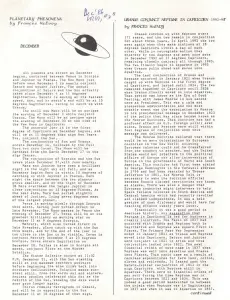
Planetary Phenomena, Uranus Conjunct Neptune in Capricorn, Historical Mundane Astrology. This detailed astrological and historical analysis by Frances McEvoy explores the upcoming conjunction of Uranus and Neptune in Capricorn (1992-1995) and compares it extensively with the historical Uranus-Neptune conjunction of 1821-1828. The author examines planetary movements for December 1986, including planetary aspects, ingresses, and general phenomena. The main focus is a deep dive into mundane astrology, examining how the Uranus-Neptune conjunction in Capricorn correlates with major societal, industrial, and political shifts, such as the Monroe Doctrine, the rise of the working class, utopian socialism, Robert Owen’s experiments, and significant architectural and literary movements.

Issue Highlights:
Detailed astrological ephemeris data for December 1986 and an exhaustive historical correlation of the Uranus-Neptune conjunction in Capricorn, looking ahead to the 1992-1995 alignment.

Articles:
Planetary Phenomena – Frances McEvoy
Uranus Conjunct Neptune in Capricorn 1992-95 – Frances McEvoy

Discussion:
Planetary movements for December 1986
Historical analysis of the 1821-1828 Uranus-Neptune conjunction in Capricorn
Mundane astrological effects on labor, industry, and social reform
Architectural revivals and romanticism during Uranus-Neptune cycles

Chart data:
N/A

Notable contributors:
Frances McEvoy (Astrological and historical analysis)

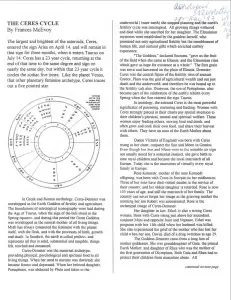
The Ceres Cycle (1993)

Frances McEvoy, Special Collections

Ceres Cycle, Natal Astrology, Psychological Astrology, Asteroids, Child Loss and Family Relationships. This issue features a comprehensive exploration of the asteroid Ceres by Frances McEvoy, examining its mythological roots as Ceres-Demeter and its profound astrological significance regarding parenting, nurturing, feeding, and maternal archetypes. The text explores how Ceres functions in natal charts, detailing its 23-year cycle, its entry into Aries, and specific connections to themes of grief, child loss, separation from children, and maternal bonds through numerous prominent historical and celebrity examples including Queen Victoria, Rose Kennedy, Ethel Kennedy, Bill Clinton, Liza Minnelli, Gloria Vanderbilt, Liv Ullman, Dancer Isadora Duncan, and Ingrid Bergman. Additionally, the issue includes an insightful article by Joyce Levine on setting up a context for astrological consultations with clients, framing the birth chart as genetic programming and offering psychological perspectives on navigating life challenges, deterministic traits, and personal growth.

Issue Highlights:

Articles:
The Ceres Cycle – Frances McEvoy
Setting Up a Context for Consultations with Clients – Joyce Levine

Discussion:
Mythological and psychological symbolism of Ceres-Demeter
Ceres in natal charts and its connection to motherhood, parenting, and nurturing
Astrological indicators of child loss, grief, and separation from children
The 23-year cycle of Ceres and transit patterns
Approaching astrological consultations and client expectations

Chart data:
Victoria, Queen of England
Rose Kennedy
Ethel Kennedy
Bill Clinton
David Azar
Geneva
Liza Minnelli
Gloria Vanderbilt
Liv Ullman
Ingmar Bergman
Isadora Duncan
Ingrid Bergman
Eleanor Roosevelt
Shirley Maclaine

Notable contributors:
Frances McEvoy (The Ceres Cycle)
Joyce Levine (Setting Up a Context for Consultations with Clients)

Mundane Astrology, Astrology History, and Astrological Techniques. This archival item is the April 1985 issue (14th Extra Edition) of Mercury Hour, a quarterly astrological magazine edited and published by Edith Custer in Lynchburg, Virginia. Featured articles include Raul Davila’s comparative study of published birth times for Ronald Reagan, Judy Goodwin’s research on name etymology in “The Astro-Punology of Names,” Marc Penfield’s chart analysis of the State of Israel, and T. Patrick Davis’s survey of geocentric and heliocentric Mars-to-Moon aspects alongside historical charts of the 1941 Pearl Harbor attack. Additional contributions cover Mary Mackenzie’s application of John H. Nelson’s heliocentric radio propagation forecasting methods, Judith Gee’s analysis of the 1939 Hitler-Stalin Pact, Marion March’s commentary on planetary configurations, and Joylyn Hill’s reflections on Atlantis. The issue also preserves community discussions regarding Gauquelin’s “Mars Effect,” astrological triggers for agoraphobia, forensic chart analyses of the Lindbergh baby kidnapping, and legal regulations surrounding professional astrology.


Issue Highlights

Book Review:

Relationships & Life Cycles, Modern Dimensions of Astrology by Stephen Arroyo – Rochelle Gordon


Articles:

Saturn Through the Signs – Bil Tierney

Crisis in the Near East – Gregg Castellucci

Chiron and Group Fusion – Tom McNamara

The Discovery of the Asteroids – Joylyn Hill

In the Winter of our Discontent – Marc Robertson (Jupiter-Saturn cycles)

Pluto (Part III) – R.C. Davison


Discussions:

AFA Conventions

Void of Course Moon

Ted Bundy

Inherited family traits


Chart data:

Ali, Mohammad
Anderson, John B.
Bergen, Candice
Crawford, Joan
Jones, Jim
Israel


Notable contributors:

Marion March (Fiji conference)

Lois Rodden (notes on chart data)

Jim Lewis (notes on A*C*G* maps of US Presidential candidates)

Lee Lehman (research on astrology & homosexuality)

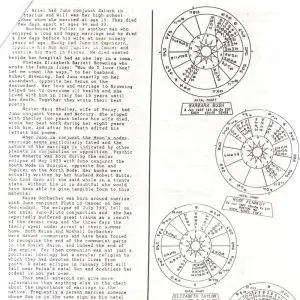
Asteroid Juno, Marriage, Power Struggles, Prominent Figures. This article explores the astrological significance of the asteroid Juno, known in mythology as the wife of Zeus and queen of the gods, focusing on her role in partnerships, marriage, jealousy, fidelity, and power dynamics. The author examines Juno’s orbital cycles, particularly its movements in Capricorn and Aquarius, and analyzes its placement in the natal charts of numerous historical figures, celebrities, and political leaders. The text highlights how prominent women often feature strong Juno placements, connecting the asteroid to public fame through marriage, career support, or notable domestic struggles.

Issue Highlights:

Articles:
JUNO: FIRST LADY OF THE GODS – Frances McEvoy

Discussion:
Astrological significance of the asteroid Juno
Juno’s cycles and stations in Capricorn and Aquarius
Juno in natal charts of political figures and celebrities
Connections between Juno aspects and marriage, divorce, and widowhood

Chart data:
Barbara Bush
Rose Kennedy
Elizabeth Taylor
Eleanor Roosevelt

Notable contributors:
Frances McEvoy (Astrological analysis of the asteroid Juno)

Ceres: Food Provider and Grieving Mother (1985)

Frances McEvoy, Special Collections

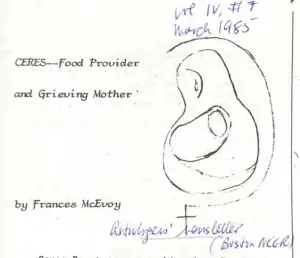
Ceres, Asteroids, Natal Astrology, Mythology. The provided text is an in-depth astrological and mythological exploration of the asteroid Ceres. The author, Frances McEvoy, characterizes Ceres as the ‘Food Provider’ and ‘Grieving Mother,’ drawing parallels between the planet’s discovery in 1801—a moment when it was positioned on the ecliptic and linked to solar and lunar eclipses—and its mythological role as the goddess of agriculture, fertility, and maternal nurturing. The synthesis explains Ceres’s 23-year cycle and its symbolic resonance with the Earth, substantiality, and the cycles of planting and harvest.

Issue Highlights:

Articles:
CERES–Food Provider and Grieving Mother – Frances McEvoy
CERES–The Earth Mother (Continued) – Frances McEvoy

Discussion:
The symbolic interpretation of Ceres in natal astrology as a representative of maternal instincts and nurturing.
The correlation between the transit of Ceres through Taurus and its impact on agriculture, famine, and economic stability.
Case studies of famous figures illustrating Ceres’ placement and its effect on their personal lives, grief, and nurturing roles.

Chart data:
Gloria Vanderbilt
Liza Minelli
Clara Barton
Liv Ullman
Isadora Duncan
Eleanor Roosevelt
Edward Kennedy
Queen Victoria
Queen Mary
Ingrid Bergman
Rose Kennedy
Ethel Kennedy

Notable contributors:
Frances McEvoy (Astrological interpretation of Ceres mythology and natal placement)

Ask A Librarian

Need assistance with your research or navigating our collection? Our library team is here to help.

Please fill out the form below with details about the topics, authors, or archival materials you are looking for, and one of our librarians will review your query and respond shortly.

Help

Whether you are looking for rare historical texts or trying to locate a specific book nearby, Alexandria iBase offers two primary ways to search. Here is how to choose the right tool for what you need:

The Library Catalogue

Think of this as your global master index.

The Catalogue works just like a traditional library search system, designed to help you locate books and media across the broader astrological landscape.

  • Physical Books: Find out where physical copies of books are held in libraries, archives, or collections near you.

  • Digital Files: Access downloadable or viewable digital editions when available.

  • Best Used For: Standard research, finding specific ISBNs or authors, and tracking down physical items in the real world.

Browse Catalogue

SPECIAL COLLECTIONS

Think of this as Alexandria’s exclusive private vault.

Collections gives you direct access to Alexandria’s own curated archive of rare, proprietary, and historic astrology media.

  • Exclusive Material: Features unique texts, manuscripts, audio recordings, and visual media that are not available anywhere else.

  • Direct Access: Digitized content ready to explore straight from the platform.

  • Best Used For: Deep-dive research, discovering hidden gems, and exploring rare, one-of-a-kind astrological resources.

Browse Special Collections

Cash & In-Kind Donations

Make a one-time or recurring tax deductible cash donation.

Payment options include donating directly with us, PayPal Giving and GoFundMe.

GoFundMe for Charities and PayPal Giving are registered for tax deductions and have no required processing fees. It does offer the option to tip.

Donate

*Subject to 2.5% processing fees

Contact Us

Have a question, feedback, or a inquiry about our archives? We’d love to hear from you. Please fill out the form below with your details and message, and a member of our team will get back to you as soon as possible.

Thank you for reaching out to the Alexandria iBase Project!