
Home » Juno

Juno

Discovered in 1804, Juno is historically associated with the Roman goddess of marriage. Astrological commentators analyze this asteroid to evaluate the structural dynamics of formal partnerships, contractual obligations, institutional marriage, and issues of loyalty, jealousy, or power imbalances within committed relationships.

Filters

Filters


See more See less
See more See less
See more See less
See more See less
See more See less
See more See less
See more See less

Sorting

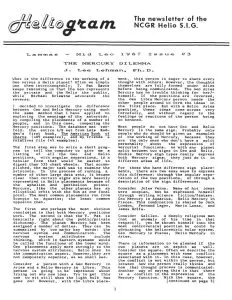
Heliocentric Mechanics, Astrometeorology, and Mundane Forecasting. This archival document is Issue No. 3 (Lammas / Mid Leo 1987) of the Heliogram, published by the NCGR Helio S.I.G.. The issue heavily features technical methodologies for integrating geocentric and heliocentric data, alongside rigorous mundane weather tracking. Key contributions include J. Lee Lehman’s statistical exploration of the differences between Geo Mercury (thinking) and Helio Mercury (communicating), Michael Erlewine’s structural breakdown of Helio Archetypes (Yin/Yang, Trine/T-Square), and T. Pat Davis’s mundane analysis of Senator Joseph McCarthy and Queen Elizabeth I. Additional features include Margaret Meister’s retrospective analysis of the 1947 Texas City Explosion, Dot Willis’s weather forecasting for the Autumnal Equinox and late-1987 eclipses, and a spirited debate between NCGR Research Director Michael P. Munkasey and Edith Custer regarding the astronomical logic of mixing heliocentric planets with geocentric house systems.

Issue Highlights

Articles: The Mercury Dilemma – J. Lee Lehman, Ph.D.

Helio Meditations II – Michael Erlewine

A Tribute to Zane B. Stein – T. Pat Davis

Texas City Revisited – Margaret M. Meister

Weather or Not – Dot Willis

Geo vs Helio Mars – T. Patrick Davis

Senator Joseph Raymond McCarthy – T. Pat Davis

Heliocentric: Magnitude of Influence – T. Patrick Davis

Discussions: Geocentric vs. Heliocentric Mercury dynamics The “Helio Challenge”: Debating the validity of mixing Geo houses with Helio planets The August 9, 1987 Supermoon and associated severe weather warnings Upcoming 1988 Saturn/Uranus conjunctions (Geo vs. Helio dates)

Notable contributors: J. Lee Lehman Margaret Meister Michael Erlewine T. Pat Davis Edith Custer Dot Willis Michael P. Munkasey

Chart data: Zane B. Stein Fred Astaire Jackie Gleason Giant Baby Panda Texas City Explosion (Grandcamp & High Flyer) Anita McKeown (“Calamity Jane”) Queen Elizabeth I Senator Joseph Raymond McCarthy 1988 Presidential Candidates (Richard Gebhardt, George Bush, Mario Cuomo, Michael Dukakis, Jack Kemp, Bruce Babbitt, Joseph Biden, Jesse Jackson, Paul Martin Simon)
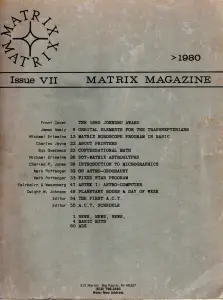
Computerized Astrology, Astrological Programming, A.C.T. Conference, Trans-Neptunian Planets. This issue of Matrix Magazine serves as a bridge between early computing technology and professional astrological practice. It focuses heavily on the technical application of microcomputers (Commodore PET, Apple II, TRS-80) to astrological research, offering BASIC programming code for chart calculations, orbital elements for Trans-Neptunian planets (Cupido, Hades, Zeus, Kronos, Apollon, Admetos, Vulkan, Poseidon), and instructions for printer-based astroglyph generation. The magazine also introduces the “ASTEK I,” a specialized astrological computer, and discusses the use of microfilm for archival astrological data storage.

Issue Highlights:
The 1980 Johndro Award is presented to Neil F. Michelsen for his pioneering work in computer-assisted ephemerides and astrological software. The issue also provides a comprehensive schedule for the first Astrological Conference on Techniques (A.C.T.) held in New Orleans, covering a wide array of research topics from planetary cycles to rectifiction methods.

Articles:
Orbital Elements for the Transneptunians – James Neely
Matrix Horoscope Program in BASIC – Michael Erlewine
Conversational Math – Buz Overbeck
Dot-Matrix Astroglyphs – Michael Erlewine
Introduction to Micrographics – Charles Paul Jones
On Astro-Geography – Mark Pottenger
Fixed Star Program – Mark Pottenger
ASTEK I: Astro-Computer – Fairbairn & Wesenberg
Planetary Hours & Day of Week – Dwight W. Johnson

Discussion:
Application of BASIC programming in natal astrology
Technical specifications and history of the ASTEK I calculator
Astro-Geography and meridian contacts
Statistical analysis of astrological data
Microfilm implementation for astrological libraries
Planetary rulers and the day of the week

Chart data:
Michael Erlewine (Born 7/18/1941, 4:03 PM EST, Lancaster, PA)

Notable contributors:
Michael Erlewine (Editor/Computing), James Neely (Orbital elements/programming), Mark Pottenger (Fixed star programming), Charles Jayne (Conference/Techniques advice), Buz Overbeck (Conversational math)

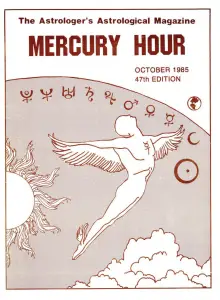
Astrological Techniques, Astrology History, and Mundane Astrology. This archival item is the October 1985 issue (47th Edition) of Mercury Hour, a quarterly magazine edited by Edith Custer and Jewell Fahey in Lynchburg, Virginia. Key contents include technical articles such as John F. Gay, III’s guide to calculating house cusps and astronomical coordinates using scientific calculators, Joan McEvers’s second installment on interpreting Lunar Returns, and Dorothy Willis’s foundational rules for astro-meteorology. Mundane and historical pieces feature Marc Penfield’s chart rectifications for Russia’s 1917 Bolshevik Revolution and the “Chart Mart” data collection, Fran Rosen’s explorations of the Kabbalistic Tree of Life and Tarot symbolism, and Gilbert Navarro’s definition of horary astrology. Additional contributions include reviews by Marion March, reports on the 7 Hills Astrological Conference, an analysis of the 1985 Bradford football stadium fire by Olivia Barclay, and reader discussions surrounding topics such as ethics, licensing, house systems, and birth data for figures like Ronald Reagan, Mikhail Gorbachev, and Mary Baker Eddy.


Issue Highlights


Book Reviews

By Marion March:

Celestial Psychology: An Astrological Guide to Growth and Transformation by Doris A. Hebel

Astrochemistry: A Study of Metal-Planet Affinities by Nick Kellerstrom

Instant Astrology by Mary Orser, Rick and Glory Brightfield

The Astrology of Deep Space by Philip Sedgwick

Spiritual Astrology: A Layperson’s Guide to Self-Unfoldment by Jan Spiller

The Practice and Profession of Astrology by Stephen Arroyo

Birth Pattern Psychology by Tamise Van Pelt

The Astrological Prayer Book by Alda Marian Jangl
Your Key to Astrology [book plus] Astrological Key Cards: Planets, Signs, Houses, Aspects by Bill Hansen – Edith Custer


Articles

Astrology and the Weather – Dorothy Willis

Lunar Return Notes, Part II – Joan McEvers

Calculation Without Tables of the Julian Day & Century, Obliquity of the Ecliptic, MC, ASC, and Houses, Part I – John F. Gay, III

The Tree of Life: An Overview – Fran Rosen

Astrological Hall of Fame Awards – Fraternity for Canadian Astrologers [2nd National Conference]

Along the Tarot Path – Fran Rosen

How I Survived my Pluto Square Pluto and Other Transits – Carol Hemingway

The Luscher Color Test, A Symbolic Testing Model – Zan Key

Observations on Astrology, Original & Borrowed – John F. Gay, III

I’m Mad at You!!!! – Mary Ellen Glass

The Horoscope of Russia – Marc Penfield

Chart Mart – Marc Penfield

A Trip Round the Hawaiian Zodiac, Part II – Cheryl Niggle

Astrology and the Weather: Forecasting the Weather, Part I – Dorothy Willis

Horary Astrology: A Definition – Gilbert Navarro

The Business Cycle, Part II – Bill Hansen

Neptune, The Collective Fantasy, and Popular Music – Amy Franco

The Mystery of the Chinese Zodiac, Now Revealed for the First Time – Frank Hampton

The Qualities of Time, Part I – Tundra Wind


Discussions

Astrology, licensure, & ethics

Quadrant house systems vs. Equal Houses

Radix-based Tarot technique

Natal location in Return chart

Birth time of Ronald Reagan

Seven Hill Astrological Conference [reports]

Mercury retrograde


Chart data

Anderson, Loni
Benetar, Haley (daughter of Pat Benetar)
Bowie, David
Eddy, Mary Baker
Eisenhower, Melanie (daughter of Julie Nixon and David Eisenhower)
Gorbachev, Mikhail
Jagger, Elizabeth (daughter of Mick Jagger and Jerri Hall)
Kennedy III Robert F.
Morgan, Vicki
Neves, Tancredo
Pace, Canio and Thomas (cross-year twins)
Reagan, Ronald
Schwab, Loluis and Leona (cross-year twins)
Spielberg, Max (son of Steven Spielberg and Amy Irving)Vaughn, Sarah

Frustaci sextuplets
Czar Nicholas II
Prince Henry

Air India 747 jetliner crash
Christian Science Church
Formation of the Soviet Union
Founding of Tel Aviv
Halley’s Comet return
Live Aid Concert 1985


Notable contributors

Joylyn Hill (Chart of Israel, chart of Robert E. Lee, the nature of Venus)

Olivia Barclay (astrological signature of fires and explosions)

Misty Kuceris (7 Hills Conference)

Robert Pelletier (7 Hills Conference)

Zane Stein (Solstice points, Sabian symbols)

Erin Sullivan (Mercury retrograde)

Michael and Margaret Erlewine (Matrix Heart Center)

Eleanor Bach (Marc Edmond Jones Award)

Lee Lehman (Kundalini and asteroid Sappho)

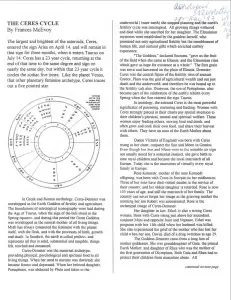
The Ceres Cycle (1993)

Frances McEvoy, Special Collections

Ceres Cycle, Natal Astrology, Psychological Astrology, Asteroids, Child Loss and Family Relationships. This issue features a comprehensive exploration of the asteroid Ceres by Frances McEvoy, examining its mythological roots as Ceres-Demeter and its profound astrological significance regarding parenting, nurturing, feeding, and maternal archetypes. The text explores how Ceres functions in natal charts, detailing its 23-year cycle, its entry into Aries, and specific connections to themes of grief, child loss, separation from children, and maternal bonds through numerous prominent historical and celebrity examples including Queen Victoria, Rose Kennedy, Ethel Kennedy, Bill Clinton, Liza Minnelli, Gloria Vanderbilt, Liv Ullman, Dancer Isadora Duncan, and Ingrid Bergman. Additionally, the issue includes an insightful article by Joyce Levine on setting up a context for astrological consultations with clients, framing the birth chart as genetic programming and offering psychological perspectives on navigating life challenges, deterministic traits, and personal growth.

Issue Highlights:

Articles:
The Ceres Cycle – Frances McEvoy
Setting Up a Context for Consultations with Clients – Joyce Levine

Discussion:
Mythological and psychological symbolism of Ceres-Demeter
Ceres in natal charts and its connection to motherhood, parenting, and nurturing
Astrological indicators of child loss, grief, and separation from children
The 23-year cycle of Ceres and transit patterns
Approaching astrological consultations and client expectations

Chart data:
Victoria, Queen of England
Rose Kennedy
Ethel Kennedy
Bill Clinton
David Azar
Geneva
Liza Minnelli
Gloria Vanderbilt
Liv Ullman
Ingmar Bergman
Isadora Duncan
Ingrid Bergman
Eleanor Roosevelt
Shirley Maclaine

Notable contributors:
Frances McEvoy (The Ceres Cycle)
Joyce Levine (Setting Up a Context for Consultations with Clients)

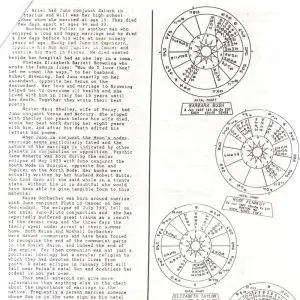
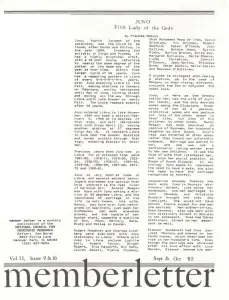
Asteroid Juno, Marriage, Power Struggles, Prominent Figures. This article explores the astrological significance of the asteroid Juno, known in mythology as the wife of Zeus and queen of the gods, focusing on her role in partnerships, marriage, jealousy, fidelity, and power dynamics. The author examines Juno’s orbital cycles, particularly its movements in Capricorn and Aquarius, and analyzes its placement in the natal charts of numerous historical figures, celebrities, and political leaders. The text highlights how prominent women often feature strong Juno placements, connecting the asteroid to public fame through marriage, career support, or notable domestic struggles.

Issue Highlights:

Articles:
JUNO: FIRST LADY OF THE GODS – Frances McEvoy

Discussion:
Astrological significance of the asteroid Juno
Juno’s cycles and stations in Capricorn and Aquarius
Juno in natal charts of political figures and celebrities
Connections between Juno aspects and marriage, divorce, and widowhood

Chart data:
Barbara Bush
Rose Kennedy
Elizabeth Taylor
Eleanor Roosevelt

Notable contributors:
Frances McEvoy (Astrological analysis of the asteroid Juno)

Frances McEvoy Juno First Lady of the Gods V.1 Volume 11 Issue 9 and 10

Juno First Lady of the Gods

Frances McEvoy, Special Collections

Asteroid Astrology, Juno in Natal Charts, Marriage and Relationships. The publication features an in-depth article exploring the astrological significance of the asteroid Juno, the ‘First Lady of the Gods,’ focusing on its orbital characteristics, cycles, and placement in the natal charts of prominent figures. Frances McEvoy details how Juno governs marriage, partnership, jealousy, fidelity, and social standing, noting its 48-year orbital cycle and repeating retrograde patterns in Libra. The text examines numerous historical and celebrity examples, demonstrating how Juno’s aspects to angles, luminaries, and outer planets correlate with marital history, infidelity, fame through marriage, and partnership dynamics.

Issue Highlights:
An exhaustive examination of the asteroid Juno’s placement across multiple charts of famous figures, highlighting its role as a key indicator of marital destiny, relationship style, and domestic partnership patterns.

Articles:
Juno: First Lady of the Gods – Frances McEvoy

Discussion:
Orbital mechanics and recurrence cycles of the asteroid Juno
Juno in Libra and its association with partnership and social recognition
Juno’s aspects to the Sun, Moon, Ascendant, Midheaven, and nodal axis in notable charts
Correlations between Juno placements and marriage, infidelity, widowhood, and divorce

Chart data:
Shah Mohammad Reza of Iran
David Brinkley
Yul Brynner
Robert Redford
Peter O’Toole
Joan Collins
Goldie Hawn
Sylvia Plath
Marlon Brando
Doris Day
Margaret Sullavan
Merle Oberon
Linda Christian
Carroll O’Connor
Jean Harlow
Princess Anne
Peter Duchin
Maria Callan
Maureen O’Sullivan
Ronald Reagan
Nancy Reagan
Jane Wyman
Jacqueline Kennedy Onassis
John Kennedy
Aristotle Onassis
Rose Kennedy
Eleanor Roosevelt
Lucy Mercer
Betty Ford
Gerald Ford
Rosalynn Carter
Jimmy Carter
Cathryn Brant Crosby
Bing Crosby
Princess Grace of Monaco
Clare Booth Luce
Henry R. Luce
Queen Elizabeth II
Prince Philip
Debbie Reynolds
Eddie Fisher
Will Durant
Ariel Durant
Buckminster Fuller
Elizabeth Taylor
Ted Kennedy
John Updike
Joan Sutherland
Richard Bonynge
Elizabeth Barrett Browning
Robert Browning
Mary Shelley
Percy B. Shelley
Jane Roberts
Robert Butts

Notable contributors:
Frances McEvoy (Asteroid Astrology and Juno in relationships)

Ask A Librarian

Need assistance with your research or navigating our collection? Our library team is here to help.

Please fill out the form below with details about the topics, authors, or archival materials you are looking for, and one of our librarians will review your query and respond shortly.

Help

Whether you are looking for rare historical texts or trying to locate a specific book nearby, Alexandria iBase offers two primary ways to search. Here is how to choose the right tool for what you need:

The Library Catalogue

Think of this as your global master index.

The Catalogue works just like a traditional library search system, designed to help you locate books and media across the broader astrological landscape.

  • Physical Books: Find out where physical copies of books are held in libraries, archives, or collections near you.

  • Digital Files: Access downloadable or viewable digital editions when available.

  • Best Used For: Standard research, finding specific ISBNs or authors, and tracking down physical items in the real world.

Browse Catalogue

SPECIAL COLLECTIONS

Think of this as Alexandria’s exclusive private vault.

Collections gives you direct access to Alexandria’s own curated archive of rare, proprietary, and historic astrology media.

  • Exclusive Material: Features unique texts, manuscripts, audio recordings, and visual media that are not available anywhere else.

  • Direct Access: Digitized content ready to explore straight from the platform.

  • Best Used For: Deep-dive research, discovering hidden gems, and exploring rare, one-of-a-kind astrological resources.

Browse Special Collections

Cash & In-Kind Donations

Make a one-time or recurring tax deductible cash donation.

Payment options include donating directly with us, PayPal Giving and GoFundMe.

GoFundMe for Charities and PayPal Giving are registered for tax deductions and have no required processing fees. It does offer the option to tip.

Donate

*Subject to 2.5% processing fees

Contact Us

Have a question, feedback, or a inquiry about our archives? We’d love to hear from you. Please fill out the form below with your details and message, and a member of our team will get back to you as soon as possible.

Thank you for reaching out to the Alexandria iBase Project!