
Home » Pallas (Pallas Athena)

Pallas (Pallas Athena)

The second asteroid discovered (1802). Astrological treatises and feminist astrological theory treat Pallas as an index for strategic intelligence, pattern recognition, political acumen, the weaving of intellectual concepts, and the navigation of patriarchal structures through wisdom rather than force.

Filters

Filters


See more See less
See more See less
See more See less
See more See less
See more See less
See more See less
See more See less

Sorting

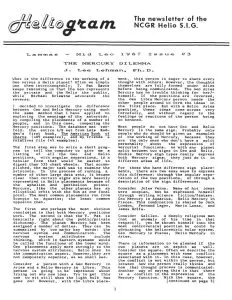
Heliocentric Mechanics, Astrometeorology, and Mundane Forecasting. This archival document is Issue No. 3 (Lammas / Mid Leo 1987) of the Heliogram, published by the NCGR Helio S.I.G.. The issue heavily features technical methodologies for integrating geocentric and heliocentric data, alongside rigorous mundane weather tracking. Key contributions include J. Lee Lehman’s statistical exploration of the differences between Geo Mercury (thinking) and Helio Mercury (communicating), Michael Erlewine’s structural breakdown of Helio Archetypes (Yin/Yang, Trine/T-Square), and T. Pat Davis’s mundane analysis of Senator Joseph McCarthy and Queen Elizabeth I. Additional features include Margaret Meister’s retrospective analysis of the 1947 Texas City Explosion, Dot Willis’s weather forecasting for the Autumnal Equinox and late-1987 eclipses, and a spirited debate between NCGR Research Director Michael P. Munkasey and Edith Custer regarding the astronomical logic of mixing heliocentric planets with geocentric house systems.

Issue Highlights

Articles: The Mercury Dilemma – J. Lee Lehman, Ph.D.

Helio Meditations II – Michael Erlewine

A Tribute to Zane B. Stein – T. Pat Davis

Texas City Revisited – Margaret M. Meister

Weather or Not – Dot Willis

Geo vs Helio Mars – T. Patrick Davis

Senator Joseph Raymond McCarthy – T. Pat Davis

Heliocentric: Magnitude of Influence – T. Patrick Davis

Discussions: Geocentric vs. Heliocentric Mercury dynamics The “Helio Challenge”: Debating the validity of mixing Geo houses with Helio planets The August 9, 1987 Supermoon and associated severe weather warnings Upcoming 1988 Saturn/Uranus conjunctions (Geo vs. Helio dates)

Notable contributors: J. Lee Lehman Margaret Meister Michael Erlewine T. Pat Davis Edith Custer Dot Willis Michael P. Munkasey

Chart data: Zane B. Stein Fred Astaire Jackie Gleason Giant Baby Panda Texas City Explosion (Grandcamp & High Flyer) Anita McKeown (“Calamity Jane”) Queen Elizabeth I Senator Joseph Raymond McCarthy 1988 Presidential Candidates (Richard Gebhardt, George Bush, Mario Cuomo, Michael Dukakis, Jack Kemp, Bruce Babbitt, Joseph Biden, Jesse Jackson, Paul Martin Simon)
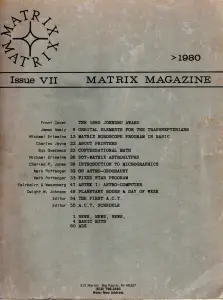
Computerized Astrology, Astrological Programming, A.C.T. Conference, Trans-Neptunian Planets. This issue of Matrix Magazine serves as a bridge between early computing technology and professional astrological practice. It focuses heavily on the technical application of microcomputers (Commodore PET, Apple II, TRS-80) to astrological research, offering BASIC programming code for chart calculations, orbital elements for Trans-Neptunian planets (Cupido, Hades, Zeus, Kronos, Apollon, Admetos, Vulkan, Poseidon), and instructions for printer-based astroglyph generation. The magazine also introduces the “ASTEK I,” a specialized astrological computer, and discusses the use of microfilm for archival astrological data storage.

Issue Highlights:
The 1980 Johndro Award is presented to Neil F. Michelsen for his pioneering work in computer-assisted ephemerides and astrological software. The issue also provides a comprehensive schedule for the first Astrological Conference on Techniques (A.C.T.) held in New Orleans, covering a wide array of research topics from planetary cycles to rectifiction methods.

Articles:
Orbital Elements for the Transneptunians – James Neely
Matrix Horoscope Program in BASIC – Michael Erlewine
Conversational Math – Buz Overbeck
Dot-Matrix Astroglyphs – Michael Erlewine
Introduction to Micrographics – Charles Paul Jones
On Astro-Geography – Mark Pottenger
Fixed Star Program – Mark Pottenger
ASTEK I: Astro-Computer – Fairbairn & Wesenberg
Planetary Hours & Day of Week – Dwight W. Johnson

Discussion:
Application of BASIC programming in natal astrology
Technical specifications and history of the ASTEK I calculator
Astro-Geography and meridian contacts
Statistical analysis of astrological data
Microfilm implementation for astrological libraries
Planetary rulers and the day of the week

Chart data:
Michael Erlewine (Born 7/18/1941, 4:03 PM EST, Lancaster, PA)

Notable contributors:
Michael Erlewine (Editor/Computing), James Neely (Orbital elements/programming), Mark Pottenger (Fixed star programming), Charles Jayne (Conference/Techniques advice), Buz Overbeck (Conversational math)

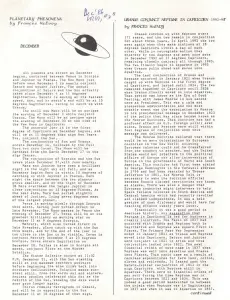
Planetary Phenomena, Uranus Conjunct Neptune in Capricorn, Historical Mundane Astrology. This detailed astrological and historical analysis by Frances McEvoy explores the upcoming conjunction of Uranus and Neptune in Capricorn (1992-1995) and compares it extensively with the historical Uranus-Neptune conjunction of 1821-1828. The author examines planetary movements for December 1986, including planetary aspects, ingresses, and general phenomena. The main focus is a deep dive into mundane astrology, examining how the Uranus-Neptune conjunction in Capricorn correlates with major societal, industrial, and political shifts, such as the Monroe Doctrine, the rise of the working class, utopian socialism, Robert Owen’s experiments, and significant architectural and literary movements.

Issue Highlights:
Detailed astrological ephemeris data for December 1986 and an exhaustive historical correlation of the Uranus-Neptune conjunction in Capricorn, looking ahead to the 1992-1995 alignment.

Articles:
Planetary Phenomena – Frances McEvoy
Uranus Conjunct Neptune in Capricorn 1992-95 – Frances McEvoy

Discussion:
Planetary movements for December 1986
Historical analysis of the 1821-1828 Uranus-Neptune conjunction in Capricorn
Mundane astrological effects on labor, industry, and social reform
Architectural revivals and romanticism during Uranus-Neptune cycles

Chart data:
N/A

Notable contributors:
Frances McEvoy (Astrological and historical analysis)

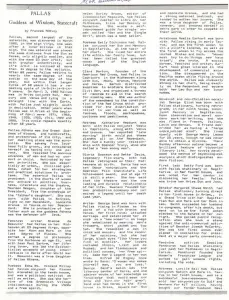
Pallas, Asteroid, Mythology, Women’s Achievements. This article explores the astrological significance and mythological background of the asteroid Pallas (Pallas Athena), focusing on her role as the goddess of wisdom, strategy, and the arts, and examining her placement in the natal charts of notable historical and contemporary women. Frances McEvoy discusses Pallas’s orbital characteristics, discovery, and cycles, linking its mythological traits—such as intellectual prowess, independence, strategic thinking, and a special bond with paternal figures—to the psychological expressions found in women who excel in politics, literature, aviation, entertainment, and social activism.

Issue Highlights:

Articles:
Pallas, Goddess of Wisdom, Statecraft – Frances McEvoy

Discussion:
Astrological influence of Pallas in women’s natal charts
Mythological connections between Pallas Athena and career achievement, intellect, and independence

Chart data:
Helen Gurley Brown
Emily Dickinson
Clara Barton
Katharine Hepburn
Gloria Swanson
Bette Davis
George Sand
Simone de Beauvoir
Edna St. Vincent Millay
Amelia Earhart
George Eliot
Betty Ford
Margaret Chase Smith
Emmeline Pankhurst
Lucille Ball
Barbara Walters
Joan Fontaine

Notable contributors:
Frances McEvoy (Astrological analysis of the asteroid Pallas in women’s charts)

Ask A Librarian

Need assistance with your research or navigating our collection? Our library team is here to help.

Please fill out the form below with details about the topics, authors, or archival materials you are looking for, and one of our librarians will review your query and respond shortly.

Help

Whether you are looking for rare historical texts or trying to locate a specific book nearby, Alexandria iBase offers two primary ways to search. Here is how to choose the right tool for what you need:

The Library Catalogue

Think of this as your global master index.

The Catalogue works just like a traditional library search system, designed to help you locate books and media across the broader astrological landscape.

  • Physical Books: Find out where physical copies of books are held in libraries, archives, or collections near you.

  • Digital Files: Access downloadable or viewable digital editions when available.

  • Best Used For: Standard research, finding specific ISBNs or authors, and tracking down physical items in the real world.

Browse Catalogue

SPECIAL COLLECTIONS

Think of this as Alexandria’s exclusive private vault.

Collections gives you direct access to Alexandria’s own curated archive of rare, proprietary, and historic astrology media.

  • Exclusive Material: Features unique texts, manuscripts, audio recordings, and visual media that are not available anywhere else.

  • Direct Access: Digitized content ready to explore straight from the platform.

  • Best Used For: Deep-dive research, discovering hidden gems, and exploring rare, one-of-a-kind astrological resources.

Browse Special Collections

Cash & In-Kind Donations

Make a one-time or recurring tax deductible cash donation.

Payment options include donating directly with us, PayPal Giving and GoFundMe.

GoFundMe for Charities and PayPal Giving are registered for tax deductions and have no required processing fees. It does offer the option to tip.

Donate

*Subject to 2.5% processing fees

Contact Us

Have a question, feedback, or a inquiry about our archives? We’d love to hear from you. Please fill out the form below with your details and message, and a member of our team will get back to you as soon as possible.

Thank you for reaching out to the Alexandria iBase Project!