
Home » Declination

Declination

Declination is an astronomical coordinate that measures the angular distance of a celestial body north or south of the celestial equator, playing a vital role in advanced astrological chart interpretation and parallel analysis. Derived from the projection of Earth’s equatorial plane into space, this vertical measurement operates independently of the zodiacal ecliptic used in standard two-dimensional horoscope wheels. Astrologers utilize declination to assess powerful parallel and contra-parallel aspects, which occur when planets share the same celestial latitude regardless of their zodiacal sign. Historically emphasized in traditional and mundane predictive frameworks, evaluating a planet’s declination reveals hidden operational intensities and out-of-bounds anomalies that significantly modify its overall astrological significations.

Filters

Filters


See more See less
See more See less
See more See less
See more See less
See more See less
See more See less
See more See less

Sorting

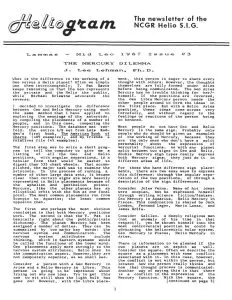
Heliocentric Mechanics, Astrometeorology, and Mundane Forecasting. This archival document is Issue No. 3 (Lammas / Mid Leo 1987) of the Heliogram, published by the NCGR Helio S.I.G.. The issue heavily features technical methodologies for integrating geocentric and heliocentric data, alongside rigorous mundane weather tracking. Key contributions include J. Lee Lehman’s statistical exploration of the differences between Geo Mercury (thinking) and Helio Mercury (communicating), Michael Erlewine’s structural breakdown of Helio Archetypes (Yin/Yang, Trine/T-Square), and T. Pat Davis’s mundane analysis of Senator Joseph McCarthy and Queen Elizabeth I. Additional features include Margaret Meister’s retrospective analysis of the 1947 Texas City Explosion, Dot Willis’s weather forecasting for the Autumnal Equinox and late-1987 eclipses, and a spirited debate between NCGR Research Director Michael P. Munkasey and Edith Custer regarding the astronomical logic of mixing heliocentric planets with geocentric house systems.

Issue Highlights

Articles: The Mercury Dilemma – J. Lee Lehman, Ph.D.

Helio Meditations II – Michael Erlewine

A Tribute to Zane B. Stein – T. Pat Davis

Texas City Revisited – Margaret M. Meister

Weather or Not – Dot Willis

Geo vs Helio Mars – T. Patrick Davis

Senator Joseph Raymond McCarthy – T. Pat Davis

Heliocentric: Magnitude of Influence – T. Patrick Davis

Discussions: Geocentric vs. Heliocentric Mercury dynamics The “Helio Challenge”: Debating the validity of mixing Geo houses with Helio planets The August 9, 1987 Supermoon and associated severe weather warnings Upcoming 1988 Saturn/Uranus conjunctions (Geo vs. Helio dates)

Notable contributors: J. Lee Lehman Margaret Meister Michael Erlewine T. Pat Davis Edith Custer Dot Willis Michael P. Munkasey

Chart data: Zane B. Stein Fred Astaire Jackie Gleason Giant Baby Panda Texas City Explosion (Grandcamp & High Flyer) Anita McKeown (“Calamity Jane”) Queen Elizabeth I Senator Joseph Raymond McCarthy 1988 Presidential Candidates (Richard Gebhardt, George Bush, Mario Cuomo, Michael Dukakis, Jack Kemp, Bruce Babbitt, Joseph Biden, Jesse Jackson, Paul Martin Simon)
House Systems, Mundane Astrology, and Astrological Techniques. This archival document is the 4th Edition of Mercury Hour (January 1975), an open-forum astrological journal edited and published by Edith Custer. The issue brings together prominent mid-20th-century astrologers to debate chart construction techniques, planetary rulerships, sensitive mathematical points, and practical counseling philosophies. Key technical contributions include Michael Munkasey’s classification of 23 house systems and introduction of the Arcturan system, Dr. James T. Hayes’s critique of cause-and-effect determinism and traditional dignities, Ivy M. G. Jacobson’s guide to L. Edward Johndro’s Birth Locality Charts, Inge Aach’s demonstration of 90-degree dial midpoint analysis using Henry Kissinger’s chart, and Ruth Dewey’s research on the Vertex. Additional discussions cover Carl Payne Tobey’s Astrology of Inner Space, Stephen Arroyo on Mars in Scorpio medical correlations, Zip Dobyns’s announcement of International Astrological Abstracts, and Isabel Hickey’s biographical account of her spiritual astrological practice.

Issue Highlights

Articles:

House Systems – Michael Munkasey

Four Questionable Practices of Astrologers – Dr. James T. Hayes

Excerpt from Foundation of the Astrological Chart – Ivy Jacobson (Johndro Locality Charts)

The Cosmic Structure – Inge Aach (continuation of the Cosmobiology Series)

The Vertex (series continuation) – Ruth Dewey

Discussion:

Carl Payne Tobey’s Astrology of Inner Space (various contributors)

Chart data:

(some in question or incomplete)

Gerald Ford
Muhammed Ali
James Dean
Marlon Brando
Clark Gable
Henry Kissinger

Notable contributors:

Stephen Arroyo (Mars in Scorpio; Polarity Therapy)

Zip Dobyns (formation of International Astrological Abstracts – IAA)

Isabel Hickey (short bio & involvement in astrology)

Mundane Astrology, Medical Astrology, and Predictive Astrology. This archival document is the 87th edition of Mercury Hour (January 1996), an astrological community journal edited and published by Edith Custer. The issue features articles, research notes, chart rectifications, software developments, and correspondence among practicing astrologers, including Bil Tierney’s psychological examination of Jupiter, Ed Dearborn’s technical breakdown of the “Translation of Light”, Valerie Vaughan’s defense of predictive astrology, Byron Ross Wahl’s analysis of the Solar Apex Synthetic Method (SASM), and the final installment of Robert “Buz” Myers’ lecture series on Moon-Saturn dynamics. Additionally, the journal covers mundane and political analyses of the O.J. Simpson verdict by John Kalus and Marion March, national chart rectifications for Washington, D.C. by Marc Penfield, insights on Uranus entering Aquarius by Kaye Shinker, medical and genetic commentary by T. Patrick Davis, software updates by Mark Pottenger, and tributes to astrologer Al H. Morrison.

Issue Highlights

Book Reviews
By Edith Custer:
Llewellyn’s 1996 Astrological Pocket Planner
Llewellyn’s Astrological Calendar 1996
Astrology Really Works by The Magi Society – Marc Penfield

Articles
A Look at Jupiter’s Shortcomings – Bil Tierney
Translation of Light – Ed Dearborn
Group Dynamics – Mary K. Creasey
Been There, Done That – Kaye Shinker
[O.J. Simpson verdict] – John Kalus
SASM, Columbus, and Samana Cay – Byron Ross Wahl
1995 Oven Saga – Roberta Strain
Moon/Saturn, Parts 7 and 8 of 8 – Robert “Buz” Myers
Winter Solstice 1995 – Dot Willis
The Art of Self-Defense: Lesson, Fighting at the Level of Your Opponent,
Part 1 of 2 – Valerie Vaughn
Al H. Morrison: Rectification, Poison Data, Genetics – T. Patrick Davis
[obituary & excerpts]
Discussions
Solar returns
O, J, Simpson trial
Chart data
(some incomplete or in question)
Powell, Colin
Washington, D.C.
Notable contributors
Donna Van Toen (various topics)
Mark Pottenger (Progressed MC techniques in software)
Marc Penfield (Chart of the U.S.A.)
Lee Lehman (corrections to Essential Dignities)
Marion March (O. J. Simpson trial, Chaos Theory, Solar Returns)

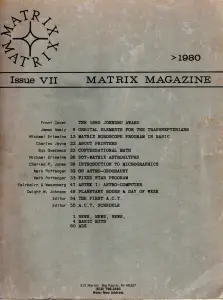
Computerized Astrology, Astrological Programming, A.C.T. Conference, Trans-Neptunian Planets. This issue of Matrix Magazine serves as a bridge between early computing technology and professional astrological practice. It focuses heavily on the technical application of microcomputers (Commodore PET, Apple II, TRS-80) to astrological research, offering BASIC programming code for chart calculations, orbital elements for Trans-Neptunian planets (Cupido, Hades, Zeus, Kronos, Apollon, Admetos, Vulkan, Poseidon), and instructions for printer-based astroglyph generation. The magazine also introduces the “ASTEK I,” a specialized astrological computer, and discusses the use of microfilm for archival astrological data storage.

Issue Highlights:
The 1980 Johndro Award is presented to Neil F. Michelsen for his pioneering work in computer-assisted ephemerides and astrological software. The issue also provides a comprehensive schedule for the first Astrological Conference on Techniques (A.C.T.) held in New Orleans, covering a wide array of research topics from planetary cycles to rectifiction methods.

Articles:
Orbital Elements for the Transneptunians – James Neely
Matrix Horoscope Program in BASIC – Michael Erlewine
Conversational Math – Buz Overbeck
Dot-Matrix Astroglyphs – Michael Erlewine
Introduction to Micrographics – Charles Paul Jones
On Astro-Geography – Mark Pottenger
Fixed Star Program – Mark Pottenger
ASTEK I: Astro-Computer – Fairbairn & Wesenberg
Planetary Hours & Day of Week – Dwight W. Johnson

Discussion:
Application of BASIC programming in natal astrology
Technical specifications and history of the ASTEK I calculator
Astro-Geography and meridian contacts
Statistical analysis of astrological data
Microfilm implementation for astrological libraries
Planetary rulers and the day of the week

Chart data:
Michael Erlewine (Born 7/18/1941, 4:03 PM EST, Lancaster, PA)

Notable contributors:
Michael Erlewine (Editor/Computing), James Neely (Orbital elements/programming), Mark Pottenger (Fixed star programming), Charles Jayne (Conference/Techniques advice), Buz Overbeck (Conversational math)

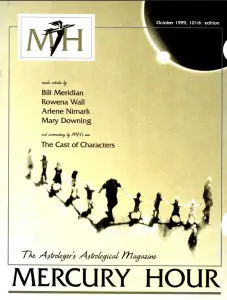
Mundane Astrology, Financial Astrology, and Astrology History. This archival item is the October 1999 issue (101st Edition B) of Mercury Hour, a quarterly astrological magazine edited and published by Edith Custer in Lynchburg, Virginia. Key contents include Bill Meridian’s review of Ron Howland’s A Chronology of American Charts alongside his article on “Shared Degree Areas” in planetary stock trading, Rowena Wall’s analysis of Y2K “Millennium Madness”, and Mary Downing’s eclipse watch report on Saros 145. The issue features the conclusion of Guy de Penguern’s 21st Century Medical Astrology Course focusing on cardiopathy, Arlene Nimark’s “Tidbits & Obits” covering Kurt Weill, the “Mercury Mets,” and the Littleton shooting birth data, and Virginia Reyer’s reference guide to Vertex signs. Additional contributions cover reader discussions on Out-of-Bounds planets, solar returns, the Bible Code, Druidic numerology, and chart analyses for John F. Kennedy Jr. and King Abdullah of Jordan.


Issue Highlights


Book Review

A Chronology of American Charts by Ron Howland – Bill Meridian


Articles

Tidbits & Obits – Arlene Nimark

Y2K Millenium Madness – Rowena Wall

Planetary Stock Trading: Shared Degree Areas – Bill Meridian

21st Century Medical Astrology Course, Part 3 of 3 [extract] – Guy de Penguern

Eclipse Watch [Saros 145] – Mary Downing

Vertex Signs – Virginia Reyer


Discussions

Out-of-Bounds planets

Columbine shooters

Leap years

Solar Returns

Asteroids Hidalgo, Pandora, Lilith

Druidic numerology

Chart of JFK, Jr.

The Bible Code

Solar storms/solar peak


Chart data

Abdullah, King of Jordan

Kennedy Jr., John F.

Nunavut (Canada)


Notable contributors

Roberta Strain (Royal Fixed Stars)

Marion March (fertility & astrology)

Astrology, Horary, House Systems, Synastry, and Transits. This edition of Mercury Hour features extensive reader discussions and technical articles covering various astrological branches. Topics include an exploration of planetary speeds and Kepler’s theories by Donald E. Byrne, declination and out-of-bounds planets by Gilbert Navarro, synastry and musical charts comparing John Lennon, Paul McCartney, Richard Nixon, and Yoko Ono by Dianne Lawson, as well as a concluding critique of the Koch House System by M. J. Makransky. Additional articles cover astrolocality mapping variants, Russian history and charts by Annibale F. Verzumo, Vernal Equinox charts, I Ching trigrams, and book reviews covering computer software, house development, and planetary stations.

Issue Highlights:

Articles:
Where is Vulcan & Nemesis? Part I – Donald E. Byrne
John Lennon and Paul McCartney, Richard Nixon, and Yoko Ono – Dianne Lawson
The Last Word on the Koch House System and Further Critique of the Koch House System, Part II, Conclusion – M. J. Makransky
Precession of the Equinox – Donald E. Byrne
How to Make Astrology Pay From A-Z, Part II, Conclusion – Adze Mixxe
Variant Forms of Astrolocality Mapping, Part I – M. J. Makransky
[Russia] Part III, Conclusion – Annibale F. Verzumo
Vernal Equinox March 20, 1992 – Dorothy S. Willis
Corrections: The Book of World Horoscopes – Nicholas Campion
I Ching: The Trigrams-Fu Hai Arrangement – Dorothy J. Sarka

Discussion:
Transpluto/Pluto Square 1991 – 1993
December 21, 1991 lunar eclipse
Secondary progressions
CSICOP and Humanistic astrology
Antichrist and Judgement Day discussions
Gulf War charts and Horary missing articles

Chart data:
Bill Clinton
Paul Keating
John Lennon
Paul McCartney
Richard Nixon
Yoko Ono
Paul Tsongas

Notable contributors:
Marion March (problematic astrological terminology)
Gilbert Navarro (declination)
Lee Lehman (humanism and CSICOP)
Diana Rosenberg (Jeffrey Dahmer chart)
Edith Custer (defending astrology)

Mundane Astrology, Astrology History, and Astrological Techniques. This archival item is the April 2000 issue (104th Edition) of Mercury Hour, a quarterly astrological magazine edited and published by Edith Custer in Lynchburg, Virginia. Key highlights include Ken Negus’s translation and commentary on Johannes Kepler’s 1608 chart interpretation for Generalissimo Albrecht Wallenstein, Rowena Wall’s astrological profile of media mogul Ted Turner following the Time Warner/AOL merger and his marital separation from Jane Fonda, and Virginia Reyer’s rectified natal and event analysis of Theodore Kaczynski (the Unabomber). The issue also features Susan Manuel’s geo/helio analysis of the Mars Polar Lander mission, Pat Geisler’s essay on professional ethics for practicing astrologers, Joan Titsworth’s overview of esoteric ray astrology, and Mary Downing’s historical reference table of Democratic National Conventions and nominees. Additional contributions document Walt Masters’ mathematical formulas for twelve “House Parts” (Arabic Parts), the 1999 Texas A&M bonfire collapse, out-of-bounds declinations, and chart analyses for prominent political figures including Vladimir Putin, Al Gore, George W. Bush, Bill Bradley, and John McCain.


Issue Highlights 


Articles


“Mouth of the South” Does it Again! [Ted Turner] – Rowena Wall


Kepler as Practicing Astrologer, Translation and Commentary – Ken Negus


Helio Planets: Mars Polar Lander – Susan Manuel


Esoteric Astrology in the World Today – Joan Titsworth


The Aquarian Eclipses of 2000 – Carol Willis


Ted Kaczynski – Virginia Reyer


Democratic National Conventions and Presidential Nominees [table]– Mary Downing


The Ethics of Astrology – Pat Geisler


Tidbits from the Tabloids – Arlene Marcia Nimark


Discussions


The 12 Arabic Parts


Bonfire collapse at Texas A&M (1999)


Declinations/Out-of-Bounds planets


Chart of Camilla Parker-Bowles


The Vertex


Chart data


(some incomplete or in question)


Bradley, Bill


Bush, George H.W.


Gore, Al


Kaczynski, Ted


McCain, John


Putin, Vladimir


Canada


Battle of Toronto (War of 1812)


Bonfire collapse at Texas A&M (1999)


Notable contributors


Marion March (avoiding generalizing in Astrology)

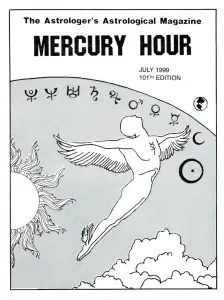
Mercury Hour 101st Edition (A) July 1999

Mercury Hour Magazine, Special Collections

Medical Astrology, Mundane Astrology, and Astrological Technique. This archival item is the July 1999 issue (101st Edition) of Mercury Hour, an astrological periodical edited and published quarterly by Edith Custer in Lynchburg, Virginia. Featured contributions include the second installment of Guy de Penguern’s course on 21st-century medical astrology focusing on genetic predispositions to cancer and amino acids, Virginia A. Reyer’s technical guide to calculating and interpreting the Vertex/Anti-Vertex axis alongside a chart analysis of Jack Kevorkian, Mark Pottenger’s mathematical correction regarding the Equation of Time and Local Apparent Time in computer software, and excerpts from Robert P. Blaschke’s treatise on progressions. Additional community discussions cover out-of-bounds planets, solar return methodologies, debates on geographic versus geocentric latitude, and classifications of the three distinct Liliths (Dark Moon, Asteroid, and Black Moon). The issue also preserves mundane astrological commentary on late-1990s events, including the Kosovo conflict and Slobodan Milosevic’s birth data, Y2K software preparedness, the August 1999 Fixed Grand Cross eclipse, and verification efforts regarding natal data for the Columbine High School shooting perpetrators.


Issue Highlights 


Articles

21st Century Medical Astrology Course, Part 2 of 3 – Guy de Penguern [extract]

The Case of the Clock Dial – Mark Pottenger

Jack Kevorkian, Part 2 of 2 – Virginia A. Reyer

“Mutable Dilemma”: Do You Mean Apparent? [Apparent vs. Mean Time]

– Mark Pottenger


Discussions

Chart of Bill Clinton

The three Liliths

Astrology & fertility

Solar returns

August 1999 Grand Cross & eclipse

The Vertex

The true “Blue Moon”

Charles Keating event/diurnal chart

Declinations/out-of-bounds planets

Equation of Time in chart calculations

Geocentric vs. heliocentric latitude


Chart data

Harris, Eric

Hussein, Saddam

Klebold, Dylan

Milosevic, Slobodan

Nicholson, Jack 


Notable contributors

Marion March (astrology & fertility)

Robert Blaschke (Astrology: A Language of Life; Volume I – Progressions [excerpt])

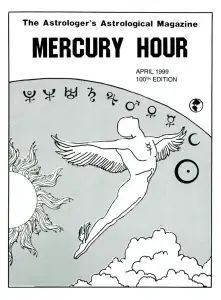
Medical Astrology, Mundane Astrology, and Fixed Stars serve as the primary focus areas of this historical astrological literature. This archival item is the April 1999 issue (100th Edition) of Mercury Hour, a long-running quarterly astrological magazine edited and published by Edith Custer in Lynchburg, Virginia. The issue highlights the first installment of Guy de Penguern’s course on 21st-century medical astrology and genetic astrophysics, a review of Enrique Linares’s A Scientific Approach to the Metaphysics of Astrology by Marguerite dar Boggia, Virginia A. Reyer’s study on fixed stars and health, and Dorothy J. Sarka’s examination of the I Ching. Additionally, the issue documents extensive reader discussions on political horoscopes and current events, including the Bill Clinton impeachment, Y2K software predictions, the 1999 Israeli election, and natal chart data for prominent figures such as Jesse Ventura and Ehud Barak.


Issue Highlights

Book Review

A Scientific Approach to the Metaphysics of Astrology by Enrique Linares

– Marguerite der Boggia


Articles

21st Century Medical Astrology Course, Part 1 of 3 – Guy de Penguern [extract]

Fixed Stars, Part 2 of 2 – Virgina A. Reyer

The Hidden Code of the I Ching – Dorothy J. Sarka


Discussions

Ken Starr/Bill Clinton impeachment

Chart of Bill ClintonU.S. Declaration of Independence

W.H. Chaney/Jack London

Astro-Twins (examples)

Asteroid rulership/association

Moon Out-of-Bounds

Israel election 1999

Y2K

August 1999 Grand Cross eclipse

August 1998 eclipse effect on Russia

Sun/Moon angle and conception


Chart data

Barak, Ehud

Bush, George

Chaney, William

Hand, Rob

Jayne, Charles

Keller, Helen

Netanyahu, Benjamin

Rose, Buddy “Playboy”

Ventura, Jesse

Russia


Notable contributors

Marion March (various topics)


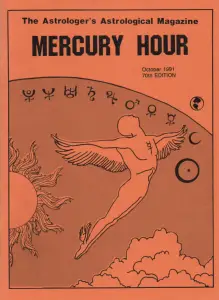
Astrology Community, Mundane Astrology, and Astrology History serve as the primary focus areas of this historical astrological literature. This archival item is the October 1991 issue (70th Edition) of Mercury Hour, “The Astrologer’s Astrological Magazine,” a reader-driven correspondence periodical edited and published by Edith Custer of Lynchburg, Virginia. Structured largely as an open forum of subscriber letters, it documents the working preoccupations of a grassroots American astrological community, with debates over classical versus modern technique, chart-matching blind tests, and the interpretation of stations, midpoints, solar returns, and heliocentric charts. Reflecting its Gulf War moment, the issue features mundane analysis of the Gulf War chart, the USSR’s dissolution, and comparative studies of Saddam Hussein, Jim Jones, and Adolf Hitler; alongside contributions from Ted George, M.J. Makransky, Joyce Wehrman, and Lee Lehman, a memorial for statistical researcher Michel Gauquelin (1928-1991), chart data for figures such as Napoleon and Helen Herron Taft, and period advertisements for early astrological software that capture the field’s transition into desktop computing.

Issue Highlights


Book Review

Working with Astrology by Michael Harding & Charles Harvey – Doris Greaves


Articles

Missing Visa Book – Marie DeLeone

Student’s Corner [the Ascendant] – Annibale F. Verzumo

Jupiter-Neptune, The Celestial Twins, Part I – Ted George

NCGR Conference [report] – Edith Custer

Indications of a Winner *or* Do You Have a Gambling Chart? – Cammille Adams

Planet Watch – Paul O. Hewit

The Natural Disposition, Part II – M.J. Makransky

Michel Gauquelin 1928-1991 – J. Lee Lehman

[USSR charts] Part I – Annibale Verzumo

The Three Amigos, Part II, Conclusion [Saddam Hussein, Jim Jones, Adolph Hitler]– Susan J. Kientz

[Risks of publishing astrological materials] Part II, Conclusion – C. J. Puotinen

Central American Data – M.J. Makransky

Her Proudest Moment [Helen Herron Taft] – T. Patrick Davis

Pluto, Part II, Transpluto – Joyce Wehrman [transcription of talk]

The Gemini Theme, Using the Astrological Language, Part III, Conclusion – Anne Foley

Autumn Equinox September 23, 1991 – Dorothy S. Willis


Discussions

Astrological weather prediction

Solar returns

Chart of Napoleon

Neptune

Gulf War chart

Heliocentric charts

Finding the time of sunrise in birthchart


Chart data

Bonaparte, Napoleon
Taft, Helen Herron
Iraq War
Costa Rica
El Salvador
Guatemala
Honduras
Nicaragua


Notable contributors

Marion March (semi-sextiles)

Lee Lehman (classical astrology techniques; homosexuality & astrology)

Marc Penfield (the astrology of Orlando, FL & Disney World)

Ask A Librarian

Need assistance with your research or navigating our collection? Our library team is here to help.

Please fill out the form below with details about the topics, authors, or archival materials you are looking for, and one of our librarians will review your query and respond shortly.

Help

Whether you are looking for rare historical texts or trying to locate a specific book nearby, Alexandria iBase offers two primary ways to search. Here is how to choose the right tool for what you need:

The Library Catalogue

Think of this as your global master index.

The Catalogue works just like a traditional library search system, designed to help you locate books and media across the broader astrological landscape.

  • Physical Books: Find out where physical copies of books are held in libraries, archives, or collections near you.

  • Digital Files: Access downloadable or viewable digital editions when available.

  • Best Used For: Standard research, finding specific ISBNs or authors, and tracking down physical items in the real world.

Browse Catalogue

SPECIAL COLLECTIONS

Think of this as Alexandria’s exclusive private vault.

Collections gives you direct access to Alexandria’s own curated archive of rare, proprietary, and historic astrology media.

  • Exclusive Material: Features unique texts, manuscripts, audio recordings, and visual media that are not available anywhere else.

  • Direct Access: Digitized content ready to explore straight from the platform.

  • Best Used For: Deep-dive research, discovering hidden gems, and exploring rare, one-of-a-kind astrological resources.

Browse Special Collections

Cash & In-Kind Donations

Make a one-time or recurring tax deductible cash donation.

Payment options include donating directly with us, PayPal Giving and GoFundMe.

GoFundMe for Charities and PayPal Giving are registered for tax deductions and have no required processing fees. It does offer the option to tip.

Donate

*Subject to 2.5% processing fees

Contact Us

Have a question, feedback, or a inquiry about our archives? We’d love to hear from you. Please fill out the form below with your details and message, and a member of our team will get back to you as soon as possible.

Thank you for reaching out to the Alexandria iBase Project!