
Home » Solar Ingress

Solar Ingress

Solar Ingress is a fundamental chart mechanics technique in mundane and predictive astrology wherein the Sun crosses the exact boundary of a tropical zodiac sign, most notably at the equinoxes and solstices. Calculated for specific capitals or coordinates, these seasonal ingress charts establish foundational celestial configurations used to forecast political trends, economic conditions, and collective shifts for the upcoming quarter or year.

Filters

Filters


See more See less
See more See less
See more See less
See more See less
See more See less
See more See less
See more See less

Sorting

Mundane Lessons

Marion D. March, Special Collections

Mundane Astrology, Houses, Planets, Signs, Eclipses, Solar Ingresses. These instructional notes by Marion D. March offer an introductory overview of mundane and political astrology, detailing the application of natal astrology techniques to countries, cities, and mass populations. The text explains how celestial bodies, houses, and signs govern collective entities rather than individuals, emphasizing the significance of specific angles like the 1st, 4th, 7th, and 10th houses for national identity, government, and international relations. Furthermore, the notes outline the predictive value of solar and lunar eclipses, solar ingresses into cardinal signs, and the distinct roles played by individual planets and zodiac signs in shaping societal trends, economic conditions, and geopolitical events.

Special emphasis is placed on how planetary archetypes manifest in worldly affairs—such as Saturn governing structure and government, Mars ruling the military and conflict, and Uranus representing revolutionary innovations and technological shifts. The document also includes comprehensive reference tables categorizing the twelve houses and planetary influences across economic, political, sociological, entrepreneurial, and meteorological domains, providing a structured framework for analyzing world events.

Issue Highlights:

Articles:
Mundane Astrology – Marion D. March
The World Horoscopes – Moon Moore

Discussion:
The significance of mundane houses in national and international affairs
The application of planetary symbolism to political leadership, economics, and disasters
The interpretation of zodiac signs in country horoscopes
The use of eclipses and solar ingresses in forecasting world events

Chart data:
United States
Nazi Germany

Notable contributors:
Marion D. March (Compilation)
Joan McEvers (Material contribution)
Michael Baigent (Material contribution)
Nicholas Campion (Material contribution)
Charles Harvey (Material contribution)
Moon Moore (Material contribution)
Priscilla Schwei (Material contribution)
Rex E. Bills (Rulership Book)
ASPECTS Vol 7 No 4 Fall 1982

ASPECTS Magazine, Special Collections

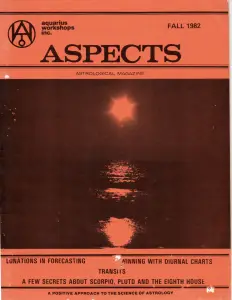
Aspects Astrological Magazine, Vol. 7 No. 4, Fall 1982. Published by Aquarius Workshops, Inc., Encino, California. Edited by Nancy Cassidy. This issue explores a wide range of advanced and foundational astrological techniques, including mundane forecasting through ingress charts, techniques for utilizing diurnal charts in financial and lottery forecasting, and psychological insights into Scorpio, Pluto, and the eighth house. Contributions from prominent astrologers cover topics such as vocational astrology, transits, lunations, and expansive analyses of Jupiter across the zodiacal signs.

Issue Highlights: Articles feature Judy Johns Tonyan examining the Libra Ingress chart for global political tensions, Jeff Jawer analyzing the psychological depth of Scorpio and Pluto, Sophia Mason detailing the mechanics and calculation of Diurnal Charts for winning potentials, and Angel Thompson providing a comprehensive guide to interpreting transits. Additionally, Marion D. March delineates the astrological chart of Prince William, Joan McEvers outlines the twelfth house, and Nancy Cassidy continues her Beginner’s Blocks series focusing on Jupiter.

Articles:
Libra Ingress – Judy Johns Tonyan
A Few Secrets About Scorpio, Pluto, and the Eighth House – Jeff Jawer
Winning With Diurnal Charts – Sophia Mason
Transits – Angel Thompson
Keys to Learning: Twelfth House – Joan McEvers
Vocations in Focus – Jon Tabakin
Basic Delineation: Prince William Arthur Philip Louis – Marion D. March
Lunations in Forecasting – Marwayne Leipzig
Beginner’s Blocks: Jupiter – Nancy Cassidy

Discussion:
Global mundane forecasts and political instability using ingress charts
Calculating and applying diurnal charts for financial timing and events
Psychological integration of Pluto, Scorpio, and eighth-house dynamics
Vocational profiling through planetary aspects and focal points
The expansive and philosophical nature of Jupiter in all twelve signs

Chart data:
Prince William Arthur Philip Louis
Bill Blass
Coco Chanel
Christen Dior
Various anonymous example charts for diurnal and transit forecasting

Notable contributors:
Judy Johns Tonyan (Mundane astrology and ingress charts)
Jeff Jawer (Psychological astrology and Pluto)
Sophia Mason (Predictive techniques and diurnal charts)
Angel Thompson (Transit interpretation)
Marion D. March (Natal and mundane delineation)
Lois Rodden (Data column and historical film charts)

Vesta: Keeper of the Flame (1994)

Frances McEvoy, Special Collections

Asteroid Vesta, Grand Trine, Natal Astrological Analysis, Confinement and Solitude, Birth Data. This issue features an in-depth astrological analysis of the asteroid Vesta by Frances McEvoy, framed by Vesta’s November 1994 station at 10 degrees Cancer forming a Grand Water Trine with Saturn in Pisces and Venus in Scorpio. McEvoy explores Vesta’s 29-year cycle, its mythological roots as the Goddess of the Hearth, and its archetypal keywords such as commitment, chastity, solitude, purity, duty, perfection, and transcendent self-discipline. The article delineates how Vesta operates in both male and female charts, highlighting themes of dedicated work, privacy, and inner strength.

The study examines numerous chart examples illustrating Vesta’s impact on public service, science, art, and personal sacrifice. Detailed case studies include Marie Curie, Margaret Mead, Maria Montessori, Anne Frank, Sister Francesca Cabrini, Saint Therese of Lisieux, Queen Victoria, Grace Kelly, Jerry Brown, David Souter, Yassar Arafat, Oliver North, Angela Davis, Betty Friedan, Helen Keller, Michel Gauquelin, Bobby Fischer, and major classical composers like Bach, Mozart, Schubert, and Chopin. Themes of confinement, religious devotion, political zealotry, and intellectual immersion are thoroughly traced through Vesta’s aspects and house placements.

Additionally, Lorraine Welsh presents “The Data Base,” providing precise birth data for political candidates and public figures of the period, including Mitt Romney, Joe Malone, Paul Cellucci, and Pope John Paul II. An informational announcement for Robert Hand’s instructional classes on Traditional Western, Renaissance, and Hellenistic astrology is also included.

Issue Highlights:

Articles:
VESTA: KEEPER OF THE FLAME – Frances McEvoy
The Data Base – Lorraine Welsh

Discussion:
Vesta cycle and astronomical station patterns
Vesta in psychological, natal, and mundane astrology
Confinement, solitude, and religious devotion in chart analysis
Verified birth data for political candidates and notable figures
Instruction in Hellenistic and Renaissance traditional astrology

Chart data:
Maria Montessori
Yassar Arafat
Helen Keller
Mitt Romney
Joe Malone
Paul Cellucci
Pope John Paul II (Karol Wojtyla)

Notable contributors:
Frances McEvoy (Vesta: Keeper of the Flame)
Lorraine Welsh (The Data Base)
Robert Hand (Traditional Astrology Classes)

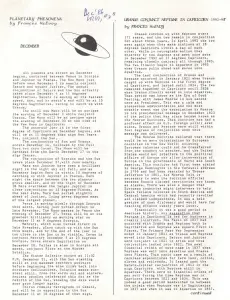
Planetary Phenomena, Uranus Conjunct Neptune in Capricorn, Historical Mundane Astrology. This detailed astrological and historical analysis by Frances McEvoy explores the upcoming conjunction of Uranus and Neptune in Capricorn (1992-1995) and compares it extensively with the historical Uranus-Neptune conjunction of 1821-1828. The author examines planetary movements for December 1986, including planetary aspects, ingresses, and general phenomena. The main focus is a deep dive into mundane astrology, examining how the Uranus-Neptune conjunction in Capricorn correlates with major societal, industrial, and political shifts, such as the Monroe Doctrine, the rise of the working class, utopian socialism, Robert Owen’s experiments, and significant architectural and literary movements.

Issue Highlights:
Detailed astrological ephemeris data for December 1986 and an exhaustive historical correlation of the Uranus-Neptune conjunction in Capricorn, looking ahead to the 1992-1995 alignment.

Articles:
Planetary Phenomena – Frances McEvoy
Uranus Conjunct Neptune in Capricorn 1992-95 – Frances McEvoy

Discussion:
Planetary movements for December 1986
Historical analysis of the 1821-1828 Uranus-Neptune conjunction in Capricorn
Mundane astrological effects on labor, industry, and social reform
Architectural revivals and romanticism during Uranus-Neptune cycles

Chart data:
N/A

Notable contributors:
Frances McEvoy (Astrological and historical analysis)

Astrological Techniques, Mundane Astrology, Historical Research. This 79th edition of Mercury Hour (January 1994) functions as a dynamic forum for practitioners to share research, personal experiences, and technical debates. A major focus throughout the issue is on natal chart rectification, the debate over house systems (specifically Lavagnini, Morinus, and Placidus/Koch), and the practical application of planetary transits and progressions to mundane events, such as the Israel-PLO accord, the Clinton presidency, and the Michael Jackson investigations. The issue also features a heavy emphasis on early American astrological history, with Robert Zoller exploring how astrology was utilized and viewed in pre-1860 American colonies and academic settings.

Technical discussions extend to specialized methodologies, including the evaluation of “accidental ascendants,” the use of Chaos Theory and septile aspects, and reviews of foundational translations like Paulus Alexandrinus. Contributors wrestle with the philosophical and ethical dimensions of the craft, debating whether astrology can be considered “from the devil” or if it serves as a valid system for psychological understanding and life navigation. The publication serves as a nexus for the community, highlighting professional conferences, software reviews (such as Matrix Software), and the ongoing efforts of Project Hindsight to recover ancient techniques.

Issue Highlights:
Articles:
Winter Solstice [1993] – Dorothy Willis
Introduction to M-13: Spiritual Theory, Part II, Conclusion – Defiance Gregg
Will Daniel Day-Lewis Get an Oscar? – Barbara Dunn
Is Astrology “From the Devil?” – Carole Devine
Open Letter of Complaint re the UAC Conference – Dorothy Martin
More Founding Dates, Part 3, Conclusion – Marc Penfield
Student Corner Rewrite [hemispheres of the chart] – Joseph S. DeMello
Student’s Corner, Part 2 of 2 [7th & 10th houses] – Annibale F. Verzumo
American Astrology Prior to 1860 – Robert Zoller
An Astrological Review of Passages, Part 5 of 6 – Bil Tierney
Computers – Joseph S. de Mello
A Review of Project Hindsight’s First Translation: Paulus Alexandrinus, Introductory Matters – Michele C. McKee

Discussion:
Lavagnini house system
Chart of Michael Jackson
Chart of Bill Clinton
Astrology & crime-solving
Evangeline Adams “accidental ascendant” technique
Chart of Baltimore, MD
Coming earth changes/polarity shift
U.S. Presidents & Chinese astrology
Universal Number/Chaos Theory/septile aspect
J. Edgar Hoover
Age of Aquarius

Chart data:
Henry, Patrick
Jackson, Michael
Koresh, David
Baltimore, MD
Israel/recognition of PLO

Notable contributors:
Lois Rodden (Bill Clinton and David Koresh birth charts, chart ratings)
Karen Christino (Saturn Return)
Marion March (Tropical vs. Sidereal)

Astrology, Horary, House Systems, Synastry, and Transits. This edition of Mercury Hour features extensive reader discussions and technical articles covering various astrological branches. Topics include an exploration of planetary speeds and Kepler’s theories by Donald E. Byrne, declination and out-of-bounds planets by Gilbert Navarro, synastry and musical charts comparing John Lennon, Paul McCartney, Richard Nixon, and Yoko Ono by Dianne Lawson, as well as a concluding critique of the Koch House System by M. J. Makransky. Additional articles cover astrolocality mapping variants, Russian history and charts by Annibale F. Verzumo, Vernal Equinox charts, I Ching trigrams, and book reviews covering computer software, house development, and planetary stations.

Issue Highlights:

Articles:
Where is Vulcan & Nemesis? Part I – Donald E. Byrne
John Lennon and Paul McCartney, Richard Nixon, and Yoko Ono – Dianne Lawson
The Last Word on the Koch House System and Further Critique of the Koch House System, Part II, Conclusion – M. J. Makransky
Precession of the Equinox – Donald E. Byrne
How to Make Astrology Pay From A-Z, Part II, Conclusion – Adze Mixxe
Variant Forms of Astrolocality Mapping, Part I – M. J. Makransky
[Russia] Part III, Conclusion – Annibale F. Verzumo
Vernal Equinox March 20, 1992 – Dorothy S. Willis
Corrections: The Book of World Horoscopes – Nicholas Campion
I Ching: The Trigrams-Fu Hai Arrangement – Dorothy J. Sarka

Discussion:
Transpluto/Pluto Square 1991 – 1993
December 21, 1991 lunar eclipse
Secondary progressions
CSICOP and Humanistic astrology
Antichrist and Judgement Day discussions
Gulf War charts and Horary missing articles

Chart data:
Bill Clinton
Paul Keating
John Lennon
Paul McCartney
Richard Nixon
Yoko Ono
Paul Tsongas

Notable contributors:
Marion March (problematic astrological terminology)
Gilbert Navarro (declination)
Lee Lehman (humanism and CSICOP)
Diana Rosenberg (Jeffrey Dahmer chart)
Edith Custer (defending astrology)

Astrology, Horary, Mundane, Chart Techniques, Software, Ethics. This edition of Mercury Hour features an eclectic collection of letters, articles, and discussions from the astrological community of the late 1980s. Key technical discussions focus on the application of horary techniques to personal events, the validity of progressions versus transits, the use of heliocentric charts, the debate surrounding psychological counseling by astrologers, and methods for calculating progressed angles. Several contributors engage in a lively back-and-forth regarding the “True Time” of the U.S. founding, with specific arguments favoring the July 4th, 1776 date.

Issue Highlights:
The issue serves as a forum for various professional and amateur astrologers to share research, personal anecdotes, and technical feedback on software and methodology. Notable articles explore the potential “Viper’s Nest” chart pattern in relation to criminals like Ted Bundy, the debate against professional astrological counseling, and techniques for natal chart rectification using historical and event-based data. Much of the content is shaped by the editor’s return to the magazine, establishing a welcoming space for community debate, software reviews, and the sharing of “Chart Mart” data.

Articles:
Salem, or A Cynic’s Centiloquy – Don Borkowski
Horary Techniques Applied to Personal Events – Edward Dearborn
Another Asteroid Turned Comet (Chiron) – Richard A. Kerr
Against Astrological Counseling – Robert Cole
Will the Real Duchess of Windsor Stand Up – Carolyn H. Caufman
Moving to Paradise – Marc Penfield
Joyce’s Key Phrases for Transiting Aspects – Joyce Wehrman
Ted Bundy’s “Viper’s Nest” Chart Pattern – John Kalus

Discussion:
Calculating progressions and progressed houses
Speculative charts for Mikhail Gorbachev and U.S. historical events
Weather predictions based on Winter Solstice and planetary alignments
The ethics of professional astrological counseling
Use of heliocentric versus geocentric charts

Chart data:
Mikhail Gorbachev
Wallis Simpson
Cheryl Crane
Davy Crockett
Katherine Hepburn
George Bush
Michael and Kitty Dukakis
Joan Quigley

Notable contributors:
Michael Munkasey (Chart of the U.S.A.)
Al H. Morrison (Neptune aspects; shamanism; horary timing)
Jim Lewis (1988 U.S.A. election)
Marion March (C-Sections; Chiron; Jesse Jackson)

Mundane Astrology, Astrology History, and Astrological Techniques. This archival item is the October 1990 issue (66th Edition) of Mercury Hour, a quarterly astrological magazine edited and published by Edith Custer in Lynchburg, Virginia. Featured articles in this issue include Marc Penfield’s solar chart analysis of Donald Trump and natal study of Greta Garbo, Part I of M.J. Makransky’s series correlating zodiacal degrees with geographical locations and political shifts in Guatemala, Robert Baumgartner’s examination of a Demotic astrological text regarding the Egyptian star Sothis, Joseph S. DeMello’s instructional guide on diurnal charts, Paul Hewitt’s analysis of the 1989 Eastern European revolutions, and T. Pat Davis’s geo-helio study of the 1901 Texas oil discovery at Spindletop. Additional contents include reviews of Alan Oken’s Soul-Centered Astrology and Margaret Millard’s The Genetics of Astrology, weather forecasts by Dot Willis, and historical discussions regarding Tycho Brahe’s birth chart, the Society for the Advancement of Astrology, the 1992 Philippine presidential election, and birth data for figures including Saddam Hussein and Kenneth Branagh.


Issue Highlights


Book Reviews


Soul-Centered Astrology: A key to the expanding Self by Alan Oken – Marguerite dar Boggia


The Genetics of Astrology by Margaret Millard – Teresa Hamilton


Articles


The Great Garbo: Sphinx or Siren? – Marc Penfield


Guatemala, Part I – M.J. Makransky


The Egyptian Sothis in Gemini – A Demotic Astrological Text, Part I – Robert Baumgartner


Saturn, Our Night-Light, Part I – Ann Foley


Living the Hero’s Journey, Part I – Carol Voeth-Lavoie


Diurnal Charts – Joseph D. DeMello


Next Philippine President – Serafin Lanot


Autumn Ingress, September 23, 1990 – Dot Willis


Students Corner: Aspects – Anne Toth


[Essential charts of Chicago], Part I – Sonja Foxe


Saturn Anxiety, Part I – Carole Devine


Donald Trump: His Solar Chart – Marc Penfield


Eastern Europe – The Revolution of 1989, Part I – Paul Hewitt


Texans Discover Oil – T. Pat Davis


Discussions


Ethics of predicting death


Chart of Tycho Brahe


History of the Society for the Advancement of Astrology

Sun sign columns


Polio vaccine/SV-40 virus/AIDS

Warren and Florence Harding


Neptune transit of Capricorn


Chart of San Francisco Astrolocality Page 2 of 2


Chart data
(some incomplete or in question)

Iraq
Kuwait
Saudi Arabia
United Arab Emirates
San Francisco, CA
Common Market/EEC

Brahe, Tycho
Branagh, Kenneth
Griffith, Melanie
Hussein, Saddam
Linares, Enrico
Quayle, Dan
Stuart, Matthew & related charts

Notable contributors

Joe DeMello (the semi-sextile aspect)
Marion March (Joan Quigley’s involvement with the Reagans)
Kay Shinker (solar returns)
Lois Rodden (chart data)
Frances McEvoy (Matthew Stuart/Boston murder case)

Ask A Librarian

Need assistance with your research or navigating our collection? Our library team is here to help.

Please fill out the form below with details about the topics, authors, or archival materials you are looking for, and one of our librarians will review your query and respond shortly.

Help

Whether you are looking for rare historical texts or trying to locate a specific book nearby, Alexandria iBase offers two primary ways to search. Here is how to choose the right tool for what you need:

The Library Catalogue

Think of this as your global master index.

The Catalogue works just like a traditional library search system, designed to help you locate books and media across the broader astrological landscape.

  • Physical Books: Find out where physical copies of books are held in libraries, archives, or collections near you.

  • Digital Files: Access downloadable or viewable digital editions when available.

  • Best Used For: Standard research, finding specific ISBNs or authors, and tracking down physical items in the real world.

Browse Catalogue

SPECIAL COLLECTIONS

Think of this as Alexandria’s exclusive private vault.

Collections gives you direct access to Alexandria’s own curated archive of rare, proprietary, and historic astrology media.

  • Exclusive Material: Features unique texts, manuscripts, audio recordings, and visual media that are not available anywhere else.

  • Direct Access: Digitized content ready to explore straight from the platform.

  • Best Used For: Deep-dive research, discovering hidden gems, and exploring rare, one-of-a-kind astrological resources.

Browse Special Collections

Cash & In-Kind Donations

Make a one-time or recurring tax deductible cash donation.

Payment options include donating directly with us, PayPal Giving and GoFundMe.

GoFundMe for Charities and PayPal Giving are registered for tax deductions and have no required processing fees. It does offer the option to tip.

Donate

*Subject to 2.5% processing fees

Contact Us

Have a question, feedback, or a inquiry about our archives? We’d love to hear from you. Please fill out the form below with your details and message, and a member of our team will get back to you as soon as possible.

Thank you for reaching out to the Alexandria iBase Project!