
Home » Guy de Penguern

Guy de Penguern

A French university teacher of astrology translating articles for Bordeaux University Campus.

Filters

Filters


See more See less
See more See less
See more See less
See more See less
See more See less
See more See less
See more See less

Sorting

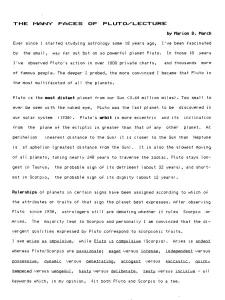
The Many Faces of Pluto (ca. 1983)

Marion D. March, Special Collections

Pluto, Astrology, Mythology, Generational Planets, House Placements, Transits. This extensive lecture by Marion D. March explores the multifaceted nature of Pluto in astrology, detailing its astronomical uniqueness, diverse historical glyphs, and deep roots in Greek and Roman mythology. The text covers Pluto’s manifestations through wealth, the unseen, sexuality, power, and transformation, bridging ancient archetypes with modern psychological and mundane astrology. Special attention is given to the collective unconscious as viewed through outer planets, alongside practical examples of Pluto transits and its placement through the twelve houses and zodiac signs.

Issue Highlights:
The Many Faces of Pluto / Lecture – Marion D. March

Articles:
The Many Faces of Pluto/Lecture – Marion D. March
Mythologisches – Fritz Gehre

Discussion:
Pluto’s astronomical characteristics and orbital peculiarities
Debates on Pluto’s rulership (Scorpio vs. Aries)
Historical analysis of Pluto’s glyphs and mythological origins (Hades, Persephone, Tantalus)
Pluto’s connection to atomic energy, plutonium, and the collective unconscious
Pluto through the twelve houses and signs of the zodiac

Chart data:
Gov. Brown
H. Kissinger
George Sand
Goethe
J.P. Getty
R. Browning
C. Jung
Robert Kennedy
W. Churchill
Lee Bailey
Krishnamurti
Charles Manson
Angela Davis
Edgar Bergen
Louis Pasteur
Earl Warren
Spencer Tracy
B. Baruch
Adelle Davis
Oliver Wendell Holmes
Emerson
Ted Kennedy
Gandhi
Gershwin
Charles Lindberg
de Gaulle
Hitler
Jackie Onassis
Isabel Hickey
Nelson Rockefeller
F.D. Roosevelt
Thomas Mann
Tallulah Bankhead
Karl Marx
Richard Nixon
Sigmund Freud
Ernest Hemingway
Pablo Picasso
Lyndon Johnson
Albert Einstein
Mme. Curie
Marilyn Monroe
Patty Hearst
Muhammad Ali
Dr. Charles Mayo

Notable contributors:
Marion D. March (Author and Astrologer)
Isabel Hickey (Astrology and Symbolism)
Liz Greene (Outer Planets and Collective Unconscious)
Fritz Gehre (Mythology)
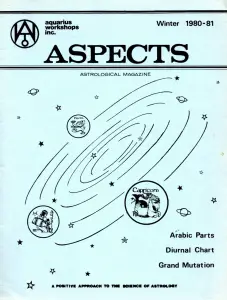
ASPECTS Vol. 6 No. 1 Winter 1980-1 Part 1/2

ASPECTS Magazine, Special Collections

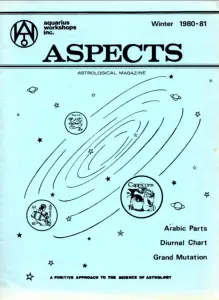
Arabic Parts, Grand Mutation, Fifth House, Sextiles. This issue of Aspects astrological magazine delivers an extensive exploration of foundational and advanced astrological techniques, featuring detailed instructional breakdowns and conference updates. Robert ‘Buz’ Myers provides a comprehensive guide on calculating and interpreting ten key Arabic Parts (including the Part of Fortune, Love, Passion, Increases, Fate, Catastrophe, Treachery, and Organization) through the twelve houses and signs. Marion D. March analyzes the monumental Great Jupiter/Saturn Conjunction and the Capricorn Ingress Chart for December 1980, discussing world consciousness shifts and the transition into the Air trigon. Additionally, Lenora M. Hill examines the Diurnal (Daily) Chart, Enrique Linarés writes on the Point of Life, Joan McEvers breaks down the symbolism of the Fifth House in her ‘Keys to Learning’ series, and Nancy Cassidy details the harmonious exchange of energy found in Sextiles.

Issue Highlights: Conference reports cover SWAC 1980, the upcoming Astrology World-Congress 1981 in Zurich, and the First Metaphysical Congress. Regular columns include Letters to the Editor, President’s Message by Roberta Fueyo, What’s Happening, Book Reviews, and Lois Rodden’s Data Column.

Articles:
How to Calculate Your Arabic Parts – Robert ‘Buz’ Myers
The Great Jupiter/Saturn Conjunction – Marion D. March
The Diurnal (Daily) Chart – Lenora M. Hill
The Point of Life – Enrique Linarés
Keys to Learning: Fifth House – Joan McEvers
Building Blocks: Sextiles – Nancy Cassidy
Capricorn Ingress – Judy Johns

Discussion:
Calculation and house interpretation of Arabic Parts
Astrological shifts during the Jupiter/Saturn conjunction in Libra
Practical applications of diurnal charts and secondary progressions
Creative and psychological significations of the Fifth House
Harmonious energy exchanges through Sextile aspects

Chart data:
Capricorn Ingress Chart (December 21, 1980, Washington, D.C.)
Sample calculation chart for Arabic Parts (October 28, 1975, Encino, CA)

Notable contributors:
Robert ‘Buz’ Myers (Arabic Parts)
Marion D. March (Great Jupiter/Saturn Conjunction)
Joan McEvers (Fifth House mechanics)
Nancy Cassidy (Sextiles)
Lenora M. Hill (Diurnal Charts)

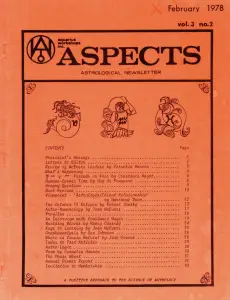
ASPECTS Vol. 3 No 2. Feb 1978

ASPECTS Magazine, Special Collections

Astrological Education, Natal Charting, and Technique Synthesis. This issue of Aspects focuses heavily on the pedagogical and professional aspects of astrology, emphasizing the “positive approach” advocated by the Aquarius Workshops organization. Key themes include the ethical responsibilities of the astrologer, the necessity of rigorous natal chart synthesis rather than superficial interpretations, and the application of astrological tools to everyday life events. The content ranges from foundational lessons for beginners to advanced discussions on eclipses, horary techniques, and speculative systems like “Humano-Cosmic Time.”

The issue provides extensive educational material, including a detailed exploration of eclipses by Robert Jansky, who characterizes them as periods of “crisis and emphasis” requiring house-based analysis. Joan McEvers contributes foundational articles on astro-numerology and chart signature assessment, while Constance Mayer offers a comparative analysis of the distinct energies of Uranus and Neptune. Additionally, the newsletter features a candid interview with Connie Mayer on the teaching and practice of astrology, emphasizing the importance of objective, non-predictive counseling that respects client free will.

Beyond theoretical discussions, the newsletter functions as a community hub, reporting on the SWAC (Southwestern Astrology Conference) and internal board business, such as membership dues and organizational bylaws. It also promotes upcoming events and publications, highlighting the ongoing effort to define and elevate the professional standards of the field through ethical conduct and informed practice.

Issue Highlights:

Articles:
Review of McEvers Lecture – Cornelia Hansen
Friends or Foes – Constance Mayer
Humano-Cosmic Time – Guy de Penguern
The October 12 Eclipse – Robert Jansky
Astro-Numerology – Joan McEvers
An Interview with Constance Mayer – Marion D. March
Building Blocks – Nancy Cassidy
Keys to Learning – Joan McEvers
Graphoanalysis – Sue Johnson
Where is Cousin Melvin? – Jean Graves
Astro-Logic – Aunt Asty (pseudonym)

Discussion:
The ethical role of the astrologer in client counseling
Application of eclipse cycles in natal prediction
Technique for “turning the house” to locate relations
Integrating astro-numerology with chart analysis

Chart data:
Capricorn Ingress Chart (Dec 21, 1977)
Horary Question Chart (July 5, 1977)

Notable contributors:
Robert Jansky (Eclipses)
Joan McEvers (Astro-numerology, teaching philosophy)
Constance Mayer (Planetary comparison)
Guy de Penguern (Humano-Cosmic Time)
Marion D. March (Interviewing & editing)

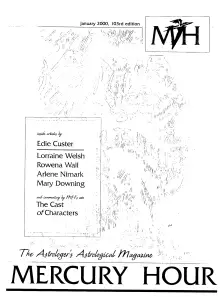
Mundane Astrology, Medical Astrology, and Astrological Techniques. This archival item is the January 2000 issue (103rd Edition) of Mercury Hour, a quarterly astrological magazine edited and published by Edith Custer in Lynchburg, Virginia. Key contents include Lorraine Welsh’s article addressing a psychiatric clinic checklist that categorized using astrology alongside mental health pathologies, Virginia Reyer’s examination of the Nodal Barrier trapped configuration across various birth charts, and Rowena Wall’s guide to relocation astrology featuring city charts for Las Vegas and Toronto. The issue features Mary Downing’s eclipse watch report on the January 20 lunar eclipse and February 5 solar eclipse, Arlene Marcia Nimark’s “Tidbits and Obits” column detailing charts for public figures including Placido Domingo, Catfish Hunter, and Lance Armstrong, and Guy de Penguern’s medical astrology study on Chiron keywords and planetary sendings. Additional contributions include reviews of books by Terry Lamb and Bil Tierney, alongside reader discussions on Y2K, solar flares, Chaos Theory, the Bible Code, and chart data for figures such as John F. Kennedy Jr. and Dr. Jack Kevorkian.


Issue Highlights
Book Reviews
By Lorraine Welsh:
Born to be Together: Love, Relationships, Astrology, and the Soul by Terry Lamb
Daily Planetary Guide 2000 by Llewellyn Publications
***
Alive and Well with Uranus by Bil Tierney – Edith Custer
Articles
Fear Abandonment, Use Astrology, Cut Wrist: The faces of prejudice
– Lorraine Welsh
Passport to Good Visiting – Rowena Wall
Trapped Configuration, also called the Nodal Barrier – Virgina Reyer
Tidbits and Obits – Marcia Nimark
Eclipse Watch [Jan 20 and Feb 5, 2000] – Mary Downing
Discussions
August 1999 Eclipse
Chart of Jack Kevorkian
Chaos Theory
War of 1812
Black Moon Lilith
Chart data
(some incomplete or in question)
Armstrong, Lance
Bessete, Carolyn
Bradley, Bill
Cullberg, Birgit
Domingo, Placido
Exner, Judith Campbell
Gore Jr., Al


Hardin, Louis “Moondog”
Hunter, Catfish
Kevorkian, Jack
McCain, John
Mraz, Charles
Mussolini, Benito
Parker Bowles, Camilla


Rimes, LeeAnn
Sarraute, Nathalie
Schoen, Leonard S.
Starr, Ringo
Weill, Kurt


New York City Subway opening
Saturday Night Live (debut)
Las Vegas, Nevada
Toronto, Ontario, Canada
Notable contributors
Bil Tierney (new books in his Alive and Well trilogy)
Marion March (birth data; books on Progressions)

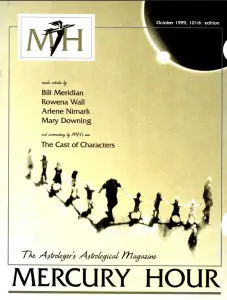
Mundane Astrology, Financial Astrology, and Astrology History. This archival item is the October 1999 issue (101st Edition B) of Mercury Hour, a quarterly astrological magazine edited and published by Edith Custer in Lynchburg, Virginia. Key contents include Bill Meridian’s review of Ron Howland’s A Chronology of American Charts alongside his article on “Shared Degree Areas” in planetary stock trading, Rowena Wall’s analysis of Y2K “Millennium Madness”, and Mary Downing’s eclipse watch report on Saros 145. The issue features the conclusion of Guy de Penguern’s 21st Century Medical Astrology Course focusing on cardiopathy, Arlene Nimark’s “Tidbits & Obits” covering Kurt Weill, the “Mercury Mets,” and the Littleton shooting birth data, and Virginia Reyer’s reference guide to Vertex signs. Additional contributions cover reader discussions on Out-of-Bounds planets, solar returns, the Bible Code, Druidic numerology, and chart analyses for John F. Kennedy Jr. and King Abdullah of Jordan.


Issue Highlights


Book Review

A Chronology of American Charts by Ron Howland – Bill Meridian


Articles

Tidbits & Obits – Arlene Nimark

Y2K Millenium Madness – Rowena Wall

Planetary Stock Trading: Shared Degree Areas – Bill Meridian

21st Century Medical Astrology Course, Part 3 of 3 [extract] – Guy de Penguern

Eclipse Watch [Saros 145] – Mary Downing

Vertex Signs – Virginia Reyer


Discussions

Out-of-Bounds planets

Columbine shooters

Leap years

Solar Returns

Asteroids Hidalgo, Pandora, Lilith

Druidic numerology

Chart of JFK, Jr.

The Bible Code

Solar storms/solar peak


Chart data

Abdullah, King of Jordan

Kennedy Jr., John F.

Nunavut (Canada)


Notable contributors

Roberta Strain (Royal Fixed Stars)

Marion March (fertility & astrology)

Astrology, Horary, Mundane, Chart Techniques, Software, Ethics. This edition of Mercury Hour features an eclectic collection of letters, articles, and discussions from the astrological community of the late 1980s. Key technical discussions focus on the application of horary techniques to personal events, the validity of progressions versus transits, the use of heliocentric charts, the debate surrounding psychological counseling by astrologers, and methods for calculating progressed angles. Several contributors engage in a lively back-and-forth regarding the “True Time” of the U.S. founding, with specific arguments favoring the July 4th, 1776 date.

Issue Highlights:
The issue serves as a forum for various professional and amateur astrologers to share research, personal anecdotes, and technical feedback on software and methodology. Notable articles explore the potential “Viper’s Nest” chart pattern in relation to criminals like Ted Bundy, the debate against professional astrological counseling, and techniques for natal chart rectification using historical and event-based data. Much of the content is shaped by the editor’s return to the magazine, establishing a welcoming space for community debate, software reviews, and the sharing of “Chart Mart” data.

Articles:
Salem, or A Cynic’s Centiloquy – Don Borkowski
Horary Techniques Applied to Personal Events – Edward Dearborn
Another Asteroid Turned Comet (Chiron) – Richard A. Kerr
Against Astrological Counseling – Robert Cole
Will the Real Duchess of Windsor Stand Up – Carolyn H. Caufman
Moving to Paradise – Marc Penfield
Joyce’s Key Phrases for Transiting Aspects – Joyce Wehrman
Ted Bundy’s “Viper’s Nest” Chart Pattern – John Kalus

Discussion:
Calculating progressions and progressed houses
Speculative charts for Mikhail Gorbachev and U.S. historical events
Weather predictions based on Winter Solstice and planetary alignments
The ethics of professional astrological counseling
Use of heliocentric versus geocentric charts

Chart data:
Mikhail Gorbachev
Wallis Simpson
Cheryl Crane
Davy Crockett
Katherine Hepburn
George Bush
Michael and Kitty Dukakis
Joan Quigley

Notable contributors:
Michael Munkasey (Chart of the U.S.A.)
Al H. Morrison (Neptune aspects; shamanism; horary timing)
Jim Lewis (1988 U.S.A. election)
Marion March (C-Sections; Chiron; Jesse Jackson)

Mercury Hour 101st Edition (A) July 1999

Mercury Hour Magazine, Special Collections

Medical Astrology, Mundane Astrology, and Astrological Technique. This archival item is the July 1999 issue (101st Edition) of Mercury Hour, an astrological periodical edited and published quarterly by Edith Custer in Lynchburg, Virginia. Featured contributions include the second installment of Guy de Penguern’s course on 21st-century medical astrology focusing on genetic predispositions to cancer and amino acids, Virginia A. Reyer’s technical guide to calculating and interpreting the Vertex/Anti-Vertex axis alongside a chart analysis of Jack Kevorkian, Mark Pottenger’s mathematical correction regarding the Equation of Time and Local Apparent Time in computer software, and excerpts from Robert P. Blaschke’s treatise on progressions. Additional community discussions cover out-of-bounds planets, solar return methodologies, debates on geographic versus geocentric latitude, and classifications of the three distinct Liliths (Dark Moon, Asteroid, and Black Moon). The issue also preserves mundane astrological commentary on late-1990s events, including the Kosovo conflict and Slobodan Milosevic’s birth data, Y2K software preparedness, the August 1999 Fixed Grand Cross eclipse, and verification efforts regarding natal data for the Columbine High School shooting perpetrators.


Issue Highlights 


Articles

21st Century Medical Astrology Course, Part 2 of 3 – Guy de Penguern [extract]

The Case of the Clock Dial – Mark Pottenger

Jack Kevorkian, Part 2 of 2 – Virginia A. Reyer

“Mutable Dilemma”: Do You Mean Apparent? [Apparent vs. Mean Time]

– Mark Pottenger


Discussions

Chart of Bill Clinton

The three Liliths

Astrology & fertility

Solar returns

August 1999 Grand Cross & eclipse

The Vertex

The true “Blue Moon”

Charles Keating event/diurnal chart

Declinations/out-of-bounds planets

Equation of Time in chart calculations

Geocentric vs. heliocentric latitude


Chart data

Harris, Eric

Hussein, Saddam

Klebold, Dylan

Milosevic, Slobodan

Nicholson, Jack 


Notable contributors

Marion March (astrology & fertility)

Robert Blaschke (Astrology: A Language of Life; Volume I – Progressions [excerpt])

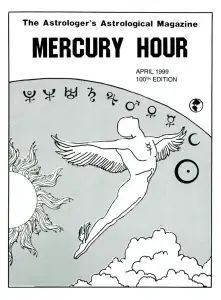
Medical Astrology, Mundane Astrology, and Fixed Stars serve as the primary focus areas of this historical astrological literature. This archival item is the April 1999 issue (100th Edition) of Mercury Hour, a long-running quarterly astrological magazine edited and published by Edith Custer in Lynchburg, Virginia. The issue highlights the first installment of Guy de Penguern’s course on 21st-century medical astrology and genetic astrophysics, a review of Enrique Linares’s A Scientific Approach to the Metaphysics of Astrology by Marguerite dar Boggia, Virginia A. Reyer’s study on fixed stars and health, and Dorothy J. Sarka’s examination of the I Ching. Additionally, the issue documents extensive reader discussions on political horoscopes and current events, including the Bill Clinton impeachment, Y2K software predictions, the 1999 Israeli election, and natal chart data for prominent figures such as Jesse Ventura and Ehud Barak.


Issue Highlights

Book Review

A Scientific Approach to the Metaphysics of Astrology by Enrique Linares

– Marguerite der Boggia


Articles

21st Century Medical Astrology Course, Part 1 of 3 – Guy de Penguern [extract]

Fixed Stars, Part 2 of 2 – Virgina A. Reyer

The Hidden Code of the I Ching – Dorothy J. Sarka


Discussions

Ken Starr/Bill Clinton impeachment

Chart of Bill ClintonU.S. Declaration of Independence

W.H. Chaney/Jack London

Astro-Twins (examples)

Asteroid rulership/association

Moon Out-of-Bounds

Israel election 1999

Y2K

August 1999 Grand Cross eclipse

August 1998 eclipse effect on Russia

Sun/Moon angle and conception


Chart data

Barak, Ehud

Bush, George

Chaney, William

Hand, Rob

Jayne, Charles

Keller, Helen

Netanyahu, Benjamin

Rose, Buddy “Playboy”

Ventura, Jesse

Russia


Notable contributors

Marion March (various topics)


ASPECTS Vol. 6 No. 1 Winter 1980-1

ASPECTS Magazine

Astrological Techniques, Arabic Parts, Mundane Astrology. This issue of ASPECTS magazine provides a deep dive into advanced astrological applications, specifically focusing on the interpretation and calculation of Arabic Parts and the impact of the Great Mutation (Jupiter-Saturn conjunction). The technical content is complemented by foundational series columns, such as Joan McEvers’ exploration of the 5th House and Nancy Cassidy’s analysis of sextile aspects. These articles bridge the gap between abstract mathematical derivations and practical, house-by-house interpretations of human experience and psychological drives.

Issue Highlights

The magazine documents the transition into a new astrological era marked by the shift of Jupiter-Saturn conjunctions from Earth signs to the Air element, specifically referencing the 1980 conjunction in Libra. It also serves as a chronicle of the burgeoning astrological community in the early 1980s, highlighting the South-Western Astrology Conference (SWAC) of 1980, upcoming conferences in Zurich, and the general professionalization of the field through organizations like Aquarius Workshops, Inc.

Articles:
How To Calculate Your Arabic Parts – Robert ‘Buz’ Myers
The Great Jupiter/Saturn Conjunction – Marion D. March
The Diurnal (Daily) Chart – Lenora M. Hill
The Point of Life – Enrique Linarés
Keys to Learning (5th House) – Joan McEvers
Building Blocks (Sextiles) – Nancy Cassidy
Capricorn Ingress – Judy Johns

Discussion:
The transition from Earth to Air element in major planetary conjunctions
Calculation and interpretation of 10 specific Arabic Parts across 12 houses
The professional development of astrology in educational and conference settings

Chart data:
10/28/75, 1:24 pm PST, Encino, CA
12/21/1980, 11:56:00 EST, Washington, DC

Notable contributors:
Robert ‘Buz’ Myers (Arabic Parts)
Marion D. March (Mundane Astrology/Conjunctions)
Joan McEvers (Astrological Education)

ASPECTS Vol. 3 No 2. Feb 1978

ASPECTS Magazine

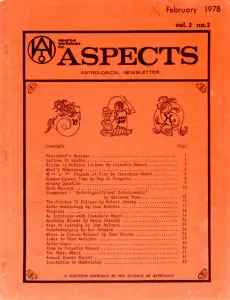
Astrology, Aquarius Workshops, Eclipses, Horary, Graphoanalysis, Ingress Charts, Planetary Aspects. This issue of Aspects Astrological Newsletter (Vol. 3, No. 2, February 1978) covers a wide range of advanced and beginner astrological techniques, organizational news, book reviews, and interviews. Highlights include discussions on Uranus and Neptune dynamics, the October 12 eclipse impact, the application of ingress charts for personal forecasting, astro-numerology, and graphoanalysis techniques correlating handwriting slant with emotional responsiveness.

Issue Highlights:
Features extensive reports on conferences, upcoming workshops by prominent astrologers like Isabel Hickey and Gina Ceaglio, presidential messages from Marion D. March, and detailed technical articles exploring natal chart interpretation, house systems, and predictive methods.

Articles:
Review of McEvers Lecture – Cornelia Hansen
Friends or Foes – Constance Mayer
Humano-Cosmic Time – Guy de Penguern
Horary Question – Anonymous
Viewpoint – Astrologer/Client Relationship – Marianne Dunn
The October 12 Eclipse – Robert Jansky
Astro-Numerology – Joan McEvers
An Interview with Constance Mayer – Marion D. March
Building Blocks – Nancy Cassidy
Keys to Learning – Joan McEvers
Graphoanalysis – Sue Johnson
Where is Cousin Melvin? – Jean Graves
Astro-Logic – Anonymous
The Phase Wheel – Anonymous
Annual Dinner Report – Karen McCauley

Discussion:
Using ingress charts for prognostications and personal forecasting
Comparing Uranus and Neptune symbolism and manifestations
Humano-Cosmic Time previewing system based on 11-minute 12-second zodiacal ticks per year of life
Turning the house method in horary and natal charts (‘Every house is a first house’)
The psychological and physiological impacts of solar and lunar eclipses across houses
Graphological analysis of writing slant and emotional styles (FA, AB, BC, CD, DE, E+)

Chart data:
Capricorn Ingress Chart (December 21, 1977)
Horary Chart for Marriage Question (July 5, 1977)

Notable contributors:
Joan McEvers (Ingress charts, astro-numerology, keys to learning)
Constance Mayer (Planetary comparison of Uranus and Neptune)
Robert Jansky (Eclipse analysis and book reviews)
Marianne Dunn (Client-astrologer relationship ethics)
Guy de Penguern (Humano-Cosmic Time system)
Sue Johnson (Graphoanalysis)
Nancy Cassidy (Beginner blocks on Leo)
Jean Graves (Derivative house systems)

Ask A Librarian

Need assistance with your research or navigating our collection? Our library team is here to help.

Please fill out the form below with details about the topics, authors, or archival materials you are looking for, and one of our librarians will review your query and respond shortly.

Help

Whether you are looking for rare historical texts or trying to locate a specific book nearby, Alexandria iBase offers two primary ways to search. Here is how to choose the right tool for what you need:

The Library Catalogue

Think of this as your global master index.

The Catalogue works just like a traditional library search system, designed to help you locate books and media across the broader astrological landscape.

  • Physical Books: Find out where physical copies of books are held in libraries, archives, or collections near you.

  • Digital Files: Access downloadable or viewable digital editions when available.

  • Best Used For: Standard research, finding specific ISBNs or authors, and tracking down physical items in the real world.

Browse Catalogue

SPECIAL COLLECTIONS

Think of this as Alexandria’s exclusive private vault.

Collections gives you direct access to Alexandria’s own curated archive of rare, proprietary, and historic astrology media.

  • Exclusive Material: Features unique texts, manuscripts, audio recordings, and visual media that are not available anywhere else.

  • Direct Access: Digitized content ready to explore straight from the platform.

  • Best Used For: Deep-dive research, discovering hidden gems, and exploring rare, one-of-a-kind astrological resources.

Browse Special Collections

Cash & In-Kind Donations

Make a one-time or recurring tax deductible cash donation.

Payment options include donating directly with us, PayPal Giving and GoFundMe.

GoFundMe for Charities and PayPal Giving are registered for tax deductions and have no required processing fees. It does offer the option to tip.

Donate

*Subject to 2.5% processing fees

Contact Us

Have a question, feedback, or a inquiry about our archives? We’d love to hear from you. Please fill out the form below with your details and message, and a member of our team will get back to you as soon as possible.

Thank you for reaching out to the Alexandria iBase Project!