
Home » Mark Pottenger

Mark Pottenger

An astrological programmer, author, and technical researcher known for developing specialized software for asteroid ephemerides, astro-mapping, fixed stars, and coordinate transformations.

Filters

Filters


See more See less
See more See less
See more See less
See more See less
See more See less
See more See less
See more See less

Sorting

The Many Faces of Pluto (ca. 1983)

Marion D. March, Special Collections

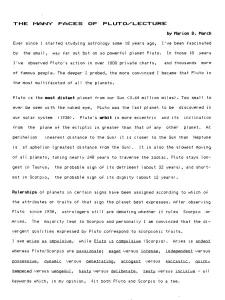
Pluto, Astrology, Mythology, Generational Planets, House Placements, Transits. This extensive lecture by Marion D. March explores the multifaceted nature of Pluto in astrology, detailing its astronomical uniqueness, diverse historical glyphs, and deep roots in Greek and Roman mythology. The text covers Pluto’s manifestations through wealth, the unseen, sexuality, power, and transformation, bridging ancient archetypes with modern psychological and mundane astrology. Special attention is given to the collective unconscious as viewed through outer planets, alongside practical examples of Pluto transits and its placement through the twelve houses and zodiac signs.

Issue Highlights:
The Many Faces of Pluto / Lecture – Marion D. March

Articles:
The Many Faces of Pluto/Lecture – Marion D. March
Mythologisches – Fritz Gehre

Discussion:
Pluto’s astronomical characteristics and orbital peculiarities
Debates on Pluto’s rulership (Scorpio vs. Aries)
Historical analysis of Pluto’s glyphs and mythological origins (Hades, Persephone, Tantalus)
Pluto’s connection to atomic energy, plutonium, and the collective unconscious
Pluto through the twelve houses and signs of the zodiac

Chart data:
Gov. Brown
H. Kissinger
George Sand
Goethe
J.P. Getty
R. Browning
C. Jung
Robert Kennedy
W. Churchill
Lee Bailey
Krishnamurti
Charles Manson
Angela Davis
Edgar Bergen
Louis Pasteur
Earl Warren
Spencer Tracy
B. Baruch
Adelle Davis
Oliver Wendell Holmes
Emerson
Ted Kennedy
Gandhi
Gershwin
Charles Lindberg
de Gaulle
Hitler
Jackie Onassis
Isabel Hickey
Nelson Rockefeller
F.D. Roosevelt
Thomas Mann
Tallulah Bankhead
Karl Marx
Richard Nixon
Sigmund Freud
Ernest Hemingway
Pablo Picasso
Lyndon Johnson
Albert Einstein
Mme. Curie
Marilyn Monroe
Patty Hearst
Muhammad Ali
Dr. Charles Mayo

Notable contributors:
Marion D. March (Author and Astrologer)
Isabel Hickey (Astrology and Symbolism)
Liz Greene (Outer Planets and Collective Unconscious)
Fritz Gehre (Mythology)
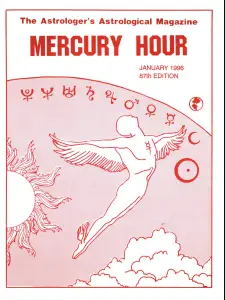
Mundane Astrology, Medical Astrology, and Predictive Astrology. This archival document is the 87th edition of Mercury Hour (January 1996), an astrological community journal edited and published by Edith Custer. The issue features articles, research notes, chart rectifications, software developments, and correspondence among practicing astrologers, including Bil Tierney’s psychological examination of Jupiter, Ed Dearborn’s technical breakdown of the “Translation of Light”, Valerie Vaughan’s defense of predictive astrology, Byron Ross Wahl’s analysis of the Solar Apex Synthetic Method (SASM), and the final installment of Robert “Buz” Myers’ lecture series on Moon-Saturn dynamics. Additionally, the journal covers mundane and political analyses of the O.J. Simpson verdict by John Kalus and Marion March, national chart rectifications for Washington, D.C. by Marc Penfield, insights on Uranus entering Aquarius by Kaye Shinker, medical and genetic commentary by T. Patrick Davis, software updates by Mark Pottenger, and tributes to astrologer Al H. Morrison.

Issue Highlights

Book Reviews
By Edith Custer:
Llewellyn’s 1996 Astrological Pocket Planner
Llewellyn’s Astrological Calendar 1996
Astrology Really Works by The Magi Society – Marc Penfield

Articles
A Look at Jupiter’s Shortcomings – Bil Tierney
Translation of Light – Ed Dearborn
Group Dynamics – Mary K. Creasey
Been There, Done That – Kaye Shinker
[O.J. Simpson verdict] – John Kalus
SASM, Columbus, and Samana Cay – Byron Ross Wahl
1995 Oven Saga – Roberta Strain
Moon/Saturn, Parts 7 and 8 of 8 – Robert “Buz” Myers
Winter Solstice 1995 – Dot Willis
The Art of Self-Defense: Lesson, Fighting at the Level of Your Opponent,
Part 1 of 2 – Valerie Vaughn
Al H. Morrison: Rectification, Poison Data, Genetics – T. Patrick Davis
[obituary & excerpts]
Discussions
Solar returns
O, J, Simpson trial
Chart data
(some incomplete or in question)
Powell, Colin
Washington, D.C.
Notable contributors
Donna Van Toen (various topics)
Mark Pottenger (Progressed MC techniques in software)
Marc Penfield (Chart of the U.S.A.)
Lee Lehman (corrections to Essential Dignities)
Marion March (O. J. Simpson trial, Chaos Theory, Solar Returns)

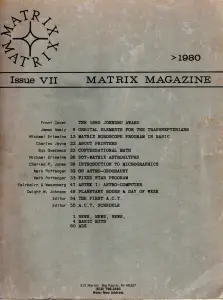
Computerized Astrology, Astrological Programming, A.C.T. Conference, Trans-Neptunian Planets. This issue of Matrix Magazine serves as a bridge between early computing technology and professional astrological practice. It focuses heavily on the technical application of microcomputers (Commodore PET, Apple II, TRS-80) to astrological research, offering BASIC programming code for chart calculations, orbital elements for Trans-Neptunian planets (Cupido, Hades, Zeus, Kronos, Apollon, Admetos, Vulkan, Poseidon), and instructions for printer-based astroglyph generation. The magazine also introduces the “ASTEK I,” a specialized astrological computer, and discusses the use of microfilm for archival astrological data storage.

Issue Highlights:
The 1980 Johndro Award is presented to Neil F. Michelsen for his pioneering work in computer-assisted ephemerides and astrological software. The issue also provides a comprehensive schedule for the first Astrological Conference on Techniques (A.C.T.) held in New Orleans, covering a wide array of research topics from planetary cycles to rectifiction methods.

Articles:
Orbital Elements for the Transneptunians – James Neely
Matrix Horoscope Program in BASIC – Michael Erlewine
Conversational Math – Buz Overbeck
Dot-Matrix Astroglyphs – Michael Erlewine
Introduction to Micrographics – Charles Paul Jones
On Astro-Geography – Mark Pottenger
Fixed Star Program – Mark Pottenger
ASTEK I: Astro-Computer – Fairbairn & Wesenberg
Planetary Hours & Day of Week – Dwight W. Johnson

Discussion:
Application of BASIC programming in natal astrology
Technical specifications and history of the ASTEK I calculator
Astro-Geography and meridian contacts
Statistical analysis of astrological data
Microfilm implementation for astrological libraries
Planetary rulers and the day of the week

Chart data:
Michael Erlewine (Born 7/18/1941, 4:03 PM EST, Lancaster, PA)

Notable contributors:
Michael Erlewine (Editor/Computing), James Neely (Orbital elements/programming), Mark Pottenger (Fixed star programming), Charles Jayne (Conference/Techniques advice), Buz Overbeck (Conversational math)

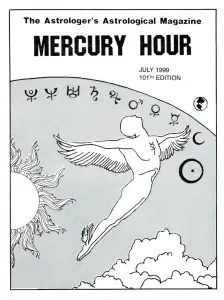
Mercury Hour 101st Edition (A) July 1999

Mercury Hour Magazine, Special Collections

Medical Astrology, Mundane Astrology, and Astrological Technique. This archival item is the July 1999 issue (101st Edition) of Mercury Hour, an astrological periodical edited and published quarterly by Edith Custer in Lynchburg, Virginia. Featured contributions include the second installment of Guy de Penguern’s course on 21st-century medical astrology focusing on genetic predispositions to cancer and amino acids, Virginia A. Reyer’s technical guide to calculating and interpreting the Vertex/Anti-Vertex axis alongside a chart analysis of Jack Kevorkian, Mark Pottenger’s mathematical correction regarding the Equation of Time and Local Apparent Time in computer software, and excerpts from Robert P. Blaschke’s treatise on progressions. Additional community discussions cover out-of-bounds planets, solar return methodologies, debates on geographic versus geocentric latitude, and classifications of the three distinct Liliths (Dark Moon, Asteroid, and Black Moon). The issue also preserves mundane astrological commentary on late-1990s events, including the Kosovo conflict and Slobodan Milosevic’s birth data, Y2K software preparedness, the August 1999 Fixed Grand Cross eclipse, and verification efforts regarding natal data for the Columbine High School shooting perpetrators.


Issue Highlights 


Articles

21st Century Medical Astrology Course, Part 2 of 3 – Guy de Penguern [extract]

The Case of the Clock Dial – Mark Pottenger

Jack Kevorkian, Part 2 of 2 – Virginia A. Reyer

“Mutable Dilemma”: Do You Mean Apparent? [Apparent vs. Mean Time]

– Mark Pottenger


Discussions

Chart of Bill Clinton

The three Liliths

Astrology & fertility

Solar returns

August 1999 Grand Cross & eclipse

The Vertex

The true “Blue Moon”

Charles Keating event/diurnal chart

Declinations/out-of-bounds planets

Equation of Time in chart calculations

Geocentric vs. heliocentric latitude


Chart data

Harris, Eric

Hussein, Saddam

Klebold, Dylan

Milosevic, Slobodan

Nicholson, Jack 


Notable contributors

Marion March (astrology & fertility)

Robert Blaschke (Astrology: A Language of Life; Volume I – Progressions [excerpt])

Ask A Librarian

Need assistance with your research or navigating our collection? Our library team is here to help.

Please fill out the form below with details about the topics, authors, or archival materials you are looking for, and one of our librarians will review your query and respond shortly.

Help

Whether you are looking for rare historical texts or trying to locate a specific book nearby, Alexandria iBase offers two primary ways to search. Here is how to choose the right tool for what you need:

The Library Catalogue

Think of this as your global master index.

The Catalogue works just like a traditional library search system, designed to help you locate books and media across the broader astrological landscape.

  • Physical Books: Find out where physical copies of books are held in libraries, archives, or collections near you.

  • Digital Files: Access downloadable or viewable digital editions when available.

  • Best Used For: Standard research, finding specific ISBNs or authors, and tracking down physical items in the real world.

Browse Catalogue

SPECIAL COLLECTIONS

Think of this as Alexandria’s exclusive private vault.

Collections gives you direct access to Alexandria’s own curated archive of rare, proprietary, and historic astrology media.

  • Exclusive Material: Features unique texts, manuscripts, audio recordings, and visual media that are not available anywhere else.

  • Direct Access: Digitized content ready to explore straight from the platform.

  • Best Used For: Deep-dive research, discovering hidden gems, and exploring rare, one-of-a-kind astrological resources.

Browse Special Collections

Cash & In-Kind Donations

Make a one-time or recurring tax deductible cash donation.

Payment options include donating directly with us, PayPal Giving and GoFundMe.

GoFundMe for Charities and PayPal Giving are registered for tax deductions and have no required processing fees. It does offer the option to tip.

Donate

*Subject to 2.5% processing fees

Contact Us

Have a question, feedback, or a inquiry about our archives? We’d love to hear from you. Please fill out the form below with your details and message, and a member of our team will get back to you as soon as possible.

Thank you for reaching out to the Alexandria iBase Project!