
Home » T. Pat Davis

T. Pat Davis

Filters

Filters


See more See less
See more See less
See more See less
See more See less
See more See less
See more See less
See more See less

Sorting

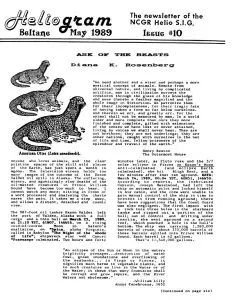
Heliocentric Astrology, Heliogram, NCGR Helio S.I.G., Mundane Astrology, Weather Prediction, Financial Astrology, Asteroids, Fixed Stars, Horary Astrology. This document is the May 1989 issue of the Heliogram, the newsletter of the NCGR Helio S.I.G. Edited by Margaret M. Meister and published with contributions from prominent heliocentric and mundane astrologers, the issue explores the intersections of heliocentric and geocentric astrology, weather forecasting, financial trends, and current world events. Articles delve into the environmental and astrological significance of the Exxon Valdez oil spill, incorporating fixed stars like Spica, Fomalhaut, and the constellation Cetus. Discussions extend to economic forecasts utilizing heliocentric horary charts, planetary alignments involving Mars, Saturn, and Uranus, and the usage of asteroids in mundane prediction. Historical analyses cover figures such as Vincent Wing, examining early heliocentric astrology and Keplerian mechanics. Comprehensive chart data and chronologies, including those for George Bush, nuclear disaster events like Three Mile Island and Chernobyl, and the Emperor Akihito, provide empirical depth to the technical explorations presented throughout the volume.

Issue Highlights:

Articles:
Ask of the Beasts – Diana K. Rosenberg
On File – Margaret M. Meister
Custer Corner: Some Thoughts On Helio – Edith Custer
New and Improved George Bush Chronology – Bill Meridian
Hello, Jupiter! – Barbara May
Elections, Nominations and Things That Go Bump in the Night – Margaret Meister, Edith Custer
Helio in the News – Zipporah Dobyns, Ph.D.
An Implausible Mars-Moon – T. Pat Davis
Emperor Akihito – Doris Greaves
Astrology and the Weather – Part V – Dorothy S. Willis
Doom Forestalled: A Study in Helio Horary – Susan Manuel
Bridge Collapse – Edith Custer
Helio History: Vincent Wing: The First Heliocentric Astrologer? – J. Lee Lehman, Ph.D.

Discussion:
Heliocentric planetary placements and comparative geo/helio charts
Mundane and economic forecasting via heliocentric horary charts
Astrological signatures of the Exxon Valdez oil spill and environmental disasters
Weather forecasting using heliocentric aspects (Venus, Mars, Jupiter, Saturn, Uranus, Neptune)
Historical analysis of heliocentric astronomy and astrology from Kepler to Vincent Wing

Chart data:
Exxon Valdez Oil Spill Chart (March 24, 1989)
Exxon Corporation Foundation Chart (August 10, 1892)
First Sustained Nuclear Reaction (December 2, 1942)
Three Mile Island Nuclear Power Plant Disaster (March 28, 1979)
Chernobyl Nuclear Plant Explosion (April 26, 1986)
Emperor Akihito Natal Chart (December 23, 1933)
Bridge Collapse, Covington, TN (April 1, 1989)
George Bush Natal Chart

Notable contributors:
Diana K. Rosenberg (Astrological zoology and environmental mundane charts)
Edith Custer (Helio Mercury configurations and structural chart observations)
Zipporah Dobyns (Asteroid placements and mundane events)
Susan Manuel (Heliocentric horary and economic predictions)
Dorothy S. Willis (Astrological weather forecasting)
J. Lee Lehman (Historical analysis of heliocentric astrology and Vincent Wing)
Barbara May (Heliocentric Jupiter placements)
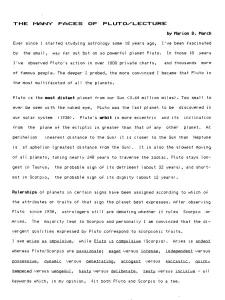
The Many Faces of Pluto (ca. 1983)

Marion D. March, Special Collections

Pluto, Astrology, Mythology, Generational Planets, House Placements, Transits. This extensive lecture by Marion D. March explores the multifaceted nature of Pluto in astrology, detailing its astronomical uniqueness, diverse historical glyphs, and deep roots in Greek and Roman mythology. The text covers Pluto’s manifestations through wealth, the unseen, sexuality, power, and transformation, bridging ancient archetypes with modern psychological and mundane astrology. Special attention is given to the collective unconscious as viewed through outer planets, alongside practical examples of Pluto transits and its placement through the twelve houses and zodiac signs.

Issue Highlights:
The Many Faces of Pluto / Lecture – Marion D. March

Articles:
The Many Faces of Pluto/Lecture – Marion D. March
Mythologisches – Fritz Gehre

Discussion:
Pluto’s astronomical characteristics and orbital peculiarities
Debates on Pluto’s rulership (Scorpio vs. Aries)
Historical analysis of Pluto’s glyphs and mythological origins (Hades, Persephone, Tantalus)
Pluto’s connection to atomic energy, plutonium, and the collective unconscious
Pluto through the twelve houses and signs of the zodiac

Chart data:
Gov. Brown
H. Kissinger
George Sand
Goethe
J.P. Getty
R. Browning
C. Jung
Robert Kennedy
W. Churchill
Lee Bailey
Krishnamurti
Charles Manson
Angela Davis
Edgar Bergen
Louis Pasteur
Earl Warren
Spencer Tracy
B. Baruch
Adelle Davis
Oliver Wendell Holmes
Emerson
Ted Kennedy
Gandhi
Gershwin
Charles Lindberg
de Gaulle
Hitler
Jackie Onassis
Isabel Hickey
Nelson Rockefeller
F.D. Roosevelt
Thomas Mann
Tallulah Bankhead
Karl Marx
Richard Nixon
Sigmund Freud
Ernest Hemingway
Pablo Picasso
Lyndon Johnson
Albert Einstein
Mme. Curie
Marilyn Monroe
Patty Hearst
Muhammad Ali
Dr. Charles Mayo

Notable contributors:
Marion D. March (Author and Astrologer)
Isabel Hickey (Astrology and Symbolism)
Liz Greene (Outer Planets and Collective Unconscious)
Fritz Gehre (Mythology)

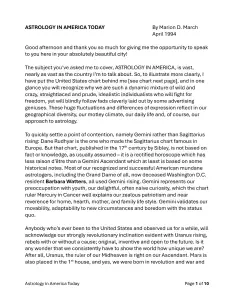
Astrology in America Today (1994)

Marion D. March, Special Collections

Astrology in America Today, Marion D. March, United States Chart, Gemini Ascendant, Uranian Astrology, Local Space, Project Hindsight, Lois Rodden, UAC. Marion D. March presents a comprehensive and sweeping lecture examining the state of astrology in the United States, utilizing a 7 July 1776 chart with Gemini rising and Uranus on the Ascendant as a symbolic reflection of American cultural and astrological traits. March discusses the rich eclecticism of American astrology, serving as a primary testing ground for international techniques and systems such as Midpoints, Uranian Astrology, Dr. Koch’s house systems, and composite charts from Germany, alongside Dane Rudhyar’s psychological insights from France. She details how American astrologers have championed innovations like Local Space (building on Edward Johndro, Charles Jayne, and Michael Erlewine), Heliocentric Astrology (popularized by T. Pat Davis), and Jim Lewis’s Astro*Carto*Graphy. Furthermore, she highlights the monumental work of Project Hindsight in retranslating classical texts, Lois Rodden’s monumental data collection efforts leading to the IDEA database, and the pioneering organizational frameworks of UAC (United Astrology Congress), AFAN, ISAR, and NCGR.

Issue Highlights:

Articles:
Astrology in America Today – Marion D. March

Discussion:
Debate between Gemini versus Sagittarius rising for the United States chart
The influence of computers and databases on astrological research (Lois Rodden, Edwin Steinbrecher, Michel and Françoise Gauquelin)
The professionalization of astrology and resistance to licensing
The intersection of astrology with technology, computers, and the Information Highway

Chart data:
US Chart 7 Gem ASC, July 4, 1776, 2:14 a.m. LMT, Philadelphia, PA

Notable contributors:
Marion D. March (Author / Lecturer)
Barbara Watters (Mundane astrology / Gemini rising usage)
Dane Rudhyar (Astrological philosophies and lunar phases)
Dr. Eugen Jonas (Fertility astrology)
Angel Thompson (Feng Shui and modern applications)
Michael Erlewine (Local Space mathematics and software)
T. Pat Davis (Heliocentric astrology)
Olivia Barclay, Ivy Jacobson, Joan McEvers (Horary astrology revitalization)
Jacob Schwartz (Draconic system)
Robert Hand, Robert Schmidt, Robert Zoller (Project Hindsight translation)
Jim Lewis (Astro*Carto*Graphy)
Lois Rodden (Data collection and birth data categorization)
Edwin Steinbrecher (Biographical research databases)
Neil Michelsen (Computerized ephemerides and research support)

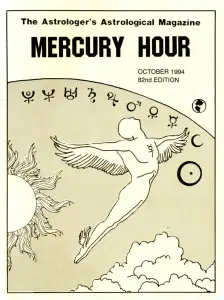
Mundane Astrology, Predictive Astrology, and Astrology History. This archival item is the October 1994 issue (82nd Edition) of Mercury Hour, a quarterly astrological magazine edited and published by Edith Custer in Lynchburg, Virginia. Key contents include Part 1 of Robert Zoller’s four-part series on Guido Bonatti and medieval European astrological literature, Van K. Golay’s mundane assessment of the “Soviet Power” regime and its post-1987 transformation, and Marc Penfield’s astrological analysis of natural disasters in California alongside chart profiles for Rodney King and O.J. Simpson. The issue features extensive coverage and reader discussions surrounding the O.J. Simpson murder case, featuring chart analyses and comparisons by T. Pat Davis, Karen Christino, Jim Haynes, Joseph S. deMello, John Somoza, and Edith Custer. Additional contributions include Dorothy Willis’s weather predictions for the 1994 Autumn Equinox, book reviews by Rose D. Owen, Edith Custer, Marc Penfield, and Ann Requa, and community discussions on solar return timing, death indicators, house representations of parents, and software/computer developments.


Issue Highlights


Book Reviews

The Eagle and the Lark (A Textbook of Predictive Astrology) by Bernadette Brady

– Rose D. Owen

Forecasting – Backward & Forward by Bruce Hammerslough

– [two reviews] Edith Custer and Marc Penfield

A History of Western Astrology by Jim Tester – Ann Requa


Articles

Crisis Alert [California natural disasters] – Marc Penfield

Autumn Equinox 1994 – Dorothy Willis

“Soviet Power” Dead or Alive? – Van K. Golay

Guido Bonatti and the Spread of Astrological Literature in Mediaeval Europe,

Sive, Pro Astrologica per se Studiendo, Part 1 of 4 – Robert Zoller

People [Rodney King; O.J. Simpson] – Marc Penfield


Discussions

O.J. Simpson case

Neptune

Transiting Saturn in Pisces (1994)

Timing in solar return charts

Locating death in a chart

House representation of parents

Bill Clinton/Whitewater


Chart data

Simpson, O.J.

O.J. Simpson case lawyers:

Cowlings, A.C.

Dershowitz, Alan

Lerner, Mark

Shapiro, Robert

Bundy, Ted

Candy, John

King, Rodney

Klaas, Polly

Davis, Richard Allen (abductor of Polly Klaas)

Los Angeles, CA (City & County)


Notable contributors

Carole Devine (astrological counseling; timing in solar returns)

Karen Christino (O.J. Simpson)

Lois Rodden (Michael Jackson birth time; continuation of chart after death)

Marion March (challenging aspects)

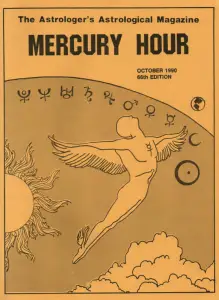
Mundane Astrology, Astrology History, and Astrological Techniques. This archival item is the October 1990 issue (66th Edition) of Mercury Hour, a quarterly astrological magazine edited and published by Edith Custer in Lynchburg, Virginia. Featured articles in this issue include Marc Penfield’s solar chart analysis of Donald Trump and natal study of Greta Garbo, Part I of M.J. Makransky’s series correlating zodiacal degrees with geographical locations and political shifts in Guatemala, Robert Baumgartner’s examination of a Demotic astrological text regarding the Egyptian star Sothis, Joseph S. DeMello’s instructional guide on diurnal charts, Paul Hewitt’s analysis of the 1989 Eastern European revolutions, and T. Pat Davis’s geo-helio study of the 1901 Texas oil discovery at Spindletop. Additional contents include reviews of Alan Oken’s Soul-Centered Astrology and Margaret Millard’s The Genetics of Astrology, weather forecasts by Dot Willis, and historical discussions regarding Tycho Brahe’s birth chart, the Society for the Advancement of Astrology, the 1992 Philippine presidential election, and birth data for figures including Saddam Hussein and Kenneth Branagh.


Issue Highlights


Book Reviews


Soul-Centered Astrology: A key to the expanding Self by Alan Oken – Marguerite dar Boggia


The Genetics of Astrology by Margaret Millard – Teresa Hamilton


Articles


The Great Garbo: Sphinx or Siren? – Marc Penfield


Guatemala, Part I – M.J. Makransky


The Egyptian Sothis in Gemini – A Demotic Astrological Text, Part I – Robert Baumgartner


Saturn, Our Night-Light, Part I – Ann Foley


Living the Hero’s Journey, Part I – Carol Voeth-Lavoie


Diurnal Charts – Joseph D. DeMello


Next Philippine President – Serafin Lanot


Autumn Ingress, September 23, 1990 – Dot Willis


Students Corner: Aspects – Anne Toth


[Essential charts of Chicago], Part I – Sonja Foxe


Saturn Anxiety, Part I – Carole Devine


Donald Trump: His Solar Chart – Marc Penfield


Eastern Europe – The Revolution of 1989, Part I – Paul Hewitt


Texans Discover Oil – T. Pat Davis


Discussions


Ethics of predicting death


Chart of Tycho Brahe


History of the Society for the Advancement of Astrology

Sun sign columns


Polio vaccine/SV-40 virus/AIDS

Warren and Florence Harding


Neptune transit of Capricorn


Chart of San Francisco Astrolocality Page 2 of 2


Chart data
(some incomplete or in question)

Iraq
Kuwait
Saudi Arabia
United Arab Emirates
San Francisco, CA
Common Market/EEC

Brahe, Tycho
Branagh, Kenneth
Griffith, Melanie
Hussein, Saddam
Linares, Enrico
Quayle, Dan
Stuart, Matthew & related charts

Notable contributors

Joe DeMello (the semi-sextile aspect)
Marion March (Joan Quigley’s involvement with the Reagans)
Kay Shinker (solar returns)
Lois Rodden (chart data)
Frances McEvoy (Matthew Stuart/Boston murder case)

Ask A Librarian

Need assistance with your research or navigating our collection? Our library team is here to help.

Please fill out the form below with details about the topics, authors, or archival materials you are looking for, and one of our librarians will review your query and respond shortly.

Help

Whether you are looking for rare historical texts or trying to locate a specific book nearby, Alexandria iBase offers two primary ways to search. Here is how to choose the right tool for what you need:

The Library Catalogue

Think of this as your global master index.

The Catalogue works just like a traditional library search system, designed to help you locate books and media across the broader astrological landscape.

  • Physical Books: Find out where physical copies of books are held in libraries, archives, or collections near you.

  • Digital Files: Access downloadable or viewable digital editions when available.

  • Best Used For: Standard research, finding specific ISBNs or authors, and tracking down physical items in the real world.

Browse Catalogue

SPECIAL COLLECTIONS

Think of this as Alexandria’s exclusive private vault.

Collections gives you direct access to Alexandria’s own curated archive of rare, proprietary, and historic astrology media.

  • Exclusive Material: Features unique texts, manuscripts, audio recordings, and visual media that are not available anywhere else.

  • Direct Access: Digitized content ready to explore straight from the platform.

  • Best Used For: Deep-dive research, discovering hidden gems, and exploring rare, one-of-a-kind astrological resources.

Browse Special Collections

Cash & In-Kind Donations

Make a one-time or recurring tax deductible cash donation.

Payment options include donating directly with us, PayPal Giving and GoFundMe.

GoFundMe for Charities and PayPal Giving are registered for tax deductions and have no required processing fees. It does offer the option to tip.

Donate

*Subject to 2.5% processing fees

Contact Us

Have a question, feedback, or a inquiry about our archives? We’d love to hear from you. Please fill out the form below with your details and message, and a member of our team will get back to you as soon as possible.

Thank you for reaching out to the Alexandria iBase Project!