
Home » Electional Astrology

Electional Astrology

Historically termed katarchic astrology, this branch involves calculating an optimal astronomical date and time to initiate a specific enterprise (such as a legal incorporation, military campaign, architectural founding, or marriage) to optimize its structural outcome.

Filters

Filters


See more See less
See more See less
See more See less
See more See less
See more See less
See more See less
See more See less

Sorting

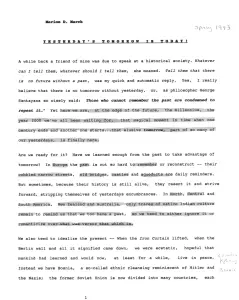
Astrology, History, Synchronicity, Evolution, and Traditional Techniques. This article serves as a reflective discourse on the evolution of astrology as the professional community approaches the turn of the millennium. Marion D. March argues that modern astrology should not entirely discard traditional wisdom in its quest to incorporate psychological insights. She highlights the necessity of balancing new, empowered approaches—which emphasize personal choice and free will—with historical techniques such as Horary and Electional astrology. March posits that true progress involves integrating the past to form the future, rather than treating ancient methods as mere fatalism.

The author discusses the shifting role of planetary archetypes, noting that as consciousness expands, our perception of planets like Saturn and Pluto evolves. She advocates for the use of Horary and Electional astrology as practical tools for empowerment, arguing that choosing an optimal moment for a venture is a demonstration of agency rather than deterministic surrender. Furthermore, she explores the broader cultural context of the 1990s, including the socio-economic impacts of technological change, the decline of rigid paradigms, and the anticipation of major outer planet transits, specifically the ingress of Uranus into Aquarius and Pluto into Sagittarius.

Issue Highlights:

Articles:
Yesterday’s Tomorrow Is Today! – Marion D. March

Discussion:
The synthesis of traditional and modern astrological techniques
The evolution of Saturn and Pluto archetypes in modern astrology
The impact of technological and societal shifts on the role of the astrologer
The philosophical divide between linear and cyclical views of time
The relevance of Electional and Horary astrology in the modern era

Chart data:
N/A

Notable contributors:
George Santayana (Philosophical context)
Carl Gustav Jung (Collective Unconscious)
Joseph Campbell (Myths and archetypes)
Steven Forest (The stigma of being an astrologer)
Christian Borup (Revival of Horary astrology)
Joan McEvers (Collaborator on Electional/Horary books)
Michel Gauquelin (Paradigm definitions)
Rob Hand (Research into old wisdom/Project Hindsight)

Astrology, Houses, Transits, Reincarnation, Eclipses, Synastry, Numerology. This 13th edition of Mercury House (April 1977) provides a comprehensive collection of astrological discussions, research notes, and reader correspondence. Key topics covered include the interpretation of Saturn in various houses, house systems and critiques of traditional vs. equal house methods, the mechanics of eclipses, chart comparison (synastry), sidereal vs. tropical numbering, and reincarnation past-life regressions mapped through natal charts. Articles explore specialized techniques such as midpoints, deciles and quintiles (minor aspects), and the application of harmonics in chart analysis. The issue also features extensive letters from subscribers detailing personal transits, planetary aspects, and astrological research anomalies.

Issue Highlights:

Articles:
Zodiacal Numbering – Jeff Jawar
Saturn in the Houses (continuation) – Dr. Robert H. Goodrich
Saturn – Marc Penfield
A Key to Relationships [The Art of Chart Comparison] Introduction – Stephen Arroyo
Eclipses (first part in a series) – Ray Merriman
Some Notes on Astrological Research – Ingrid Naiman
Reincarnation – Marc Penfield
The Zodiac of Aspects (first of a two-part series) – Glenda Tomosovich
Astrological Review of an Autobiography [Alone by Admiral Richard E. Byrd] – Prem H. Joshi
The People’s Choice…A Different View of the Next Four Years – Dr. Robert H. Goodrich

Discussion:
Saturn in the 1st and 6th houses
House systems and Gauquelin research
Horoscope of Jesus
Aspects of artistic genius and medical astrology

Chart data:
Bob Dylan
Thor Heyerdahl
OJ Simpson
Omar Sharif
Ethel Kennedy
Jerry Brown
John Dean
Neil A. Armstrong
New York Stock Exchange

Notable contributors:
Marion March (Various topics and responses)
Zip Dobyns (Birthcharts and commentary)

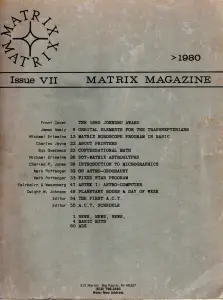
Computerized Astrology, Astrological Programming, A.C.T. Conference, Trans-Neptunian Planets. This issue of Matrix Magazine serves as a bridge between early computing technology and professional astrological practice. It focuses heavily on the technical application of microcomputers (Commodore PET, Apple II, TRS-80) to astrological research, offering BASIC programming code for chart calculations, orbital elements for Trans-Neptunian planets (Cupido, Hades, Zeus, Kronos, Apollon, Admetos, Vulkan, Poseidon), and instructions for printer-based astroglyph generation. The magazine also introduces the “ASTEK I,” a specialized astrological computer, and discusses the use of microfilm for archival astrological data storage.

Issue Highlights:
The 1980 Johndro Award is presented to Neil F. Michelsen for his pioneering work in computer-assisted ephemerides and astrological software. The issue also provides a comprehensive schedule for the first Astrological Conference on Techniques (A.C.T.) held in New Orleans, covering a wide array of research topics from planetary cycles to rectifiction methods.

Articles:
Orbital Elements for the Transneptunians – James Neely
Matrix Horoscope Program in BASIC – Michael Erlewine
Conversational Math – Buz Overbeck
Dot-Matrix Astroglyphs – Michael Erlewine
Introduction to Micrographics – Charles Paul Jones
On Astro-Geography – Mark Pottenger
Fixed Star Program – Mark Pottenger
ASTEK I: Astro-Computer – Fairbairn & Wesenberg
Planetary Hours & Day of Week – Dwight W. Johnson

Discussion:
Application of BASIC programming in natal astrology
Technical specifications and history of the ASTEK I calculator
Astro-Geography and meridian contacts
Statistical analysis of astrological data
Microfilm implementation for astrological libraries
Planetary rulers and the day of the week

Chart data:
Michael Erlewine (Born 7/18/1941, 4:03 PM EST, Lancaster, PA)

Notable contributors:
Michael Erlewine (Editor/Computing), James Neely (Orbital elements/programming), Mark Pottenger (Fixed star programming), Charles Jayne (Conference/Techniques advice), Buz Overbeck (Conversational math)

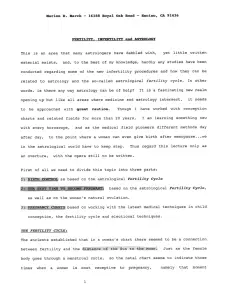
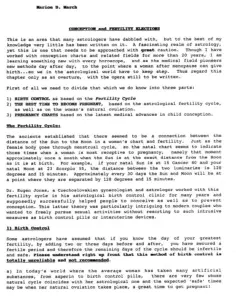
Fertility, Infertility, and Astrology, Astrological Fertility Cycle, Dr. Eugen Jonas, Birth Control, Electional Pregnancy Charts, In Vitro Fertilization, Artificial Insemination, GIFT, ZIFT. Marion D. March explores the intersection of medical procedures and astrological fertility cycles, noting that while the topic needs great caution, the astrological fertility cycle based on the Sun-Moon distance at birth can be remarkably effective for timing pregnancy. The text outlines three main divisions: birth control using the cycle (which March cautions is unreliable), determining the best time to become pregnant via personalized fertility dates and electional rules, and timing pregnancies through modern medical techniques such as artificial insemination and in-vitro fertilization.

Issue Highlights: Comprehensive lecture notes and case studies focusing on the practical application of astrological fertility cycles, detailed computer-generated fertility lists, and step-by-step chart interpretations for a client named Mindy.

Articles:
Fertility, Infertility and Astrology – Marion D. March

Discussion:
The validity and unreliability of astrological birth control
Calculating the fertility cycle based on the Sun-Moon distance from the natal chart
Using electional astrology and lunar aspects for conception and medical implantation
Correlating moon signs with the biological prediction of a baby’s gender
Applying fertility timing to modern medical procedures like IVF, GIFT, and ZIFT

Chart data:
Mikki March Andina (Michele Dia March)
Mindy’s Fertility Charts (#1, #2, #3, #3A, #4, #7, #7A)

Notable contributors:
Marion D. March (Author and Astrologer)
Dr. Eugen Jonas (Czechoslovakian gynecologist and astrologer known for his work on fertility cycles)

ELEKTIONEN

Marion D. March, Special Collections

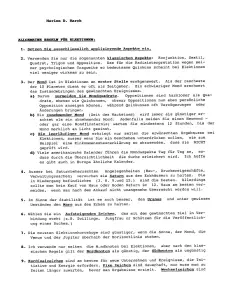
Electional Astrology, Horary vs. Electional, Rules for Marriage, Real Estate, Business Openings, and Automobile Purchases. This extensive instructional text and chart collection by renowned astrologer Marion D. March provides a comprehensive guide to Electional Astrology (Zeitwahl), detailing the foundational mechanics of selecting auspicious times for major life events. March contrasts electional astrology with horary astrology, emphasizing that while horary discovers answers from the moment a question is asked, electional proactively engineers a favorable outcome by consciously choosing the timing of an endeavor. The text systematically outlines the general rules of electional work, highlighting the paramount importance of the Moon as the fastest-moving time-giver, the avoidance of voids-of-course Moons and lunar hard aspects, the placement of the luminaries and benefics above the horizon, and the strategic positioning or restriction of malefics like Saturn, Mars, Uranus, and Pluto away from the angles (Eckhäuser). Furthermore, March offers deep philosophical insights into the psychological vs. pragmatic approaches of modern astrology, arguing that while natal and directional counseling embraces Jungian free will and therapeutic dialogue, electional charts require unvarnished, pragmatic precision to protect clients from missteps and failures. Special attention is given to the rulership systems of outer planets (Uranus, Neptune, Pluto) and their integration into modern practice, drawing on historical timelines of their discoveries coinciding with major paradigm shifts in human civilization.

Issue Highlights: Comprehensive manuals and multiple case-study charts with detailed annotations by Marion D. March covering weddings, home relocations, property acquisitions, land sales, business inaugurations, and vehicle purchases.

Articles:
Allgemeine Regeln für Elektionen – Marion D. March
Was sind Elektionen? – Marion D. March
Regeln für eine Eheschliessung – Marion D. March
Umzug in ein Haus, eine Eigentums- oder Mietwohnung – Marion D. March
Ankauf oder Verkauf von Immobilien (Haus oder Grundstücke) – Marion D. March
Gründung einer Firma oder Aktiengesellschaft – Marion D. March
Regeln für Organisationshoroskope – Rex Bill
Ankauf eines Autos – Marion D. March

Discussion:
The primacy of the Moon in electional timing and avoiding void-of-course states
The strategic management of Saturn and outer planets in angular houses
The application of the Part of Fortune (Pars Fortuna) to resolve restrictive chart configurations
Contrasting psychological natal counseling with pragmatic electional forecasting
The modern attribution of planetary rulerships for Uranus (Aquarius) and Neptune (Pisces)

Chart data:
Heirat (June 7, 1992, Los Angeles, CA)
Heirat Molly & Fred (April 7, 1974, Sherman Oaks, CA)
Heirat Jan & Robert (July 8, 1978, Wailua, Kauai, HI)
Heirat Franz & Corinne (July 13, 1990, Basel, Switzerland)
Heirat Christa & Brett (September 15, 1973, Tahoe City, NV)
Hauseinzug (December 3, 1973, Los Angeles, CA)
Apartamentseinzug (September 15, 1988, Zurich, Switzerland)
Hauskauf (January 9, 1992, San Diego, CA)
Landverkauf (March 10, 1990, Malibu, CA)
Geschaeftseroeffnung / Buchladen (June 16, 1978, New York, NY)
Restauranteroeffnung (March 1, 1983, Coeur d’Alene, ID)
Organisationshoroskop (October 28, 1975, Encino, CA)
Automobilkauf (October 1, 1983, Beverly Hills, CA)
Rolls Royce Kauf (March 15, 1989, Los Angeles, CA)

Notable contributors:
Marion D. March (Author, Astrologer, and Instructor)
Rex Bill (Author of ‘The Rulership Book’ utilized for organizational and derivative house analysis)

Electional Astrology Rules

Marion D. March, Special Collections

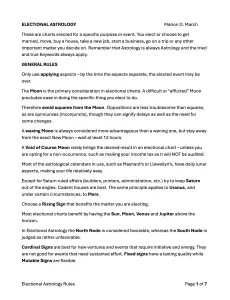
Electional Astrology, Timing Events, Natal Chart Integration. Marion D. March outlines comprehensive rules and practical guidelines for erecting and interpreting electional astrology charts for various life events. The text emphasizes that the Moon serves as the primary consideration in any electional chart, requiring careful attention to its phase, speed, aspects, and zodiacal placement while strictly avoiding squares and void of course conditions. General rules dictate the use of applying aspects, favoring waxing moons, placing benefic planets like the Sun, Moon, Venus, and Jupiter above the horizon, and utilizing appropriate rising signs and modal qualities (cardinal, fixed, mutable) tailored to the specific venture.

Issue Highlights:
Detailed breakdown of electional requirements for specific life milestones, including marriage, moving into a home, purchasing a car or real estate, initiating lawsuits, undergoing surgery, and launching a business enterprise. Each category details specific house significators, planetary placements to avoid (such as angular Saturn, Uranus, or retrograde planets), and tactical adjustments required when perfection is unattainable.

Articles:
Electional Astrology – Marion D. March

Discussion:
General electional rules and lunar considerations
Marriage timing and relationship longevity indicators
Moving into a new residence and real estate purchases
Car purchases, contracts, and mechanical safeguards
Lawsuits, plaintiffs, defendants, and winning configurations
Surgical procedures, transit moon placements, and medical timing
Business startups, corporate formations, and planetary rulers

Chart data:
N/A
N/A

Notable contributors:
Marion D. March (Electional Astrology)

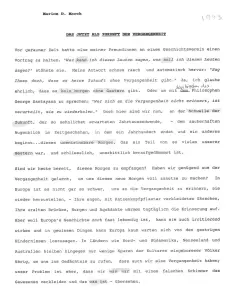
Marion D. March, Electional Astrology, Horary Astrology, Future of Astrology, Turning to the Past for Future Wisdom. In this thoughtful essay, prominent astrologer Marion D. March reflects on the transition from the 20th century into the new millennium, examining how astrologers must reclaim traditional techniques while embracing modern psychological insights. She discusses the danger of throwing out the past in pursuit of entirely modern psychological or New Age frameworks, advocating instead for a synthesis of ancient practices such as electional astrology (Zeitwahlhoroskop) and horary astrology with contemporary astrological counseling. March draws on historical milestones, societal changes in Europe and globally, and the outer planets (Uranus, Neptune, and Pluto) to chart a course for the evolution of astrology in the 21st century.

March elaborates on her personal transition toward electional astrology, noting how utilizing electional charts for film production schedules yielded tangible success and two Academy Awards for a client. She critiques the historical rejection of traditional methods and urges practitioners to overcome the stigma of fatalism. Furthermore, she explores mundane shifts, such as upcoming ingresses of Uranus and Neptune into Aquarius and Pluto into Sagittarius, linking them to cultural transformations, the re-emergence of ancient modalities like Feng-Shui and the I-Ching, and the ongoing dialogue between science, religion, and astrology.

Issue Highlights:

Articles:
Das Jetzt als Zukunft der Vergangenheit – Marion D. March

Discussion:
Integrating traditional electional and horary techniques with modern psychological astrology
The evolution of outer planet symbolism (Saturn, Uranus, Neptune, Pluto) and their sign ingresses
Overcoming public and religious skepticism towards astrology
Reclaiming ancient wisdom and cultural heritage (Feng-Shui, I-Ching) for the 21st century

Chart data:
N/A

Notable contributors:
Marion D. March (Author and Astrologer)
Christian Borup (Electional and Horary Astrology)
Steven Forrest (Discussion of astrological public reception)

Fertility Astrology, Dr. Eugen Jonas Method, Electional Charts for Conception. Marion D. March provides a detailed guide on utilizing astrological fertility cycles (pioneered by Dr. Eugen Jonas) and electional charts for determining the best times to conceive. The text covers the three main divisions: birth control based on fertility cycles, optimal times for pregnancy based on both astrological fertility cycles and natural ovulation, and pregnancy charts adapted to modern medical procedures like in-vitro fertilization. March discusses practical case studies involving clients like Mindy, Marissa, Sarah, and Jennifer, analyzing the application of lunar aspects, void-of-course moons, and planetary transits in relation to natal charts.

Issue Highlights:

Articles:
Conception and Fertility Elections – Marion D. March

Discussion:
Calculating astrological fertility cycles based on the Sun-Moon phase angle at birth
Electional chart rules for conception focusing on the Moon’s applying aspects
Aligning astrological fertility dates with modern medical fertility treatments and in-vitro procedures

Chart data:
Mindy
Marissa
Sarah
Jennifer

Notable contributors:
Marion D. March (Author and Astrologer)
Dr. Eugen Jonas (Developer of the astrological fertility and birth control cycle)

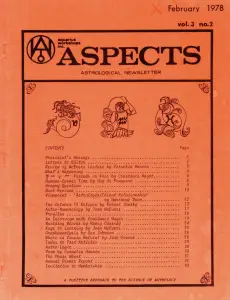
ASPECTS Vol. 3 No 2. Feb 1978

ASPECTS Magazine, Special Collections

Astrological Education, Natal Charting, and Technique Synthesis. This issue of Aspects focuses heavily on the pedagogical and professional aspects of astrology, emphasizing the “positive approach” advocated by the Aquarius Workshops organization. Key themes include the ethical responsibilities of the astrologer, the necessity of rigorous natal chart synthesis rather than superficial interpretations, and the application of astrological tools to everyday life events. The content ranges from foundational lessons for beginners to advanced discussions on eclipses, horary techniques, and speculative systems like “Humano-Cosmic Time.”

The issue provides extensive educational material, including a detailed exploration of eclipses by Robert Jansky, who characterizes them as periods of “crisis and emphasis” requiring house-based analysis. Joan McEvers contributes foundational articles on astro-numerology and chart signature assessment, while Constance Mayer offers a comparative analysis of the distinct energies of Uranus and Neptune. Additionally, the newsletter features a candid interview with Connie Mayer on the teaching and practice of astrology, emphasizing the importance of objective, non-predictive counseling that respects client free will.

Beyond theoretical discussions, the newsletter functions as a community hub, reporting on the SWAC (Southwestern Astrology Conference) and internal board business, such as membership dues and organizational bylaws. It also promotes upcoming events and publications, highlighting the ongoing effort to define and elevate the professional standards of the field through ethical conduct and informed practice.

Issue Highlights:

Articles:
Review of McEvers Lecture – Cornelia Hansen
Friends or Foes – Constance Mayer
Humano-Cosmic Time – Guy de Penguern
The October 12 Eclipse – Robert Jansky
Astro-Numerology – Joan McEvers
An Interview with Constance Mayer – Marion D. March
Building Blocks – Nancy Cassidy
Keys to Learning – Joan McEvers
Graphoanalysis – Sue Johnson
Where is Cousin Melvin? – Jean Graves
Astro-Logic – Aunt Asty (pseudonym)

Discussion:
The ethical role of the astrologer in client counseling
Application of eclipse cycles in natal prediction
Technique for “turning the house” to locate relations
Integrating astro-numerology with chart analysis

Chart data:
Capricorn Ingress Chart (Dec 21, 1977)
Horary Question Chart (July 5, 1977)

Notable contributors:
Robert Jansky (Eclipses)
Joan McEvers (Astro-numerology, teaching philosophy)
Constance Mayer (Planetary comparison)
Guy de Penguern (Humano-Cosmic Time)
Marion D. March (Interviewing & editing)

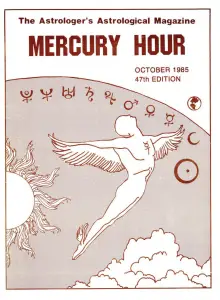
Astrological Techniques, Astrology History, and Mundane Astrology. This archival item is the October 1985 issue (47th Edition) of Mercury Hour, a quarterly magazine edited by Edith Custer and Jewell Fahey in Lynchburg, Virginia. Key contents include technical articles such as John F. Gay, III’s guide to calculating house cusps and astronomical coordinates using scientific calculators, Joan McEvers’s second installment on interpreting Lunar Returns, and Dorothy Willis’s foundational rules for astro-meteorology. Mundane and historical pieces feature Marc Penfield’s chart rectifications for Russia’s 1917 Bolshevik Revolution and the “Chart Mart” data collection, Fran Rosen’s explorations of the Kabbalistic Tree of Life and Tarot symbolism, and Gilbert Navarro’s definition of horary astrology. Additional contributions include reviews by Marion March, reports on the 7 Hills Astrological Conference, an analysis of the 1985 Bradford football stadium fire by Olivia Barclay, and reader discussions surrounding topics such as ethics, licensing, house systems, and birth data for figures like Ronald Reagan, Mikhail Gorbachev, and Mary Baker Eddy.


Issue Highlights


Book Reviews

By Marion March:

Celestial Psychology: An Astrological Guide to Growth and Transformation by Doris A. Hebel

Astrochemistry: A Study of Metal-Planet Affinities by Nick Kellerstrom

Instant Astrology by Mary Orser, Rick and Glory Brightfield

The Astrology of Deep Space by Philip Sedgwick

Spiritual Astrology: A Layperson’s Guide to Self-Unfoldment by Jan Spiller

The Practice and Profession of Astrology by Stephen Arroyo

Birth Pattern Psychology by Tamise Van Pelt

The Astrological Prayer Book by Alda Marian Jangl
Your Key to Astrology [book plus] Astrological Key Cards: Planets, Signs, Houses, Aspects by Bill Hansen – Edith Custer


Articles

Astrology and the Weather – Dorothy Willis

Lunar Return Notes, Part II – Joan McEvers

Calculation Without Tables of the Julian Day & Century, Obliquity of the Ecliptic, MC, ASC, and Houses, Part I – John F. Gay, III

The Tree of Life: An Overview – Fran Rosen

Astrological Hall of Fame Awards – Fraternity for Canadian Astrologers [2nd National Conference]

Along the Tarot Path – Fran Rosen

How I Survived my Pluto Square Pluto and Other Transits – Carol Hemingway

The Luscher Color Test, A Symbolic Testing Model – Zan Key

Observations on Astrology, Original & Borrowed – John F. Gay, III

I’m Mad at You!!!! – Mary Ellen Glass

The Horoscope of Russia – Marc Penfield

Chart Mart – Marc Penfield

A Trip Round the Hawaiian Zodiac, Part II – Cheryl Niggle

Astrology and the Weather: Forecasting the Weather, Part I – Dorothy Willis

Horary Astrology: A Definition – Gilbert Navarro

The Business Cycle, Part II – Bill Hansen

Neptune, The Collective Fantasy, and Popular Music – Amy Franco

The Mystery of the Chinese Zodiac, Now Revealed for the First Time – Frank Hampton

The Qualities of Time, Part I – Tundra Wind


Discussions

Astrology, licensure, & ethics

Quadrant house systems vs. Equal Houses

Radix-based Tarot technique

Natal location in Return chart

Birth time of Ronald Reagan

Seven Hill Astrological Conference [reports]

Mercury retrograde


Chart data

Anderson, Loni
Benetar, Haley (daughter of Pat Benetar)
Bowie, David
Eddy, Mary Baker
Eisenhower, Melanie (daughter of Julie Nixon and David Eisenhower)
Gorbachev, Mikhail
Jagger, Elizabeth (daughter of Mick Jagger and Jerri Hall)
Kennedy III Robert F.
Morgan, Vicki
Neves, Tancredo
Pace, Canio and Thomas (cross-year twins)
Reagan, Ronald
Schwab, Loluis and Leona (cross-year twins)
Spielberg, Max (son of Steven Spielberg and Amy Irving)Vaughn, Sarah

Frustaci sextuplets
Czar Nicholas II
Prince Henry

Air India 747 jetliner crash
Christian Science Church
Formation of the Soviet Union
Founding of Tel Aviv
Halley’s Comet return
Live Aid Concert 1985


Notable contributors

Joylyn Hill (Chart of Israel, chart of Robert E. Lee, the nature of Venus)

Olivia Barclay (astrological signature of fires and explosions)

Misty Kuceris (7 Hills Conference)

Robert Pelletier (7 Hills Conference)

Zane Stein (Solstice points, Sabian symbols)

Erin Sullivan (Mercury retrograde)

Michael and Margaret Erlewine (Matrix Heart Center)

Eleanor Bach (Marc Edmond Jones Award)

Lee Lehman (Kundalini and asteroid Sappho)

Ask A Librarian

Need assistance with your research or navigating our collection? Our library team is here to help.

Please fill out the form below with details about the topics, authors, or archival materials you are looking for, and one of our librarians will review your query and respond shortly.

Help

Whether you are looking for rare historical texts or trying to locate a specific book nearby, Alexandria iBase offers two primary ways to search. Here is how to choose the right tool for what you need:

The Library Catalogue

Think of this as your global master index.

The Catalogue works just like a traditional library search system, designed to help you locate books and media across the broader astrological landscape.

  • Physical Books: Find out where physical copies of books are held in libraries, archives, or collections near you.

  • Digital Files: Access downloadable or viewable digital editions when available.

  • Best Used For: Standard research, finding specific ISBNs or authors, and tracking down physical items in the real world.

Browse Catalogue

SPECIAL COLLECTIONS

Think of this as Alexandria’s exclusive private vault.

Collections gives you direct access to Alexandria’s own curated archive of rare, proprietary, and historic astrology media.

  • Exclusive Material: Features unique texts, manuscripts, audio recordings, and visual media that are not available anywhere else.

  • Direct Access: Digitized content ready to explore straight from the platform.

  • Best Used For: Deep-dive research, discovering hidden gems, and exploring rare, one-of-a-kind astrological resources.

Browse Special Collections

Cash & In-Kind Donations

Make a one-time or recurring tax deductible cash donation.

Payment options include donating directly with us, PayPal Giving and GoFundMe.

GoFundMe for Charities and PayPal Giving are registered for tax deductions and have no required processing fees. It does offer the option to tip.

Donate

*Subject to 2.5% processing fees

Contact Us

Have a question, feedback, or a inquiry about our archives? We’d love to hear from you. Please fill out the form below with your details and message, and a member of our team will get back to you as soon as possible.

Thank you for reaching out to the Alexandria iBase Project!