
Home » Cardinal

Cardinal

Cardinal is one of the three foundational chart qualities, or quadruplicities, alongside fixed and mutable, which categorizes the behavioral expression and dynamic orientation of the astrological signs. Comprising Aries, Cancer, Libra, and Capricorn, the cardinal signs align with the equinoxes and solstices, symbolizing initiation, action, leadership, and the impulse to break new ground or instigate change. In chart mechanics and natal interpretation, an emphasis or deficiency in this quality reflects an individual’s capacity for enterprise, drive, and proactive engagement with the world.

Filters

Filters


See more See less
See more See less
See more See less
See more See less
See more See less
See more See less
See more See less

Sorting

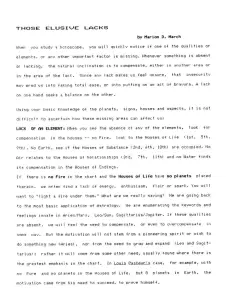
Those Elusive Lacks

Marion D. March, Special Collections

Natal Astrology, Psychological Astrology. This comprehensive article explores the phenomenon of ‘lacks’ or deficiencies in a birth chart, specifically focusing on missing elements (Fire, Earth, Air, Water), missing qualities (Cardinal, Fixed, Mutable), missing house emphases, unaspected planets, and missing aspect types. March provides a profound psychological framework where deficiencies often result in compensatory or overcompensatory behaviors, leading individuals to either struggle with or excel in those specific areas based on other configurations in their chart.

The text is heavily illustrated with examples of public figures, ranging from celebrities and politicians to historical figures and criminals, to demonstrate how a lack manifests in real life. March explains that when an element or quality is missing, the individual’s motivation often shifts to other emphasized areas of the chart, creating a dynamic of ‘faking’ or overcompensating for the perceived deficit. For example, a lack of Fire might lead to a lack of energy or enthusiasm, but an individual with such a deficiency might push themselves into the spotlight to prove their value to others.

The final sections discuss technical nuances, such as unaspected planets and specific aspect deficiencies like the lack of oppositions or squares. The author emphasizes that while these ‘lacks’ present challenges, they are rarely insurmountable; rather, they demand a different approach to internal integration and growth. A skilled astrologer, per the author, can guide clients to recognize these patterns and find healthy ways to balance their charts, thereby preventing the negative internalization or avoidance behaviors often associated with these deficiencies.

Issue Highlights:

Articles:
Those Elusive Lacks – Marion D. March

Discussion:
Compensatory mechanisms for missing elements in a chart
Psychological impacts of missing qualities (Cardinal, Fixed, Mutable)
The influence of unaspected planets on personality integration
Difficulty of life challenges for charts lacking squares or oppositions

Chart data:
Louis Pasteur, Jack Benny, Merle Oberon, Vincent Price, Hubert H. Humphrey, Fanny Brice, Zelda Fitzgerald, James Huberty, Mark Twain, Maurice Udall, Claus von Bulow, Christiaan Barnard, J. Paul Getty, Vincent van Gogh, Geraldine Ferraro, Judith Krantz, Edgar Cayce, Marlon Brando, Dustin Hoffman, Jack Nicholson, Helen Keller, Napoleon Bonaparte, Jeffrey MacDonald, Marlene Dietrich, Muhammed Ali, George Foreman, Joe Frazier, Placido Domingo, Henri Toulouse Lautrec, Ludwig van Beethoven, Bruno Hauptmann, George Braque, Barbra Streisand, Elizabeth Barrett Browning, Errol Flynn, Arturo Toscanini, Corazon Aquino, Prince Philip, Jim Jones, Bruce Springsteen, Timothy Leary, Jesse Jackson, John Belushi, Sam Goldwyn, Gary Hart, Desi Arnaz, Orson Welles, Princess Diana, Barbara Hutton, T.E. Lawrence, Linus Pauling, Prince Charles, Robyn Smith, Queen Elizabeth II, Mia Farrow, Ava Gardner, Rajiv Gandhi, Vida Blue, Vaslav Nijinsky, Maria Montessori, Mahatma Gandhi, Anwar Sadat, Art Buchwald, Jean Claude Killy, Mickey Rooney, Sammy Davis Jr., Nancy Reagan, Roald Amundsen, Rock Hudson, Robert Oppenheimer, Lena Horne, Richard Loeb, Ogden Nash, Ted Kennedy, Sally Ride, James Pike, Marvin Mitchelson, Frank Sinatra, John F. Kennedy, Nelson Rockefeller, Clint Eastwood, Ignace Paderewski, Emily Dickinson, Simone de Beauvoir, Sandra O’Connor, Keenan Wynn, Anne Morrow Lindbergh, Gertrude Stein, Beatrix of the Netherlands, John Dean, Enrico Caruso, Maurice Chevalier, Alfred Hitchcock, Stacey Keach, Princess Anne, Prince Charles, Benito Mussolini, David Bowie, Madonna, Charles Manson, Josef Goebbels, Tyrone Power, Montgomery Clift, Scott Fitzgerald, Noel Coward, Margaret Sullavan, Leslie Howard, Charles Lindbergh.

Notable contributors:
Marion D. March (Psychological interpretations of natal chart deficiencies)
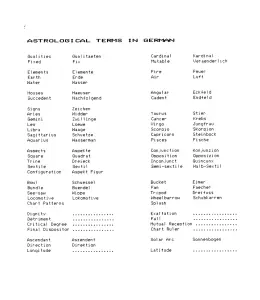
Astrology Terms German and English

Marion D. March, Special Collections

Astrological Terms in German, Qualities, Elements, Houses, Signs, Aspects, Chart Patterns, Dignities, Ascendant, Solar Arc. This document provides a comprehensive bilingual reference guide translating core astrological terminology from English into German. It covers fundamental structural components of astrology, including the zodiac qualities (Cardinal, Fixed, Mutable), elemental classifications (Fire, Earth, Air, Water), house types (Angular, Succedent, Cadent), and the complete set of twelve zodiac signs from Aries to Pisces. Furthermore, the text systematically translates major and minor aspects (Conjunction, Square, Opposition, Trine, Inconjunct, Sextile, Semi-sextile), planetary configurations, and specific Marc Jones chart patterns such as Bowl, Bundle, See-saw, Locomotive, Bucket, Fan, Tripod, Wheelbarrow, and Splash. Essential astrological conditions including dignity, detriment, exaltation, fall, critical degree, mutual reception, and final dispositor are also mapped, alongside structural chart points like the Ascendant, Direction, Longitude, Latitude, and Solar Arc (Sonnenbogen).

Issue Highlights:

Articles:
N/A – N/A

Discussion:
Translation of astrological terms from English to German
Zodiac signs, elements, and qualities in German
Aspects and chart patterns terminology

Chart data:
N/A

Notable contributors:
Marion D. March

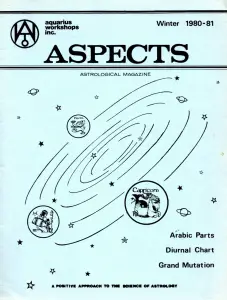
ASPECTS Vol. 6 No. 1 Winter 1980-1 Part 1/2

ASPECTS Magazine, Special Collections

Arabic Parts, Grand Mutation, Fifth House, Sextiles. This issue of Aspects astrological magazine delivers an extensive exploration of foundational and advanced astrological techniques, featuring detailed instructional breakdowns and conference updates. Robert ‘Buz’ Myers provides a comprehensive guide on calculating and interpreting ten key Arabic Parts (including the Part of Fortune, Love, Passion, Increases, Fate, Catastrophe, Treachery, and Organization) through the twelve houses and signs. Marion D. March analyzes the monumental Great Jupiter/Saturn Conjunction and the Capricorn Ingress Chart for December 1980, discussing world consciousness shifts and the transition into the Air trigon. Additionally, Lenora M. Hill examines the Diurnal (Daily) Chart, Enrique Linarés writes on the Point of Life, Joan McEvers breaks down the symbolism of the Fifth House in her ‘Keys to Learning’ series, and Nancy Cassidy details the harmonious exchange of energy found in Sextiles.

Issue Highlights: Conference reports cover SWAC 1980, the upcoming Astrology World-Congress 1981 in Zurich, and the First Metaphysical Congress. Regular columns include Letters to the Editor, President’s Message by Roberta Fueyo, What’s Happening, Book Reviews, and Lois Rodden’s Data Column.

Articles:
How to Calculate Your Arabic Parts – Robert ‘Buz’ Myers
The Great Jupiter/Saturn Conjunction – Marion D. March
The Diurnal (Daily) Chart – Lenora M. Hill
The Point of Life – Enrique Linarés
Keys to Learning: Fifth House – Joan McEvers
Building Blocks: Sextiles – Nancy Cassidy
Capricorn Ingress – Judy Johns

Discussion:
Calculation and house interpretation of Arabic Parts
Astrological shifts during the Jupiter/Saturn conjunction in Libra
Practical applications of diurnal charts and secondary progressions
Creative and psychological significations of the Fifth House
Harmonious energy exchanges through Sextile aspects

Chart data:
Capricorn Ingress Chart (December 21, 1980, Washington, D.C.)
Sample calculation chart for Arabic Parts (October 28, 1975, Encino, CA)

Notable contributors:
Robert ‘Buz’ Myers (Arabic Parts)
Marion D. March (Great Jupiter/Saturn Conjunction)
Joan McEvers (Fifth House mechanics)
Nancy Cassidy (Sextiles)
Lenora M. Hill (Diurnal Charts)

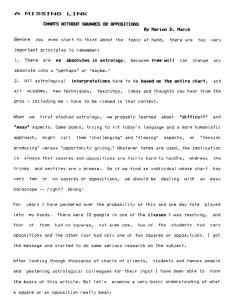
Charts Without Squares or Oppositions, Aspect Deficiencies, Natal Imbalances, Evolutionary Astrology. In this detailed astrological study titled ‘A Missing Link: Charts Without Squares or Oppositions,’ Marion D. March explores the profound implications of birth charts that lack challenging aspects like squares and oppositions. March challenges the common astrological assumption that charts devoid of hard aspects represent ‘easy’ or uncomplicated lives. Through the analysis of elemental balances, aspect patterns (such as see-saw, bowl, fan, and tripod), unaspected planets, and lacking modalities or houses, she demonstrates how individuals with squareless or oppositionless charts frequently struggle with self-awareness, conflict resolution, and internal drive. Without the natural tension of squares to prompt action or oppositions to foster awareness of the ‘other,’ natives often resort to avoidance, projection, or internalizing stress, which can manifest as chronic physical ailments, phobias, or psychological difficulties.

The text extensively examines various specific natal charts of both clients and renowned figures to illustrate how chart deficiencies manifest in real life. March analyzes how individuals compensate for missing elements, such as a lack of water, air, or earth, and how unaspected planets or single focal points in bucket patterns direct the native’s life path. She emphasizes that while progressions and transits can activate these points over time, understanding the innate lack of impetus allows astrologers to provide effective psychological and astrological guidance to help clients harness the strengths inherent in their unique configurations.

Issue Highlights:

Articles:
A Missing Link: Charts Without Squares or Oppositions – Marion D. March

Discussion:
Interpreting charts lacking squares or oppositions
The psychological impact of unaspected planets and missing elements
Using chart patterns and progressions to understand developmental crises
Case studies of famous artists, actors, and individuals navigating squareless charts

Chart data:
Chart I (Jan 31, 1919)
Chart II (Mar 7, 1921)
Georges Braque (May 9, 1882)
Chart III (Dec 3, 1918)
Margaret Sullavan (May 16, 1919)
Marlene Dietrich (Dec 27, 1901)
Chart IV (June 30, 1943)
Chart V (July 1, 1924)
Chart VI (Apr 18, 1928)
Vincent Van Gogh (Mar 30, 1853)
Fanny Brice (Oct 29, 1891)
Montgomery Clift (Oct 17, 1920)

Notable contributors:
Marion D. March (Author)

Astrology, Mercury Hour, October 1993, Edith Custer, planetary transits, horary astrology, mundane astrology, death charts, solar returns, heliocentric astrology, asteroids, fixed stars. This issue of Mercury Hour (78th Edition, October 1993), edited by Edith Custer, is a comprehensive astrological journal featuring extensive correspondence, member discussions, and in-depth technical articles. Key topics covered include the twelve-year cycle of Jupiter in Russia, prognostications using eclipse cycles and geodetic equivalents (notably predicting earthquakes in Japan), horary techniques including the judgment of theft and void-of-course moons, and psychological astrology focusing on planetary aspects such as Uranus-Neptune and Pluto’s generational influences. Contributors examine mundane charts of cities and countries, biographical data of prominent public figures, and advanced predictive methods like Diurnal charts and Sidereal Solar Returns.

Issue Highlights

The edition includes detailed book reviews of works by Wendy Hawks, Patrick Curry, and Marc Penfield. Articles range from technical instructional pieces on cardinal signs and houses, heliocentric astrology for beginners, and the mechanics of the Transpluto awakening, to political and historical mundane studies such as Russia’s Jupiter cycle and the founding dates of American cities. Personal reflections, travel anecdotes from NCGR conferences, and exhaustive subscriber correspondence make up a significant portion of the text, highlighting community engagement and collaborative astrological research.

Articles:
Russia and the Twelve-Year Cycle of Jupiter – Ted George
An Astrological Review of “Passages”, Part 4 of 6: The Rooting and Extending Passage [32-35] – Bil Tierney
Student’s Corner, Part 1 of 2 [Cardinal signs and houses] – Annibale F. Verzumo
Founding Dates [American cities], Part 2 of 3 [table] – Marc Penfield
XX Century: The New Arrival of the Christ – Ruben Jungbluth & Nora Portal
Helio for Rookies – Kaye Shinker
Predicted! Japan’s 7.8 Quake – Ann E Parker
Horary Astrology – Olivia Barclay
Birth Chart: City of Jacksonville, FL – Ted George
Autumn Equinox 1993 – Dorothy S. Willis
Introduction to M-13: Spiritual Theory, Part One – Defiance Gregg
Pluto as Power Indicator, Pluto as Generational Guide – Louise Jenkins
A Correct Prediction: The NYC Building Strike of 1991 – Robert Zoller
XXI Century: The Birth of a New Mankind – Ruben Jungbluth
[Uranus-Neptune], Part 2 of 2 – Annibale F. Verzumo
The Transpluto Awakening – Michael & Jeanne Baruch
People in the News – Marc Penfield

Discussion:
Natal ascendant of Rush Limbaugh
CapSolar (Sidereal technique) and Pluto/Moon aspects of violence
Bill Clinton birth time
Chart of Israel
Sideral calculations for Solar Returns

Chart data:
Hoover, J. Edgar
Jackson, Michael
Malcolm X (Little)
Nureyev, Rudolph
Japan earthquake July 1993

Notable contributors:
Lee Lehman (Void of Course Moon; prediction of death)
Carol Lavoie (Nostradamus computer program)
Lois Rodden (time of death charts)
Karen Christino (prediction of death)
Marion March (prediction of death)
Dorothy Kovach (20-year Presidential Curse & the Great Mutation)

ASPECTS Vol. 3 No 2. Feb 1978

ASPECTS Magazine

Astrology, Aquarius Workshops, Eclipses, Horary, Graphoanalysis, Ingress Charts, Planetary Aspects. This issue of Aspects Astrological Newsletter (Vol. 3, No. 2, February 1978) covers a wide range of advanced and beginner astrological techniques, organizational news, book reviews, and interviews. Highlights include discussions on Uranus and Neptune dynamics, the October 12 eclipse impact, the application of ingress charts for personal forecasting, astro-numerology, and graphoanalysis techniques correlating handwriting slant with emotional responsiveness.

Issue Highlights:
Features extensive reports on conferences, upcoming workshops by prominent astrologers like Isabel Hickey and Gina Ceaglio, presidential messages from Marion D. March, and detailed technical articles exploring natal chart interpretation, house systems, and predictive methods.

Articles:
Review of McEvers Lecture – Cornelia Hansen
Friends or Foes – Constance Mayer
Humano-Cosmic Time – Guy de Penguern
Horary Question – Anonymous
Viewpoint – Astrologer/Client Relationship – Marianne Dunn
The October 12 Eclipse – Robert Jansky
Astro-Numerology – Joan McEvers
An Interview with Constance Mayer – Marion D. March
Building Blocks – Nancy Cassidy
Keys to Learning – Joan McEvers
Graphoanalysis – Sue Johnson
Where is Cousin Melvin? – Jean Graves
Astro-Logic – Anonymous
The Phase Wheel – Anonymous
Annual Dinner Report – Karen McCauley

Discussion:
Using ingress charts for prognostications and personal forecasting
Comparing Uranus and Neptune symbolism and manifestations
Humano-Cosmic Time previewing system based on 11-minute 12-second zodiacal ticks per year of life
Turning the house method in horary and natal charts (‘Every house is a first house’)
The psychological and physiological impacts of solar and lunar eclipses across houses
Graphological analysis of writing slant and emotional styles (FA, AB, BC, CD, DE, E+)

Chart data:
Capricorn Ingress Chart (December 21, 1977)
Horary Chart for Marriage Question (July 5, 1977)

Notable contributors:
Joan McEvers (Ingress charts, astro-numerology, keys to learning)
Constance Mayer (Planetary comparison of Uranus and Neptune)
Robert Jansky (Eclipse analysis and book reviews)
Marianne Dunn (Client-astrologer relationship ethics)
Guy de Penguern (Humano-Cosmic Time system)
Sue Johnson (Graphoanalysis)
Nancy Cassidy (Beginner blocks on Leo)
Jean Graves (Derivative house systems)

Ask A Librarian

Need assistance with your research or navigating our collection? Our library team is here to help.

Please fill out the form below with details about the topics, authors, or archival materials you are looking for, and one of our librarians will review your query and respond shortly.

Help

Whether you are looking for rare historical texts or trying to locate a specific book nearby, Alexandria iBase offers two primary ways to search. Here is how to choose the right tool for what you need:

The Library Catalogue

Think of this as your global master index.

The Catalogue works just like a traditional library search system, designed to help you locate books and media across the broader astrological landscape.

  • Physical Books: Find out where physical copies of books are held in libraries, archives, or collections near you.

  • Digital Files: Access downloadable or viewable digital editions when available.

  • Best Used For: Standard research, finding specific ISBNs or authors, and tracking down physical items in the real world.

Browse Catalogue

SPECIAL COLLECTIONS

Think of this as Alexandria’s exclusive private vault.

Collections gives you direct access to Alexandria’s own curated archive of rare, proprietary, and historic astrology media.

  • Exclusive Material: Features unique texts, manuscripts, audio recordings, and visual media that are not available anywhere else.

  • Direct Access: Digitized content ready to explore straight from the platform.

  • Best Used For: Deep-dive research, discovering hidden gems, and exploring rare, one-of-a-kind astrological resources.

Browse Special Collections

Cash & In-Kind Donations

Make a one-time or recurring tax deductible cash donation.

Payment options include donating directly with us, PayPal Giving and GoFundMe.

GoFundMe for Charities and PayPal Giving are registered for tax deductions and have no required processing fees. It does offer the option to tip.

Donate

*Subject to 2.5% processing fees

Contact Us

Have a question, feedback, or a inquiry about our archives? We’d love to hear from you. Please fill out the form below with your details and message, and a member of our team will get back to you as soon as possible.

Thank you for reaching out to the Alexandria iBase Project!