
Home » Grand Trine

Grand Trine

A geometric configuration consisting of three celestial bodies forming a closed equilateral triangle (120° apart), typically within the same elemental triplicity. Astrological literature interprets this as a self-sustaining circuit of extreme systemic ease, innate talent, and protective flow that may paradoxically result in developmental inertia.

Filters

Filters


See more See less
See more See less
See more See less
See more See less
See more See less
See more See less
See more See less

Sorting

Heliocentric Mechanics, Astrometeorology, and Mundane Forecasting. This archival document is Issue No. 3 (Lammas / Mid Leo 1987) of the Heliogram, published by the NCGR Helio S.I.G.. The issue heavily features technical methodologies for integrating geocentric and heliocentric data, alongside rigorous mundane weather tracking. Key contributions include J. Lee Lehman’s statistical exploration of the differences between Geo Mercury (thinking) and Helio Mercury (communicating), Michael Erlewine’s structural breakdown of Helio Archetypes (Yin/Yang, Trine/T-Square), and T. Pat Davis’s mundane analysis of Senator Joseph McCarthy and Queen Elizabeth I. Additional features include Margaret Meister’s retrospective analysis of the 1947 Texas City Explosion, Dot Willis’s weather forecasting for the Autumnal Equinox and late-1987 eclipses, and a spirited debate between NCGR Research Director Michael P. Munkasey and Edith Custer regarding the astronomical logic of mixing heliocentric planets with geocentric house systems.

Issue Highlights

Articles: The Mercury Dilemma – J. Lee Lehman, Ph.D.

Helio Meditations II – Michael Erlewine

A Tribute to Zane B. Stein – T. Pat Davis

Texas City Revisited – Margaret M. Meister

Weather or Not – Dot Willis

Geo vs Helio Mars – T. Patrick Davis

Senator Joseph Raymond McCarthy – T. Pat Davis

Heliocentric: Magnitude of Influence – T. Patrick Davis

Discussions: Geocentric vs. Heliocentric Mercury dynamics The “Helio Challenge”: Debating the validity of mixing Geo houses with Helio planets The August 9, 1987 Supermoon and associated severe weather warnings Upcoming 1988 Saturn/Uranus conjunctions (Geo vs. Helio dates)

Notable contributors: J. Lee Lehman Margaret Meister Michael Erlewine T. Pat Davis Edith Custer Dot Willis Michael P. Munkasey

Chart data: Zane B. Stein Fred Astaire Jackie Gleason Giant Baby Panda Texas City Explosion (Grandcamp & High Flyer) Anita McKeown (“Calamity Jane”) Queen Elizabeth I Senator Joseph Raymond McCarthy 1988 Presidential Candidates (Richard Gebhardt, George Bush, Mario Cuomo, Michael Dukakis, Jack Kemp, Bruce Babbitt, Joseph Biden, Jesse Jackson, Paul Martin Simon)
Astrological Delineation, Chart Synthesis, Progressions, Transits, House Rulerships, Decanates, Free Will. This document provides a comprehensive, step-by-step lecture by Marion D. March on the art and discipline of thorough astrological chart delineation. March emphasizes looking beyond obvious isolated placements (like Jupiter in the 10th house or Saturn-Sun conjunctions) to uncover hidden talents, potentials, and traumas through systematic chart analysis. She outlines an initial ‘overview’ examining element/quality distribution, chart patterns (bundle, bucket, locomotive), and configurations (grand crosses, T-squares, yods). Following the overview, she details dissecting the chart starting with the ‘heart of the chart’ (the Sun by sign, house, ruler, decanate, and aspects), followed by the Moon for emotional personality, the Ascendant for outer personality, and proceeding planet-by-planet and house-by-house.

Issue Highlights:
The text further explores the synthesis of recurring traits, handling human contradictions, and integrating progressions and transits. March shares her personal technique of placing three rings around a chart: natal, secondary progressions alongside solar arcs, and slow-moving transits in the outer ring. She stresses that progressions reflect changes in inner attitude and psychological shifts, whereas transits indicate tangible outer events. Crucial astrological maxims are highlighted, notably ‘The stars impel, they do not compel’ and ‘All important events are backed by aspects, but not every aspect will bring an important event,’ reinforcing the primacy of client free will and counseling caution in rigid prediction.

Articles:
The Importance of Thorough Delineation – Marion D. March

Discussion:
Step-by-step chart delineation methodology
Utilizing the ‘overview’ for chart synthesis
Analyzing the Sun, Moon, and Ascendant
House rulers and house-to-house connections
Secondary progressions and Solar Arc directions
The interplay between transits, inner attitudes, and free will

Chart data:
Sun at 12 Gemini in the 6th house, ruled by Mercury in Cancer in the 7th house

Notable contributors:
Marion D. March (Author and Lecturer)

Grand Configurations, Stelliums, T-Squares, Grand Trines, Yods, Mystic Rectangles, Astrological Aspects, Chart Configurations, Chart Patterns. This document is a comprehensive transcript of two 1.5-hour lectures by Marion D. March, focusing on major and minor astrological configurations, aspect patterns, and how to find the highest philosophical and spiritual potential in a chart. March explores how 3 or more planets joined by aspect form a definite pattern or ‘Gestalt’ that exerts an all-pervading and powerful force in a horoscope. Detailed rules for allowable orbs are discussed, emphasizing that tighter orbs yield stronger effects. Major aspect patterns covered include the Stellium, Grand Square (Grand Cross), T-Square, Grand Trine, Kite, Inconjunct, Yod (Finger of God), Mystic Rectangle, and Grand Sextile, alongside minor configurations derived from midpoints, semi-squares, and semi-sextiles. Concrete celebrity chart examples are analyzed for each configuration: Louis Pasteur for the Stellium, Albert Schweitzer for the Fixed Grand Square, Marlon Brando for the T-Square, Angela Davis for the Grand Trine, and Walt Disney for the Yod.

Issue Highlights:

Articles:
Grand Configurations and How to Find the Highest Philosophical and Spiritual Potential in a Chart – Marion D. March

Discussion:
Stelliums and Conjunctions in the 1st House
Grand Squares across Cardinal, Fixed, and Mutable Qualities
T-Squares and the Significance of the Focal Planet and Empty Opposition
Grand Trines across Fire, Earth, Air, and Water Elements
Yods (Finger of God) and Inconjunct (Quincunx) Dynamics
Midpoint Structures and Minor Configurations

Chart data:
Louis Pasteur (12/22/1822)
Albert Schweitzer (1/14/1875)
Marlon Brando (4/3/1924)
Angela Davis (1/26/1944)
Walt Disney (12/5/1901)

Notable contributors:
Marion D. March (Author and Lecturer on Astrological Configurations)

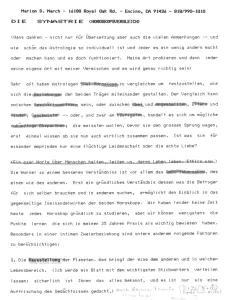
Synastry, Composite Charts, House Placements, Aspects, Midpoints. This instructional material by prominent astrologer Marion D. March covers comprehensive techniques in astrological synastry (Horoskopvergleich) and composite/midpoint charts (Schnittpunktthoroskope). The text details how to analyze house placements of planets between partners, the significance of empty houses, aspect patterns such as T-squares, Grand Crosses, Yods, and Grand Trines, as well as the karmic role of lunar nodes in relationships. Numerous celebrity examples are examined to illustrate these principles, including Prince Rainier and Grace Kelly, Richard Burton and Elizabeth Taylor, John Lennon and Yoko Ono, and Robert and Clara Schumann.

Issue Highlights:
Detailed methodology on comparing two charts, interpreting house overlays, calculating and analyzing composite/midpoint charts, and evaluating planetary configurations (Sun, Moon, Mercury, Venus, Mars, Jupiter, Saturn, Uranus, Neptune, Pluto) within partnership astrology.

Articles:
Die Synastrie (Horoskopvergleich) – Marion D. March
Schnittpunktthoroskope – Marion D. March
Haus Positionen für Synastrie – Marion D. March

Discussion:
House overlays and planetary contacts in synastry
The significance of empty houses activated by a partner
Aspect configurations (T-Square, Yod, Grand Trine, Grand Cross)
Composite and midpoint chart calculation and interpretation
Karmic connections through Lunar Nodes

Chart data:
Prince Rainier
Grace Kelly
Princess Caroline
Prince Albert
Princess Stephanie
Richard Burton
Elizabeth Taylor
John Lennon
Yoko Ono
Robert Schumann
Clara Schumann
Marilyn Monroe
Arthur Miller
Benito Mussolini
Rachele Mussolini
Adolf Hitler
Eva Braun

Notable contributors:
Marion D. March (Astrology, Synastry, and Composite Chart Methodology)

Astrology in America Today (1994)

Marion D. March, Special Collections

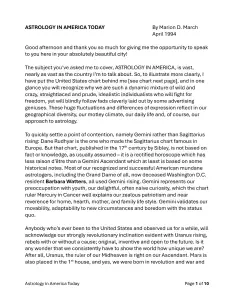
Astrology in America Today, Marion D. March, United States Chart, Gemini Ascendant, Uranian Astrology, Local Space, Project Hindsight, Lois Rodden, UAC. Marion D. March presents a comprehensive and sweeping lecture examining the state of astrology in the United States, utilizing a 7 July 1776 chart with Gemini rising and Uranus on the Ascendant as a symbolic reflection of American cultural and astrological traits. March discusses the rich eclecticism of American astrology, serving as a primary testing ground for international techniques and systems such as Midpoints, Uranian Astrology, Dr. Koch’s house systems, and composite charts from Germany, alongside Dane Rudhyar’s psychological insights from France. She details how American astrologers have championed innovations like Local Space (building on Edward Johndro, Charles Jayne, and Michael Erlewine), Heliocentric Astrology (popularized by T. Pat Davis), and Jim Lewis’s Astro*Carto*Graphy. Furthermore, she highlights the monumental work of Project Hindsight in retranslating classical texts, Lois Rodden’s monumental data collection efforts leading to the IDEA database, and the pioneering organizational frameworks of UAC (United Astrology Congress), AFAN, ISAR, and NCGR.

Issue Highlights:

Articles:
Astrology in America Today – Marion D. March

Discussion:
Debate between Gemini versus Sagittarius rising for the United States chart
The influence of computers and databases on astrological research (Lois Rodden, Edwin Steinbrecher, Michel and Françoise Gauquelin)
The professionalization of astrology and resistance to licensing
The intersection of astrology with technology, computers, and the Information Highway

Chart data:
US Chart 7 Gem ASC, July 4, 1776, 2:14 a.m. LMT, Philadelphia, PA

Notable contributors:
Marion D. March (Author / Lecturer)
Barbara Watters (Mundane astrology / Gemini rising usage)
Dane Rudhyar (Astrological philosophies and lunar phases)
Dr. Eugen Jonas (Fertility astrology)
Angel Thompson (Feng Shui and modern applications)
Michael Erlewine (Local Space mathematics and software)
T. Pat Davis (Heliocentric astrology)
Olivia Barclay, Ivy Jacobson, Joan McEvers (Horary astrology revitalization)
Jacob Schwartz (Draconic system)
Robert Hand, Robert Schmidt, Robert Zoller (Project Hindsight translation)
Jim Lewis (Astro*Carto*Graphy)
Lois Rodden (Data collection and birth data categorization)
Edwin Steinbrecher (Biographical research databases)
Neil Michelsen (Computerized ephemerides and research support)

Vesta: Keeper of the Flame (1994)

Frances McEvoy, Special Collections

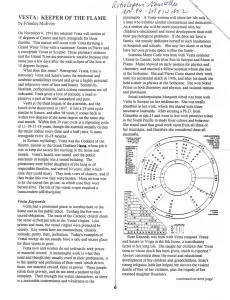
Asteroid Vesta, Grand Trine, Natal Astrological Analysis, Confinement and Solitude, Birth Data. This issue features an in-depth astrological analysis of the asteroid Vesta by Frances McEvoy, framed by Vesta’s November 1994 station at 10 degrees Cancer forming a Grand Water Trine with Saturn in Pisces and Venus in Scorpio. McEvoy explores Vesta’s 29-year cycle, its mythological roots as the Goddess of the Hearth, and its archetypal keywords such as commitment, chastity, solitude, purity, duty, perfection, and transcendent self-discipline. The article delineates how Vesta operates in both male and female charts, highlighting themes of dedicated work, privacy, and inner strength.

The study examines numerous chart examples illustrating Vesta’s impact on public service, science, art, and personal sacrifice. Detailed case studies include Marie Curie, Margaret Mead, Maria Montessori, Anne Frank, Sister Francesca Cabrini, Saint Therese of Lisieux, Queen Victoria, Grace Kelly, Jerry Brown, David Souter, Yassar Arafat, Oliver North, Angela Davis, Betty Friedan, Helen Keller, Michel Gauquelin, Bobby Fischer, and major classical composers like Bach, Mozart, Schubert, and Chopin. Themes of confinement, religious devotion, political zealotry, and intellectual immersion are thoroughly traced through Vesta’s aspects and house placements.

Additionally, Lorraine Welsh presents “The Data Base,” providing precise birth data for political candidates and public figures of the period, including Mitt Romney, Joe Malone, Paul Cellucci, and Pope John Paul II. An informational announcement for Robert Hand’s instructional classes on Traditional Western, Renaissance, and Hellenistic astrology is also included.

Issue Highlights:

Articles:
VESTA: KEEPER OF THE FLAME – Frances McEvoy
The Data Base – Lorraine Welsh

Discussion:
Vesta cycle and astronomical station patterns
Vesta in psychological, natal, and mundane astrology
Confinement, solitude, and religious devotion in chart analysis
Verified birth data for political candidates and notable figures
Instruction in Hellenistic and Renaissance traditional astrology

Chart data:
Maria Montessori
Yassar Arafat
Helen Keller
Mitt Romney
Joe Malone
Paul Cellucci
Pope John Paul II (Karol Wojtyla)

Notable contributors:
Frances McEvoy (Vesta: Keeper of the Flame)
Lorraine Welsh (The Data Base)
Robert Hand (Traditional Astrology Classes)

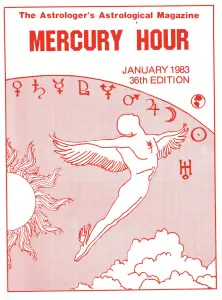
Astrology, Mercury Hour, Natal charts, Transits, Progressions, Mundane Astrology, Astro*Carto*Graphy, Chiron, Void of Course Moon, Solar Returns, Uranian astrology, Cosmobiology. This 36th Edition of Mercury Hour (January 1983), edited and published by Edith Custer, is a comprehensive astrological magazine featuring diverse correspondence, extensive theoretical and technical articles, book reviews, conference reports, and in-depth chart delineations. Key themes explored across the publication include life-stage transitions such as the ‘Catch-30’ passage and Uranus age cycles, mundane and political astrology including analyses of nuclear war threats, the Falklands crisis, and the chart of Israel, as well as technical discussions regarding software, heliocentric nodes, house systems, and the accuracy of astrological statistics (such as Gauquelin studies).

Issue Highlights:

Articles:
The Vertex – Jan Popelka
Student’s Section: A Visit to Astrologers in the U.S.A. – Ann Stevens-Patacchiola
The Catch-30 Passage: [28-32], Part III – Bil Tierney
[Uranus age cycle] Part II – Dale Huckeby
Mysterious Neptune, Part II (Marcia Moore’s chart and death) – Manik Chand Jain
Moon Void of Course in the Signs, Part I – Ted George
Is Nuclear War in Our Future? [An Astrological Call to Action] – Virginia Miller
The Pshaw Report – Jayj Jacobs
The Role of the Moon’s Nodes in World Events – Alan Richter
The New Orleans Air Crash of July 1982 – Jeff Jawer
The Effects of Saturn Transits in the Lives of the Pacific Club Members – Dona Shaw
A Royal Baby (Prince William) – Judith Gee
Determining the Winner of a Game – Sophia Mason
The Psychological Patterns of Jesus Christ – Frank Jakubowsky

Discussion:
Astro*Carto*Graphy, geodetic equivalents, and mundane predictions
Astrology hardware and software (Osborne, Astro Star, Matrix software reports)
Sunspot activity and the stock market
Gauquelin studies and statistical analysis
Lindbergh baby kidnapping and Bruno Hauptmann chart analysis
Intruder in the Queen’s Bedroom (Michael Fagan and Elizabeth II charts)
Fraternity for Canadian Astrologers 1st National Conference awards

Chart data:
August Belmont
David Crosby
Richard Dreyfuss
Michael Fagan
Andy Gibb
Bruno Hauptmann
Charley Pride
Victoria Principal
Ronald Reagan
Michael Trestrail
Israel and Partition
United Kingdom

Notable contributors:
Jim Lewis (Astro*Carto*Graphy and Ronald Reagan chart)
Jeff Jawer (First Canadian National Conference)
Barbara Watters (Grand trines and Sex and the Outer Planets)
Tracy Marks (financial compensation for astrologers)
Zane Stein (Chiron research)
Erin Sullivan (astrology of sexuality)

Ask A Librarian

Need assistance with your research or navigating our collection? Our library team is here to help.

Please fill out the form below with details about the topics, authors, or archival materials you are looking for, and one of our librarians will review your query and respond shortly.

Help

Whether you are looking for rare historical texts or trying to locate a specific book nearby, Alexandria iBase offers two primary ways to search. Here is how to choose the right tool for what you need:

The Library Catalogue

Think of this as your global master index.

The Catalogue works just like a traditional library search system, designed to help you locate books and media across the broader astrological landscape.

  • Physical Books: Find out where physical copies of books are held in libraries, archives, or collections near you.

  • Digital Files: Access downloadable or viewable digital editions when available.

  • Best Used For: Standard research, finding specific ISBNs or authors, and tracking down physical items in the real world.

Browse Catalogue

SPECIAL COLLECTIONS

Think of this as Alexandria’s exclusive private vault.

Collections gives you direct access to Alexandria’s own curated archive of rare, proprietary, and historic astrology media.

  • Exclusive Material: Features unique texts, manuscripts, audio recordings, and visual media that are not available anywhere else.

  • Direct Access: Digitized content ready to explore straight from the platform.

  • Best Used For: Deep-dive research, discovering hidden gems, and exploring rare, one-of-a-kind astrological resources.

Browse Special Collections

Cash & In-Kind Donations

Make a one-time or recurring tax deductible cash donation.

Payment options include donating directly with us, PayPal Giving and GoFundMe.

GoFundMe for Charities and PayPal Giving are registered for tax deductions and have no required processing fees. It does offer the option to tip.

Donate

*Subject to 2.5% processing fees

Contact Us

Have a question, feedback, or a inquiry about our archives? We’d love to hear from you. Please fill out the form below with your details and message, and a member of our team will get back to you as soon as possible.

Thank you for reaching out to the Alexandria iBase Project!