Home » Sun Sign

Sun Sign

Sun Sign is a fundamental concept in natal astrology that designates the specific zodiacal sign through which the Sun was transiting at the exact moment of an individual’s birth. Based upon the apparent annual path of the Sun along the ecliptic, this placement serves as the cornerstone of popular astrological identity, representing the core ego, vital life force, and conscious will of the native. Within comprehensive chart interpretation, the Sun Sign acts as the primary focal point for understanding a person’s fundamental vitality and conscious self-expression, though it must be synthesized with other chart mechanics such as the Ascendant and lunar placement for a complete psychological portrait.

Filters

Filters


See more See less
See more See less
See more See less
See more See less
See more See less
See more See less
See more See less

Sorting

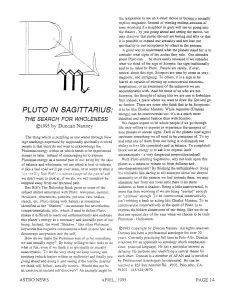
Pluto, Sagittarius, Shadow-self, Integration, Wholeness, Psychological Astrology. The text explores the psychological integration of Plutonian energy, challenging the tendency within New Age circles to shun “dark” planetary influences. Duncan Nanney argues that by suppressing the shadow aspects of our psyche—those associated with taboos, intense emotions, and the unknown—we impede our potential for genuine wholeness and spiritual balance. By embracing these darker facets consciously, we avoid the unconscious manifestation of destructive energies, reframing the “shadow” as an essential component of human experience rather than a force to be feared.

The article specifically addresses the transition of Pluto into Sagittarius during 1995. Nanney posits that rather than seeking to eliminate fear or controversy from our lives, we should constructively express these deep-seated needs. Using the example of Scorpio to illustrate how society projects traits onto signs, the author highlights the necessity of confronting our “unthinkable” impulses to avoid living a one-dimensional, stunted existence. The ultimate message is that personal evolution requires the active integration of all planetary energies into the conscious self.

Issue Highlights:

Articles:
Pluto in Sagittarius: The Search for Wholeness – Duncan Nanney

Discussion:
Psychological integration of the shadow self
The role of taboo and controversy in personal growth
The transition of Pluto into Sagittarius and its collective implications

Chart data:
N/A

Notable contributors:
Duncan Nanney (Astrological counseling, integration of shadow energy)

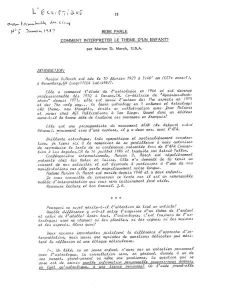
Child astrology, natal interpretation, family dynamics, birth charts. This article by Marion D. March explores the unique methodology and ethical considerations required when interpreting the astrological birth chart of a child or baby. Unlike adult consultations, child astrology involves communicating with parents or third parties regarding potential, hereditary factors, and the environment without dictating a fixed destiny. March discusses the importance of looking at squares and oppositions as potential for growth, analyzes planetary signatures, elements, and house placements, and presents several detailed case studies with charts including Mikki, Bolly, Prince William, Tina, and Linda.

Issue Highlights:

Articles:
Comment interpreter le theme d’un enfant? – Marion D. March

Discussion:
Interpreting children’s natal charts
Ethical considerations in parental consultations
The role of hard aspects (squares and oppositions) in childhood development
The influence of family environment and heredity on natal potential

Chart data:
Mikki (March 6, 1951, Los Angeles, CA)
Bolly (July 10, 1977, Zurich, Switzerland)
Prince William of England (June 21, 1982, London, UK)
Tina (June 3, 1974, Phoenix, AZ)
Linda (August 5, 1951, Buffalo, NY)

Notable contributors:
Marion D. March (Author and international lecturer on child astrology and psychological approaches)

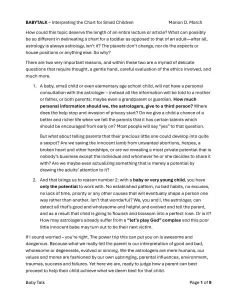
Child Astrology, Ethics in Consultation, Chart Interpretation for Toddlers and Youths. Marion D. March explores the profound ethical and practical responsibilities involved when astrologers delineate charts for infants, toddlers, and small children. Rather than consulting directly with the individual, the astrologer speaks to parents, guardians, or grandparents, raising critical questions regarding privacy, potential versus actualization, and the danger of falling into a “let’s play God” complex. March stresses that a child’s chart reveals potential, not a fixed destiny, and warns against imposing the astrologer’s or parents’ personal biases upon the developing mind. The text examines the psychological value of stress and squares in a chart as crucial catalysts for personal growth, resilience, and independence rather than purely negative omens.

Issue Highlights:
Detailed chart delineations for several children (Mikki, Bolly, Tina, and Linda), alongside the royal chart of Prince William of England, demonstrating how similar ascendants (such as Sagittarius) manifest entirely different personalities based on planetary configurations, aspects, and family dynamics. March also details her personal practice methodology, including client data sheets, recording sessions, and written addendums for young children.

Articles:
BABYTALK – Interpreting the Chart for Small Children – Marion D. March

Discussion:
Ethics of third-party consultations and child privacy
The psychological function of squares and stress in personal development
Yods, T-squares, and mutual reception in youth horoscopes
Evaluating sibling dynamics and birth timing through transits and progressions
Cultural, ethnic, and religious backgrounds affecting child-rearing expectations
Astrological indicators for legal careers, communication talents, and artistic inclinations

Chart data:
Mikki 
Bolly
Prince William of England
Tina 
Linda

Notable contributors:
Marion D. March (Author and Astrologer)

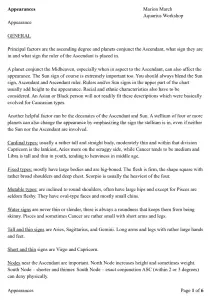
Physical Astrology, Natal Astrology, Physiognomy. This document provides a foundational guide to determining physical appearance through natal astrology, focusing on the Ascendant (rising sign), the ruler of the Ascendant, and planets conjunct the Ascendant or Midheaven. Marion March outlines a methodology that blends these factors with the Sun sign and decanates to synthesize a person’s physical description. The guide specifically cautions that these interpretations are based on Caucasian physiological traits and may need adjustment for different ethnic backgrounds. The text categorizes the zodiac signs into modalities (Cardinal, Fixed, Mutable) and elements (Water signs) to offer generalized physical traits, while also noting how planetary aspects—such as the Lunar Nodes, Saturn, and Jupiter—further modify one’s physical stature, weight, and features.

Issue Highlights:

Articles:
Appearances – Marion March

Discussion:
Methods for determining physical appearance from natal charts.
The role of Ascendant rulers and decanates in physical expression.
Influence of modality types (Cardinal, Fixed, Mutable) on body structure.

Chart data:
Marilyn Monroe, John Kennedy, Natalie Wood, Princess Diana, Jacqueline Susann, Alan Alda, Jim Morrison, Robert Redford, Barbra Streisand, Pearl Bailey, Gregory Peck, Judy Garland, Pablo Picasso, Sissy Spacek, Rock Hudson, Ed Asner, Linda Ronstadt, Sophia Loren, Errol Flynn, Gwen Verdon

Notable contributors:
Marion March (Physical Astrology)

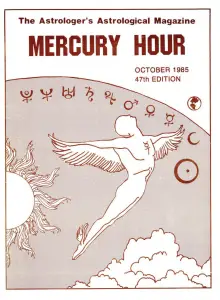
Astrological Techniques, Astrology History, and Mundane Astrology. This archival item is the October 1985 issue (47th Edition) of Mercury Hour, a quarterly magazine edited by Edith Custer and Jewell Fahey in Lynchburg, Virginia. Key contents include technical articles such as John F. Gay, III’s guide to calculating house cusps and astronomical coordinates using scientific calculators, Joan McEvers’s second installment on interpreting Lunar Returns, and Dorothy Willis’s foundational rules for astro-meteorology. Mundane and historical pieces feature Marc Penfield’s chart rectifications for Russia’s 1917 Bolshevik Revolution and the “Chart Mart” data collection, Fran Rosen’s explorations of the Kabbalistic Tree of Life and Tarot symbolism, and Gilbert Navarro’s definition of horary astrology. Additional contributions include reviews by Marion March, reports on the 7 Hills Astrological Conference, an analysis of the 1985 Bradford football stadium fire by Olivia Barclay, and reader discussions surrounding topics such as ethics, licensing, house systems, and birth data for figures like Ronald Reagan, Mikhail Gorbachev, and Mary Baker Eddy.


Issue Highlights


Book Reviews

By Marion March:

Celestial Psychology: An Astrological Guide to Growth and Transformation by Doris A. Hebel

Astrochemistry: A Study of Metal-Planet Affinities by Nick Kellerstrom

Instant Astrology by Mary Orser, Rick and Glory Brightfield

The Astrology of Deep Space by Philip Sedgwick

Spiritual Astrology: A Layperson’s Guide to Self-Unfoldment by Jan Spiller

The Practice and Profession of Astrology by Stephen Arroyo

Birth Pattern Psychology by Tamise Van Pelt

The Astrological Prayer Book by Alda Marian Jangl
Your Key to Astrology [book plus] Astrological Key Cards: Planets, Signs, Houses, Aspects by Bill Hansen – Edith Custer


Articles

Astrology and the Weather – Dorothy Willis

Lunar Return Notes, Part II – Joan McEvers

Calculation Without Tables of the Julian Day & Century, Obliquity of the Ecliptic, MC, ASC, and Houses, Part I – John F. Gay, III

The Tree of Life: An Overview – Fran Rosen

Astrological Hall of Fame Awards – Fraternity for Canadian Astrologers [2nd National Conference]

Along the Tarot Path – Fran Rosen

How I Survived my Pluto Square Pluto and Other Transits – Carol Hemingway

The Luscher Color Test, A Symbolic Testing Model – Zan Key

Observations on Astrology, Original & Borrowed – John F. Gay, III

I’m Mad at You!!!! – Mary Ellen Glass

The Horoscope of Russia – Marc Penfield

Chart Mart – Marc Penfield

A Trip Round the Hawaiian Zodiac, Part II – Cheryl Niggle

Astrology and the Weather: Forecasting the Weather, Part I – Dorothy Willis

Horary Astrology: A Definition – Gilbert Navarro

The Business Cycle, Part II – Bill Hansen

Neptune, The Collective Fantasy, and Popular Music – Amy Franco

The Mystery of the Chinese Zodiac, Now Revealed for the First Time – Frank Hampton

The Qualities of Time, Part I – Tundra Wind


Discussions

Astrology, licensure, & ethics

Quadrant house systems vs. Equal Houses

Radix-based Tarot technique

Natal location in Return chart

Birth time of Ronald Reagan

Seven Hill Astrological Conference [reports]

Mercury retrograde


Chart data

Anderson, Loni
Benetar, Haley (daughter of Pat Benetar)
Bowie, David
Eddy, Mary Baker
Eisenhower, Melanie (daughter of Julie Nixon and David Eisenhower)
Gorbachev, Mikhail
Jagger, Elizabeth (daughter of Mick Jagger and Jerri Hall)
Kennedy III Robert F.
Morgan, Vicki
Neves, Tancredo
Pace, Canio and Thomas (cross-year twins)
Reagan, Ronald
Schwab, Loluis and Leona (cross-year twins)
Spielberg, Max (son of Steven Spielberg and Amy Irving)Vaughn, Sarah

Frustaci sextuplets
Czar Nicholas II
Prince Henry

Air India 747 jetliner crash
Christian Science Church
Formation of the Soviet Union
Founding of Tel Aviv
Halley’s Comet return
Live Aid Concert 1985


Notable contributors

Joylyn Hill (Chart of Israel, chart of Robert E. Lee, the nature of Venus)

Olivia Barclay (astrological signature of fires and explosions)

Misty Kuceris (7 Hills Conference)

Robert Pelletier (7 Hills Conference)

Zane Stein (Solstice points, Sabian symbols)

Erin Sullivan (Mercury retrograde)

Michael and Margaret Erlewine (Matrix Heart Center)

Eleanor Bach (Marc Edmond Jones Award)

Lee Lehman (Kundalini and asteroid Sappho)
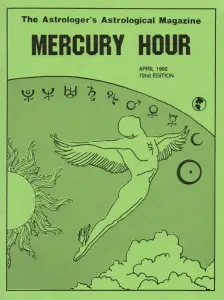
Astrology, Horary, House Systems, Synastry, and Transits. This edition of Mercury Hour features extensive reader discussions and technical articles covering various astrological branches. Topics include an exploration of planetary speeds and Kepler’s theories by Donald E. Byrne, declination and out-of-bounds planets by Gilbert Navarro, synastry and musical charts comparing John Lennon, Paul McCartney, Richard Nixon, and Yoko Ono by Dianne Lawson, as well as a concluding critique of the Koch House System by M. J. Makransky. Additional articles cover astrolocality mapping variants, Russian history and charts by Annibale F. Verzumo, Vernal Equinox charts, I Ching trigrams, and book reviews covering computer software, house development, and planetary stations.

Issue Highlights:

Articles:
Where is Vulcan & Nemesis? Part I – Donald E. Byrne
John Lennon and Paul McCartney, Richard Nixon, and Yoko Ono – Dianne Lawson
The Last Word on the Koch House System and Further Critique of the Koch House System, Part II, Conclusion – M. J. Makransky
Precession of the Equinox – Donald E. Byrne
How to Make Astrology Pay From A-Z, Part II, Conclusion – Adze Mixxe
Variant Forms of Astrolocality Mapping, Part I – M. J. Makransky
[Russia] Part III, Conclusion – Annibale F. Verzumo
Vernal Equinox March 20, 1992 – Dorothy S. Willis
Corrections: The Book of World Horoscopes – Nicholas Campion
I Ching: The Trigrams-Fu Hai Arrangement – Dorothy J. Sarka

Discussion:
Transpluto/Pluto Square 1991 – 1993
December 21, 1991 lunar eclipse
Secondary progressions
CSICOP and Humanistic astrology
Antichrist and Judgement Day discussions
Gulf War charts and Horary missing articles

Chart data:
Bill Clinton
Paul Keating
John Lennon
Paul McCartney
Richard Nixon
Yoko Ono
Paul Tsongas

Notable contributors:
Marion March (problematic astrological terminology)
Gilbert Navarro (declination)
Lee Lehman (humanism and CSICOP)
Diana Rosenberg (Jeffrey Dahmer chart)
Edith Custer (defending astrology)

Ask A Librarian

Need assistance with your research or navigating our collection? Our library team is here to help.

Please fill out the form below with details about the topics, authors, or archival materials you are looking for, and one of our librarians will review your query and respond shortly.

Help

Whether you are looking for rare historical texts or trying to locate a specific book nearby, Alexandria iBase offers two primary ways to search. Here is how to choose the right tool for what you need:

The Library Catalogue

Think of this as your global master index.

The Catalogue works just like a traditional library search system, designed to help you locate books and media across the broader astrological landscape.

  • Physical Books: Find out where physical copies of books are held in libraries, archives, or collections near you.

  • Digital Files: Access downloadable or viewable digital editions when available.

  • Best Used For: Standard research, finding specific ISBNs or authors, and tracking down physical items in the real world.

Browse Catalogue

SPECIAL COLLECTIONS

Think of this as Alexandria’s exclusive private vault.

Collections gives you direct access to Alexandria’s own curated archive of rare, proprietary, and historic astrology media.

  • Exclusive Material: Features unique texts, manuscripts, audio recordings, and visual media that are not available anywhere else.

  • Direct Access: Digitized content ready to explore straight from the platform.

  • Best Used For: Deep-dive research, discovering hidden gems, and exploring rare, one-of-a-kind astrological resources.

Browse Special Collections

Cash & In-Kind Donations

Make a one-time or recurring tax deductible cash donation.

Payment options include donating directly with us, PayPal Giving and GoFundMe.

GoFundMe for Charities and PayPal Giving are registered for tax deductions and have no required processing fees. It does offer the option to tip.

Donate

*Subject to 2.5% processing fees

Contact Us

Have a question, feedback, or a inquiry about our archives? We’d love to hear from you. Please fill out the form below with your details and message, and a member of our team will get back to you as soon as possible.

Thank you for reaching out to the Alexandria iBase Project!