
Home » Joan McEvers

Joan McEvers

Filters

Filters


See more See less
See more See less
See more See less
See more See less
See more See less
See more See less
See more See less

Sorting

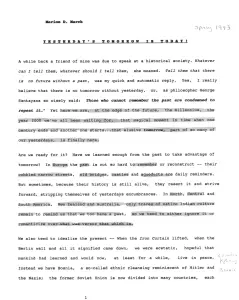
Astrology, History, Synchronicity, Evolution, and Traditional Techniques. This article serves as a reflective discourse on the evolution of astrology as the professional community approaches the turn of the millennium. Marion D. March argues that modern astrology should not entirely discard traditional wisdom in its quest to incorporate psychological insights. She highlights the necessity of balancing new, empowered approaches—which emphasize personal choice and free will—with historical techniques such as Horary and Electional astrology. March posits that true progress involves integrating the past to form the future, rather than treating ancient methods as mere fatalism.

The author discusses the shifting role of planetary archetypes, noting that as consciousness expands, our perception of planets like Saturn and Pluto evolves. She advocates for the use of Horary and Electional astrology as practical tools for empowerment, arguing that choosing an optimal moment for a venture is a demonstration of agency rather than deterministic surrender. Furthermore, she explores the broader cultural context of the 1990s, including the socio-economic impacts of technological change, the decline of rigid paradigms, and the anticipation of major outer planet transits, specifically the ingress of Uranus into Aquarius and Pluto into Sagittarius.

Issue Highlights:

Articles:
Yesterday’s Tomorrow Is Today! – Marion D. March

Discussion:
The synthesis of traditional and modern astrological techniques
The evolution of Saturn and Pluto archetypes in modern astrology
The impact of technological and societal shifts on the role of the astrologer
The philosophical divide between linear and cyclical views of time
The relevance of Electional and Horary astrology in the modern era

Chart data:
N/A

Notable contributors:
George Santayana (Philosophical context)
Carl Gustav Jung (Collective Unconscious)
Joseph Campbell (Myths and archetypes)
Steven Forest (The stigma of being an astrologer)
Christian Borup (Revival of Horary astrology)
Joan McEvers (Collaborator on Electional/Horary books)
Michel Gauquelin (Paradigm definitions)
Rob Hand (Research into old wisdom/Project Hindsight)
The Many Faces of Pluto (ca. 1983)

Marion D. March, Special Collections

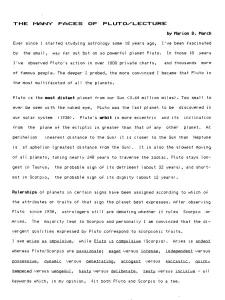
Pluto, Astrology, Mythology, Generational Planets, House Placements, Transits. This extensive lecture by Marion D. March explores the multifaceted nature of Pluto in astrology, detailing its astronomical uniqueness, diverse historical glyphs, and deep roots in Greek and Roman mythology. The text covers Pluto’s manifestations through wealth, the unseen, sexuality, power, and transformation, bridging ancient archetypes with modern psychological and mundane astrology. Special attention is given to the collective unconscious as viewed through outer planets, alongside practical examples of Pluto transits and its placement through the twelve houses and zodiac signs.

Issue Highlights:
The Many Faces of Pluto / Lecture – Marion D. March

Articles:
The Many Faces of Pluto/Lecture – Marion D. March
Mythologisches – Fritz Gehre

Discussion:
Pluto’s astronomical characteristics and orbital peculiarities
Debates on Pluto’s rulership (Scorpio vs. Aries)
Historical analysis of Pluto’s glyphs and mythological origins (Hades, Persephone, Tantalus)
Pluto’s connection to atomic energy, plutonium, and the collective unconscious
Pluto through the twelve houses and signs of the zodiac

Chart data:
Gov. Brown
H. Kissinger
George Sand
Goethe
J.P. Getty
R. Browning
C. Jung
Robert Kennedy
W. Churchill
Lee Bailey
Krishnamurti
Charles Manson
Angela Davis
Edgar Bergen
Louis Pasteur
Earl Warren
Spencer Tracy
B. Baruch
Adelle Davis
Oliver Wendell Holmes
Emerson
Ted Kennedy
Gandhi
Gershwin
Charles Lindberg
de Gaulle
Hitler
Jackie Onassis
Isabel Hickey
Nelson Rockefeller
F.D. Roosevelt
Thomas Mann
Tallulah Bankhead
Karl Marx
Richard Nixon
Sigmund Freud
Ernest Hemingway
Pablo Picasso
Lyndon Johnson
Albert Einstein
Mme. Curie
Marilyn Monroe
Patty Hearst
Muhammad Ali
Dr. Charles Mayo

Notable contributors:
Marion D. March (Author and Astrologer)
Isabel Hickey (Astrology and Symbolism)
Liz Greene (Outer Planets and Collective Unconscious)
Fritz Gehre (Mythology)

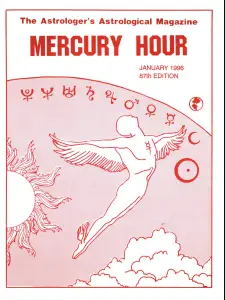
Mundane Astrology, Medical Astrology, and Predictive Astrology. This archival document is the 87th edition of Mercury Hour (January 1996), an astrological community journal edited and published by Edith Custer. The issue features articles, research notes, chart rectifications, software developments, and correspondence among practicing astrologers, including Bil Tierney’s psychological examination of Jupiter, Ed Dearborn’s technical breakdown of the “Translation of Light”, Valerie Vaughan’s defense of predictive astrology, Byron Ross Wahl’s analysis of the Solar Apex Synthetic Method (SASM), and the final installment of Robert “Buz” Myers’ lecture series on Moon-Saturn dynamics. Additionally, the journal covers mundane and political analyses of the O.J. Simpson verdict by John Kalus and Marion March, national chart rectifications for Washington, D.C. by Marc Penfield, insights on Uranus entering Aquarius by Kaye Shinker, medical and genetic commentary by T. Patrick Davis, software updates by Mark Pottenger, and tributes to astrologer Al H. Morrison.

Issue Highlights

Book Reviews
By Edith Custer:
Llewellyn’s 1996 Astrological Pocket Planner
Llewellyn’s Astrological Calendar 1996
Astrology Really Works by The Magi Society – Marc Penfield

Articles
A Look at Jupiter’s Shortcomings – Bil Tierney
Translation of Light – Ed Dearborn
Group Dynamics – Mary K. Creasey
Been There, Done That – Kaye Shinker
[O.J. Simpson verdict] – John Kalus
SASM, Columbus, and Samana Cay – Byron Ross Wahl
1995 Oven Saga – Roberta Strain
Moon/Saturn, Parts 7 and 8 of 8 – Robert “Buz” Myers
Winter Solstice 1995 – Dot Willis
The Art of Self-Defense: Lesson, Fighting at the Level of Your Opponent,
Part 1 of 2 – Valerie Vaughn
Al H. Morrison: Rectification, Poison Data, Genetics – T. Patrick Davis
[obituary & excerpts]
Discussions
Solar returns
O, J, Simpson trial
Chart data
(some incomplete or in question)
Powell, Colin
Washington, D.C.
Notable contributors
Donna Van Toen (various topics)
Mark Pottenger (Progressed MC techniques in software)
Marc Penfield (Chart of the U.S.A.)
Lee Lehman (corrections to Essential Dignities)
Marion March (O. J. Simpson trial, Chaos Theory, Solar Returns)

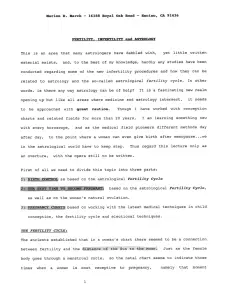
Fertility, Infertility, and Astrology, Astrological Fertility Cycle, Dr. Eugen Jonas, Birth Control, Electional Pregnancy Charts, In Vitro Fertilization, Artificial Insemination, GIFT, ZIFT. Marion D. March explores the intersection of medical procedures and astrological fertility cycles, noting that while the topic needs great caution, the astrological fertility cycle based on the Sun-Moon distance at birth can be remarkably effective for timing pregnancy. The text outlines three main divisions: birth control using the cycle (which March cautions is unreliable), determining the best time to become pregnant via personalized fertility dates and electional rules, and timing pregnancies through modern medical techniques such as artificial insemination and in-vitro fertilization.

Issue Highlights: Comprehensive lecture notes and case studies focusing on the practical application of astrological fertility cycles, detailed computer-generated fertility lists, and step-by-step chart interpretations for a client named Mindy.

Articles:
Fertility, Infertility and Astrology – Marion D. March

Discussion:
The validity and unreliability of astrological birth control
Calculating the fertility cycle based on the Sun-Moon distance from the natal chart
Using electional astrology and lunar aspects for conception and medical implantation
Correlating moon signs with the biological prediction of a baby’s gender
Applying fertility timing to modern medical procedures like IVF, GIFT, and ZIFT

Chart data:
Mikki March Andina (Michele Dia March)
Mindy’s Fertility Charts (#1, #2, #3, #3A, #4, #7, #7A)

Notable contributors:
Marion D. March (Author and Astrologer)
Dr. Eugen Jonas (Czechoslovakian gynecologist and astrologer known for his work on fertility cycles)

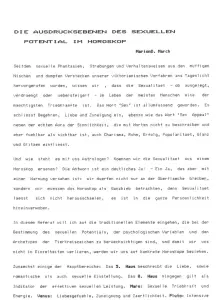
Sexual Potential in the Horoscope, Psychological Variables, Archetypes, Astrological Indicators of Sexuality. This detailed astrological lecture and analysis by Marion D. March explores the expressions of sexual potential within the natal chart, moving beyond surface interpretations to analyze the whole personality. March examines the fundamental meanings of the 5th and 8th houses, planetary influences (Mars, Venus, Pluto, Neptune, Uranus, Mercury, Saturn, Jupiter, Sun, and Moon), and mythological underpinnings such as the archetypes of Venus/Aphrodite, Mars/Ares, and Pluto/Hades. The text features in-depth case studies and natal chart analyses of prominent figures including Marilyn Monroe, Xaviera Hollander, David Bowie, Richard Pryor, Frank Sinatra, Marlene Dietrich, Tennessee Williams, and Gertrude Stein, illustrating how complex configurations, T-squares, and planetary combinations manifest in intimate lives, sexual expression, and public images. Additionally, the lecture addresses homosexuality and bisexuality through astrological indicators and includes a lighthearted numerological ‘Astro-test’ by G.G. Stoctay, PhD, to score sex drive based on planetary placements.

Issue Highlights:
Detailed exploration of sexual dynamics, house significators (5th and 8th houses), planetary aspects relating to intimacy and drive, mythological context of sexual archetypes, and extensive chart examples of celebrities.

Articles:
Die Ausdrucksebenen des sexuellen Potential im Horoskop – Marion D. March

Discussion:
The 5th House and romantic/sexual attitude
The 8th House as an indicator of effective sexual performance
Planetary significators of sex drive, intimacy, and fantasy (Mars, Venus, Pluto, Neptune, Uranus)
Mythological roots of Venus, Mars, and Pluto
Astrological indicators of homosexuality and bisexuality
Case studies of celebrities and their complex psychological and sexual configurations
Stoctay’s Astro-test for evaluating the strength of the sex drive

Chart data:
Marilyn Monroe
Xaviera Hollander
David Bowie
Richard Pryor
Frank Sinatra
Marlene Dietrich
Thomas Lanier ‘Tennessee’ Williams
Gertrude Stein

Notable contributors:
Marion D. March (Author)
Joan McEvers (Co-creator/Chart source reference)
G.G. Stoctay (Astro-test creator)

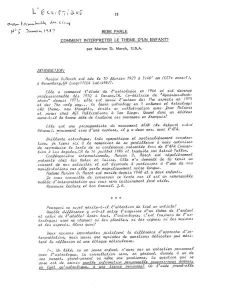
Child astrology, natal interpretation, family dynamics, birth charts. This article by Marion D. March explores the unique methodology and ethical considerations required when interpreting the astrological birth chart of a child or baby. Unlike adult consultations, child astrology involves communicating with parents or third parties regarding potential, hereditary factors, and the environment without dictating a fixed destiny. March discusses the importance of looking at squares and oppositions as potential for growth, analyzes planetary signatures, elements, and house placements, and presents several detailed case studies with charts including Mikki, Bolly, Prince William, Tina, and Linda.

Issue Highlights:

Articles:
Comment interpreter le theme d’un enfant? – Marion D. March

Discussion:
Interpreting children’s natal charts
Ethical considerations in parental consultations
The role of hard aspects (squares and oppositions) in childhood development
The influence of family environment and heredity on natal potential

Chart data:
Mikki (March 6, 1951, Los Angeles, CA)
Bolly (July 10, 1977, Zurich, Switzerland)
Prince William of England (June 21, 1982, London, UK)
Tina (June 3, 1974, Phoenix, AZ)
Linda (August 5, 1951, Buffalo, NY)

Notable contributors:
Marion D. March (Author and international lecturer on child astrology and psychological approaches)

Astrology in America Today (1994)

Marion D. March, Special Collections

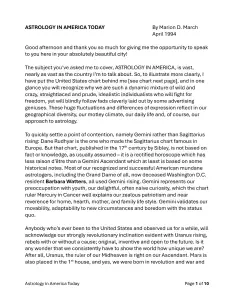
Astrology in America Today, Marion D. March, United States Chart, Gemini Ascendant, Uranian Astrology, Local Space, Project Hindsight, Lois Rodden, UAC. Marion D. March presents a comprehensive and sweeping lecture examining the state of astrology in the United States, utilizing a 7 July 1776 chart with Gemini rising and Uranus on the Ascendant as a symbolic reflection of American cultural and astrological traits. March discusses the rich eclecticism of American astrology, serving as a primary testing ground for international techniques and systems such as Midpoints, Uranian Astrology, Dr. Koch’s house systems, and composite charts from Germany, alongside Dane Rudhyar’s psychological insights from France. She details how American astrologers have championed innovations like Local Space (building on Edward Johndro, Charles Jayne, and Michael Erlewine), Heliocentric Astrology (popularized by T. Pat Davis), and Jim Lewis’s Astro*Carto*Graphy. Furthermore, she highlights the monumental work of Project Hindsight in retranslating classical texts, Lois Rodden’s monumental data collection efforts leading to the IDEA database, and the pioneering organizational frameworks of UAC (United Astrology Congress), AFAN, ISAR, and NCGR.

Issue Highlights:

Articles:
Astrology in America Today – Marion D. March

Discussion:
Debate between Gemini versus Sagittarius rising for the United States chart
The influence of computers and databases on astrological research (Lois Rodden, Edwin Steinbrecher, Michel and Françoise Gauquelin)
The professionalization of astrology and resistance to licensing
The intersection of astrology with technology, computers, and the Information Highway

Chart data:
US Chart 7 Gem ASC, July 4, 1776, 2:14 a.m. LMT, Philadelphia, PA

Notable contributors:
Marion D. March (Author / Lecturer)
Barbara Watters (Mundane astrology / Gemini rising usage)
Dane Rudhyar (Astrological philosophies and lunar phases)
Dr. Eugen Jonas (Fertility astrology)
Angel Thompson (Feng Shui and modern applications)
Michael Erlewine (Local Space mathematics and software)
T. Pat Davis (Heliocentric astrology)
Olivia Barclay, Ivy Jacobson, Joan McEvers (Horary astrology revitalization)
Jacob Schwartz (Draconic system)
Robert Hand, Robert Schmidt, Robert Zoller (Project Hindsight translation)
Jim Lewis (Astro*Carto*Graphy)
Lois Rodden (Data collection and birth data categorization)
Edwin Steinbrecher (Biographical research databases)
Neil Michelsen (Computerized ephemerides and research support)

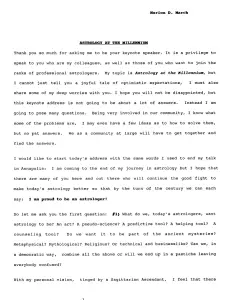
Professionalism, Astrological Standards, Millennium, Cultural Integration. Marion D. March delivers a passionate and challenging keynote address focusing on the state of astrology as the 20th century draws to a close. She raises eleven critical questions regarding the identity, reputation, standards, and future of astrology in a rapidly changing world. March examines external criticisms from scientists like Richard Dawkins, legal and financial controversies, the need for standardized training and testing akin to acupuncture and psychology, and the internal politics of major astrological organizations such as AFA, AFAN, ISAR, and NCGR. She highlights positive milestones including UAC faculty compensation, improved literature, computer advancements, financial research by Arch Crawford and Ray Merriman, the Gauquelins’ statistical research, Project Hindsight, and the unifying power of the Internet.

Issue Highlights:
A keynote address exploring the evolution of astrology, the necessity of professional standards, overcoming poverty consciousness among astrologers, and navigating technological and societal seachanges toward the new millennium.

Articles:
Astrology at the Millennium – Marion D. March

Discussion:
What do astrologers want astrology to be (art, science, predictive tool, helping tool)?
Public perception and attacks from the scientific community.
The need for testing, licensing, and standardized education.
Internal politics and division among astrological organizations.
The validity of astrology and empirical vs. judicial approaches.
The impact of computers, the Internet, and Project Hindsight.
Astrologers’ poverty consciousness and professional compensation.
Cyclical time vs. linear time and the philosophical implications of the upcoming millennium.

Chart data:
N/A

Notable contributors:
Marion D. March (Keynote Speaker)
Nick Campion (Natural vs. Judicial Astrology)
Joan McEvers (Astrology as a tool)
Arch Crawford (Financial Astrology)
Ray Merriman (Financial Astrology)

ASPECTS Vol. 6 No. 1 Winter 1980-81 Part 2/2

ASPECTS Magazine, Special Collections

Astrological techniques, horary analysis, Arabic parts, Diurnal charts, and the Grand Mutation of Jupiter and Saturn. This issue of Aspects features extensive technical explorations of predictive and mundane astrology. Robert ‘Buz’ Myers details the calculation and application of Arabic Parts. Marion D. March explores the grand astrological significance of the Jupiter-Saturn conjunction, evaluating its historical impacts and mundane country correlations using Jim Lewis’s Astro*Carto*Graphy. Lenora M. Hill introduces the simplicity and practical application of the Diurnal (daily) Chart, complete with step-by-step mathematical examples, Yod configurations, and transit correlations. Joan McEvers provides insights into numerological pinnacles, while Linda Green investigates Astropalmistry through hand-shape classifications and water-hand patterns. Enrique Linarés introduces the ‘Point of Life’ progression method. Additionally, book reviews by Marion D. March and data columns by Lois Rodden round out the edition.

Issue Highlights:

Articles:
How to Calculate Your Arabic Parts – Robert ‘Buz’ Myers
The Great Jupiter/Saturn Conjunction – Marion D. March
The Diurnal (Daily) Chart – Lenora M. Hill
The Point of Life – Enrique Linarés
Basic Delineation – Marion D. March
Astro-Numerology: The Meanings of the Numbers (Pinnacles) – Joan McEvers
Astropalmistry – Linda Green

Discussion:
Calculating Arabic parts using formula segments
Jupiter-Saturn conjunctions and Grand Mutations entering Air signs
Diurnal chart calculation and activation via house cusps
Point of Life progression calculations
Astrological data corrections and book reviews

Chart data:
Horary Question (8/17/79 8:49 PM PDT, Coeur d’Alene)
Basic Delineation natal chart (3/30/1853 11:00 AM LMT, Zundert, Holland)
Diurnal Chart (June 28, 1980)
Water Hand Natal Horoscope (Figure 2)

Notable contributors:
Robert ‘Buz’ Myers (Arabic Parts)
Marion D. March (Jupiter-Saturn Conjunction & Basic Delineation)
Lenora M. Hill (Diurnal Charts)
Enrique Linarés (Point of Life Progression)
Joan McEvers (Astro-Numerology)
Linda Green (Astropalmistry)
Lois Rodden (Data Column)

ASPECTS Vol. 6 No. 1 Winter 1980-1 Part 1/2

ASPECTS Magazine, Special Collections

Arabic Parts, Grand Mutation, Fifth House, Sextiles. This issue of Aspects astrological magazine delivers an extensive exploration of foundational and advanced astrological techniques, featuring detailed instructional breakdowns and conference updates. Robert ‘Buz’ Myers provides a comprehensive guide on calculating and interpreting ten key Arabic Parts (including the Part of Fortune, Love, Passion, Increases, Fate, Catastrophe, Treachery, and Organization) through the twelve houses and signs. Marion D. March analyzes the monumental Great Jupiter/Saturn Conjunction and the Capricorn Ingress Chart for December 1980, discussing world consciousness shifts and the transition into the Air trigon. Additionally, Lenora M. Hill examines the Diurnal (Daily) Chart, Enrique Linarés writes on the Point of Life, Joan McEvers breaks down the symbolism of the Fifth House in her ‘Keys to Learning’ series, and Nancy Cassidy details the harmonious exchange of energy found in Sextiles.

Issue Highlights: Conference reports cover SWAC 1980, the upcoming Astrology World-Congress 1981 in Zurich, and the First Metaphysical Congress. Regular columns include Letters to the Editor, President’s Message by Roberta Fueyo, What’s Happening, Book Reviews, and Lois Rodden’s Data Column.

Articles:
How to Calculate Your Arabic Parts – Robert ‘Buz’ Myers
The Great Jupiter/Saturn Conjunction – Marion D. March
The Diurnal (Daily) Chart – Lenora M. Hill
The Point of Life – Enrique Linarés
Keys to Learning: Fifth House – Joan McEvers
Building Blocks: Sextiles – Nancy Cassidy
Capricorn Ingress – Judy Johns

Discussion:
Calculation and house interpretation of Arabic Parts
Astrological shifts during the Jupiter/Saturn conjunction in Libra
Practical applications of diurnal charts and secondary progressions
Creative and psychological significations of the Fifth House
Harmonious energy exchanges through Sextile aspects

Chart data:
Capricorn Ingress Chart (December 21, 1980, Washington, D.C.)
Sample calculation chart for Arabic Parts (October 28, 1975, Encino, CA)

Notable contributors:
Robert ‘Buz’ Myers (Arabic Parts)
Marion D. March (Great Jupiter/Saturn Conjunction)
Joan McEvers (Fifth House mechanics)
Nancy Cassidy (Sextiles)
Lenora M. Hill (Diurnal Charts)

Ask A Librarian

Need assistance with your research or navigating our collection? Our library team is here to help.

Please fill out the form below with details about the topics, authors, or archival materials you are looking for, and one of our librarians will review your query and respond shortly.

Help

Whether you are looking for rare historical texts or trying to locate a specific book nearby, Alexandria iBase offers two primary ways to search. Here is how to choose the right tool for what you need:

The Library Catalogue

Think of this as your global master index.

The Catalogue works just like a traditional library search system, designed to help you locate books and media across the broader astrological landscape.

  • Physical Books: Find out where physical copies of books are held in libraries, archives, or collections near you.

  • Digital Files: Access downloadable or viewable digital editions when available.

  • Best Used For: Standard research, finding specific ISBNs or authors, and tracking down physical items in the real world.

Browse Catalogue

SPECIAL COLLECTIONS

Think of this as Alexandria’s exclusive private vault.

Collections gives you direct access to Alexandria’s own curated archive of rare, proprietary, and historic astrology media.

  • Exclusive Material: Features unique texts, manuscripts, audio recordings, and visual media that are not available anywhere else.

  • Direct Access: Digitized content ready to explore straight from the platform.

  • Best Used For: Deep-dive research, discovering hidden gems, and exploring rare, one-of-a-kind astrological resources.

Browse Special Collections

Cash & In-Kind Donations

Make a one-time or recurring tax deductible cash donation.

Payment options include donating directly with us, PayPal Giving and GoFundMe.

GoFundMe for Charities and PayPal Giving are registered for tax deductions and have no required processing fees. It does offer the option to tip.

Donate

*Subject to 2.5% processing fees

Contact Us

Have a question, feedback, or a inquiry about our archives? We’d love to hear from you. Please fill out the form below with your details and message, and a member of our team will get back to you as soon as possible.

Thank you for reaching out to the Alexandria iBase Project!