
Home » Horary Astrology

Horary Astrology

A technical branch of classical divination in which an astrological chart is constructed for the precise time and geographic location at which an astrologer receives and understands a specific question. Practitioners rely on strict geometric rules and essential dignities to provide binary or prescriptive answers to concrete situations.

Filters

Filters


See more See less
See more See less
See more See less
See more See less
See more See less
See more See less
See more See less

Sorting

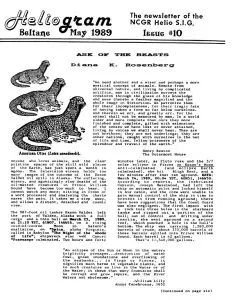
Heliocentric Astrology, Heliogram, NCGR Helio S.I.G., Mundane Astrology, Weather Prediction, Financial Astrology, Asteroids, Fixed Stars, Horary Astrology. This document is the May 1989 issue of the Heliogram, the newsletter of the NCGR Helio S.I.G. Edited by Margaret M. Meister and published with contributions from prominent heliocentric and mundane astrologers, the issue explores the intersections of heliocentric and geocentric astrology, weather forecasting, financial trends, and current world events. Articles delve into the environmental and astrological significance of the Exxon Valdez oil spill, incorporating fixed stars like Spica, Fomalhaut, and the constellation Cetus. Discussions extend to economic forecasts utilizing heliocentric horary charts, planetary alignments involving Mars, Saturn, and Uranus, and the usage of asteroids in mundane prediction. Historical analyses cover figures such as Vincent Wing, examining early heliocentric astrology and Keplerian mechanics. Comprehensive chart data and chronologies, including those for George Bush, nuclear disaster events like Three Mile Island and Chernobyl, and the Emperor Akihito, provide empirical depth to the technical explorations presented throughout the volume.

Issue Highlights:

Articles:
Ask of the Beasts – Diana K. Rosenberg
On File – Margaret M. Meister
Custer Corner: Some Thoughts On Helio – Edith Custer
New and Improved George Bush Chronology – Bill Meridian
Hello, Jupiter! – Barbara May
Elections, Nominations and Things That Go Bump in the Night – Margaret Meister, Edith Custer
Helio in the News – Zipporah Dobyns, Ph.D.
An Implausible Mars-Moon – T. Pat Davis
Emperor Akihito – Doris Greaves
Astrology and the Weather – Part V – Dorothy S. Willis
Doom Forestalled: A Study in Helio Horary – Susan Manuel
Bridge Collapse – Edith Custer
Helio History: Vincent Wing: The First Heliocentric Astrologer? – J. Lee Lehman, Ph.D.

Discussion:
Heliocentric planetary placements and comparative geo/helio charts
Mundane and economic forecasting via heliocentric horary charts
Astrological signatures of the Exxon Valdez oil spill and environmental disasters
Weather forecasting using heliocentric aspects (Venus, Mars, Jupiter, Saturn, Uranus, Neptune)
Historical analysis of heliocentric astronomy and astrology from Kepler to Vincent Wing

Chart data:
Exxon Valdez Oil Spill Chart (March 24, 1989)
Exxon Corporation Foundation Chart (August 10, 1892)
First Sustained Nuclear Reaction (December 2, 1942)
Three Mile Island Nuclear Power Plant Disaster (March 28, 1979)
Chernobyl Nuclear Plant Explosion (April 26, 1986)
Emperor Akihito Natal Chart (December 23, 1933)
Bridge Collapse, Covington, TN (April 1, 1989)
George Bush Natal Chart

Notable contributors:
Diana K. Rosenberg (Astrological zoology and environmental mundane charts)
Edith Custer (Helio Mercury configurations and structural chart observations)
Zipporah Dobyns (Asteroid placements and mundane events)
Susan Manuel (Heliocentric horary and economic predictions)
Dorothy S. Willis (Astrological weather forecasting)
J. Lee Lehman (Historical analysis of heliocentric astrology and Vincent Wing)
Barbara May (Heliocentric Jupiter placements)
Heliogram #1 Candlemas 1987

Heliogram, Special Collections

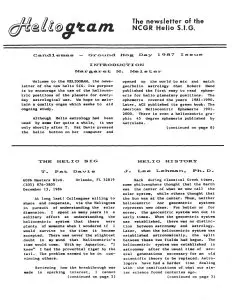
Heliocentric Astrology, Astrometeorology, and Astrological History. This archival document is the inaugural Candlemas / Ground Hog Day 1987 Issue of the Heliogram, the official newsletter of the NCGR Helio Special Interest Group (S.I.G.) edited by Margaret M. Meister. The issue establishes the group’s mission to encourage the everyday use of heliocentric planetary positions and features foundational essays on the history and validity of the heliocentric perspective. Key contributions include J. Lee Lehman’s historical trace of heliocentric concepts from ancient Greece, Phillip Sedgwick’s philosophical essay on the paradigm shifts required to embrace heliocentricism, and Dot Willis’s detailed astrometeorological forecasts using heliocentric alignments to predict extreme weather and seismic events for the 1987 Vernal Equinox and eclipses. Additional features include Edith Custer’s “Custer Corner” discussing Sylvester Stallone’s chart and Supermoon flooding, along with T. Pat Davis advocating for the commercial and analytical integration of helio coordinates.

Issue Highlights

Articles: Introduction – Margaret Meister

The Helio SIG – T. Pat Davis

Helio History – J. Lee Lehman, Ph.D.

Essentiality of Heliocentricism – Phillip Sedgwick

Weather: Vernal Equinox & Eclipses – Dot Willis

Discussions: Sylvester Stallone’s helio chart indicating violent action roles The impact of “Supermoons” on coastal flooding and weather U.S.A. helio chart transits during Reagan’s November 1986 speech Using Helio Mercury in relationship charts and horary astrology

Notable contributors: Margaret Meister T. Pat Davis J. Lee Lehman Edith Custer Phillip Sedgwick Dot Willis Barbara May

Chart data: Sylvester Stallone U.S.A. (Helio with transits) Winter Solstice 1986 (Geo and Helio) Vernal Equinox 1987 (Helio) Annular and Lunar Eclipses 1987

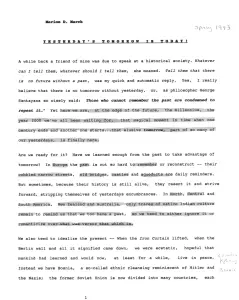
Astrology, History, Synchronicity, Evolution, and Traditional Techniques. This article serves as a reflective discourse on the evolution of astrology as the professional community approaches the turn of the millennium. Marion D. March argues that modern astrology should not entirely discard traditional wisdom in its quest to incorporate psychological insights. She highlights the necessity of balancing new, empowered approaches—which emphasize personal choice and free will—with historical techniques such as Horary and Electional astrology. March posits that true progress involves integrating the past to form the future, rather than treating ancient methods as mere fatalism.

The author discusses the shifting role of planetary archetypes, noting that as consciousness expands, our perception of planets like Saturn and Pluto evolves. She advocates for the use of Horary and Electional astrology as practical tools for empowerment, arguing that choosing an optimal moment for a venture is a demonstration of agency rather than deterministic surrender. Furthermore, she explores the broader cultural context of the 1990s, including the socio-economic impacts of technological change, the decline of rigid paradigms, and the anticipation of major outer planet transits, specifically the ingress of Uranus into Aquarius and Pluto into Sagittarius.

Issue Highlights:

Articles:
Yesterday’s Tomorrow Is Today! – Marion D. March

Discussion:
The synthesis of traditional and modern astrological techniques
The evolution of Saturn and Pluto archetypes in modern astrology
The impact of technological and societal shifts on the role of the astrologer
The philosophical divide between linear and cyclical views of time
The relevance of Electional and Horary astrology in the modern era

Chart data:
N/A

Notable contributors:
George Santayana (Philosophical context)
Carl Gustav Jung (Collective Unconscious)
Joseph Campbell (Myths and archetypes)
Steven Forest (The stigma of being an astrologer)
Christian Borup (Revival of Horary astrology)
Joan McEvers (Collaborator on Electional/Horary books)
Michel Gauquelin (Paradigm definitions)
Rob Hand (Research into old wisdom/Project Hindsight)

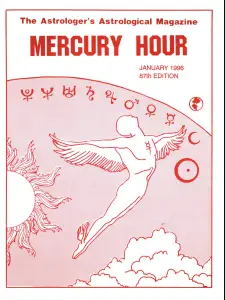
Mundane Astrology, Medical Astrology, and Predictive Astrology. This archival document is the 87th edition of Mercury Hour (January 1996), an astrological community journal edited and published by Edith Custer. The issue features articles, research notes, chart rectifications, software developments, and correspondence among practicing astrologers, including Bil Tierney’s psychological examination of Jupiter, Ed Dearborn’s technical breakdown of the “Translation of Light”, Valerie Vaughan’s defense of predictive astrology, Byron Ross Wahl’s analysis of the Solar Apex Synthetic Method (SASM), and the final installment of Robert “Buz” Myers’ lecture series on Moon-Saturn dynamics. Additionally, the journal covers mundane and political analyses of the O.J. Simpson verdict by John Kalus and Marion March, national chart rectifications for Washington, D.C. by Marc Penfield, insights on Uranus entering Aquarius by Kaye Shinker, medical and genetic commentary by T. Patrick Davis, software updates by Mark Pottenger, and tributes to astrologer Al H. Morrison.

Issue Highlights

Book Reviews
By Edith Custer:
Llewellyn’s 1996 Astrological Pocket Planner
Llewellyn’s Astrological Calendar 1996
Astrology Really Works by The Magi Society – Marc Penfield

Articles
A Look at Jupiter’s Shortcomings – Bil Tierney
Translation of Light – Ed Dearborn
Group Dynamics – Mary K. Creasey
Been There, Done That – Kaye Shinker
[O.J. Simpson verdict] – John Kalus
SASM, Columbus, and Samana Cay – Byron Ross Wahl
1995 Oven Saga – Roberta Strain
Moon/Saturn, Parts 7 and 8 of 8 – Robert “Buz” Myers
Winter Solstice 1995 – Dot Willis
The Art of Self-Defense: Lesson, Fighting at the Level of Your Opponent,
Part 1 of 2 – Valerie Vaughn
Al H. Morrison: Rectification, Poison Data, Genetics – T. Patrick Davis
[obituary & excerpts]
Discussions
Solar returns
O, J, Simpson trial
Chart data
(some incomplete or in question)
Powell, Colin
Washington, D.C.
Notable contributors
Donna Van Toen (various topics)
Mark Pottenger (Progressed MC techniques in software)
Marc Penfield (Chart of the U.S.A.)
Lee Lehman (corrections to Essential Dignities)
Marion March (O. J. Simpson trial, Chaos Theory, Solar Returns)

ELEKTIONEN

Marion D. March, Special Collections

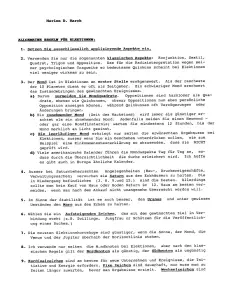
Electional Astrology, Horary vs. Electional, Rules for Marriage, Real Estate, Business Openings, and Automobile Purchases. This extensive instructional text and chart collection by renowned astrologer Marion D. March provides a comprehensive guide to Electional Astrology (Zeitwahl), detailing the foundational mechanics of selecting auspicious times for major life events. March contrasts electional astrology with horary astrology, emphasizing that while horary discovers answers from the moment a question is asked, electional proactively engineers a favorable outcome by consciously choosing the timing of an endeavor. The text systematically outlines the general rules of electional work, highlighting the paramount importance of the Moon as the fastest-moving time-giver, the avoidance of voids-of-course Moons and lunar hard aspects, the placement of the luminaries and benefics above the horizon, and the strategic positioning or restriction of malefics like Saturn, Mars, Uranus, and Pluto away from the angles (Eckhäuser). Furthermore, March offers deep philosophical insights into the psychological vs. pragmatic approaches of modern astrology, arguing that while natal and directional counseling embraces Jungian free will and therapeutic dialogue, electional charts require unvarnished, pragmatic precision to protect clients from missteps and failures. Special attention is given to the rulership systems of outer planets (Uranus, Neptune, Pluto) and their integration into modern practice, drawing on historical timelines of their discoveries coinciding with major paradigm shifts in human civilization.

Issue Highlights: Comprehensive manuals and multiple case-study charts with detailed annotations by Marion D. March covering weddings, home relocations, property acquisitions, land sales, business inaugurations, and vehicle purchases.

Articles:
Allgemeine Regeln für Elektionen – Marion D. March
Was sind Elektionen? – Marion D. March
Regeln für eine Eheschliessung – Marion D. March
Umzug in ein Haus, eine Eigentums- oder Mietwohnung – Marion D. March
Ankauf oder Verkauf von Immobilien (Haus oder Grundstücke) – Marion D. March
Gründung einer Firma oder Aktiengesellschaft – Marion D. March
Regeln für Organisationshoroskope – Rex Bill
Ankauf eines Autos – Marion D. March

Discussion:
The primacy of the Moon in electional timing and avoiding void-of-course states
The strategic management of Saturn and outer planets in angular houses
The application of the Part of Fortune (Pars Fortuna) to resolve restrictive chart configurations
Contrasting psychological natal counseling with pragmatic electional forecasting
The modern attribution of planetary rulerships for Uranus (Aquarius) and Neptune (Pisces)

Chart data:
Heirat (June 7, 1992, Los Angeles, CA)
Heirat Molly & Fred (April 7, 1974, Sherman Oaks, CA)
Heirat Jan & Robert (July 8, 1978, Wailua, Kauai, HI)
Heirat Franz & Corinne (July 13, 1990, Basel, Switzerland)
Heirat Christa & Brett (September 15, 1973, Tahoe City, NV)
Hauseinzug (December 3, 1973, Los Angeles, CA)
Apartamentseinzug (September 15, 1988, Zurich, Switzerland)
Hauskauf (January 9, 1992, San Diego, CA)
Landverkauf (March 10, 1990, Malibu, CA)
Geschaeftseroeffnung / Buchladen (June 16, 1978, New York, NY)
Restauranteroeffnung (March 1, 1983, Coeur d’Alene, ID)
Organisationshoroskop (October 28, 1975, Encino, CA)
Automobilkauf (October 1, 1983, Beverly Hills, CA)
Rolls Royce Kauf (March 15, 1989, Los Angeles, CA)

Notable contributors:
Marion D. March (Author, Astrologer, and Instructor)
Rex Bill (Author of ‘The Rulership Book’ utilized for organizational and derivative house analysis)

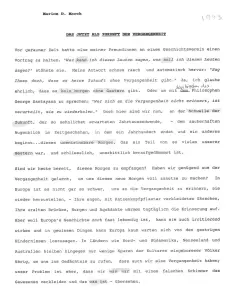
Marion D. March, Electional Astrology, Horary Astrology, Future of Astrology, Turning to the Past for Future Wisdom. In this thoughtful essay, prominent astrologer Marion D. March reflects on the transition from the 20th century into the new millennium, examining how astrologers must reclaim traditional techniques while embracing modern psychological insights. She discusses the danger of throwing out the past in pursuit of entirely modern psychological or New Age frameworks, advocating instead for a synthesis of ancient practices such as electional astrology (Zeitwahlhoroskop) and horary astrology with contemporary astrological counseling. March draws on historical milestones, societal changes in Europe and globally, and the outer planets (Uranus, Neptune, and Pluto) to chart a course for the evolution of astrology in the 21st century.

March elaborates on her personal transition toward electional astrology, noting how utilizing electional charts for film production schedules yielded tangible success and two Academy Awards for a client. She critiques the historical rejection of traditional methods and urges practitioners to overcome the stigma of fatalism. Furthermore, she explores mundane shifts, such as upcoming ingresses of Uranus and Neptune into Aquarius and Pluto into Sagittarius, linking them to cultural transformations, the re-emergence of ancient modalities like Feng-Shui and the I-Ching, and the ongoing dialogue between science, religion, and astrology.

Issue Highlights:

Articles:
Das Jetzt als Zukunft der Vergangenheit – Marion D. March

Discussion:
Integrating traditional electional and horary techniques with modern psychological astrology
The evolution of outer planet symbolism (Saturn, Uranus, Neptune, Pluto) and their sign ingresses
Overcoming public and religious skepticism towards astrology
Reclaiming ancient wisdom and cultural heritage (Feng-Shui, I-Ching) for the 21st century

Chart data:
N/A

Notable contributors:
Marion D. March (Author and Astrologer)
Christian Borup (Electional and Horary Astrology)
Steven Forrest (Discussion of astrological public reception)

Astrology in America Today (1994)

Marion D. March, Special Collections

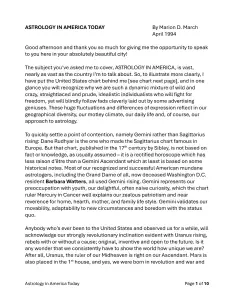
Astrology in America Today, Marion D. March, United States Chart, Gemini Ascendant, Uranian Astrology, Local Space, Project Hindsight, Lois Rodden, UAC. Marion D. March presents a comprehensive and sweeping lecture examining the state of astrology in the United States, utilizing a 7 July 1776 chart with Gemini rising and Uranus on the Ascendant as a symbolic reflection of American cultural and astrological traits. March discusses the rich eclecticism of American astrology, serving as a primary testing ground for international techniques and systems such as Midpoints, Uranian Astrology, Dr. Koch’s house systems, and composite charts from Germany, alongside Dane Rudhyar’s psychological insights from France. She details how American astrologers have championed innovations like Local Space (building on Edward Johndro, Charles Jayne, and Michael Erlewine), Heliocentric Astrology (popularized by T. Pat Davis), and Jim Lewis’s Astro*Carto*Graphy. Furthermore, she highlights the monumental work of Project Hindsight in retranslating classical texts, Lois Rodden’s monumental data collection efforts leading to the IDEA database, and the pioneering organizational frameworks of UAC (United Astrology Congress), AFAN, ISAR, and NCGR.

Issue Highlights:

Articles:
Astrology in America Today – Marion D. March

Discussion:
Debate between Gemini versus Sagittarius rising for the United States chart
The influence of computers and databases on astrological research (Lois Rodden, Edwin Steinbrecher, Michel and Françoise Gauquelin)
The professionalization of astrology and resistance to licensing
The intersection of astrology with technology, computers, and the Information Highway

Chart data:
US Chart 7 Gem ASC, July 4, 1776, 2:14 a.m. LMT, Philadelphia, PA

Notable contributors:
Marion D. March (Author / Lecturer)
Barbara Watters (Mundane astrology / Gemini rising usage)
Dane Rudhyar (Astrological philosophies and lunar phases)
Dr. Eugen Jonas (Fertility astrology)
Angel Thompson (Feng Shui and modern applications)
Michael Erlewine (Local Space mathematics and software)
T. Pat Davis (Heliocentric astrology)
Olivia Barclay, Ivy Jacobson, Joan McEvers (Horary astrology revitalization)
Jacob Schwartz (Draconic system)
Robert Hand, Robert Schmidt, Robert Zoller (Project Hindsight translation)
Jim Lewis (Astro*Carto*Graphy)
Lois Rodden (Data collection and birth data categorization)
Edwin Steinbrecher (Biographical research databases)
Neil Michelsen (Computerized ephemerides and research support)

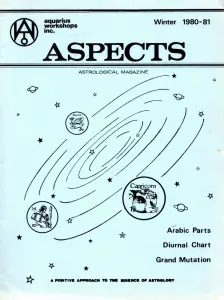
ASPECTS Vol. 6 No. 1 Winter 1980-81 Part 2/2

ASPECTS Magazine, Special Collections

Astrological techniques, horary analysis, Arabic parts, Diurnal charts, and the Grand Mutation of Jupiter and Saturn. This issue of Aspects features extensive technical explorations of predictive and mundane astrology. Robert ‘Buz’ Myers details the calculation and application of Arabic Parts. Marion D. March explores the grand astrological significance of the Jupiter-Saturn conjunction, evaluating its historical impacts and mundane country correlations using Jim Lewis’s Astro*Carto*Graphy. Lenora M. Hill introduces the simplicity and practical application of the Diurnal (daily) Chart, complete with step-by-step mathematical examples, Yod configurations, and transit correlations. Joan McEvers provides insights into numerological pinnacles, while Linda Green investigates Astropalmistry through hand-shape classifications and water-hand patterns. Enrique Linarés introduces the ‘Point of Life’ progression method. Additionally, book reviews by Marion D. March and data columns by Lois Rodden round out the edition.

Issue Highlights:

Articles:
How to Calculate Your Arabic Parts – Robert ‘Buz’ Myers
The Great Jupiter/Saturn Conjunction – Marion D. March
The Diurnal (Daily) Chart – Lenora M. Hill
The Point of Life – Enrique Linarés
Basic Delineation – Marion D. March
Astro-Numerology: The Meanings of the Numbers (Pinnacles) – Joan McEvers
Astropalmistry – Linda Green

Discussion:
Calculating Arabic parts using formula segments
Jupiter-Saturn conjunctions and Grand Mutations entering Air signs
Diurnal chart calculation and activation via house cusps
Point of Life progression calculations
Astrological data corrections and book reviews

Chart data:
Horary Question (8/17/79 8:49 PM PDT, Coeur d’Alene)
Basic Delineation natal chart (3/30/1853 11:00 AM LMT, Zundert, Holland)
Diurnal Chart (June 28, 1980)
Water Hand Natal Horoscope (Figure 2)

Notable contributors:
Robert ‘Buz’ Myers (Arabic Parts)
Marion D. March (Jupiter-Saturn Conjunction & Basic Delineation)
Lenora M. Hill (Diurnal Charts)
Enrique Linarés (Point of Life Progression)
Joan McEvers (Astro-Numerology)
Linda Green (Astropalmistry)
Lois Rodden (Data Column)

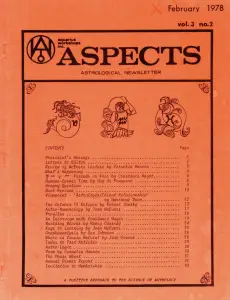
ASPECTS Vol. 3 No 2. Feb 1978

ASPECTS Magazine, Special Collections

Astrological Education, Natal Charting, and Technique Synthesis. This issue of Aspects focuses heavily on the pedagogical and professional aspects of astrology, emphasizing the “positive approach” advocated by the Aquarius Workshops organization. Key themes include the ethical responsibilities of the astrologer, the necessity of rigorous natal chart synthesis rather than superficial interpretations, and the application of astrological tools to everyday life events. The content ranges from foundational lessons for beginners to advanced discussions on eclipses, horary techniques, and speculative systems like “Humano-Cosmic Time.”

The issue provides extensive educational material, including a detailed exploration of eclipses by Robert Jansky, who characterizes them as periods of “crisis and emphasis” requiring house-based analysis. Joan McEvers contributes foundational articles on astro-numerology and chart signature assessment, while Constance Mayer offers a comparative analysis of the distinct energies of Uranus and Neptune. Additionally, the newsletter features a candid interview with Connie Mayer on the teaching and practice of astrology, emphasizing the importance of objective, non-predictive counseling that respects client free will.

Beyond theoretical discussions, the newsletter functions as a community hub, reporting on the SWAC (Southwestern Astrology Conference) and internal board business, such as membership dues and organizational bylaws. It also promotes upcoming events and publications, highlighting the ongoing effort to define and elevate the professional standards of the field through ethical conduct and informed practice.

Issue Highlights:

Articles:
Review of McEvers Lecture – Cornelia Hansen
Friends or Foes – Constance Mayer
Humano-Cosmic Time – Guy de Penguern
The October 12 Eclipse – Robert Jansky
Astro-Numerology – Joan McEvers
An Interview with Constance Mayer – Marion D. March
Building Blocks – Nancy Cassidy
Keys to Learning – Joan McEvers
Graphoanalysis – Sue Johnson
Where is Cousin Melvin? – Jean Graves
Astro-Logic – Aunt Asty (pseudonym)

Discussion:
The ethical role of the astrologer in client counseling
Application of eclipse cycles in natal prediction
Technique for “turning the house” to locate relations
Integrating astro-numerology with chart analysis

Chart data:
Capricorn Ingress Chart (Dec 21, 1977)
Horary Question Chart (July 5, 1977)

Notable contributors:
Robert Jansky (Eclipses)
Joan McEvers (Astro-numerology, teaching philosophy)
Constance Mayer (Planetary comparison)
Guy de Penguern (Humano-Cosmic Time)
Marion D. March (Interviewing & editing)

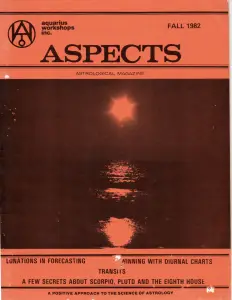
ASPECTS Vol 7 No 4 Fall 1982

ASPECTS Magazine, Special Collections

Aspects Astrological Magazine, Vol. 7 No. 4, Fall 1982. Published by Aquarius Workshops, Inc., Encino, California. Edited by Nancy Cassidy. This issue explores a wide range of advanced and foundational astrological techniques, including mundane forecasting through ingress charts, techniques for utilizing diurnal charts in financial and lottery forecasting, and psychological insights into Scorpio, Pluto, and the eighth house. Contributions from prominent astrologers cover topics such as vocational astrology, transits, lunations, and expansive analyses of Jupiter across the zodiacal signs.

Issue Highlights: Articles feature Judy Johns Tonyan examining the Libra Ingress chart for global political tensions, Jeff Jawer analyzing the psychological depth of Scorpio and Pluto, Sophia Mason detailing the mechanics and calculation of Diurnal Charts for winning potentials, and Angel Thompson providing a comprehensive guide to interpreting transits. Additionally, Marion D. March delineates the astrological chart of Prince William, Joan McEvers outlines the twelfth house, and Nancy Cassidy continues her Beginner’s Blocks series focusing on Jupiter.

Articles:
Libra Ingress – Judy Johns Tonyan
A Few Secrets About Scorpio, Pluto, and the Eighth House – Jeff Jawer
Winning With Diurnal Charts – Sophia Mason
Transits – Angel Thompson
Keys to Learning: Twelfth House – Joan McEvers
Vocations in Focus – Jon Tabakin
Basic Delineation: Prince William Arthur Philip Louis – Marion D. March
Lunations in Forecasting – Marwayne Leipzig
Beginner’s Blocks: Jupiter – Nancy Cassidy

Discussion:
Global mundane forecasts and political instability using ingress charts
Calculating and applying diurnal charts for financial timing and events
Psychological integration of Pluto, Scorpio, and eighth-house dynamics
Vocational profiling through planetary aspects and focal points
The expansive and philosophical nature of Jupiter in all twelve signs

Chart data:
Prince William Arthur Philip Louis
Bill Blass
Coco Chanel
Christen Dior
Various anonymous example charts for diurnal and transit forecasting

Notable contributors:
Judy Johns Tonyan (Mundane astrology and ingress charts)
Jeff Jawer (Psychological astrology and Pluto)
Sophia Mason (Predictive techniques and diurnal charts)
Angel Thompson (Transit interpretation)
Marion D. March (Natal and mundane delineation)
Lois Rodden (Data column and historical film charts)

Ask A Librarian

Need assistance with your research or navigating our collection? Our library team is here to help.

Please fill out the form below with details about the topics, authors, or archival materials you are looking for, and one of our librarians will review your query and respond shortly.

Help

Whether you are looking for rare historical texts or trying to locate a specific book nearby, Alexandria iBase offers two primary ways to search. Here is how to choose the right tool for what you need:

The Library Catalogue

Think of this as your global master index.

The Catalogue works just like a traditional library search system, designed to help you locate books and media across the broader astrological landscape.

  • Physical Books: Find out where physical copies of books are held in libraries, archives, or collections near you.

  • Digital Files: Access downloadable or viewable digital editions when available.

  • Best Used For: Standard research, finding specific ISBNs or authors, and tracking down physical items in the real world.

Browse Catalogue

SPECIAL COLLECTIONS

Think of this as Alexandria’s exclusive private vault.

Collections gives you direct access to Alexandria’s own curated archive of rare, proprietary, and historic astrology media.

  • Exclusive Material: Features unique texts, manuscripts, audio recordings, and visual media that are not available anywhere else.

  • Direct Access: Digitized content ready to explore straight from the platform.

  • Best Used For: Deep-dive research, discovering hidden gems, and exploring rare, one-of-a-kind astrological resources.

Browse Special Collections

Cash & In-Kind Donations

Make a one-time or recurring tax deductible cash donation.

Payment options include donating directly with us, PayPal Giving and GoFundMe.

GoFundMe for Charities and PayPal Giving are registered for tax deductions and have no required processing fees. It does offer the option to tip.

Donate

*Subject to 2.5% processing fees

Contact Us

Have a question, feedback, or a inquiry about our archives? We’d love to hear from you. Please fill out the form below with your details and message, and a member of our team will get back to you as soon as possible.

Thank you for reaching out to the Alexandria iBase Project!