
Predictive Astrology

Predictive Astrology is a specialized branch of astrological practice focused on anticipating future trends, developmental phases, and specific events by analyzing the interaction between a native birth chart and ongoing planetary movements. Utilizing core timing methodologies such as transits, secondary progressions, solar arc directions, and solar return charts, this approach evaluates how dynamic celestial cycles activate natal potentials over time. Rather than assuming strict fatalism, modern predictive techniques function as a structural framework for recognizing cyclic opportunities and challenges, allowing practitioners to map the unfolding timeline of an individual’s life or collective mundane events.

Filters

Filters


See more See less
See more See less
See more See less
See more See less
See more See less
See more See less
See more See less

Sorting

Fertility, Infertility, and Astrology, Astrological Fertility Cycle, Dr. Eugen Jonas, Birth Control, Electional Pregnancy Charts, In Vitro Fertilization, Artificial Insemination, GIFT, ZIFT. Marion D. March explores the intersection of medical procedures and astrological fertility cycles, noting that while the topic needs great caution, the astrological fertility cycle based on the Sun-Moon distance at birth can be remarkably effective for timing pregnancy. The text outlines three main divisions: birth control using the cycle (which March cautions is unreliable), determining the best time to become pregnant via personalized fertility dates and electional rules, and timing pregnancies through modern medical techniques such as artificial insemination and in-vitro fertilization.

Issue Highlights: Comprehensive lecture notes and case studies focusing on the practical application of astrological fertility cycles, detailed computer-generated fertility lists, and step-by-step chart interpretations for a client named Mindy.

Articles:
Fertility, Infertility and Astrology – Marion D. March

Discussion:
The validity and unreliability of astrological birth control
Calculating the fertility cycle based on the Sun-Moon distance from the natal chart
Using electional astrology and lunar aspects for conception and medical implantation
Correlating moon signs with the biological prediction of a baby’s gender
Applying fertility timing to modern medical procedures like IVF, GIFT, and ZIFT

Chart data:
Mikki March Andina (Michele Dia March)
Mindy’s Fertility Charts (#1, #2, #3, #3A, #4, #7, #7A)

Notable contributors:
Marion D. March (Author and Astrologer)
Dr. Eugen Jonas (Czechoslovakian gynecologist and astrologer known for his work on fertility cycles)
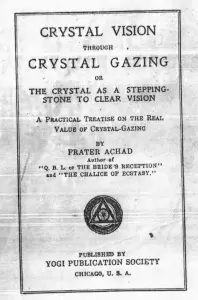
Crystal Gazing, Scrying, Thelemic Magick, Ritual Practice, Inner Vision. This practical treatise titled “Crystal Vision Through Crystal Gazing or The Crystal as a Stepping-Stone to Clear Vision” by Frater Achad (C. Stansfeld-Jones) provides a comprehensive guide to the occult, ceremonial, and psychological methods of scrying using crystal spheres and magical instruments. The author outlines the preparation, purification, consecration, and initiation of both the scryer and the crystal (referred to through chapters on the Lesser, Greater, and Universal Crystalline Spheres). Drawing on historical practices such as those of Dr. John Dee and Sir Edward Kelley, Trithemius of Spanheim, and Francis Barrett, the text details the construction of magical circles, tables of practice, planetary hours, elemental and planetary rulers, and angelic invocations. Furthermore, it incorporates profound teachings from the Golden Dawn tradition, Thelema, the Holy Qabalah, and the Tarot, emphasizing the transition from physical scrying to true inner vision, astral travel in the Body of Light, and the attainment of union with the Higher Self and Star Consciousness.

Issue Highlights:

Articles:
Foreword – Frater Achad
Chapter I: The Lesser Crystalline Sphere – Frater Achad
Chapter II: The Greater Crystalline Sphere – Frater Achad
Chapter III: The Universal Crystalline Sphere – Frater Achad
Chapter IV: A Consideration of the Ancient Methods – Frater Achad
Chapter V: Further Considerations—The Methods of Dr. Dee and Sir Edward Kelly – Frater Achad
Chapter VI: The Attainment of Crystal Vision – Frater Achad
Chapter VII: Of the Ultimate Crystal – Frater Achad

Discussion:
Methods of purifying and consecrating a crystal sphere
Planetary hours and angelic rulers in ritual practice
The distinction between astral visions and true spiritual illumination
Travel in the Body of Light and its application to scrying
The use of magical weapons, pentacles, and divine names

Chart data:
Tables of Planetary Hours and Rulers for Days and Nights
Magical Instruments and Tables of Angels (Michael, Gabriel, Samael, Sachiel, Anael, Cassiel, Raphael)

Notable contributors:
Frater Achad (Author)
John Melville (Author of Crystal Gazing and Clairvoyance)
Dr. John Dee (Seer and Magician)
Sir Edward Kelly (Scryer and Medium)
Trithemius of Spanheim (Historical occultist and instructor)
Francis Barrett (Translator and compiler of magical instructions)

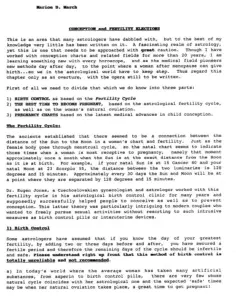
Fertility Astrology, Dr. Eugen Jonas Method, Electional Charts for Conception. Marion D. March provides a detailed guide on utilizing astrological fertility cycles (pioneered by Dr. Eugen Jonas) and electional charts for determining the best times to conceive. The text covers the three main divisions: birth control based on fertility cycles, optimal times for pregnancy based on both astrological fertility cycles and natural ovulation, and pregnancy charts adapted to modern medical procedures like in-vitro fertilization. March discusses practical case studies involving clients like Mindy, Marissa, Sarah, and Jennifer, analyzing the application of lunar aspects, void-of-course moons, and planetary transits in relation to natal charts.

Issue Highlights:

Articles:
Conception and Fertility Elections – Marion D. March

Discussion:
Calculating astrological fertility cycles based on the Sun-Moon phase angle at birth
Electional chart rules for conception focusing on the Moon’s applying aspects
Aligning astrological fertility dates with modern medical fertility treatments and in-vitro procedures

Chart data:
Mindy
Marissa
Sarah
Jennifer

Notable contributors:
Marion D. March (Author and Astrologer)
Dr. Eugen Jonas (Developer of the astrological fertility and birth control cycle)

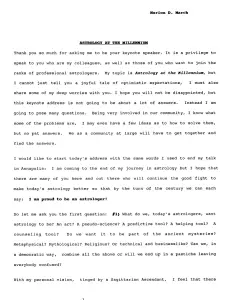
Professionalism, Astrological Standards, Millennium, Cultural Integration. Marion D. March delivers a passionate and challenging keynote address focusing on the state of astrology as the 20th century draws to a close. She raises eleven critical questions regarding the identity, reputation, standards, and future of astrology in a rapidly changing world. March examines external criticisms from scientists like Richard Dawkins, legal and financial controversies, the need for standardized training and testing akin to acupuncture and psychology, and the internal politics of major astrological organizations such as AFA, AFAN, ISAR, and NCGR. She highlights positive milestones including UAC faculty compensation, improved literature, computer advancements, financial research by Arch Crawford and Ray Merriman, the Gauquelins’ statistical research, Project Hindsight, and the unifying power of the Internet.

Issue Highlights:
A keynote address exploring the evolution of astrology, the necessity of professional standards, overcoming poverty consciousness among astrologers, and navigating technological and societal seachanges toward the new millennium.

Articles:
Astrology at the Millennium – Marion D. March

Discussion:
What do astrologers want astrology to be (art, science, predictive tool, helping tool)?
Public perception and attacks from the scientific community.
The need for testing, licensing, and standardized education.
Internal politics and division among astrological organizations.
The validity of astrology and empirical vs. judicial approaches.
The impact of computers, the Internet, and Project Hindsight.
Astrologers’ poverty consciousness and professional compensation.
Cyclical time vs. linear time and the philosophical implications of the upcoming millennium.

Chart data:
N/A

Notable contributors:
Marion D. March (Keynote Speaker)
Nick Campion (Natural vs. Judicial Astrology)
Joan McEvers (Astrology as a tool)
Arch Crawford (Financial Astrology)
Ray Merriman (Financial Astrology)

ASPECTS Vol. 6 No. 1 Winter 1980-81 Part 2/2

ASPECTS Magazine, Special Collections

Astrological techniques, horary analysis, Arabic parts, Diurnal charts, and the Grand Mutation of Jupiter and Saturn. This issue of Aspects features extensive technical explorations of predictive and mundane astrology. Robert ‘Buz’ Myers details the calculation and application of Arabic Parts. Marion D. March explores the grand astrological significance of the Jupiter-Saturn conjunction, evaluating its historical impacts and mundane country correlations using Jim Lewis’s Astro*Carto*Graphy. Lenora M. Hill introduces the simplicity and practical application of the Diurnal (daily) Chart, complete with step-by-step mathematical examples, Yod configurations, and transit correlations. Joan McEvers provides insights into numerological pinnacles, while Linda Green investigates Astropalmistry through hand-shape classifications and water-hand patterns. Enrique Linarés introduces the ‘Point of Life’ progression method. Additionally, book reviews by Marion D. March and data columns by Lois Rodden round out the edition.

Issue Highlights:

Articles:
How to Calculate Your Arabic Parts – Robert ‘Buz’ Myers
The Great Jupiter/Saturn Conjunction – Marion D. March
The Diurnal (Daily) Chart – Lenora M. Hill
The Point of Life – Enrique Linarés
Basic Delineation – Marion D. March
Astro-Numerology: The Meanings of the Numbers (Pinnacles) – Joan McEvers
Astropalmistry – Linda Green

Discussion:
Calculating Arabic parts using formula segments
Jupiter-Saturn conjunctions and Grand Mutations entering Air signs
Diurnal chart calculation and activation via house cusps
Point of Life progression calculations
Astrological data corrections and book reviews

Chart data:
Horary Question (8/17/79 8:49 PM PDT, Coeur d’Alene)
Basic Delineation natal chart (3/30/1853 11:00 AM LMT, Zundert, Holland)
Diurnal Chart (June 28, 1980)
Water Hand Natal Horoscope (Figure 2)

Notable contributors:
Robert ‘Buz’ Myers (Arabic Parts)
Marion D. March (Jupiter-Saturn Conjunction & Basic Delineation)
Lenora M. Hill (Diurnal Charts)
Enrique Linarés (Point of Life Progression)
Joan McEvers (Astro-Numerology)
Linda Green (Astropalmistry)
Lois Rodden (Data Column)

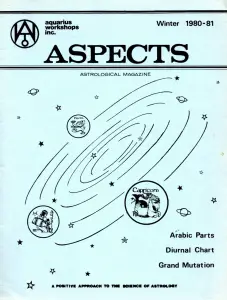
ASPECTS Vol. 6 No. 1 Winter 1980-1 Part 1/2

ASPECTS Magazine, Special Collections

Arabic Parts, Grand Mutation, Fifth House, Sextiles. This issue of Aspects astrological magazine delivers an extensive exploration of foundational and advanced astrological techniques, featuring detailed instructional breakdowns and conference updates. Robert ‘Buz’ Myers provides a comprehensive guide on calculating and interpreting ten key Arabic Parts (including the Part of Fortune, Love, Passion, Increases, Fate, Catastrophe, Treachery, and Organization) through the twelve houses and signs. Marion D. March analyzes the monumental Great Jupiter/Saturn Conjunction and the Capricorn Ingress Chart for December 1980, discussing world consciousness shifts and the transition into the Air trigon. Additionally, Lenora M. Hill examines the Diurnal (Daily) Chart, Enrique Linarés writes on the Point of Life, Joan McEvers breaks down the symbolism of the Fifth House in her ‘Keys to Learning’ series, and Nancy Cassidy details the harmonious exchange of energy found in Sextiles.

Issue Highlights: Conference reports cover SWAC 1980, the upcoming Astrology World-Congress 1981 in Zurich, and the First Metaphysical Congress. Regular columns include Letters to the Editor, President’s Message by Roberta Fueyo, What’s Happening, Book Reviews, and Lois Rodden’s Data Column.

Articles:
How to Calculate Your Arabic Parts – Robert ‘Buz’ Myers
The Great Jupiter/Saturn Conjunction – Marion D. March
The Diurnal (Daily) Chart – Lenora M. Hill
The Point of Life – Enrique Linarés
Keys to Learning: Fifth House – Joan McEvers
Building Blocks: Sextiles – Nancy Cassidy
Capricorn Ingress – Judy Johns

Discussion:
Calculation and house interpretation of Arabic Parts
Astrological shifts during the Jupiter/Saturn conjunction in Libra
Practical applications of diurnal charts and secondary progressions
Creative and psychological significations of the Fifth House
Harmonious energy exchanges through Sextile aspects

Chart data:
Capricorn Ingress Chart (December 21, 1980, Washington, D.C.)
Sample calculation chart for Arabic Parts (October 28, 1975, Encino, CA)

Notable contributors:
Robert ‘Buz’ Myers (Arabic Parts)
Marion D. March (Great Jupiter/Saturn Conjunction)
Joan McEvers (Fifth House mechanics)
Nancy Cassidy (Sextiles)
Lenora M. Hill (Diurnal Charts)

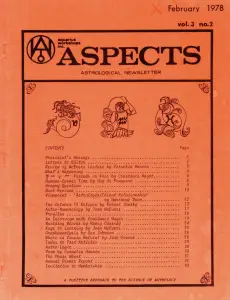
ASPECTS Vol. 3 No 2. Feb 1978

ASPECTS Magazine, Special Collections

Astrological Education, Natal Charting, and Technique Synthesis. This issue of Aspects focuses heavily on the pedagogical and professional aspects of astrology, emphasizing the “positive approach” advocated by the Aquarius Workshops organization. Key themes include the ethical responsibilities of the astrologer, the necessity of rigorous natal chart synthesis rather than superficial interpretations, and the application of astrological tools to everyday life events. The content ranges from foundational lessons for beginners to advanced discussions on eclipses, horary techniques, and speculative systems like “Humano-Cosmic Time.”

The issue provides extensive educational material, including a detailed exploration of eclipses by Robert Jansky, who characterizes them as periods of “crisis and emphasis” requiring house-based analysis. Joan McEvers contributes foundational articles on astro-numerology and chart signature assessment, while Constance Mayer offers a comparative analysis of the distinct energies of Uranus and Neptune. Additionally, the newsletter features a candid interview with Connie Mayer on the teaching and practice of astrology, emphasizing the importance of objective, non-predictive counseling that respects client free will.

Beyond theoretical discussions, the newsletter functions as a community hub, reporting on the SWAC (Southwestern Astrology Conference) and internal board business, such as membership dues and organizational bylaws. It also promotes upcoming events and publications, highlighting the ongoing effort to define and elevate the professional standards of the field through ethical conduct and informed practice.

Issue Highlights:

Articles:
Review of McEvers Lecture – Cornelia Hansen
Friends or Foes – Constance Mayer
Humano-Cosmic Time – Guy de Penguern
The October 12 Eclipse – Robert Jansky
Astro-Numerology – Joan McEvers
An Interview with Constance Mayer – Marion D. March
Building Blocks – Nancy Cassidy
Keys to Learning – Joan McEvers
Graphoanalysis – Sue Johnson
Where is Cousin Melvin? – Jean Graves
Astro-Logic – Aunt Asty (pseudonym)

Discussion:
The ethical role of the astrologer in client counseling
Application of eclipse cycles in natal prediction
Technique for “turning the house” to locate relations
Integrating astro-numerology with chart analysis

Chart data:
Capricorn Ingress Chart (Dec 21, 1977)
Horary Question Chart (July 5, 1977)

Notable contributors:
Robert Jansky (Eclipses)
Joan McEvers (Astro-numerology, teaching philosophy)
Constance Mayer (Planetary comparison)
Guy de Penguern (Humano-Cosmic Time)
Marion D. March (Interviewing & editing)

ASPECTS Vol 7 No 4 Fall 1982

ASPECTS Magazine, Special Collections

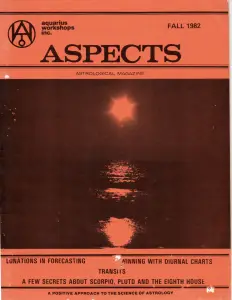
Aspects Astrological Magazine, Vol. 7 No. 4, Fall 1982. Published by Aquarius Workshops, Inc., Encino, California. Edited by Nancy Cassidy. This issue explores a wide range of advanced and foundational astrological techniques, including mundane forecasting through ingress charts, techniques for utilizing diurnal charts in financial and lottery forecasting, and psychological insights into Scorpio, Pluto, and the eighth house. Contributions from prominent astrologers cover topics such as vocational astrology, transits, lunations, and expansive analyses of Jupiter across the zodiacal signs.

Issue Highlights: Articles feature Judy Johns Tonyan examining the Libra Ingress chart for global political tensions, Jeff Jawer analyzing the psychological depth of Scorpio and Pluto, Sophia Mason detailing the mechanics and calculation of Diurnal Charts for winning potentials, and Angel Thompson providing a comprehensive guide to interpreting transits. Additionally, Marion D. March delineates the astrological chart of Prince William, Joan McEvers outlines the twelfth house, and Nancy Cassidy continues her Beginner’s Blocks series focusing on Jupiter.

Articles:
Libra Ingress – Judy Johns Tonyan
A Few Secrets About Scorpio, Pluto, and the Eighth House – Jeff Jawer
Winning With Diurnal Charts – Sophia Mason
Transits – Angel Thompson
Keys to Learning: Twelfth House – Joan McEvers
Vocations in Focus – Jon Tabakin
Basic Delineation: Prince William Arthur Philip Louis – Marion D. March
Lunations in Forecasting – Marwayne Leipzig
Beginner’s Blocks: Jupiter – Nancy Cassidy

Discussion:
Global mundane forecasts and political instability using ingress charts
Calculating and applying diurnal charts for financial timing and events
Psychological integration of Pluto, Scorpio, and eighth-house dynamics
Vocational profiling through planetary aspects and focal points
The expansive and philosophical nature of Jupiter in all twelve signs

Chart data:
Prince William Arthur Philip Louis
Bill Blass
Coco Chanel
Christen Dior
Various anonymous example charts for diurnal and transit forecasting

Notable contributors:
Judy Johns Tonyan (Mundane astrology and ingress charts)
Jeff Jawer (Psychological astrology and Pluto)
Sophia Mason (Predictive techniques and diurnal charts)
Angel Thompson (Transit interpretation)
Marion D. March (Natal and mundane delineation)
Lois Rodden (Data column and historical film charts)

ASPECTS Vol 6 No 2 Spring 1982

ASPECTS Magazine, Special Collections

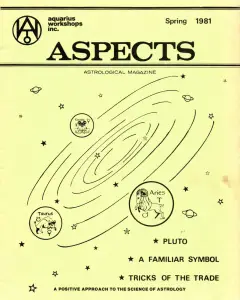
Astrological Methodology, Natal Analysis, and Evolutionary Astrology. This issue of Aspects features extensive technical discussions regarding the practical application of astrology. A significant portion of the magazine is dedicated to the philosophy and mechanics of individual charts, notably through Robert Carl Jansky’s detailed exploration of the Sun symbol as a representation of personal space, ego-control, and evolutionary potential. The discourse extends to professional practice with Robert Glasscock’s insights into client management, chart rectification techniques, and the “degree for a year” predictive method. Additionally, Jeff Green provides a deep dive into evolutionary astrology, examining Pluto’s role in the birth chart as a primary indicator of karmic patterns and the soul’s path through incarnation, utilizing the charts of historical figures like Richard Nixon as case studies.

Issue Highlights:
The magazine explores mundane astrology through the lens of the 1981 Aries Ingress chart, projecting potential national trends in economy, diplomacy, and global politics. Practical “building blocks” are provided for students, including a breakdown of the 6th House by Joan McEvers and an introduction to the inconjunct (quincunx) aspect by Nancy Cassidy. The content is further enriched by a Q&A interview with Angela Gallo, who discusses the challenges of teaching astrology and the ethical considerations of working with clients, as well as a data column by Lois Rodden verifying birth times for various famous women in sports.

Articles:
A New Look at a Familiar Symbol – Robert Carl Jansky
Pluto: The Evolutionary Cause of Incarnation – Jeff Green
Tricks of the Trade: Confessions of a Professional Astrologer – Robert Glasscock
Aries Ingress – Judy Johns
Sixth House – Joan McEvers
Inconjunct – Nancy Cassidy
Basic Delineation: The Overview – Marion March

Discussion:
Techniques for client management and professional ethics.
Evolutionary astrology and the role of Pluto and the Nodal axis.
Practical applications of the inconjunct aspect in natal charts.
Mundane analysis of the 1981 Aries Ingress.

Chart data:
Richard Nixon
Vincent Van Gogh

Notable contributors:
Robert Carl Jansky (Sun Symbolism)
Jeff Green (Evolutionary Astrology)
Robert Glasscock (Professional Techniques)
Marion D. March (Chart Delineation)
Lois Rodden (Data/Research)

Arabic Parts, Lunar Nodes, Karmic Astrology, Chart Interpretation, Part of Fortune, Part of Spirit, The Web. In this address given to the Astrology Buff Club on February 15, 1973, Marion March explores the deeper psychological and karmic layers of the horoscope beyond standard sun-sign and basic natal chart delineations. Critiquing superficial newspaper forecasts, March discusses how accurate birth times and precise house calculations unlock core personality traits, while lunar nodes and specialized Arabic parts reveal unconscious patterns, past-life tendencies, and future spiritual evolution. Drawing on the philosophies of Dane Rudhyar and Isabel Hickey, March contrasts the comfortable habits of the South Node with the developmental challenge of the North Node, and reinterprets the formulas for the Part of Fortune, Part of Spirit, and a unique Arabic part known as ‘The Web’ taught by Irma Norman.

Issue Highlights:

Articles:
Address to the Astrology Buff Club – Marion March
Some Arabic Points and Their Deeper Meanings – Marion March

Discussion:
Differentiating solar charts from precise natal horoscopes
Psychological interpretation of the Lunar Nodes (North and South Nodes)
Reinterpreting the Part of Fortune (Pars Fortuna) and Part of Spirit
The Web Arabic Part and identifying psychological traps based on house placement
Using tight orbs for Arabic part aspects (maximum 3-degree orb)

Chart data:
N/A

Notable contributors:
Marion March (Author and lecturer)
Dane Rudhyar (Evolutionary and archetypal philosophy)
Isabel Hickey (Lunar nodes and subconscious patterns)
Ronald C. Davison (Planetary distribution relative to the lunar nodes)
Sydney Omarr (Newspaper astrological forecasts comparison)
Irma Norman (Originator of ‘The Web’ Arabic part)

Ask A Librarian

Need assistance with your research or navigating our collection? Our library team is here to help.

Please fill out the form below with details about the topics, authors, or archival materials you are looking for, and one of our librarians will review your query and respond shortly.

Help

Whether you are looking for rare historical texts or trying to locate a specific book nearby, Alexandria iBase offers two primary ways to search. Here is how to choose the right tool for what you need:

The Library Catalogue

Think of this as your global master index.

The Catalogue works just like a traditional library search system, designed to help you locate books and media across the broader astrological landscape.

  • Physical Books: Find out where physical copies of books are held in libraries, archives, or collections near you.

  • Digital Files: Access downloadable or viewable digital editions when available.

  • Best Used For: Standard research, finding specific ISBNs or authors, and tracking down physical items in the real world.

Browse Catalogue

SPECIAL COLLECTIONS

Think of this as Alexandria’s exclusive private vault.

Collections gives you direct access to Alexandria’s own curated archive of rare, proprietary, and historic astrology media.

  • Exclusive Material: Features unique texts, manuscripts, audio recordings, and visual media that are not available anywhere else.

  • Direct Access: Digitized content ready to explore straight from the platform.

  • Best Used For: Deep-dive research, discovering hidden gems, and exploring rare, one-of-a-kind astrological resources.

Browse Special Collections

Cash & In-Kind Donations

Make a one-time or recurring tax deductible cash donation.

Payment options include donating directly with us, PayPal Giving and GoFundMe.

GoFundMe for Charities and PayPal Giving are registered for tax deductions and have no required processing fees. It does offer the option to tip.

Donate

*Subject to 2.5% processing fees

Contact Us

Have a question, feedback, or a inquiry about our archives? We’d love to hear from you. Please fill out the form below with your details and message, and a member of our team will get back to you as soon as possible.

Thank you for reaching out to the Alexandria iBase Project!