
Home » Quincunx (Inconjunct)

Quincunx (Inconjunct)

A geometric aspect of 150 degrees separating two celestial bodies, connecting zodiacal signs that share no elemental, modal, or polar affinities. Also referred to as an inconjunct, this aspect is analyzed in astrological literature as a structural blind spot requiring constant psychological adjustment, often manifesting as subtle systemic friction, somatic stressors, or the need to reconcile fundamentally incompatible drives.

Filters

Filters


See more See less
See more See less
See more See less
See more See less
See more See less
See more See less
See more See less

Sorting

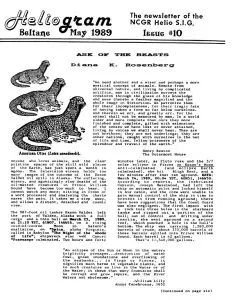
Heliocentric Astrology, Heliogram, NCGR Helio S.I.G., Mundane Astrology, Weather Prediction, Financial Astrology, Asteroids, Fixed Stars, Horary Astrology. This document is the May 1989 issue of the Heliogram, the newsletter of the NCGR Helio S.I.G. Edited by Margaret M. Meister and published with contributions from prominent heliocentric and mundane astrologers, the issue explores the intersections of heliocentric and geocentric astrology, weather forecasting, financial trends, and current world events. Articles delve into the environmental and astrological significance of the Exxon Valdez oil spill, incorporating fixed stars like Spica, Fomalhaut, and the constellation Cetus. Discussions extend to economic forecasts utilizing heliocentric horary charts, planetary alignments involving Mars, Saturn, and Uranus, and the usage of asteroids in mundane prediction. Historical analyses cover figures such as Vincent Wing, examining early heliocentric astrology and Keplerian mechanics. Comprehensive chart data and chronologies, including those for George Bush, nuclear disaster events like Three Mile Island and Chernobyl, and the Emperor Akihito, provide empirical depth to the technical explorations presented throughout the volume.

Issue Highlights:

Articles:
Ask of the Beasts – Diana K. Rosenberg
On File – Margaret M. Meister
Custer Corner: Some Thoughts On Helio – Edith Custer
New and Improved George Bush Chronology – Bill Meridian
Hello, Jupiter! – Barbara May
Elections, Nominations and Things That Go Bump in the Night – Margaret Meister, Edith Custer
Helio in the News – Zipporah Dobyns, Ph.D.
An Implausible Mars-Moon – T. Pat Davis
Emperor Akihito – Doris Greaves
Astrology and the Weather – Part V – Dorothy S. Willis
Doom Forestalled: A Study in Helio Horary – Susan Manuel
Bridge Collapse – Edith Custer
Helio History: Vincent Wing: The First Heliocentric Astrologer? – J. Lee Lehman, Ph.D.

Discussion:
Heliocentric planetary placements and comparative geo/helio charts
Mundane and economic forecasting via heliocentric horary charts
Astrological signatures of the Exxon Valdez oil spill and environmental disasters
Weather forecasting using heliocentric aspects (Venus, Mars, Jupiter, Saturn, Uranus, Neptune)
Historical analysis of heliocentric astronomy and astrology from Kepler to Vincent Wing

Chart data:
Exxon Valdez Oil Spill Chart (March 24, 1989)
Exxon Corporation Foundation Chart (August 10, 1892)
First Sustained Nuclear Reaction (December 2, 1942)
Three Mile Island Nuclear Power Plant Disaster (March 28, 1979)
Chernobyl Nuclear Plant Explosion (April 26, 1986)
Emperor Akihito Natal Chart (December 23, 1933)
Bridge Collapse, Covington, TN (April 1, 1989)
George Bush Natal Chart

Notable contributors:
Diana K. Rosenberg (Astrological zoology and environmental mundane charts)
Edith Custer (Helio Mercury configurations and structural chart observations)
Zipporah Dobyns (Asteroid placements and mundane events)
Susan Manuel (Heliocentric horary and economic predictions)
Dorothy S. Willis (Astrological weather forecasting)
J. Lee Lehman (Historical analysis of heliocentric astrology and Vincent Wing)
Barbara May (Heliocentric Jupiter placements)
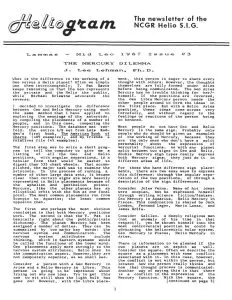
Heliocentric Mechanics, Astrometeorology, and Mundane Forecasting. This archival document is Issue No. 3 (Lammas / Mid Leo 1987) of the Heliogram, published by the NCGR Helio S.I.G.. The issue heavily features technical methodologies for integrating geocentric and heliocentric data, alongside rigorous mundane weather tracking. Key contributions include J. Lee Lehman’s statistical exploration of the differences between Geo Mercury (thinking) and Helio Mercury (communicating), Michael Erlewine’s structural breakdown of Helio Archetypes (Yin/Yang, Trine/T-Square), and T. Pat Davis’s mundane analysis of Senator Joseph McCarthy and Queen Elizabeth I. Additional features include Margaret Meister’s retrospective analysis of the 1947 Texas City Explosion, Dot Willis’s weather forecasting for the Autumnal Equinox and late-1987 eclipses, and a spirited debate between NCGR Research Director Michael P. Munkasey and Edith Custer regarding the astronomical logic of mixing heliocentric planets with geocentric house systems.

Issue Highlights

Articles: The Mercury Dilemma – J. Lee Lehman, Ph.D.

Helio Meditations II – Michael Erlewine

A Tribute to Zane B. Stein – T. Pat Davis

Texas City Revisited – Margaret M. Meister

Weather or Not – Dot Willis

Geo vs Helio Mars – T. Patrick Davis

Senator Joseph Raymond McCarthy – T. Pat Davis

Heliocentric: Magnitude of Influence – T. Patrick Davis

Discussions: Geocentric vs. Heliocentric Mercury dynamics The “Helio Challenge”: Debating the validity of mixing Geo houses with Helio planets The August 9, 1987 Supermoon and associated severe weather warnings Upcoming 1988 Saturn/Uranus conjunctions (Geo vs. Helio dates)

Notable contributors: J. Lee Lehman Margaret Meister Michael Erlewine T. Pat Davis Edith Custer Dot Willis Michael P. Munkasey

Chart data: Zane B. Stein Fred Astaire Jackie Gleason Giant Baby Panda Texas City Explosion (Grandcamp & High Flyer) Anita McKeown (“Calamity Jane”) Queen Elizabeth I Senator Joseph Raymond McCarthy 1988 Presidential Candidates (Richard Gebhardt, George Bush, Mario Cuomo, Michael Dukakis, Jack Kemp, Bruce Babbitt, Joseph Biden, Jesse Jackson, Paul Martin Simon)

Heliogram #1 Candlemas 1987

Heliogram, Special Collections

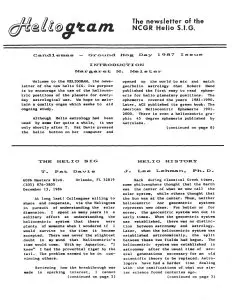
Heliocentric Astrology, Astrometeorology, and Astrological History. This archival document is the inaugural Candlemas / Ground Hog Day 1987 Issue of the Heliogram, the official newsletter of the NCGR Helio Special Interest Group (S.I.G.) edited by Margaret M. Meister. The issue establishes the group’s mission to encourage the everyday use of heliocentric planetary positions and features foundational essays on the history and validity of the heliocentric perspective. Key contributions include J. Lee Lehman’s historical trace of heliocentric concepts from ancient Greece, Phillip Sedgwick’s philosophical essay on the paradigm shifts required to embrace heliocentricism, and Dot Willis’s detailed astrometeorological forecasts using heliocentric alignments to predict extreme weather and seismic events for the 1987 Vernal Equinox and eclipses. Additional features include Edith Custer’s “Custer Corner” discussing Sylvester Stallone’s chart and Supermoon flooding, along with T. Pat Davis advocating for the commercial and analytical integration of helio coordinates.

Issue Highlights

Articles: Introduction – Margaret Meister

The Helio SIG – T. Pat Davis

Helio History – J. Lee Lehman, Ph.D.

Essentiality of Heliocentricism – Phillip Sedgwick

Weather: Vernal Equinox & Eclipses – Dot Willis

Discussions: Sylvester Stallone’s helio chart indicating violent action roles The impact of “Supermoons” on coastal flooding and weather U.S.A. helio chart transits during Reagan’s November 1986 speech Using Helio Mercury in relationship charts and horary astrology

Notable contributors: Margaret Meister T. Pat Davis J. Lee Lehman Edith Custer Phillip Sedgwick Dot Willis Barbara May

Chart data: Sylvester Stallone U.S.A. (Helio with transits) Winter Solstice 1986 (Geo and Helio) Vernal Equinox 1987 (Helio) Annular and Lunar Eclipses 1987

Those Elusive Lacks

Marion D. March, Special Collections

Natal Astrology, Psychological Astrology. This comprehensive article explores the phenomenon of ‘lacks’ or deficiencies in a birth chart, specifically focusing on missing elements (Fire, Earth, Air, Water), missing qualities (Cardinal, Fixed, Mutable), missing house emphases, unaspected planets, and missing aspect types. March provides a profound psychological framework where deficiencies often result in compensatory or overcompensatory behaviors, leading individuals to either struggle with or excel in those specific areas based on other configurations in their chart.

The text is heavily illustrated with examples of public figures, ranging from celebrities and politicians to historical figures and criminals, to demonstrate how a lack manifests in real life. March explains that when an element or quality is missing, the individual’s motivation often shifts to other emphasized areas of the chart, creating a dynamic of ‘faking’ or overcompensating for the perceived deficit. For example, a lack of Fire might lead to a lack of energy or enthusiasm, but an individual with such a deficiency might push themselves into the spotlight to prove their value to others.

The final sections discuss technical nuances, such as unaspected planets and specific aspect deficiencies like the lack of oppositions or squares. The author emphasizes that while these ‘lacks’ present challenges, they are rarely insurmountable; rather, they demand a different approach to internal integration and growth. A skilled astrologer, per the author, can guide clients to recognize these patterns and find healthy ways to balance their charts, thereby preventing the negative internalization or avoidance behaviors often associated with these deficiencies.

Issue Highlights:

Articles:
Those Elusive Lacks – Marion D. March

Discussion:
Compensatory mechanisms for missing elements in a chart
Psychological impacts of missing qualities (Cardinal, Fixed, Mutable)
The influence of unaspected planets on personality integration
Difficulty of life challenges for charts lacking squares or oppositions

Chart data:
Louis Pasteur, Jack Benny, Merle Oberon, Vincent Price, Hubert H. Humphrey, Fanny Brice, Zelda Fitzgerald, James Huberty, Mark Twain, Maurice Udall, Claus von Bulow, Christiaan Barnard, J. Paul Getty, Vincent van Gogh, Geraldine Ferraro, Judith Krantz, Edgar Cayce, Marlon Brando, Dustin Hoffman, Jack Nicholson, Helen Keller, Napoleon Bonaparte, Jeffrey MacDonald, Marlene Dietrich, Muhammed Ali, George Foreman, Joe Frazier, Placido Domingo, Henri Toulouse Lautrec, Ludwig van Beethoven, Bruno Hauptmann, George Braque, Barbra Streisand, Elizabeth Barrett Browning, Errol Flynn, Arturo Toscanini, Corazon Aquino, Prince Philip, Jim Jones, Bruce Springsteen, Timothy Leary, Jesse Jackson, John Belushi, Sam Goldwyn, Gary Hart, Desi Arnaz, Orson Welles, Princess Diana, Barbara Hutton, T.E. Lawrence, Linus Pauling, Prince Charles, Robyn Smith, Queen Elizabeth II, Mia Farrow, Ava Gardner, Rajiv Gandhi, Vida Blue, Vaslav Nijinsky, Maria Montessori, Mahatma Gandhi, Anwar Sadat, Art Buchwald, Jean Claude Killy, Mickey Rooney, Sammy Davis Jr., Nancy Reagan, Roald Amundsen, Rock Hudson, Robert Oppenheimer, Lena Horne, Richard Loeb, Ogden Nash, Ted Kennedy, Sally Ride, James Pike, Marvin Mitchelson, Frank Sinatra, John F. Kennedy, Nelson Rockefeller, Clint Eastwood, Ignace Paderewski, Emily Dickinson, Simone de Beauvoir, Sandra O’Connor, Keenan Wynn, Anne Morrow Lindbergh, Gertrude Stein, Beatrix of the Netherlands, John Dean, Enrico Caruso, Maurice Chevalier, Alfred Hitchcock, Stacey Keach, Princess Anne, Prince Charles, Benito Mussolini, David Bowie, Madonna, Charles Manson, Josef Goebbels, Tyrone Power, Montgomery Clift, Scott Fitzgerald, Noel Coward, Margaret Sullavan, Leslie Howard, Charles Lindbergh.

Notable contributors:
Marion D. March (Psychological interpretations of natal chart deficiencies)

Solar Return Astrology, Natal-Solar Synthesis, House Placements, Aspect Analysis. This document serves as a comprehensive instructional manual authored by Marion D. March regarding the methodology and interpretation of Solar Return charts. It provides a detailed breakdown of how to integrate the Radix (natal chart) with the Solar Return (annual return) to predict life events. The author emphasizes the significance of the Solar Ascendant, the placement of the Sun within Solar houses, and the importance of analyzing planetary house rulerships to determine focus areas for the upcoming year. The guide differentiates between the use of birth locations versus current locations, advocating for a pragmatic approach that accounts for the individual’s primary residence.

The text extensively covers the thematic meanings of all twelve houses within the Solar Return, offering specific delineations for career, finance, relationships, health, and travel. A central component of the instruction is the synthesis of Radix and Solar charts, with specific techniques for interpreting planetary influences at the chart angles. The author provides cautionary notes on interpreting stressful aspects, emphasizing that “the stars incline but do not compel,” and encourages astrologers to develop a consistent method that best suits their practice.

Issue Highlights:

Articles:
Tierkreiszeichen am Solar-Aszendenten – Marion D. March
Häuser im Solar – Marion D. March
Planeten um den Solaraszendenten – Marion D. March
Allgemeine Regeln für Solare – Marion D. March
Besondere Anzeigen im Solar – Marion D. March

Discussion:
Techniques for Solar Return calculation
Interpretation of the Solar Ascendant
Synthesis of Radix and Solar houses
Significance of planets at the chart angles
Practical case studies on famous individuals

Chart data:
Luciano Pavarotti
Ernest Hemingway
Pablo Picasso
Boris Becker
Hermann Hesse

Notable contributors:
Marion D. March (Astrological instruction and methodology)

House Systems, Mundane Astrology, and Astrological Techniques. This archival document is the 4th Edition of Mercury Hour (January 1975), an open-forum astrological journal edited and published by Edith Custer. The issue brings together prominent mid-20th-century astrologers to debate chart construction techniques, planetary rulerships, sensitive mathematical points, and practical counseling philosophies. Key technical contributions include Michael Munkasey’s classification of 23 house systems and introduction of the Arcturan system, Dr. James T. Hayes’s critique of cause-and-effect determinism and traditional dignities, Ivy M. G. Jacobson’s guide to L. Edward Johndro’s Birth Locality Charts, Inge Aach’s demonstration of 90-degree dial midpoint analysis using Henry Kissinger’s chart, and Ruth Dewey’s research on the Vertex. Additional discussions cover Carl Payne Tobey’s Astrology of Inner Space, Stephen Arroyo on Mars in Scorpio medical correlations, Zip Dobyns’s announcement of International Astrological Abstracts, and Isabel Hickey’s biographical account of her spiritual astrological practice.

Issue Highlights

Articles:

House Systems – Michael Munkasey

Four Questionable Practices of Astrologers – Dr. James T. Hayes

Excerpt from Foundation of the Astrological Chart – Ivy Jacobson (Johndro Locality Charts)

The Cosmic Structure – Inge Aach (continuation of the Cosmobiology Series)

The Vertex (series continuation) – Ruth Dewey

Discussion:

Carl Payne Tobey’s Astrology of Inner Space (various contributors)

Chart data:

(some in question or incomplete)

Gerald Ford
Muhammed Ali
James Dean
Marlon Brando
Clark Gable
Henry Kissinger

Notable contributors:

Stephen Arroyo (Mars in Scorpio; Polarity Therapy)

Zip Dobyns (formation of International Astrological Abstracts – IAA)

Isabel Hickey (short bio & involvement in astrology)

Computerized Astrology, Astrological Programming, A.C.T. Conference, Trans-Neptunian Planets. This issue of Matrix Magazine serves as a bridge between early computing technology and professional astrological practice. It focuses heavily on the technical application of microcomputers (Commodore PET, Apple II, TRS-80) to astrological research, offering BASIC programming code for chart calculations, orbital elements for Trans-Neptunian planets (Cupido, Hades, Zeus, Kronos, Apollon, Admetos, Vulkan, Poseidon), and instructions for printer-based astroglyph generation. The magazine also introduces the “ASTEK I,” a specialized astrological computer, and discusses the use of microfilm for archival astrological data storage.

Issue Highlights:
The 1980 Johndro Award is presented to Neil F. Michelsen for his pioneering work in computer-assisted ephemerides and astrological software. The issue also provides a comprehensive schedule for the first Astrological Conference on Techniques (A.C.T.) held in New Orleans, covering a wide array of research topics from planetary cycles to rectifiction methods.

Articles:
Orbital Elements for the Transneptunians – James Neely
Matrix Horoscope Program in BASIC – Michael Erlewine
Conversational Math – Buz Overbeck
Dot-Matrix Astroglyphs – Michael Erlewine
Introduction to Micrographics – Charles Paul Jones
On Astro-Geography – Mark Pottenger
Fixed Star Program – Mark Pottenger
ASTEK I: Astro-Computer – Fairbairn & Wesenberg
Planetary Hours & Day of Week – Dwight W. Johnson

Discussion:
Application of BASIC programming in natal astrology
Technical specifications and history of the ASTEK I calculator
Astro-Geography and meridian contacts
Statistical analysis of astrological data
Microfilm implementation for astrological libraries
Planetary rulers and the day of the week

Chart data:
Michael Erlewine (Born 7/18/1941, 4:03 PM EST, Lancaster, PA)

Notable contributors:
Michael Erlewine (Editor/Computing), James Neely (Orbital elements/programming), Mark Pottenger (Fixed star programming), Charles Jayne (Conference/Techniques advice), Buz Overbeck (Conversational math)

Grand Configurations, Stelliums, T-Squares, Grand Trines, Yods, Mystic Rectangles, Astrological Aspects, Chart Configurations, Chart Patterns. This document is a comprehensive transcript of two 1.5-hour lectures by Marion D. March, focusing on major and minor astrological configurations, aspect patterns, and how to find the highest philosophical and spiritual potential in a chart. March explores how 3 or more planets joined by aspect form a definite pattern or ‘Gestalt’ that exerts an all-pervading and powerful force in a horoscope. Detailed rules for allowable orbs are discussed, emphasizing that tighter orbs yield stronger effects. Major aspect patterns covered include the Stellium, Grand Square (Grand Cross), T-Square, Grand Trine, Kite, Inconjunct, Yod (Finger of God), Mystic Rectangle, and Grand Sextile, alongside minor configurations derived from midpoints, semi-squares, and semi-sextiles. Concrete celebrity chart examples are analyzed for each configuration: Louis Pasteur for the Stellium, Albert Schweitzer for the Fixed Grand Square, Marlon Brando for the T-Square, Angela Davis for the Grand Trine, and Walt Disney for the Yod.

Issue Highlights:

Articles:
Grand Configurations and How to Find the Highest Philosophical and Spiritual Potential in a Chart – Marion D. March

Discussion:
Stelliums and Conjunctions in the 1st House
Grand Squares across Cardinal, Fixed, and Mutable Qualities
T-Squares and the Significance of the Focal Planet and Empty Opposition
Grand Trines across Fire, Earth, Air, and Water Elements
Yods (Finger of God) and Inconjunct (Quincunx) Dynamics
Midpoint Structures and Minor Configurations

Chart data:
Louis Pasteur (12/22/1822)
Albert Schweitzer (1/14/1875)
Marlon Brando (4/3/1924)
Angela Davis (1/26/1944)
Walt Disney (12/5/1901)

Notable contributors:
Marion D. March (Author and Lecturer on Astrological Configurations)

Fertility, Infertility, and Astrology, Astrological Fertility Cycle, Dr. Eugen Jonas, Birth Control, Electional Pregnancy Charts, In Vitro Fertilization, Artificial Insemination, GIFT, ZIFT. Marion D. March explores the intersection of medical procedures and astrological fertility cycles, noting that while the topic needs great caution, the astrological fertility cycle based on the Sun-Moon distance at birth can be remarkably effective for timing pregnancy. The text outlines three main divisions: birth control using the cycle (which March cautions is unreliable), determining the best time to become pregnant via personalized fertility dates and electional rules, and timing pregnancies through modern medical techniques such as artificial insemination and in-vitro fertilization.

Issue Highlights: Comprehensive lecture notes and case studies focusing on the practical application of astrological fertility cycles, detailed computer-generated fertility lists, and step-by-step chart interpretations for a client named Mindy.

Articles:
Fertility, Infertility and Astrology – Marion D. March

Discussion:
The validity and unreliability of astrological birth control
Calculating the fertility cycle based on the Sun-Moon distance from the natal chart
Using electional astrology and lunar aspects for conception and medical implantation
Correlating moon signs with the biological prediction of a baby’s gender
Applying fertility timing to modern medical procedures like IVF, GIFT, and ZIFT

Chart data:
Mikki March Andina (Michele Dia March)
Mindy’s Fertility Charts (#1, #2, #3, #3A, #4, #7, #7A)

Notable contributors:
Marion D. March (Author and Astrologer)
Dr. Eugen Jonas (Czechoslovakian gynecologist and astrologer known for his work on fertility cycles)

Electional Astrology Rules

Marion D. March, Special Collections

Electional Astrology, Timing Events, Natal Chart Integration. Marion D. March outlines comprehensive rules and practical guidelines for erecting and interpreting electional astrology charts for various life events. The text emphasizes that the Moon serves as the primary consideration in any electional chart, requiring careful attention to its phase, speed, aspects, and zodiacal placement while strictly avoiding squares and void of course conditions. General rules dictate the use of applying aspects, favoring waxing moons, placing benefic planets like the Sun, Moon, Venus, and Jupiter above the horizon, and utilizing appropriate rising signs and modal qualities (cardinal, fixed, mutable) tailored to the specific venture.

Issue Highlights:
Detailed breakdown of electional requirements for specific life milestones, including marriage, moving into a home, purchasing a car or real estate, initiating lawsuits, undergoing surgery, and launching a business enterprise. Each category details specific house significators, planetary placements to avoid (such as angular Saturn, Uranus, or retrograde planets), and tactical adjustments required when perfection is unattainable.

Articles:
Electional Astrology – Marion D. March

Discussion:
General electional rules and lunar considerations
Marriage timing and relationship longevity indicators
Moving into a new residence and real estate purchases
Car purchases, contracts, and mechanical safeguards
Lawsuits, plaintiffs, defendants, and winning configurations
Surgical procedures, transit moon placements, and medical timing
Business startups, corporate formations, and planetary rulers

Chart data:
N/A
N/A

Notable contributors:
Marion D. March (Electional Astrology)

Ask A Librarian

Need assistance with your research or navigating our collection? Our library team is here to help.

Please fill out the form below with details about the topics, authors, or archival materials you are looking for, and one of our librarians will review your query and respond shortly.

Help

Whether you are looking for rare historical texts or trying to locate a specific book nearby, Alexandria iBase offers two primary ways to search. Here is how to choose the right tool for what you need:

The Library Catalogue

Think of this as your global master index.

The Catalogue works just like a traditional library search system, designed to help you locate books and media across the broader astrological landscape.

  • Physical Books: Find out where physical copies of books are held in libraries, archives, or collections near you.

  • Digital Files: Access downloadable or viewable digital editions when available.

  • Best Used For: Standard research, finding specific ISBNs or authors, and tracking down physical items in the real world.

Browse Catalogue

SPECIAL COLLECTIONS

Think of this as Alexandria’s exclusive private vault.

Collections gives you direct access to Alexandria’s own curated archive of rare, proprietary, and historic astrology media.

  • Exclusive Material: Features unique texts, manuscripts, audio recordings, and visual media that are not available anywhere else.

  • Direct Access: Digitized content ready to explore straight from the platform.

  • Best Used For: Deep-dive research, discovering hidden gems, and exploring rare, one-of-a-kind astrological resources.

Browse Special Collections

Cash & In-Kind Donations

Make a one-time or recurring tax deductible cash donation.

Payment options include donating directly with us, PayPal Giving and GoFundMe.

GoFundMe for Charities and PayPal Giving are registered for tax deductions and have no required processing fees. It does offer the option to tip.

Donate

*Subject to 2.5% processing fees

Contact Us

Have a question, feedback, or a inquiry about our archives? We’d love to hear from you. Please fill out the form below with your details and message, and a member of our team will get back to you as soon as possible.

Thank you for reaching out to the Alexandria iBase Project!