
Home » Retrograde Motion

Retrograde Motion

An astronomical optical illusion resulting from the differing orbital velocities of Earth and other celestial bodies, causing a planet to appear to move backward against the background stars. Astrological texts operationalize this phenomenon as a period of delay, revision, structural internalization, or procedural malfunction.

Filters

Filters


See more See less
See more See less
See more See less
See more See less
See more See less
See more See less
See more See less

Sorting

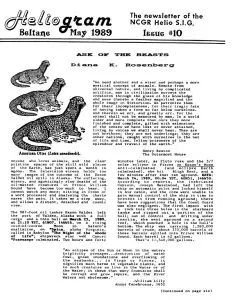
Heliocentric Astrology, Heliogram, NCGR Helio S.I.G., Mundane Astrology, Weather Prediction, Financial Astrology, Asteroids, Fixed Stars, Horary Astrology. This document is the May 1989 issue of the Heliogram, the newsletter of the NCGR Helio S.I.G. Edited by Margaret M. Meister and published with contributions from prominent heliocentric and mundane astrologers, the issue explores the intersections of heliocentric and geocentric astrology, weather forecasting, financial trends, and current world events. Articles delve into the environmental and astrological significance of the Exxon Valdez oil spill, incorporating fixed stars like Spica, Fomalhaut, and the constellation Cetus. Discussions extend to economic forecasts utilizing heliocentric horary charts, planetary alignments involving Mars, Saturn, and Uranus, and the usage of asteroids in mundane prediction. Historical analyses cover figures such as Vincent Wing, examining early heliocentric astrology and Keplerian mechanics. Comprehensive chart data and chronologies, including those for George Bush, nuclear disaster events like Three Mile Island and Chernobyl, and the Emperor Akihito, provide empirical depth to the technical explorations presented throughout the volume.

Issue Highlights:

Articles:
Ask of the Beasts – Diana K. Rosenberg
On File – Margaret M. Meister
Custer Corner: Some Thoughts On Helio – Edith Custer
New and Improved George Bush Chronology – Bill Meridian
Hello, Jupiter! – Barbara May
Elections, Nominations and Things That Go Bump in the Night – Margaret Meister, Edith Custer
Helio in the News – Zipporah Dobyns, Ph.D.
An Implausible Mars-Moon – T. Pat Davis
Emperor Akihito – Doris Greaves
Astrology and the Weather – Part V – Dorothy S. Willis
Doom Forestalled: A Study in Helio Horary – Susan Manuel
Bridge Collapse – Edith Custer
Helio History: Vincent Wing: The First Heliocentric Astrologer? – J. Lee Lehman, Ph.D.

Discussion:
Heliocentric planetary placements and comparative geo/helio charts
Mundane and economic forecasting via heliocentric horary charts
Astrological signatures of the Exxon Valdez oil spill and environmental disasters
Weather forecasting using heliocentric aspects (Venus, Mars, Jupiter, Saturn, Uranus, Neptune)
Historical analysis of heliocentric astronomy and astrology from Kepler to Vincent Wing

Chart data:
Exxon Valdez Oil Spill Chart (March 24, 1989)
Exxon Corporation Foundation Chart (August 10, 1892)
First Sustained Nuclear Reaction (December 2, 1942)
Three Mile Island Nuclear Power Plant Disaster (March 28, 1979)
Chernobyl Nuclear Plant Explosion (April 26, 1986)
Emperor Akihito Natal Chart (December 23, 1933)
Bridge Collapse, Covington, TN (April 1, 1989)
George Bush Natal Chart

Notable contributors:
Diana K. Rosenberg (Astrological zoology and environmental mundane charts)
Edith Custer (Helio Mercury configurations and structural chart observations)
Zipporah Dobyns (Asteroid placements and mundane events)
Susan Manuel (Heliocentric horary and economic predictions)
Dorothy S. Willis (Astrological weather forecasting)
J. Lee Lehman (Historical analysis of heliocentric astrology and Vincent Wing)
Barbara May (Heliocentric Jupiter placements)

Astrology, Houses, Transits, Reincarnation, Eclipses, Synastry, Numerology. This 13th edition of Mercury House (April 1977) provides a comprehensive collection of astrological discussions, research notes, and reader correspondence. Key topics covered include the interpretation of Saturn in various houses, house systems and critiques of traditional vs. equal house methods, the mechanics of eclipses, chart comparison (synastry), sidereal vs. tropical numbering, and reincarnation past-life regressions mapped through natal charts. Articles explore specialized techniques such as midpoints, deciles and quintiles (minor aspects), and the application of harmonics in chart analysis. The issue also features extensive letters from subscribers detailing personal transits, planetary aspects, and astrological research anomalies.

Issue Highlights:

Articles:
Zodiacal Numbering – Jeff Jawar
Saturn in the Houses (continuation) – Dr. Robert H. Goodrich
Saturn – Marc Penfield
A Key to Relationships [The Art of Chart Comparison] Introduction – Stephen Arroyo
Eclipses (first part in a series) – Ray Merriman
Some Notes on Astrological Research – Ingrid Naiman
Reincarnation – Marc Penfield
The Zodiac of Aspects (first of a two-part series) – Glenda Tomosovich
Astrological Review of an Autobiography [Alone by Admiral Richard E. Byrd] – Prem H. Joshi
The People’s Choice…A Different View of the Next Four Years – Dr. Robert H. Goodrich

Discussion:
Saturn in the 1st and 6th houses
House systems and Gauquelin research
Horoscope of Jesus
Aspects of artistic genius and medical astrology

Chart data:
Bob Dylan
Thor Heyerdahl
OJ Simpson
Omar Sharif
Ethel Kennedy
Jerry Brown
John Dean
Neil A. Armstrong
New York Stock Exchange

Notable contributors:
Marion March (Various topics and responses)
Zip Dobyns (Birthcharts and commentary)

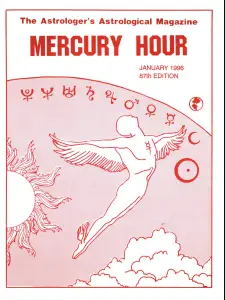
Mundane Astrology, Medical Astrology, and Predictive Astrology. This archival document is the 87th edition of Mercury Hour (January 1996), an astrological community journal edited and published by Edith Custer. The issue features articles, research notes, chart rectifications, software developments, and correspondence among practicing astrologers, including Bil Tierney’s psychological examination of Jupiter, Ed Dearborn’s technical breakdown of the “Translation of Light”, Valerie Vaughan’s defense of predictive astrology, Byron Ross Wahl’s analysis of the Solar Apex Synthetic Method (SASM), and the final installment of Robert “Buz” Myers’ lecture series on Moon-Saturn dynamics. Additionally, the journal covers mundane and political analyses of the O.J. Simpson verdict by John Kalus and Marion March, national chart rectifications for Washington, D.C. by Marc Penfield, insights on Uranus entering Aquarius by Kaye Shinker, medical and genetic commentary by T. Patrick Davis, software updates by Mark Pottenger, and tributes to astrologer Al H. Morrison.

Issue Highlights

Book Reviews
By Edith Custer:
Llewellyn’s 1996 Astrological Pocket Planner
Llewellyn’s Astrological Calendar 1996
Astrology Really Works by The Magi Society – Marc Penfield

Articles
A Look at Jupiter’s Shortcomings – Bil Tierney
Translation of Light – Ed Dearborn
Group Dynamics – Mary K. Creasey
Been There, Done That – Kaye Shinker
[O.J. Simpson verdict] – John Kalus
SASM, Columbus, and Samana Cay – Byron Ross Wahl
1995 Oven Saga – Roberta Strain
Moon/Saturn, Parts 7 and 8 of 8 – Robert “Buz” Myers
Winter Solstice 1995 – Dot Willis
The Art of Self-Defense: Lesson, Fighting at the Level of Your Opponent,
Part 1 of 2 – Valerie Vaughn
Al H. Morrison: Rectification, Poison Data, Genetics – T. Patrick Davis
[obituary & excerpts]
Discussions
Solar returns
O, J, Simpson trial
Chart data
(some incomplete or in question)
Powell, Colin
Washington, D.C.
Notable contributors
Donna Van Toen (various topics)
Mark Pottenger (Progressed MC techniques in software)
Marc Penfield (Chart of the U.S.A.)
Lee Lehman (corrections to Essential Dignities)
Marion March (O. J. Simpson trial, Chaos Theory, Solar Returns)

Pluto, Astrology, Shadow Work, Obsession, Metamorphosis. This lecture transcript from Duncan Nanney provides an unconventional exploration of Pluto, challenging standard astrological interpretations by encouraging the direct, conscious engagement with “forbidden” or taboo aspects of the human experience. Nanney argues that Pluto represents intense energy that, if repressed, manifests as uncontrollable or destructive external forces; conversely, he posits that by consciously confronting one’s “shadow” (obsessions, taboo sexual expressions, and deep-seated fears), an individual can achieve greater psychological integration and metamorphosis. He utilizes a “Planetville” concept—inspired by Rex Bills’ The Rulership Book—to map astrological archetypes onto a city, where Pluto governs the often ignored, “bad” parts of town, which are nonetheless essential to the whole.

Issue Highlights: The document serves as an analytical guide to navigating the 2002 Saturn-Pluto opposition, which the speaker links to broader themes of national security post-9/11 and the necessity for individual inner work. He discusses the difference between Uranus-driven inventiveness and Pluto-driven obsessive inquiry, frequently illustrating his points with film analyses (e.g., Blue Velvet) and personal anecdotes concerning his own “Plutonian” pursuits, including his experiences as a performance artist and in S/M communities. The lecture serves as a workshop in radical self-honesty, demanding that participants acknowledge their own dark desires rather than projecting them onto others or masking them with spiritual platitudes.

Articles:
How to Have Fun with Pluto (Revisited) – Duncan Nanney

Discussion:
The role of the Saturn-Pluto opposition in personal and collective transformation
The necessity of integrating the shadow and forbidden fruits in spiritual growth
The use of Local Space Maps to identify geographic correlations with natal charts
Case studies of celebrities (Madonna, Ed Wood, Jr., Lenny Bruce, Jack Nicholson, John Holmes, Roman Polanski, Anton LaVey, Ed Gein) through the lens of Plutonian energy

Chart data:
Madonna
Ed Wood, Jr.
Lenny Bruce
Jack Nicholson
John Holmes
Duncan Nanney
Roman Polanski
Anton LaVey
Ed Gein

Notable contributors:
Duncan Nanney (Astrological lecture, author of Planetville map)

ELEKTIONEN

Marion D. March, Special Collections

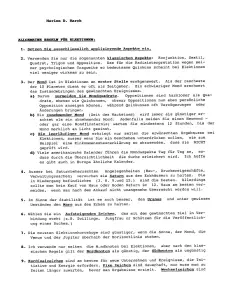
Electional Astrology, Horary vs. Electional, Rules for Marriage, Real Estate, Business Openings, and Automobile Purchases. This extensive instructional text and chart collection by renowned astrologer Marion D. March provides a comprehensive guide to Electional Astrology (Zeitwahl), detailing the foundational mechanics of selecting auspicious times for major life events. March contrasts electional astrology with horary astrology, emphasizing that while horary discovers answers from the moment a question is asked, electional proactively engineers a favorable outcome by consciously choosing the timing of an endeavor. The text systematically outlines the general rules of electional work, highlighting the paramount importance of the Moon as the fastest-moving time-giver, the avoidance of voids-of-course Moons and lunar hard aspects, the placement of the luminaries and benefics above the horizon, and the strategic positioning or restriction of malefics like Saturn, Mars, Uranus, and Pluto away from the angles (Eckhäuser). Furthermore, March offers deep philosophical insights into the psychological vs. pragmatic approaches of modern astrology, arguing that while natal and directional counseling embraces Jungian free will and therapeutic dialogue, electional charts require unvarnished, pragmatic precision to protect clients from missteps and failures. Special attention is given to the rulership systems of outer planets (Uranus, Neptune, Pluto) and their integration into modern practice, drawing on historical timelines of their discoveries coinciding with major paradigm shifts in human civilization.

Issue Highlights: Comprehensive manuals and multiple case-study charts with detailed annotations by Marion D. March covering weddings, home relocations, property acquisitions, land sales, business inaugurations, and vehicle purchases.

Articles:
Allgemeine Regeln für Elektionen – Marion D. March
Was sind Elektionen? – Marion D. March
Regeln für eine Eheschliessung – Marion D. March
Umzug in ein Haus, eine Eigentums- oder Mietwohnung – Marion D. March
Ankauf oder Verkauf von Immobilien (Haus oder Grundstücke) – Marion D. March
Gründung einer Firma oder Aktiengesellschaft – Marion D. March
Regeln für Organisationshoroskope – Rex Bill
Ankauf eines Autos – Marion D. March

Discussion:
The primacy of the Moon in electional timing and avoiding void-of-course states
The strategic management of Saturn and outer planets in angular houses
The application of the Part of Fortune (Pars Fortuna) to resolve restrictive chart configurations
Contrasting psychological natal counseling with pragmatic electional forecasting
The modern attribution of planetary rulerships for Uranus (Aquarius) and Neptune (Pisces)

Chart data:
Heirat (June 7, 1992, Los Angeles, CA)
Heirat Molly & Fred (April 7, 1974, Sherman Oaks, CA)
Heirat Jan & Robert (July 8, 1978, Wailua, Kauai, HI)
Heirat Franz & Corinne (July 13, 1990, Basel, Switzerland)
Heirat Christa & Brett (September 15, 1973, Tahoe City, NV)
Hauseinzug (December 3, 1973, Los Angeles, CA)
Apartamentseinzug (September 15, 1988, Zurich, Switzerland)
Hauskauf (January 9, 1992, San Diego, CA)
Landverkauf (March 10, 1990, Malibu, CA)
Geschaeftseroeffnung / Buchladen (June 16, 1978, New York, NY)
Restauranteroeffnung (March 1, 1983, Coeur d’Alene, ID)
Organisationshoroskop (October 28, 1975, Encino, CA)
Automobilkauf (October 1, 1983, Beverly Hills, CA)
Rolls Royce Kauf (March 15, 1989, Los Angeles, CA)

Notable contributors:
Marion D. March (Author, Astrologer, and Instructor)
Rex Bill (Author of ‘The Rulership Book’ utilized for organizational and derivative house analysis)

Electional Astrology Rules

Marion D. March, Special Collections

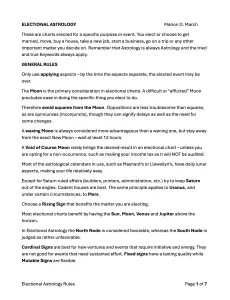
Electional Astrology, Timing Events, Natal Chart Integration. Marion D. March outlines comprehensive rules and practical guidelines for erecting and interpreting electional astrology charts for various life events. The text emphasizes that the Moon serves as the primary consideration in any electional chart, requiring careful attention to its phase, speed, aspects, and zodiacal placement while strictly avoiding squares and void of course conditions. General rules dictate the use of applying aspects, favoring waxing moons, placing benefic planets like the Sun, Moon, Venus, and Jupiter above the horizon, and utilizing appropriate rising signs and modal qualities (cardinal, fixed, mutable) tailored to the specific venture.

Issue Highlights:
Detailed breakdown of electional requirements for specific life milestones, including marriage, moving into a home, purchasing a car or real estate, initiating lawsuits, undergoing surgery, and launching a business enterprise. Each category details specific house significators, planetary placements to avoid (such as angular Saturn, Uranus, or retrograde planets), and tactical adjustments required when perfection is unattainable.

Articles:
Electional Astrology – Marion D. March

Discussion:
General electional rules and lunar considerations
Marriage timing and relationship longevity indicators
Moving into a new residence and real estate purchases
Car purchases, contracts, and mechanical safeguards
Lawsuits, plaintiffs, defendants, and winning configurations
Surgical procedures, transit moon placements, and medical timing
Business startups, corporate formations, and planetary rulers

Chart data:
N/A
N/A

Notable contributors:
Marion D. March (Electional Astrology)

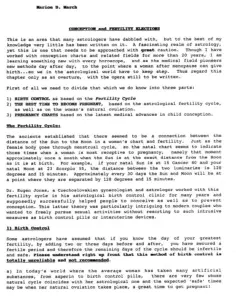
Fertility Astrology, Dr. Eugen Jonas Method, Electional Charts for Conception. Marion D. March provides a detailed guide on utilizing astrological fertility cycles (pioneered by Dr. Eugen Jonas) and electional charts for determining the best times to conceive. The text covers the three main divisions: birth control based on fertility cycles, optimal times for pregnancy based on both astrological fertility cycles and natural ovulation, and pregnancy charts adapted to modern medical procedures like in-vitro fertilization. March discusses practical case studies involving clients like Mindy, Marissa, Sarah, and Jennifer, analyzing the application of lunar aspects, void-of-course moons, and planetary transits in relation to natal charts.

Issue Highlights:

Articles:
Conception and Fertility Elections – Marion D. March

Discussion:
Calculating astrological fertility cycles based on the Sun-Moon phase angle at birth
Electional chart rules for conception focusing on the Moon’s applying aspects
Aligning astrological fertility dates with modern medical fertility treatments and in-vitro procedures

Chart data:
Mindy
Marissa
Sarah
Jennifer

Notable contributors:
Marion D. March (Author and Astrologer)
Dr. Eugen Jonas (Developer of the astrological fertility and birth control cycle)

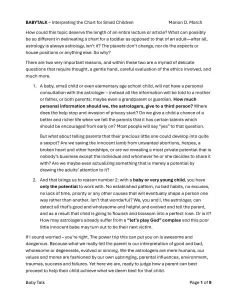
Child Astrology, Ethics in Consultation, Chart Interpretation for Toddlers and Youths. Marion D. March explores the profound ethical and practical responsibilities involved when astrologers delineate charts for infants, toddlers, and small children. Rather than consulting directly with the individual, the astrologer speaks to parents, guardians, or grandparents, raising critical questions regarding privacy, potential versus actualization, and the danger of falling into a “let’s play God” complex. March stresses that a child’s chart reveals potential, not a fixed destiny, and warns against imposing the astrologer’s or parents’ personal biases upon the developing mind. The text examines the psychological value of stress and squares in a chart as crucial catalysts for personal growth, resilience, and independence rather than purely negative omens.

Issue Highlights:
Detailed chart delineations for several children (Mikki, Bolly, Tina, and Linda), alongside the royal chart of Prince William of England, demonstrating how similar ascendants (such as Sagittarius) manifest entirely different personalities based on planetary configurations, aspects, and family dynamics. March also details her personal practice methodology, including client data sheets, recording sessions, and written addendums for young children.

Articles:
BABYTALK – Interpreting the Chart for Small Children – Marion D. March

Discussion:
Ethics of third-party consultations and child privacy
The psychological function of squares and stress in personal development
Yods, T-squares, and mutual reception in youth horoscopes
Evaluating sibling dynamics and birth timing through transits and progressions
Cultural, ethnic, and religious backgrounds affecting child-rearing expectations
Astrological indicators for legal careers, communication talents, and artistic inclinations

Chart data:
Mikki 
Bolly
Prince William of England
Tina 
Linda

Notable contributors:
Marion D. March (Author and Astrologer)

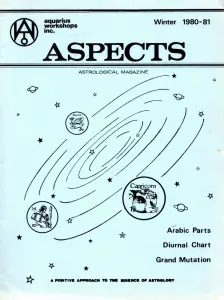
ASPECTS Vol. 6 No. 1 Winter 1980-81 Part 2/2

ASPECTS Magazine, Special Collections

Astrological techniques, horary analysis, Arabic parts, Diurnal charts, and the Grand Mutation of Jupiter and Saturn. This issue of Aspects features extensive technical explorations of predictive and mundane astrology. Robert ‘Buz’ Myers details the calculation and application of Arabic Parts. Marion D. March explores the grand astrological significance of the Jupiter-Saturn conjunction, evaluating its historical impacts and mundane country correlations using Jim Lewis’s Astro*Carto*Graphy. Lenora M. Hill introduces the simplicity and practical application of the Diurnal (daily) Chart, complete with step-by-step mathematical examples, Yod configurations, and transit correlations. Joan McEvers provides insights into numerological pinnacles, while Linda Green investigates Astropalmistry through hand-shape classifications and water-hand patterns. Enrique Linarés introduces the ‘Point of Life’ progression method. Additionally, book reviews by Marion D. March and data columns by Lois Rodden round out the edition.

Issue Highlights:

Articles:
How to Calculate Your Arabic Parts – Robert ‘Buz’ Myers
The Great Jupiter/Saturn Conjunction – Marion D. March
The Diurnal (Daily) Chart – Lenora M. Hill
The Point of Life – Enrique Linarés
Basic Delineation – Marion D. March
Astro-Numerology: The Meanings of the Numbers (Pinnacles) – Joan McEvers
Astropalmistry – Linda Green

Discussion:
Calculating Arabic parts using formula segments
Jupiter-Saturn conjunctions and Grand Mutations entering Air signs
Diurnal chart calculation and activation via house cusps
Point of Life progression calculations
Astrological data corrections and book reviews

Chart data:
Horary Question (8/17/79 8:49 PM PDT, Coeur d’Alene)
Basic Delineation natal chart (3/30/1853 11:00 AM LMT, Zundert, Holland)
Diurnal Chart (June 28, 1980)
Water Hand Natal Horoscope (Figure 2)

Notable contributors:
Robert ‘Buz’ Myers (Arabic Parts)
Marion D. March (Jupiter-Saturn Conjunction & Basic Delineation)
Lenora M. Hill (Diurnal Charts)
Enrique Linarés (Point of Life Progression)
Joan McEvers (Astro-Numerology)
Linda Green (Astropalmistry)
Lois Rodden (Data Column)

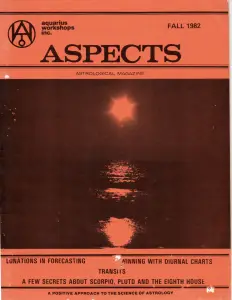
ASPECTS Vol 7 No 4 Fall 1982

ASPECTS Magazine, Special Collections

Aspects Astrological Magazine, Vol. 7 No. 4, Fall 1982. Published by Aquarius Workshops, Inc., Encino, California. Edited by Nancy Cassidy. This issue explores a wide range of advanced and foundational astrological techniques, including mundane forecasting through ingress charts, techniques for utilizing diurnal charts in financial and lottery forecasting, and psychological insights into Scorpio, Pluto, and the eighth house. Contributions from prominent astrologers cover topics such as vocational astrology, transits, lunations, and expansive analyses of Jupiter across the zodiacal signs.

Issue Highlights: Articles feature Judy Johns Tonyan examining the Libra Ingress chart for global political tensions, Jeff Jawer analyzing the psychological depth of Scorpio and Pluto, Sophia Mason detailing the mechanics and calculation of Diurnal Charts for winning potentials, and Angel Thompson providing a comprehensive guide to interpreting transits. Additionally, Marion D. March delineates the astrological chart of Prince William, Joan McEvers outlines the twelfth house, and Nancy Cassidy continues her Beginner’s Blocks series focusing on Jupiter.

Articles:
Libra Ingress – Judy Johns Tonyan
A Few Secrets About Scorpio, Pluto, and the Eighth House – Jeff Jawer
Winning With Diurnal Charts – Sophia Mason
Transits – Angel Thompson
Keys to Learning: Twelfth House – Joan McEvers
Vocations in Focus – Jon Tabakin
Basic Delineation: Prince William Arthur Philip Louis – Marion D. March
Lunations in Forecasting – Marwayne Leipzig
Beginner’s Blocks: Jupiter – Nancy Cassidy

Discussion:
Global mundane forecasts and political instability using ingress charts
Calculating and applying diurnal charts for financial timing and events
Psychological integration of Pluto, Scorpio, and eighth-house dynamics
Vocational profiling through planetary aspects and focal points
The expansive and philosophical nature of Jupiter in all twelve signs

Chart data:
Prince William Arthur Philip Louis
Bill Blass
Coco Chanel
Christen Dior
Various anonymous example charts for diurnal and transit forecasting

Notable contributors:
Judy Johns Tonyan (Mundane astrology and ingress charts)
Jeff Jawer (Psychological astrology and Pluto)
Sophia Mason (Predictive techniques and diurnal charts)
Angel Thompson (Transit interpretation)
Marion D. March (Natal and mundane delineation)
Lois Rodden (Data column and historical film charts)

Ask A Librarian

Need assistance with your research or navigating our collection? Our library team is here to help.

Please fill out the form below with details about the topics, authors, or archival materials you are looking for, and one of our librarians will review your query and respond shortly.

Help

Whether you are looking for rare historical texts or trying to locate a specific book nearby, Alexandria iBase offers two primary ways to search. Here is how to choose the right tool for what you need:

The Library Catalogue

Think of this as your global master index.

The Catalogue works just like a traditional library search system, designed to help you locate books and media across the broader astrological landscape.

  • Physical Books: Find out where physical copies of books are held in libraries, archives, or collections near you.

  • Digital Files: Access downloadable or viewable digital editions when available.

  • Best Used For: Standard research, finding specific ISBNs or authors, and tracking down physical items in the real world.

Browse Catalogue

SPECIAL COLLECTIONS

Think of this as Alexandria’s exclusive private vault.

Collections gives you direct access to Alexandria’s own curated archive of rare, proprietary, and historic astrology media.

  • Exclusive Material: Features unique texts, manuscripts, audio recordings, and visual media that are not available anywhere else.

  • Direct Access: Digitized content ready to explore straight from the platform.

  • Best Used For: Deep-dive research, discovering hidden gems, and exploring rare, one-of-a-kind astrological resources.

Browse Special Collections

Cash & In-Kind Donations

Make a one-time or recurring tax deductible cash donation.

Payment options include donating directly with us, PayPal Giving and GoFundMe.

GoFundMe for Charities and PayPal Giving are registered for tax deductions and have no required processing fees. It does offer the option to tip.

Donate

*Subject to 2.5% processing fees

Contact Us

Have a question, feedback, or a inquiry about our archives? We’d love to hear from you. Please fill out the form below with your details and message, and a member of our team will get back to you as soon as possible.

Thank you for reaching out to the Alexandria iBase Project!