
Home » Joan McEvers » Page 2

Joan McEvers

Filters

Filters


See more See less
See more See less
See more See less
See more See less
See more See less
See more See less
See more See less

Sorting

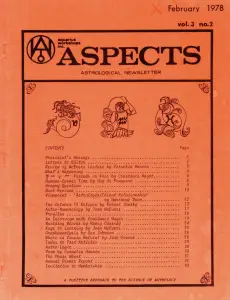
ASPECTS Vol. 3 No 2. Feb 1978

ASPECTS Magazine, Special Collections

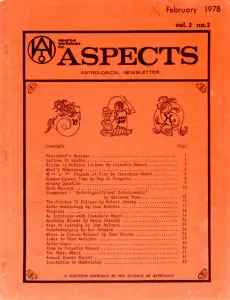
Astrological Education, Natal Charting, and Technique Synthesis. This issue of Aspects focuses heavily on the pedagogical and professional aspects of astrology, emphasizing the “positive approach” advocated by the Aquarius Workshops organization. Key themes include the ethical responsibilities of the astrologer, the necessity of rigorous natal chart synthesis rather than superficial interpretations, and the application of astrological tools to everyday life events. The content ranges from foundational lessons for beginners to advanced discussions on eclipses, horary techniques, and speculative systems like “Humano-Cosmic Time.”

The issue provides extensive educational material, including a detailed exploration of eclipses by Robert Jansky, who characterizes them as periods of “crisis and emphasis” requiring house-based analysis. Joan McEvers contributes foundational articles on astro-numerology and chart signature assessment, while Constance Mayer offers a comparative analysis of the distinct energies of Uranus and Neptune. Additionally, the newsletter features a candid interview with Connie Mayer on the teaching and practice of astrology, emphasizing the importance of objective, non-predictive counseling that respects client free will.

Beyond theoretical discussions, the newsletter functions as a community hub, reporting on the SWAC (Southwestern Astrology Conference) and internal board business, such as membership dues and organizational bylaws. It also promotes upcoming events and publications, highlighting the ongoing effort to define and elevate the professional standards of the field through ethical conduct and informed practice.

Issue Highlights:

Articles:
Review of McEvers Lecture – Cornelia Hansen
Friends or Foes – Constance Mayer
Humano-Cosmic Time – Guy de Penguern
The October 12 Eclipse – Robert Jansky
Astro-Numerology – Joan McEvers
An Interview with Constance Mayer – Marion D. March
Building Blocks – Nancy Cassidy
Keys to Learning – Joan McEvers
Graphoanalysis – Sue Johnson
Where is Cousin Melvin? – Jean Graves
Astro-Logic – Aunt Asty (pseudonym)

Discussion:
The ethical role of the astrologer in client counseling
Application of eclipse cycles in natal prediction
Technique for “turning the house” to locate relations
Integrating astro-numerology with chart analysis

Chart data:
Capricorn Ingress Chart (Dec 21, 1977)
Horary Question Chart (July 5, 1977)

Notable contributors:
Robert Jansky (Eclipses)
Joan McEvers (Astro-numerology, teaching philosophy)
Constance Mayer (Planetary comparison)
Guy de Penguern (Humano-Cosmic Time)
Marion D. March (Interviewing & editing)
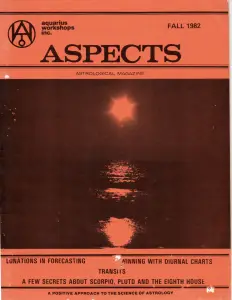
ASPECTS Vol 7 No 4 Fall 1982

ASPECTS Magazine, Special Collections

Aspects Astrological Magazine, Vol. 7 No. 4, Fall 1982. Published by Aquarius Workshops, Inc., Encino, California. Edited by Nancy Cassidy. This issue explores a wide range of advanced and foundational astrological techniques, including mundane forecasting through ingress charts, techniques for utilizing diurnal charts in financial and lottery forecasting, and psychological insights into Scorpio, Pluto, and the eighth house. Contributions from prominent astrologers cover topics such as vocational astrology, transits, lunations, and expansive analyses of Jupiter across the zodiacal signs.

Issue Highlights: Articles feature Judy Johns Tonyan examining the Libra Ingress chart for global political tensions, Jeff Jawer analyzing the psychological depth of Scorpio and Pluto, Sophia Mason detailing the mechanics and calculation of Diurnal Charts for winning potentials, and Angel Thompson providing a comprehensive guide to interpreting transits. Additionally, Marion D. March delineates the astrological chart of Prince William, Joan McEvers outlines the twelfth house, and Nancy Cassidy continues her Beginner’s Blocks series focusing on Jupiter.

Articles:
Libra Ingress – Judy Johns Tonyan
A Few Secrets About Scorpio, Pluto, and the Eighth House – Jeff Jawer
Winning With Diurnal Charts – Sophia Mason
Transits – Angel Thompson
Keys to Learning: Twelfth House – Joan McEvers
Vocations in Focus – Jon Tabakin
Basic Delineation: Prince William Arthur Philip Louis – Marion D. March
Lunations in Forecasting – Marwayne Leipzig
Beginner’s Blocks: Jupiter – Nancy Cassidy

Discussion:
Global mundane forecasts and political instability using ingress charts
Calculating and applying diurnal charts for financial timing and events
Psychological integration of Pluto, Scorpio, and eighth-house dynamics
Vocational profiling through planetary aspects and focal points
The expansive and philosophical nature of Jupiter in all twelve signs

Chart data:
Prince William Arthur Philip Louis
Bill Blass
Coco Chanel
Christen Dior
Various anonymous example charts for diurnal and transit forecasting

Notable contributors:
Judy Johns Tonyan (Mundane astrology and ingress charts)
Jeff Jawer (Psychological astrology and Pluto)
Sophia Mason (Predictive techniques and diurnal charts)
Angel Thompson (Transit interpretation)
Marion D. March (Natal and mundane delineation)
Lois Rodden (Data column and historical film charts)

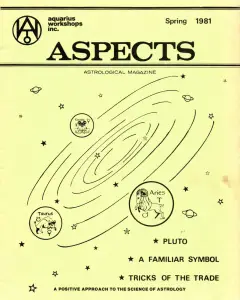
ASPECTS Vol 6 No 2 Spring 1982

ASPECTS Magazine, Special Collections

Astrological Methodology, Natal Analysis, and Evolutionary Astrology. This issue of Aspects features extensive technical discussions regarding the practical application of astrology. A significant portion of the magazine is dedicated to the philosophy and mechanics of individual charts, notably through Robert Carl Jansky’s detailed exploration of the Sun symbol as a representation of personal space, ego-control, and evolutionary potential. The discourse extends to professional practice with Robert Glasscock’s insights into client management, chart rectification techniques, and the “degree for a year” predictive method. Additionally, Jeff Green provides a deep dive into evolutionary astrology, examining Pluto’s role in the birth chart as a primary indicator of karmic patterns and the soul’s path through incarnation, utilizing the charts of historical figures like Richard Nixon as case studies.

Issue Highlights:
The magazine explores mundane astrology through the lens of the 1981 Aries Ingress chart, projecting potential national trends in economy, diplomacy, and global politics. Practical “building blocks” are provided for students, including a breakdown of the 6th House by Joan McEvers and an introduction to the inconjunct (quincunx) aspect by Nancy Cassidy. The content is further enriched by a Q&A interview with Angela Gallo, who discusses the challenges of teaching astrology and the ethical considerations of working with clients, as well as a data column by Lois Rodden verifying birth times for various famous women in sports.

Articles:
A New Look at a Familiar Symbol – Robert Carl Jansky
Pluto: The Evolutionary Cause of Incarnation – Jeff Green
Tricks of the Trade: Confessions of a Professional Astrologer – Robert Glasscock
Aries Ingress – Judy Johns
Sixth House – Joan McEvers
Inconjunct – Nancy Cassidy
Basic Delineation: The Overview – Marion March

Discussion:
Techniques for client management and professional ethics.
Evolutionary astrology and the role of Pluto and the Nodal axis.
Practical applications of the inconjunct aspect in natal charts.
Mundane analysis of the 1981 Aries Ingress.

Chart data:
Richard Nixon
Vincent Van Gogh

Notable contributors:
Robert Carl Jansky (Sun Symbolism)
Jeff Green (Evolutionary Astrology)
Robert Glasscock (Professional Techniques)
Marion D. March (Chart Delineation)
Lois Rodden (Data/Research)

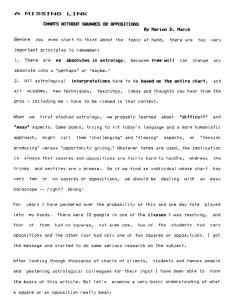
Charts Without Squares or Oppositions, Aspect Deficiencies, Natal Imbalances, Evolutionary Astrology. In this detailed astrological study titled ‘A Missing Link: Charts Without Squares or Oppositions,’ Marion D. March explores the profound implications of birth charts that lack challenging aspects like squares and oppositions. March challenges the common astrological assumption that charts devoid of hard aspects represent ‘easy’ or uncomplicated lives. Through the analysis of elemental balances, aspect patterns (such as see-saw, bowl, fan, and tripod), unaspected planets, and lacking modalities or houses, she demonstrates how individuals with squareless or oppositionless charts frequently struggle with self-awareness, conflict resolution, and internal drive. Without the natural tension of squares to prompt action or oppositions to foster awareness of the ‘other,’ natives often resort to avoidance, projection, or internalizing stress, which can manifest as chronic physical ailments, phobias, or psychological difficulties.

The text extensively examines various specific natal charts of both clients and renowned figures to illustrate how chart deficiencies manifest in real life. March analyzes how individuals compensate for missing elements, such as a lack of water, air, or earth, and how unaspected planets or single focal points in bucket patterns direct the native’s life path. She emphasizes that while progressions and transits can activate these points over time, understanding the innate lack of impetus allows astrologers to provide effective psychological and astrological guidance to help clients harness the strengths inherent in their unique configurations.

Issue Highlights:

Articles:
A Missing Link: Charts Without Squares or Oppositions – Marion D. March

Discussion:
Interpreting charts lacking squares or oppositions
The psychological impact of unaspected planets and missing elements
Using chart patterns and progressions to understand developmental crises
Case studies of famous artists, actors, and individuals navigating squareless charts

Chart data:
Chart I (Jan 31, 1919)
Chart II (Mar 7, 1921)
Georges Braque (May 9, 1882)
Chart III (Dec 3, 1918)
Margaret Sullavan (May 16, 1919)
Marlene Dietrich (Dec 27, 1901)
Chart IV (June 30, 1943)
Chart V (July 1, 1924)
Chart VI (Apr 18, 1928)
Vincent Van Gogh (Mar 30, 1853)
Fanny Brice (Oct 29, 1891)
Montgomery Clift (Oct 17, 1920)

Notable contributors:
Marion D. March (Author)

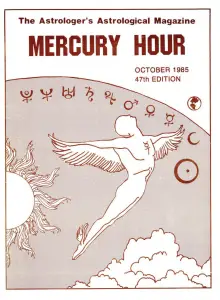
Astrological Techniques, Astrology History, and Mundane Astrology. This archival item is the October 1985 issue (47th Edition) of Mercury Hour, a quarterly magazine edited by Edith Custer and Jewell Fahey in Lynchburg, Virginia. Key contents include technical articles such as John F. Gay, III’s guide to calculating house cusps and astronomical coordinates using scientific calculators, Joan McEvers’s second installment on interpreting Lunar Returns, and Dorothy Willis’s foundational rules for astro-meteorology. Mundane and historical pieces feature Marc Penfield’s chart rectifications for Russia’s 1917 Bolshevik Revolution and the “Chart Mart” data collection, Fran Rosen’s explorations of the Kabbalistic Tree of Life and Tarot symbolism, and Gilbert Navarro’s definition of horary astrology. Additional contributions include reviews by Marion March, reports on the 7 Hills Astrological Conference, an analysis of the 1985 Bradford football stadium fire by Olivia Barclay, and reader discussions surrounding topics such as ethics, licensing, house systems, and birth data for figures like Ronald Reagan, Mikhail Gorbachev, and Mary Baker Eddy.


Issue Highlights


Book Reviews

By Marion March:

Celestial Psychology: An Astrological Guide to Growth and Transformation by Doris A. Hebel

Astrochemistry: A Study of Metal-Planet Affinities by Nick Kellerstrom

Instant Astrology by Mary Orser, Rick and Glory Brightfield

The Astrology of Deep Space by Philip Sedgwick

Spiritual Astrology: A Layperson’s Guide to Self-Unfoldment by Jan Spiller

The Practice and Profession of Astrology by Stephen Arroyo

Birth Pattern Psychology by Tamise Van Pelt

The Astrological Prayer Book by Alda Marian Jangl
Your Key to Astrology [book plus] Astrological Key Cards: Planets, Signs, Houses, Aspects by Bill Hansen – Edith Custer


Articles

Astrology and the Weather – Dorothy Willis

Lunar Return Notes, Part II – Joan McEvers

Calculation Without Tables of the Julian Day & Century, Obliquity of the Ecliptic, MC, ASC, and Houses, Part I – John F. Gay, III

The Tree of Life: An Overview – Fran Rosen

Astrological Hall of Fame Awards – Fraternity for Canadian Astrologers [2nd National Conference]

Along the Tarot Path – Fran Rosen

How I Survived my Pluto Square Pluto and Other Transits – Carol Hemingway

The Luscher Color Test, A Symbolic Testing Model – Zan Key

Observations on Astrology, Original & Borrowed – John F. Gay, III

I’m Mad at You!!!! – Mary Ellen Glass

The Horoscope of Russia – Marc Penfield

Chart Mart – Marc Penfield

A Trip Round the Hawaiian Zodiac, Part II – Cheryl Niggle

Astrology and the Weather: Forecasting the Weather, Part I – Dorothy Willis

Horary Astrology: A Definition – Gilbert Navarro

The Business Cycle, Part II – Bill Hansen

Neptune, The Collective Fantasy, and Popular Music – Amy Franco

The Mystery of the Chinese Zodiac, Now Revealed for the First Time – Frank Hampton

The Qualities of Time, Part I – Tundra Wind


Discussions

Astrology, licensure, & ethics

Quadrant house systems vs. Equal Houses

Radix-based Tarot technique

Natal location in Return chart

Birth time of Ronald Reagan

Seven Hill Astrological Conference [reports]

Mercury retrograde


Chart data

Anderson, Loni
Benetar, Haley (daughter of Pat Benetar)
Bowie, David
Eddy, Mary Baker
Eisenhower, Melanie (daughter of Julie Nixon and David Eisenhower)
Gorbachev, Mikhail
Jagger, Elizabeth (daughter of Mick Jagger and Jerri Hall)
Kennedy III Robert F.
Morgan, Vicki
Neves, Tancredo
Pace, Canio and Thomas (cross-year twins)
Reagan, Ronald
Schwab, Loluis and Leona (cross-year twins)
Spielberg, Max (son of Steven Spielberg and Amy Irving)Vaughn, Sarah

Frustaci sextuplets
Czar Nicholas II
Prince Henry

Air India 747 jetliner crash
Christian Science Church
Formation of the Soviet Union
Founding of Tel Aviv
Halley’s Comet return
Live Aid Concert 1985


Notable contributors

Joylyn Hill (Chart of Israel, chart of Robert E. Lee, the nature of Venus)

Olivia Barclay (astrological signature of fires and explosions)

Misty Kuceris (7 Hills Conference)

Robert Pelletier (7 Hills Conference)

Zane Stein (Solstice points, Sabian symbols)

Erin Sullivan (Mercury retrograde)

Michael and Margaret Erlewine (Matrix Heart Center)

Eleanor Bach (Marc Edmond Jones Award)

Lee Lehman (Kundalini and asteroid Sappho)

ASPECTS Vol. 6 No. 1 Winter 1980-1

ASPECTS Magazine

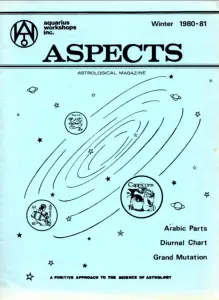
Astrological Techniques, Arabic Parts, Mundane Astrology. This issue of ASPECTS magazine provides a deep dive into advanced astrological applications, specifically focusing on the interpretation and calculation of Arabic Parts and the impact of the Great Mutation (Jupiter-Saturn conjunction). The technical content is complemented by foundational series columns, such as Joan McEvers’ exploration of the 5th House and Nancy Cassidy’s analysis of sextile aspects. These articles bridge the gap between abstract mathematical derivations and practical, house-by-house interpretations of human experience and psychological drives.

Issue Highlights

The magazine documents the transition into a new astrological era marked by the shift of Jupiter-Saturn conjunctions from Earth signs to the Air element, specifically referencing the 1980 conjunction in Libra. It also serves as a chronicle of the burgeoning astrological community in the early 1980s, highlighting the South-Western Astrology Conference (SWAC) of 1980, upcoming conferences in Zurich, and the general professionalization of the field through organizations like Aquarius Workshops, Inc.

Articles:
How To Calculate Your Arabic Parts – Robert ‘Buz’ Myers
The Great Jupiter/Saturn Conjunction – Marion D. March
The Diurnal (Daily) Chart – Lenora M. Hill
The Point of Life – Enrique Linarés
Keys to Learning (5th House) – Joan McEvers
Building Blocks (Sextiles) – Nancy Cassidy
Capricorn Ingress – Judy Johns

Discussion:
The transition from Earth to Air element in major planetary conjunctions
Calculation and interpretation of 10 specific Arabic Parts across 12 houses
The professional development of astrology in educational and conference settings

Chart data:
10/28/75, 1:24 pm PST, Encino, CA
12/21/1980, 11:56:00 EST, Washington, DC

Notable contributors:
Robert ‘Buz’ Myers (Arabic Parts)
Marion D. March (Mundane Astrology/Conjunctions)
Joan McEvers (Astrological Education)

ASPECTS Vol. 3 No 2. Feb 1978

ASPECTS Magazine

Astrology, Aquarius Workshops, Eclipses, Horary, Graphoanalysis, Ingress Charts, Planetary Aspects. This issue of Aspects Astrological Newsletter (Vol. 3, No. 2, February 1978) covers a wide range of advanced and beginner astrological techniques, organizational news, book reviews, and interviews. Highlights include discussions on Uranus and Neptune dynamics, the October 12 eclipse impact, the application of ingress charts for personal forecasting, astro-numerology, and graphoanalysis techniques correlating handwriting slant with emotional responsiveness.

Issue Highlights:
Features extensive reports on conferences, upcoming workshops by prominent astrologers like Isabel Hickey and Gina Ceaglio, presidential messages from Marion D. March, and detailed technical articles exploring natal chart interpretation, house systems, and predictive methods.

Articles:
Review of McEvers Lecture – Cornelia Hansen
Friends or Foes – Constance Mayer
Humano-Cosmic Time – Guy de Penguern
Horary Question – Anonymous
Viewpoint – Astrologer/Client Relationship – Marianne Dunn
The October 12 Eclipse – Robert Jansky
Astro-Numerology – Joan McEvers
An Interview with Constance Mayer – Marion D. March
Building Blocks – Nancy Cassidy
Keys to Learning – Joan McEvers
Graphoanalysis – Sue Johnson
Where is Cousin Melvin? – Jean Graves
Astro-Logic – Anonymous
The Phase Wheel – Anonymous
Annual Dinner Report – Karen McCauley

Discussion:
Using ingress charts for prognostications and personal forecasting
Comparing Uranus and Neptune symbolism and manifestations
Humano-Cosmic Time previewing system based on 11-minute 12-second zodiacal ticks per year of life
Turning the house method in horary and natal charts (‘Every house is a first house’)
The psychological and physiological impacts of solar and lunar eclipses across houses
Graphological analysis of writing slant and emotional styles (FA, AB, BC, CD, DE, E+)

Chart data:
Capricorn Ingress Chart (December 21, 1977)
Horary Chart for Marriage Question (July 5, 1977)

Notable contributors:
Joan McEvers (Ingress charts, astro-numerology, keys to learning)
Constance Mayer (Planetary comparison of Uranus and Neptune)
Robert Jansky (Eclipse analysis and book reviews)
Marianne Dunn (Client-astrologer relationship ethics)
Guy de Penguern (Humano-Cosmic Time system)
Sue Johnson (Graphoanalysis)
Nancy Cassidy (Beginner blocks on Leo)
Jean Graves (Derivative house systems)

Ask A Librarian

Need assistance with your research or navigating our collection? Our library team is here to help.

Please fill out the form below with details about the topics, authors, or archival materials you are looking for, and one of our librarians will review your query and respond shortly.

Help

Whether you are looking for rare historical texts or trying to locate a specific book nearby, Alexandria iBase offers two primary ways to search. Here is how to choose the right tool for what you need:

The Library Catalogue

Think of this as your global master index.

The Catalogue works just like a traditional library search system, designed to help you locate books and media across the broader astrological landscape.

  • Physical Books: Find out where physical copies of books are held in libraries, archives, or collections near you.

  • Digital Files: Access downloadable or viewable digital editions when available.

  • Best Used For: Standard research, finding specific ISBNs or authors, and tracking down physical items in the real world.

Browse Catalogue

SPECIAL COLLECTIONS

Think of this as Alexandria’s exclusive private vault.

Collections gives you direct access to Alexandria’s own curated archive of rare, proprietary, and historic astrology media.

  • Exclusive Material: Features unique texts, manuscripts, audio recordings, and visual media that are not available anywhere else.

  • Direct Access: Digitized content ready to explore straight from the platform.

  • Best Used For: Deep-dive research, discovering hidden gems, and exploring rare, one-of-a-kind astrological resources.

Browse Special Collections

Cash & In-Kind Donations

Make a one-time or recurring tax deductible cash donation.

Payment options include donating directly with us, PayPal Giving and GoFundMe.

GoFundMe for Charities and PayPal Giving are registered for tax deductions and have no required processing fees. It does offer the option to tip.

Donate

*Subject to 2.5% processing fees

Contact Us

Have a question, feedback, or a inquiry about our archives? We’d love to hear from you. Please fill out the form below with your details and message, and a member of our team will get back to you as soon as possible.

Thank you for reaching out to the Alexandria iBase Project!