
Quincunx (Inconjunct)

A geometric aspect of 150 degrees separating two celestial bodies, connecting zodiacal signs that share no elemental, modal, or polar affinities. Also referred to as an inconjunct, this aspect is analyzed in astrological literature as a structural blind spot requiring constant psychological adjustment, often manifesting as subtle systemic friction, somatic stressors, or the need to reconcile fundamentally incompatible drives.

Filters

Filters


See more See less
See more See less
See more See less
See more See less
See more See less
See more See less
See more See less

Sorting

Sexual Potential in the Horoscope, Psychological Variables, Archetypes, Astrological Indicators of Sexuality. This detailed astrological lecture and analysis by Marion D. March explores the expressions of sexual potential within the natal chart, moving beyond surface interpretations to analyze the whole personality. March examines the fundamental meanings of the 5th and 8th houses, planetary influences (Mars, Venus, Pluto, Neptune, Uranus, Mercury, Saturn, Jupiter, Sun, and Moon), and mythological underpinnings such as the archetypes of Venus/Aphrodite, Mars/Ares, and Pluto/Hades. The text features in-depth case studies and natal chart analyses of prominent figures including Marilyn Monroe, Xaviera Hollander, David Bowie, Richard Pryor, Frank Sinatra, Marlene Dietrich, Tennessee Williams, and Gertrude Stein, illustrating how complex configurations, T-squares, and planetary combinations manifest in intimate lives, sexual expression, and public images. Additionally, the lecture addresses homosexuality and bisexuality through astrological indicators and includes a lighthearted numerological ‘Astro-test’ by G.G. Stoctay, PhD, to score sex drive based on planetary placements.

Issue Highlights:
Detailed exploration of sexual dynamics, house significators (5th and 8th houses), planetary aspects relating to intimacy and drive, mythological context of sexual archetypes, and extensive chart examples of celebrities.

Articles:
Die Ausdrucksebenen des sexuellen Potential im Horoskop – Marion D. March

Discussion:
The 5th House and romantic/sexual attitude
The 8th House as an indicator of effective sexual performance
Planetary significators of sex drive, intimacy, and fantasy (Mars, Venus, Pluto, Neptune, Uranus)
Mythological roots of Venus, Mars, and Pluto
Astrological indicators of homosexuality and bisexuality
Case studies of celebrities and their complex psychological and sexual configurations
Stoctay’s Astro-test for evaluating the strength of the sex drive

Chart data:
Marilyn Monroe
Xaviera Hollander
David Bowie
Richard Pryor
Frank Sinatra
Marlene Dietrich
Thomas Lanier ‘Tennessee’ Williams
Gertrude Stein

Notable contributors:
Marion D. March (Author)
Joan McEvers (Co-creator/Chart source reference)
G.G. Stoctay (Astro-test creator)
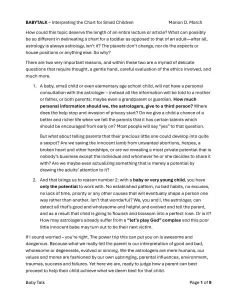
Child astrology, natal interpretation, family dynamics, birth charts. This article by Marion D. March explores the unique methodology and ethical considerations required when interpreting the astrological birth chart of a child or baby. Unlike adult consultations, child astrology involves communicating with parents or third parties regarding potential, hereditary factors, and the environment without dictating a fixed destiny. March discusses the importance of looking at squares and oppositions as potential for growth, analyzes planetary signatures, elements, and house placements, and presents several detailed case studies with charts including Mikki, Bolly, Prince William, Tina, and Linda.

Issue Highlights:

Articles:
Comment interpreter le theme d’un enfant? – Marion D. March

Discussion:
Interpreting children’s natal charts
Ethical considerations in parental consultations
The role of hard aspects (squares and oppositions) in childhood development
The influence of family environment and heredity on natal potential

Chart data:
Mikki (March 6, 1951, Los Angeles, CA)
Bolly (July 10, 1977, Zurich, Switzerland)
Prince William of England (June 21, 1982, London, UK)
Tina (June 3, 1974, Phoenix, AZ)
Linda (August 5, 1951, Buffalo, NY)

Notable contributors:
Marion D. March (Author and international lecturer on child astrology and psychological approaches)

Child Astrology, Ethics in Consultation, Chart Interpretation for Toddlers and Youths. Marion D. March explores the profound ethical and practical responsibilities involved when astrologers delineate charts for infants, toddlers, and small children. Rather than consulting directly with the individual, the astrologer speaks to parents, guardians, or grandparents, raising critical questions regarding privacy, potential versus actualization, and the danger of falling into a “let’s play God” complex. March stresses that a child’s chart reveals potential, not a fixed destiny, and warns against imposing the astrologer’s or parents’ personal biases upon the developing mind. The text examines the psychological value of stress and squares in a chart as crucial catalysts for personal growth, resilience, and independence rather than purely negative omens.

Issue Highlights:
Detailed chart delineations for several children (Mikki, Bolly, Tina, and Linda), alongside the royal chart of Prince William of England, demonstrating how similar ascendants (such as Sagittarius) manifest entirely different personalities based on planetary configurations, aspects, and family dynamics. March also details her personal practice methodology, including client data sheets, recording sessions, and written addendums for young children.

Articles:
BABYTALK – Interpreting the Chart for Small Children – Marion D. March

Discussion:
Ethics of third-party consultations and child privacy
The psychological function of squares and stress in personal development
Yods, T-squares, and mutual reception in youth horoscopes
Evaluating sibling dynamics and birth timing through transits and progressions
Cultural, ethnic, and religious backgrounds affecting child-rearing expectations
Astrological indicators for legal careers, communication talents, and artistic inclinations

Chart data:
Mikki 
Bolly
Prince William of England
Tina 
Linda

Notable contributors:
Marion D. March (Author and Astrologer)

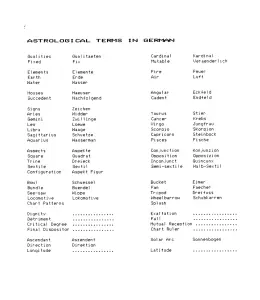
Astrology Terms German and English

Marion D. March, Special Collections

Astrological Terms in German, Qualities, Elements, Houses, Signs, Aspects, Chart Patterns, Dignities, Ascendant, Solar Arc. This document provides a comprehensive bilingual reference guide translating core astrological terminology from English into German. It covers fundamental structural components of astrology, including the zodiac qualities (Cardinal, Fixed, Mutable), elemental classifications (Fire, Earth, Air, Water), house types (Angular, Succedent, Cadent), and the complete set of twelve zodiac signs from Aries to Pisces. Furthermore, the text systematically translates major and minor aspects (Conjunction, Square, Opposition, Trine, Inconjunct, Sextile, Semi-sextile), planetary configurations, and specific Marc Jones chart patterns such as Bowl, Bundle, See-saw, Locomotive, Bucket, Fan, Tripod, Wheelbarrow, and Splash. Essential astrological conditions including dignity, detriment, exaltation, fall, critical degree, mutual reception, and final dispositor are also mapped, alongside structural chart points like the Ascendant, Direction, Longitude, Latitude, and Solar Arc (Sonnenbogen).

Issue Highlights:

Articles:
N/A – N/A

Discussion:
Translation of astrological terms from English to German
Zodiac signs, elements, and qualities in German
Aspects and chart patterns terminology

Chart data:
N/A

Notable contributors:
Marion D. March

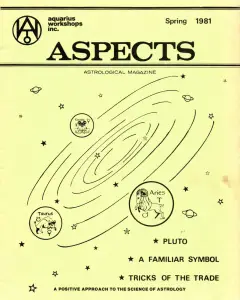
ASPECTS Vol 6 No 2 Spring 1982

ASPECTS Magazine, Special Collections

Astrological Methodology, Natal Analysis, and Evolutionary Astrology. This issue of Aspects features extensive technical discussions regarding the practical application of astrology. A significant portion of the magazine is dedicated to the philosophy and mechanics of individual charts, notably through Robert Carl Jansky’s detailed exploration of the Sun symbol as a representation of personal space, ego-control, and evolutionary potential. The discourse extends to professional practice with Robert Glasscock’s insights into client management, chart rectification techniques, and the “degree for a year” predictive method. Additionally, Jeff Green provides a deep dive into evolutionary astrology, examining Pluto’s role in the birth chart as a primary indicator of karmic patterns and the soul’s path through incarnation, utilizing the charts of historical figures like Richard Nixon as case studies.

Issue Highlights:
The magazine explores mundane astrology through the lens of the 1981 Aries Ingress chart, projecting potential national trends in economy, diplomacy, and global politics. Practical “building blocks” are provided for students, including a breakdown of the 6th House by Joan McEvers and an introduction to the inconjunct (quincunx) aspect by Nancy Cassidy. The content is further enriched by a Q&A interview with Angela Gallo, who discusses the challenges of teaching astrology and the ethical considerations of working with clients, as well as a data column by Lois Rodden verifying birth times for various famous women in sports.

Articles:
A New Look at a Familiar Symbol – Robert Carl Jansky
Pluto: The Evolutionary Cause of Incarnation – Jeff Green
Tricks of the Trade: Confessions of a Professional Astrologer – Robert Glasscock
Aries Ingress – Judy Johns
Sixth House – Joan McEvers
Inconjunct – Nancy Cassidy
Basic Delineation: The Overview – Marion March

Discussion:
Techniques for client management and professional ethics.
Evolutionary astrology and the role of Pluto and the Nodal axis.
Practical applications of the inconjunct aspect in natal charts.
Mundane analysis of the 1981 Aries Ingress.

Chart data:
Richard Nixon
Vincent Van Gogh

Notable contributors:
Robert Carl Jansky (Sun Symbolism)
Jeff Green (Evolutionary Astrology)
Robert Glasscock (Professional Techniques)
Marion D. March (Chart Delineation)
Lois Rodden (Data/Research)

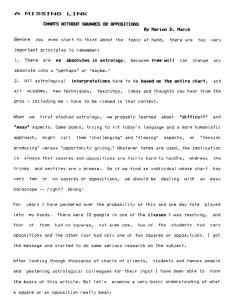
Charts Without Squares or Oppositions, Aspect Deficiencies, Natal Imbalances, Evolutionary Astrology. In this detailed astrological study titled ‘A Missing Link: Charts Without Squares or Oppositions,’ Marion D. March explores the profound implications of birth charts that lack challenging aspects like squares and oppositions. March challenges the common astrological assumption that charts devoid of hard aspects represent ‘easy’ or uncomplicated lives. Through the analysis of elemental balances, aspect patterns (such as see-saw, bowl, fan, and tripod), unaspected planets, and lacking modalities or houses, she demonstrates how individuals with squareless or oppositionless charts frequently struggle with self-awareness, conflict resolution, and internal drive. Without the natural tension of squares to prompt action or oppositions to foster awareness of the ‘other,’ natives often resort to avoidance, projection, or internalizing stress, which can manifest as chronic physical ailments, phobias, or psychological difficulties.

The text extensively examines various specific natal charts of both clients and renowned figures to illustrate how chart deficiencies manifest in real life. March analyzes how individuals compensate for missing elements, such as a lack of water, air, or earth, and how unaspected planets or single focal points in bucket patterns direct the native’s life path. She emphasizes that while progressions and transits can activate these points over time, understanding the innate lack of impetus allows astrologers to provide effective psychological and astrological guidance to help clients harness the strengths inherent in their unique configurations.

Issue Highlights:

Articles:
A Missing Link: Charts Without Squares or Oppositions – Marion D. March

Discussion:
Interpreting charts lacking squares or oppositions
The psychological impact of unaspected planets and missing elements
Using chart patterns and progressions to understand developmental crises
Case studies of famous artists, actors, and individuals navigating squareless charts

Chart data:
Chart I (Jan 31, 1919)
Chart II (Mar 7, 1921)
Georges Braque (May 9, 1882)
Chart III (Dec 3, 1918)
Margaret Sullavan (May 16, 1919)
Marlene Dietrich (Dec 27, 1901)
Chart IV (June 30, 1943)
Chart V (July 1, 1924)
Chart VI (Apr 18, 1928)
Vincent Van Gogh (Mar 30, 1853)
Fanny Brice (Oct 29, 1891)
Montgomery Clift (Oct 17, 1920)

Notable contributors:
Marion D. March (Author)

Vesta: Keeper of the Flame (1994)

Frances McEvoy, Special Collections

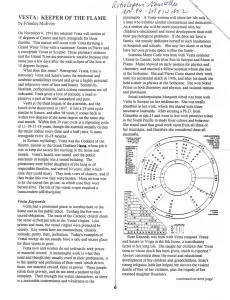
Asteroid Vesta, Grand Trine, Natal Astrological Analysis, Confinement and Solitude, Birth Data. This issue features an in-depth astrological analysis of the asteroid Vesta by Frances McEvoy, framed by Vesta’s November 1994 station at 10 degrees Cancer forming a Grand Water Trine with Saturn in Pisces and Venus in Scorpio. McEvoy explores Vesta’s 29-year cycle, its mythological roots as the Goddess of the Hearth, and its archetypal keywords such as commitment, chastity, solitude, purity, duty, perfection, and transcendent self-discipline. The article delineates how Vesta operates in both male and female charts, highlighting themes of dedicated work, privacy, and inner strength.

The study examines numerous chart examples illustrating Vesta’s impact on public service, science, art, and personal sacrifice. Detailed case studies include Marie Curie, Margaret Mead, Maria Montessori, Anne Frank, Sister Francesca Cabrini, Saint Therese of Lisieux, Queen Victoria, Grace Kelly, Jerry Brown, David Souter, Yassar Arafat, Oliver North, Angela Davis, Betty Friedan, Helen Keller, Michel Gauquelin, Bobby Fischer, and major classical composers like Bach, Mozart, Schubert, and Chopin. Themes of confinement, religious devotion, political zealotry, and intellectual immersion are thoroughly traced through Vesta’s aspects and house placements.

Additionally, Lorraine Welsh presents “The Data Base,” providing precise birth data for political candidates and public figures of the period, including Mitt Romney, Joe Malone, Paul Cellucci, and Pope John Paul II. An informational announcement for Robert Hand’s instructional classes on Traditional Western, Renaissance, and Hellenistic astrology is also included.

Issue Highlights:

Articles:
VESTA: KEEPER OF THE FLAME – Frances McEvoy
The Data Base – Lorraine Welsh

Discussion:
Vesta cycle and astronomical station patterns
Vesta in psychological, natal, and mundane astrology
Confinement, solitude, and religious devotion in chart analysis
Verified birth data for political candidates and notable figures
Instruction in Hellenistic and Renaissance traditional astrology

Chart data:
Maria Montessori
Yassar Arafat
Helen Keller
Mitt Romney
Joe Malone
Paul Cellucci
Pope John Paul II (Karol Wojtyla)

Notable contributors:
Frances McEvoy (Vesta: Keeper of the Flame)
Lorraine Welsh (The Data Base)
Robert Hand (Traditional Astrology Classes)

Pallas, Asteroid, Mythology, Women’s Achievements. This article explores the astrological significance and mythological background of the asteroid Pallas (Pallas Athena), focusing on her role as the goddess of wisdom, strategy, and the arts, and examining her placement in the natal charts of notable historical and contemporary women. Frances McEvoy discusses Pallas’s orbital characteristics, discovery, and cycles, linking its mythological traits—such as intellectual prowess, independence, strategic thinking, and a special bond with paternal figures—to the psychological expressions found in women who excel in politics, literature, aviation, entertainment, and social activism.

Issue Highlights:

Articles:
Pallas, Goddess of Wisdom, Statecraft – Frances McEvoy

Discussion:
Astrological influence of Pallas in women’s natal charts
Mythological connections between Pallas Athena and career achievement, intellect, and independence

Chart data:
Helen Gurley Brown
Emily Dickinson
Clara Barton
Katharine Hepburn
Gloria Swanson
Bette Davis
George Sand
Simone de Beauvoir
Edna St. Vincent Millay
Amelia Earhart
George Eliot
Betty Ford
Margaret Chase Smith
Emmeline Pankhurst
Lucille Ball
Barbara Walters
Joan Fontaine

Notable contributors:
Frances McEvoy (Astrological analysis of the asteroid Pallas in women’s charts)

Astrological Research, Midpoints, Mundane Astrology. This issue of Mercury Hour serves as a dynamic forum for technical and philosophical astrological discourse during the early 1980s. The magazine balances detailed technical research—such as midpoint analysis, heliocentric vs. geocentric chart comparison, and mundane astrology applied to political events (e.g., the situation in Lebanon and Poland)—with active reader correspondence. A significant portion of the content is dedicated to challenging mainstream perceptions of astrology, exploring the intersection of psychology and astrology, and critiquing the rapidly emerging field of computerized chart calculation.

Issue Highlights:

Articles:
Chart Mart – Marc Penfield
Tragedy at Tanque Verde Falls: A Case for Midpoints – Barbara May
Khomeini’s Days Are Numbered – Manik Chand Jain
Mercury – Erin Sullivan
An Astrological Review of Passages (by Gail Sheedy) – Bil Tierney
Astrology vs. Psychology: A Minor Dilemma for the 80’s – Stanley Kustesky

Discussion:
Astrological research on incest
Astrological birth control (human and equine)
Ayatollah Khomeini
Pluto transits
Heliocentric astrology
Charts of Israel
Chart of Ronald Reagan
Astro*Carto*Graphy
Crash of AirFlorida Jet, Jan 13, 1982

Chart data:
Lucille Ball, John Lennon, Elvis Presley, Harvey Milk, Dan White, Pope John Paul II, Ronald Reagan, Ayatollah Khomeini

Notable contributors:
Zane Stein (eclipses, quincunxes, Association for Studying Chiron)
Michael Erlewine (Heliocentric astrology)
Al H. Morrison (Void-of-Course Moon)
Erin Sullivan (diverse astrological topics)

Ask A Librarian

Need assistance with your research or navigating our collection? Our library team is here to help.

Please fill out the form below with details about the topics, authors, or archival materials you are looking for, and one of our librarians will review your query and respond shortly.

Help

Whether you are looking for rare historical texts or trying to locate a specific book nearby, Alexandria iBase offers two primary ways to search. Here is how to choose the right tool for what you need:

The Library Catalogue

Think of this as your global master index.

The Catalogue works just like a traditional library search system, designed to help you locate books and media across the broader astrological landscape.

  • Physical Books: Find out where physical copies of books are held in libraries, archives, or collections near you.

  • Digital Files: Access downloadable or viewable digital editions when available.

  • Best Used For: Standard research, finding specific ISBNs or authors, and tracking down physical items in the real world.

Browse Catalogue

SPECIAL COLLECTIONS

Think of this as Alexandria’s exclusive private vault.

Collections gives you direct access to Alexandria’s own curated archive of rare, proprietary, and historic astrology media.

  • Exclusive Material: Features unique texts, manuscripts, audio recordings, and visual media that are not available anywhere else.

  • Direct Access: Digitized content ready to explore straight from the platform.

  • Best Used For: Deep-dive research, discovering hidden gems, and exploring rare, one-of-a-kind astrological resources.

Browse Special Collections

Cash & In-Kind Donations

Make a one-time or recurring tax deductible cash donation.

Payment options include donating directly with us, PayPal Giving and GoFundMe.

GoFundMe for Charities and PayPal Giving are registered for tax deductions and have no required processing fees. It does offer the option to tip.

Donate

*Subject to 2.5% processing fees

Contact Us

Have a question, feedback, or a inquiry about our archives? We’d love to hear from you. Please fill out the form below with your details and message, and a member of our team will get back to you as soon as possible.

Thank you for reaching out to the Alexandria iBase Project!