
Home » Yod (Finger of God)

Yod (Finger of God)

Yod (Finger of God) is an intricate astrological aspect configuration formed when two planets in sextile aspect (60 degrees) both make a quincunx or inconjunct aspect (150 degrees) to a third, focal planet. Visually resembling a narrow isosceles triangle often referred to as the Finger of God, this dynamic pattern combines the harmonious opportunity of the sextile with the acute tension, adjustment, and crisis of integration inherent to the quincunx. In chart interpretation, the apex planet bears the immense pressure of resolving the underlying polarity of the base planets, typically symbolizing a fated sense of mission, unique specialization, or a compelling evolutionary path that requires profound personal transformation.

Filters

Filters


See more See less
See more See less
See more See less
See more See less
See more See less
See more See less
See more See less

Sorting

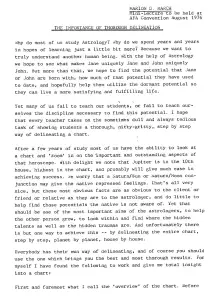
Astrological Delineation, Chart Synthesis, Progressions, Transits, House Rulerships, Decanates, Free Will. This document provides a comprehensive, step-by-step lecture by Marion D. March on the art and discipline of thorough astrological chart delineation. March emphasizes looking beyond obvious isolated placements (like Jupiter in the 10th house or Saturn-Sun conjunctions) to uncover hidden talents, potentials, and traumas through systematic chart analysis. She outlines an initial ‘overview’ examining element/quality distribution, chart patterns (bundle, bucket, locomotive), and configurations (grand crosses, T-squares, yods). Following the overview, she details dissecting the chart starting with the ‘heart of the chart’ (the Sun by sign, house, ruler, decanate, and aspects), followed by the Moon for emotional personality, the Ascendant for outer personality, and proceeding planet-by-planet and house-by-house.

Issue Highlights:
The text further explores the synthesis of recurring traits, handling human contradictions, and integrating progressions and transits. March shares her personal technique of placing three rings around a chart: natal, secondary progressions alongside solar arcs, and slow-moving transits in the outer ring. She stresses that progressions reflect changes in inner attitude and psychological shifts, whereas transits indicate tangible outer events. Crucial astrological maxims are highlighted, notably ‘The stars impel, they do not compel’ and ‘All important events are backed by aspects, but not every aspect will bring an important event,’ reinforcing the primacy of client free will and counseling caution in rigid prediction.

Articles:
The Importance of Thorough Delineation – Marion D. March

Discussion:
Step-by-step chart delineation methodology
Utilizing the ‘overview’ for chart synthesis
Analyzing the Sun, Moon, and Ascendant
House rulers and house-to-house connections
Secondary progressions and Solar Arc directions
The interplay between transits, inner attitudes, and free will

Chart data:
Sun at 12 Gemini in the 6th house, ruled by Mercury in Cancer in the 7th house

Notable contributors:
Marion D. March (Author and Lecturer)
Solar Arc Directions

Marion D. March, Special Collections

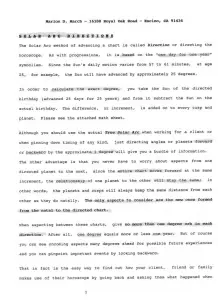
Solar Arcs, Secondary Progressions, Transits, Astrology Cycles, Predictive Techniques. This document provides a comprehensive instructional overview of major predictive astrological techniques, focusing on Solar Arc Directions, secondary progressions, and planetary transits. Marion D. March emphasizes the practical application of these methods, urging students to avoid rigid adherence to a single system and instead utilize a combination of techniques, including Solar Returns, to gain a nuanced understanding of a client’s experiences. The text underscores that while these methods provide insights into life rhythms, individual free will remains the ultimate governing factor in how these energies are expressed.

The manual details the mechanics of Solar Arc Directions—the “one day for one year” symbolism—and provides step-by-step mathematical instructions for calculating arcs. A significant portion of the guide is dedicated to case study analysis of Kitty Kelley, tracking her life events (career, marriage, writing) through transits and directed aspects of slow-moving planets like Jupiter, Saturn, Uranus, Neptune, and Pluto. The author differentiates the influence of these planets, noting that personal planets govern daily moods and minor events, while transcendental planets mark long-term periods of transformation, such as the midlife crisis associated with Uranus, or the intense, deliberate shifts indicated by Pluto transits.

Furthermore, the document explores the cyclical nature of planetary movement through the four quadrants of the horoscope, defining them by key psychological phases: Learn (Ascendant to IC), Experience (IC to Descendant), Act (Descendant to MC), and Gather Rewards (MC to Ascendant). It highlights the importance of T-squares, yods, and grand crosses in natal configurations, noting how these are activated by directed or transiting planets. The text concludes by reinforcing the need for practitioners to remain grounded in common sense, prioritizing logic and awareness over fatalistic predictions.

Issue Highlights:

Articles:
Solar Arc Directions – Marion D. March
Transits – Marion D. March
Cycles – Marion D. March
Planetary Speeds and Cycles – Marion D. March
Math Instructions for Solar Arc Directions – Marion D. March

Discussion:
The use of Solar Arcs vs. Secondary Progressions and Transits
The influence of planetary speeds on life events
Interpreting natal T-squares and yods under transit activation
The psychological significance of the four astrological quadrants
Methodological differences between natal, progressed, and directed charts

Chart data:
Kitty Kelley (Born April 4, 1942, 5:00 pm PDT, Spokane, WA)

Notable contributors:
Marion D. March (Astrological education, techniques, and predictive theory)

Astrology, Houses, Transits, Reincarnation, Eclipses, Synastry, Numerology. This 13th edition of Mercury House (April 1977) provides a comprehensive collection of astrological discussions, research notes, and reader correspondence. Key topics covered include the interpretation of Saturn in various houses, house systems and critiques of traditional vs. equal house methods, the mechanics of eclipses, chart comparison (synastry), sidereal vs. tropical numbering, and reincarnation past-life regressions mapped through natal charts. Articles explore specialized techniques such as midpoints, deciles and quintiles (minor aspects), and the application of harmonics in chart analysis. The issue also features extensive letters from subscribers detailing personal transits, planetary aspects, and astrological research anomalies.

Issue Highlights:

Articles:
Zodiacal Numbering – Jeff Jawar
Saturn in the Houses (continuation) – Dr. Robert H. Goodrich
Saturn – Marc Penfield
A Key to Relationships [The Art of Chart Comparison] Introduction – Stephen Arroyo
Eclipses (first part in a series) – Ray Merriman
Some Notes on Astrological Research – Ingrid Naiman
Reincarnation – Marc Penfield
The Zodiac of Aspects (first of a two-part series) – Glenda Tomosovich
Astrological Review of an Autobiography [Alone by Admiral Richard E. Byrd] – Prem H. Joshi
The People’s Choice…A Different View of the Next Four Years – Dr. Robert H. Goodrich

Discussion:
Saturn in the 1st and 6th houses
House systems and Gauquelin research
Horoscope of Jesus
Aspects of artistic genius and medical astrology

Chart data:
Bob Dylan
Thor Heyerdahl
OJ Simpson
Omar Sharif
Ethel Kennedy
Jerry Brown
John Dean
Neil A. Armstrong
New York Stock Exchange

Notable contributors:
Marion March (Various topics and responses)
Zip Dobyns (Birthcharts and commentary)

Grand Configurations, Stelliums, T-Squares, Grand Trines, Yods, Mystic Rectangles, Astrological Aspects, Chart Configurations, Chart Patterns. This document is a comprehensive transcript of two 1.5-hour lectures by Marion D. March, focusing on major and minor astrological configurations, aspect patterns, and how to find the highest philosophical and spiritual potential in a chart. March explores how 3 or more planets joined by aspect form a definite pattern or ‘Gestalt’ that exerts an all-pervading and powerful force in a horoscope. Detailed rules for allowable orbs are discussed, emphasizing that tighter orbs yield stronger effects. Major aspect patterns covered include the Stellium, Grand Square (Grand Cross), T-Square, Grand Trine, Kite, Inconjunct, Yod (Finger of God), Mystic Rectangle, and Grand Sextile, alongside minor configurations derived from midpoints, semi-squares, and semi-sextiles. Concrete celebrity chart examples are analyzed for each configuration: Louis Pasteur for the Stellium, Albert Schweitzer for the Fixed Grand Square, Marlon Brando for the T-Square, Angela Davis for the Grand Trine, and Walt Disney for the Yod.

Issue Highlights:

Articles:
Grand Configurations and How to Find the Highest Philosophical and Spiritual Potential in a Chart – Marion D. March

Discussion:
Stelliums and Conjunctions in the 1st House
Grand Squares across Cardinal, Fixed, and Mutable Qualities
T-Squares and the Significance of the Focal Planet and Empty Opposition
Grand Trines across Fire, Earth, Air, and Water Elements
Yods (Finger of God) and Inconjunct (Quincunx) Dynamics
Midpoint Structures and Minor Configurations

Chart data:
Louis Pasteur (12/22/1822)
Albert Schweitzer (1/14/1875)
Marlon Brando (4/3/1924)
Angela Davis (1/26/1944)
Walt Disney (12/5/1901)

Notable contributors:
Marion D. March (Author and Lecturer on Astrological Configurations)

Synastry, Composite Charts, House Placements, Aspects, Midpoints. This instructional material by prominent astrologer Marion D. March covers comprehensive techniques in astrological synastry (Horoskopvergleich) and composite/midpoint charts (Schnittpunktthoroskope). The text details how to analyze house placements of planets between partners, the significance of empty houses, aspect patterns such as T-squares, Grand Crosses, Yods, and Grand Trines, as well as the karmic role of lunar nodes in relationships. Numerous celebrity examples are examined to illustrate these principles, including Prince Rainier and Grace Kelly, Richard Burton and Elizabeth Taylor, John Lennon and Yoko Ono, and Robert and Clara Schumann.

Issue Highlights:
Detailed methodology on comparing two charts, interpreting house overlays, calculating and analyzing composite/midpoint charts, and evaluating planetary configurations (Sun, Moon, Mercury, Venus, Mars, Jupiter, Saturn, Uranus, Neptune, Pluto) within partnership astrology.

Articles:
Die Synastrie (Horoskopvergleich) – Marion D. March
Schnittpunktthoroskope – Marion D. March
Haus Positionen für Synastrie – Marion D. March

Discussion:
House overlays and planetary contacts in synastry
The significance of empty houses activated by a partner
Aspect configurations (T-Square, Yod, Grand Trine, Grand Cross)
Composite and midpoint chart calculation and interpretation
Karmic connections through Lunar Nodes

Chart data:
Prince Rainier
Grace Kelly
Princess Caroline
Prince Albert
Princess Stephanie
Richard Burton
Elizabeth Taylor
John Lennon
Yoko Ono
Robert Schumann
Clara Schumann
Marilyn Monroe
Arthur Miller
Benito Mussolini
Rachele Mussolini
Adolf Hitler
Eva Braun

Notable contributors:
Marion D. March (Astrology, Synastry, and Composite Chart Methodology)

Child astrology, natal interpretation, family dynamics, birth charts. This article by Marion D. March explores the unique methodology and ethical considerations required when interpreting the astrological birth chart of a child or baby. Unlike adult consultations, child astrology involves communicating with parents or third parties regarding potential, hereditary factors, and the environment without dictating a fixed destiny. March discusses the importance of looking at squares and oppositions as potential for growth, analyzes planetary signatures, elements, and house placements, and presents several detailed case studies with charts including Mikki, Bolly, Prince William, Tina, and Linda.

Issue Highlights:

Articles:
Comment interpreter le theme d’un enfant? – Marion D. March

Discussion:
Interpreting children’s natal charts
Ethical considerations in parental consultations
The role of hard aspects (squares and oppositions) in childhood development
The influence of family environment and heredity on natal potential

Chart data:
Mikki (March 6, 1951, Los Angeles, CA)
Bolly (July 10, 1977, Zurich, Switzerland)
Prince William of England (June 21, 1982, London, UK)
Tina (June 3, 1974, Phoenix, AZ)
Linda (August 5, 1951, Buffalo, NY)

Notable contributors:
Marion D. March (Author and international lecturer on child astrology and psychological approaches)

Child Astrology, Ethics in Consultation, Chart Interpretation for Toddlers and Youths. Marion D. March explores the profound ethical and practical responsibilities involved when astrologers delineate charts for infants, toddlers, and small children. Rather than consulting directly with the individual, the astrologer speaks to parents, guardians, or grandparents, raising critical questions regarding privacy, potential versus actualization, and the danger of falling into a “let’s play God” complex. March stresses that a child’s chart reveals potential, not a fixed destiny, and warns against imposing the astrologer’s or parents’ personal biases upon the developing mind. The text examines the psychological value of stress and squares in a chart as crucial catalysts for personal growth, resilience, and independence rather than purely negative omens.

Issue Highlights:
Detailed chart delineations for several children (Mikki, Bolly, Tina, and Linda), alongside the royal chart of Prince William of England, demonstrating how similar ascendants (such as Sagittarius) manifest entirely different personalities based on planetary configurations, aspects, and family dynamics. March also details her personal practice methodology, including client data sheets, recording sessions, and written addendums for young children.

Articles:
BABYTALK – Interpreting the Chart for Small Children – Marion D. March

Discussion:
Ethics of third-party consultations and child privacy
The psychological function of squares and stress in personal development
Yods, T-squares, and mutual reception in youth horoscopes
Evaluating sibling dynamics and birth timing through transits and progressions
Cultural, ethnic, and religious backgrounds affecting child-rearing expectations
Astrological indicators for legal careers, communication talents, and artistic inclinations

Chart data:
Mikki 
Bolly
Prince William of England
Tina 
Linda

Notable contributors:
Marion D. March (Author and Astrologer)

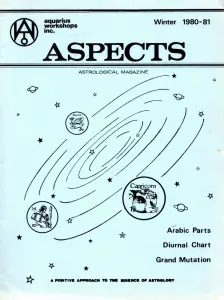
ASPECTS Vol. 6 No. 1 Winter 1980-81 Part 2/2

ASPECTS Magazine, Special Collections

Astrological techniques, horary analysis, Arabic parts, Diurnal charts, and the Grand Mutation of Jupiter and Saturn. This issue of Aspects features extensive technical explorations of predictive and mundane astrology. Robert ‘Buz’ Myers details the calculation and application of Arabic Parts. Marion D. March explores the grand astrological significance of the Jupiter-Saturn conjunction, evaluating its historical impacts and mundane country correlations using Jim Lewis’s Astro*Carto*Graphy. Lenora M. Hill introduces the simplicity and practical application of the Diurnal (daily) Chart, complete with step-by-step mathematical examples, Yod configurations, and transit correlations. Joan McEvers provides insights into numerological pinnacles, while Linda Green investigates Astropalmistry through hand-shape classifications and water-hand patterns. Enrique Linarés introduces the ‘Point of Life’ progression method. Additionally, book reviews by Marion D. March and data columns by Lois Rodden round out the edition.

Issue Highlights:

Articles:
How to Calculate Your Arabic Parts – Robert ‘Buz’ Myers
The Great Jupiter/Saturn Conjunction – Marion D. March
The Diurnal (Daily) Chart – Lenora M. Hill
The Point of Life – Enrique Linarés
Basic Delineation – Marion D. March
Astro-Numerology: The Meanings of the Numbers (Pinnacles) – Joan McEvers
Astropalmistry – Linda Green

Discussion:
Calculating Arabic parts using formula segments
Jupiter-Saturn conjunctions and Grand Mutations entering Air signs
Diurnal chart calculation and activation via house cusps
Point of Life progression calculations
Astrological data corrections and book reviews

Chart data:
Horary Question (8/17/79 8:49 PM PDT, Coeur d’Alene)
Basic Delineation natal chart (3/30/1853 11:00 AM LMT, Zundert, Holland)
Diurnal Chart (June 28, 1980)
Water Hand Natal Horoscope (Figure 2)

Notable contributors:
Robert ‘Buz’ Myers (Arabic Parts)
Marion D. March (Jupiter-Saturn Conjunction & Basic Delineation)
Lenora M. Hill (Diurnal Charts)
Enrique Linarés (Point of Life Progression)
Joan McEvers (Astro-Numerology)
Linda Green (Astropalmistry)
Lois Rodden (Data Column)

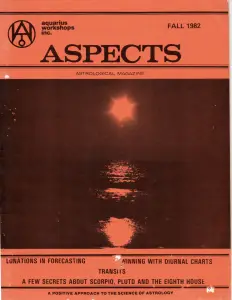
ASPECTS Vol 7 No 4 Fall 1982

ASPECTS Magazine, Special Collections

Aspects Astrological Magazine, Vol. 7 No. 4, Fall 1982. Published by Aquarius Workshops, Inc., Encino, California. Edited by Nancy Cassidy. This issue explores a wide range of advanced and foundational astrological techniques, including mundane forecasting through ingress charts, techniques for utilizing diurnal charts in financial and lottery forecasting, and psychological insights into Scorpio, Pluto, and the eighth house. Contributions from prominent astrologers cover topics such as vocational astrology, transits, lunations, and expansive analyses of Jupiter across the zodiacal signs.

Issue Highlights: Articles feature Judy Johns Tonyan examining the Libra Ingress chart for global political tensions, Jeff Jawer analyzing the psychological depth of Scorpio and Pluto, Sophia Mason detailing the mechanics and calculation of Diurnal Charts for winning potentials, and Angel Thompson providing a comprehensive guide to interpreting transits. Additionally, Marion D. March delineates the astrological chart of Prince William, Joan McEvers outlines the twelfth house, and Nancy Cassidy continues her Beginner’s Blocks series focusing on Jupiter.

Articles:
Libra Ingress – Judy Johns Tonyan
A Few Secrets About Scorpio, Pluto, and the Eighth House – Jeff Jawer
Winning With Diurnal Charts – Sophia Mason
Transits – Angel Thompson
Keys to Learning: Twelfth House – Joan McEvers
Vocations in Focus – Jon Tabakin
Basic Delineation: Prince William Arthur Philip Louis – Marion D. March
Lunations in Forecasting – Marwayne Leipzig
Beginner’s Blocks: Jupiter – Nancy Cassidy

Discussion:
Global mundane forecasts and political instability using ingress charts
Calculating and applying diurnal charts for financial timing and events
Psychological integration of Pluto, Scorpio, and eighth-house dynamics
Vocational profiling through planetary aspects and focal points
The expansive and philosophical nature of Jupiter in all twelve signs

Chart data:
Prince William Arthur Philip Louis
Bill Blass
Coco Chanel
Christen Dior
Various anonymous example charts for diurnal and transit forecasting

Notable contributors:
Judy Johns Tonyan (Mundane astrology and ingress charts)
Jeff Jawer (Psychological astrology and Pluto)
Sophia Mason (Predictive techniques and diurnal charts)
Angel Thompson (Transit interpretation)
Marion D. March (Natal and mundane delineation)
Lois Rodden (Data column and historical film charts)

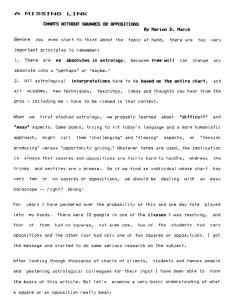
Charts Without Squares or Oppositions, Aspect Deficiencies, Natal Imbalances, Evolutionary Astrology. In this detailed astrological study titled ‘A Missing Link: Charts Without Squares or Oppositions,’ Marion D. March explores the profound implications of birth charts that lack challenging aspects like squares and oppositions. March challenges the common astrological assumption that charts devoid of hard aspects represent ‘easy’ or uncomplicated lives. Through the analysis of elemental balances, aspect patterns (such as see-saw, bowl, fan, and tripod), unaspected planets, and lacking modalities or houses, she demonstrates how individuals with squareless or oppositionless charts frequently struggle with self-awareness, conflict resolution, and internal drive. Without the natural tension of squares to prompt action or oppositions to foster awareness of the ‘other,’ natives often resort to avoidance, projection, or internalizing stress, which can manifest as chronic physical ailments, phobias, or psychological difficulties.

The text extensively examines various specific natal charts of both clients and renowned figures to illustrate how chart deficiencies manifest in real life. March analyzes how individuals compensate for missing elements, such as a lack of water, air, or earth, and how unaspected planets or single focal points in bucket patterns direct the native’s life path. She emphasizes that while progressions and transits can activate these points over time, understanding the innate lack of impetus allows astrologers to provide effective psychological and astrological guidance to help clients harness the strengths inherent in their unique configurations.

Issue Highlights:

Articles:
A Missing Link: Charts Without Squares or Oppositions – Marion D. March

Discussion:
Interpreting charts lacking squares or oppositions
The psychological impact of unaspected planets and missing elements
Using chart patterns and progressions to understand developmental crises
Case studies of famous artists, actors, and individuals navigating squareless charts

Chart data:
Chart I (Jan 31, 1919)
Chart II (Mar 7, 1921)
Georges Braque (May 9, 1882)
Chart III (Dec 3, 1918)
Margaret Sullavan (May 16, 1919)
Marlene Dietrich (Dec 27, 1901)
Chart IV (June 30, 1943)
Chart V (July 1, 1924)
Chart VI (Apr 18, 1928)
Vincent Van Gogh (Mar 30, 1853)
Fanny Brice (Oct 29, 1891)
Montgomery Clift (Oct 17, 1920)

Notable contributors:
Marion D. March (Author)

Ask A Librarian

Need assistance with your research or navigating our collection? Our library team is here to help.

Please fill out the form below with details about the topics, authors, or archival materials you are looking for, and one of our librarians will review your query and respond shortly.

Help

Whether you are looking for rare historical texts or trying to locate a specific book nearby, Alexandria iBase offers two primary ways to search. Here is how to choose the right tool for what you need:

The Library Catalogue

Think of this as your global master index.

The Catalogue works just like a traditional library search system, designed to help you locate books and media across the broader astrological landscape.

  • Physical Books: Find out where physical copies of books are held in libraries, archives, or collections near you.

  • Digital Files: Access downloadable or viewable digital editions when available.

  • Best Used For: Standard research, finding specific ISBNs or authors, and tracking down physical items in the real world.

Browse Catalogue

SPECIAL COLLECTIONS

Think of this as Alexandria’s exclusive private vault.

Collections gives you direct access to Alexandria’s own curated archive of rare, proprietary, and historic astrology media.

  • Exclusive Material: Features unique texts, manuscripts, audio recordings, and visual media that are not available anywhere else.

  • Direct Access: Digitized content ready to explore straight from the platform.

  • Best Used For: Deep-dive research, discovering hidden gems, and exploring rare, one-of-a-kind astrological resources.

Browse Special Collections

Cash & In-Kind Donations

Make a one-time or recurring tax deductible cash donation.

Payment options include donating directly with us, PayPal Giving and GoFundMe.

GoFundMe for Charities and PayPal Giving are registered for tax deductions and have no required processing fees. It does offer the option to tip.

Donate

*Subject to 2.5% processing fees

Contact Us

Have a question, feedback, or a inquiry about our archives? We’d love to hear from you. Please fill out the form below with your details and message, and a member of our team will get back to you as soon as possible.

Thank you for reaching out to the Alexandria iBase Project!