
Home » Solar Arc Directions

Solar Arc Directions

A predictive technique where all points in a natal chart are moved forward by the same increment of arc, typically equivalent to the Sun’s daily motion.

Filters

Filters


See more See less
See more See less
See more See less
See more See less
See more See less
See more See less
See more See less

Sorting

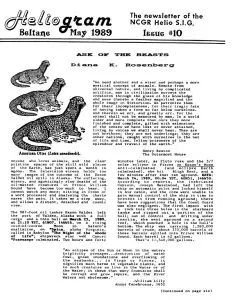
Heliocentric Astrology, Heliogram, NCGR Helio S.I.G., Mundane Astrology, Weather Prediction, Financial Astrology, Asteroids, Fixed Stars, Horary Astrology. This document is the May 1989 issue of the Heliogram, the newsletter of the NCGR Helio S.I.G. Edited by Margaret M. Meister and published with contributions from prominent heliocentric and mundane astrologers, the issue explores the intersections of heliocentric and geocentric astrology, weather forecasting, financial trends, and current world events. Articles delve into the environmental and astrological significance of the Exxon Valdez oil spill, incorporating fixed stars like Spica, Fomalhaut, and the constellation Cetus. Discussions extend to economic forecasts utilizing heliocentric horary charts, planetary alignments involving Mars, Saturn, and Uranus, and the usage of asteroids in mundane prediction. Historical analyses cover figures such as Vincent Wing, examining early heliocentric astrology and Keplerian mechanics. Comprehensive chart data and chronologies, including those for George Bush, nuclear disaster events like Three Mile Island and Chernobyl, and the Emperor Akihito, provide empirical depth to the technical explorations presented throughout the volume.

Issue Highlights:

Articles:
Ask of the Beasts – Diana K. Rosenberg
On File – Margaret M. Meister
Custer Corner: Some Thoughts On Helio – Edith Custer
New and Improved George Bush Chronology – Bill Meridian
Hello, Jupiter! – Barbara May
Elections, Nominations and Things That Go Bump in the Night – Margaret Meister, Edith Custer
Helio in the News – Zipporah Dobyns, Ph.D.
An Implausible Mars-Moon – T. Pat Davis
Emperor Akihito – Doris Greaves
Astrology and the Weather – Part V – Dorothy S. Willis
Doom Forestalled: A Study in Helio Horary – Susan Manuel
Bridge Collapse – Edith Custer
Helio History: Vincent Wing: The First Heliocentric Astrologer? – J. Lee Lehman, Ph.D.

Discussion:
Heliocentric planetary placements and comparative geo/helio charts
Mundane and economic forecasting via heliocentric horary charts
Astrological signatures of the Exxon Valdez oil spill and environmental disasters
Weather forecasting using heliocentric aspects (Venus, Mars, Jupiter, Saturn, Uranus, Neptune)
Historical analysis of heliocentric astronomy and astrology from Kepler to Vincent Wing

Chart data:
Exxon Valdez Oil Spill Chart (March 24, 1989)
Exxon Corporation Foundation Chart (August 10, 1892)
First Sustained Nuclear Reaction (December 2, 1942)
Three Mile Island Nuclear Power Plant Disaster (March 28, 1979)
Chernobyl Nuclear Plant Explosion (April 26, 1986)
Emperor Akihito Natal Chart (December 23, 1933)
Bridge Collapse, Covington, TN (April 1, 1989)
George Bush Natal Chart

Notable contributors:
Diana K. Rosenberg (Astrological zoology and environmental mundane charts)
Edith Custer (Helio Mercury configurations and structural chart observations)
Zipporah Dobyns (Asteroid placements and mundane events)
Susan Manuel (Heliocentric horary and economic predictions)
Dorothy S. Willis (Astrological weather forecasting)
J. Lee Lehman (Historical analysis of heliocentric astrology and Vincent Wing)
Barbara May (Heliocentric Jupiter placements)
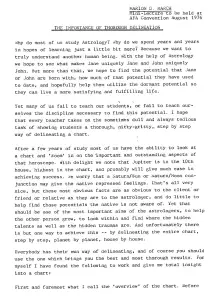
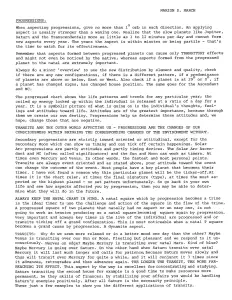
Astrological Delineation, Chart Synthesis, Progressions, Transits, House Rulerships, Decanates, Free Will. This document provides a comprehensive, step-by-step lecture by Marion D. March on the art and discipline of thorough astrological chart delineation. March emphasizes looking beyond obvious isolated placements (like Jupiter in the 10th house or Saturn-Sun conjunctions) to uncover hidden talents, potentials, and traumas through systematic chart analysis. She outlines an initial ‘overview’ examining element/quality distribution, chart patterns (bundle, bucket, locomotive), and configurations (grand crosses, T-squares, yods). Following the overview, she details dissecting the chart starting with the ‘heart of the chart’ (the Sun by sign, house, ruler, decanate, and aspects), followed by the Moon for emotional personality, the Ascendant for outer personality, and proceeding planet-by-planet and house-by-house.

Issue Highlights:
The text further explores the synthesis of recurring traits, handling human contradictions, and integrating progressions and transits. March shares her personal technique of placing three rings around a chart: natal, secondary progressions alongside solar arcs, and slow-moving transits in the outer ring. She stresses that progressions reflect changes in inner attitude and psychological shifts, whereas transits indicate tangible outer events. Crucial astrological maxims are highlighted, notably ‘The stars impel, they do not compel’ and ‘All important events are backed by aspects, but not every aspect will bring an important event,’ reinforcing the primacy of client free will and counseling caution in rigid prediction.

Articles:
The Importance of Thorough Delineation – Marion D. March

Discussion:
Step-by-step chart delineation methodology
Utilizing the ‘overview’ for chart synthesis
Analyzing the Sun, Moon, and Ascendant
House rulers and house-to-house connections
Secondary progressions and Solar Arc directions
The interplay between transits, inner attitudes, and free will

Chart data:
Sun at 12 Gemini in the 6th house, ruled by Mercury in Cancer in the 7th house

Notable contributors:
Marion D. March (Author and Lecturer)

Solar Arc Directions

Marion D. March, Special Collections

Solar Arcs, Secondary Progressions, Transits, Astrology Cycles, Predictive Techniques. This document provides a comprehensive instructional overview of major predictive astrological techniques, focusing on Solar Arc Directions, secondary progressions, and planetary transits. Marion D. March emphasizes the practical application of these methods, urging students to avoid rigid adherence to a single system and instead utilize a combination of techniques, including Solar Returns, to gain a nuanced understanding of a client’s experiences. The text underscores that while these methods provide insights into life rhythms, individual free will remains the ultimate governing factor in how these energies are expressed.

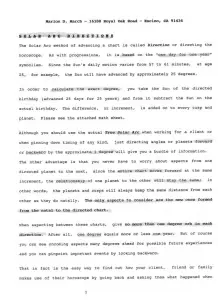
The manual details the mechanics of Solar Arc Directions—the “one day for one year” symbolism—and provides step-by-step mathematical instructions for calculating arcs. A significant portion of the guide is dedicated to case study analysis of Kitty Kelley, tracking her life events (career, marriage, writing) through transits and directed aspects of slow-moving planets like Jupiter, Saturn, Uranus, Neptune, and Pluto. The author differentiates the influence of these planets, noting that personal planets govern daily moods and minor events, while transcendental planets mark long-term periods of transformation, such as the midlife crisis associated with Uranus, or the intense, deliberate shifts indicated by Pluto transits.

Furthermore, the document explores the cyclical nature of planetary movement through the four quadrants of the horoscope, defining them by key psychological phases: Learn (Ascendant to IC), Experience (IC to Descendant), Act (Descendant to MC), and Gather Rewards (MC to Ascendant). It highlights the importance of T-squares, yods, and grand crosses in natal configurations, noting how these are activated by directed or transiting planets. The text concludes by reinforcing the need for practitioners to remain grounded in common sense, prioritizing logic and awareness over fatalistic predictions.

Issue Highlights:

Articles:
Solar Arc Directions – Marion D. March
Transits – Marion D. March
Cycles – Marion D. March
Planetary Speeds and Cycles – Marion D. March
Math Instructions for Solar Arc Directions – Marion D. March

Discussion:
The use of Solar Arcs vs. Secondary Progressions and Transits
The influence of planetary speeds on life events
Interpreting natal T-squares and yods under transit activation
The psychological significance of the four astrological quadrants
Methodological differences between natal, progressed, and directed charts

Chart data:
Kitty Kelley (Born April 4, 1942, 5:00 pm PDT, Spokane, WA)

Notable contributors:
Marion D. March (Astrological education, techniques, and predictive theory)

Secondary Progressions, Transits, and Predictive Timing. This document provides a foundational guide on the distinct roles and technical applications of secondary progressions and transits in astrology. Marion D. March emphasizes that secondary progressions are primarily inward-oriented indicators of psychological patterns and attitudinal shifts, utilizing the symbolic ‘day for a year’ ratio. She advises practitioners to conduct a comprehensive overview of the progressed chart, checking for shifts in elements, qualities, planetary houses, signs, and angular configurations to gauge the evolving trends of an individual’s year.

In contrast to the attitudinal nature of progressions, transits are described as event-oriented external influences. The text clarifies that while progressions signify internal changes of consciousness, transits represent the outer world affecting the individual. A significant portion of the instruction focuses on the relationship between natal potential and dynamic movement, particularly stressing that the natal chart remains the anchor for all interpretations. The author highlights the potency of transits and progressions when they ‘trigger’ natal configurations, such as a natal T-square evolving into a grand cross.

Furthermore, the text offers practical guidance on technical nuances, such as applying a strict one-degree orb for progressions, the importance of partile aspects, and the varying durations of transits based on the velocity of the planets. It specifically contrasts the fleeting, often unconscious effects of rapid transits (like Venus or Mercury) against the long-lasting, formative impact of slower-moving outer planets like Saturn. By integrating these two predictive methodologies, the author argues that one can better understand both the timing of life events and the internal psychological responses to them.

Issue Highlights:

Articles:
Progressions – Marion D. March
Transits – Marion D. March

Discussion:
Differentiating between internal (progression) and external (transit) influences
The symbolic ‘day-for-a-year’ ratio
Timing events using secondary progressions vs. Solar Arc
The importance of natal chart configuration triggers
Saturn transits and the necessity principle

Chart data:
Not applicable

Notable contributors:
Marion D. March (Astrological technique and methodology)

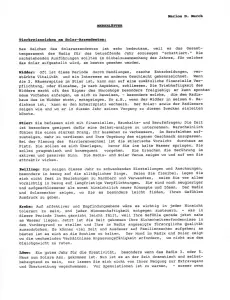
Solar Return Astrology, Natal-Solar Synthesis, House Placements, Aspect Analysis. This document serves as a comprehensive instructional manual authored by Marion D. March regarding the methodology and interpretation of Solar Return charts. It provides a detailed breakdown of how to integrate the Radix (natal chart) with the Solar Return (annual return) to predict life events. The author emphasizes the significance of the Solar Ascendant, the placement of the Sun within Solar houses, and the importance of analyzing planetary house rulerships to determine focus areas for the upcoming year. The guide differentiates between the use of birth locations versus current locations, advocating for a pragmatic approach that accounts for the individual’s primary residence.

The text extensively covers the thematic meanings of all twelve houses within the Solar Return, offering specific delineations for career, finance, relationships, health, and travel. A central component of the instruction is the synthesis of Radix and Solar charts, with specific techniques for interpreting planetary influences at the chart angles. The author provides cautionary notes on interpreting stressful aspects, emphasizing that “the stars incline but do not compel,” and encourages astrologers to develop a consistent method that best suits their practice.

Issue Highlights:

Articles:
Tierkreiszeichen am Solar-Aszendenten – Marion D. March
Häuser im Solar – Marion D. March
Planeten um den Solaraszendenten – Marion D. March
Allgemeine Regeln für Solare – Marion D. March
Besondere Anzeigen im Solar – Marion D. March

Discussion:
Techniques for Solar Return calculation
Interpretation of the Solar Ascendant
Synthesis of Radix and Solar houses
Significance of planets at the chart angles
Practical case studies on famous individuals

Chart data:
Luciano Pavarotti
Ernest Hemingway
Pablo Picasso
Boris Becker
Hermann Hesse

Notable contributors:
Marion D. March (Astrological instruction and methodology)

House Systems, Mundane Astrology, and Astrological Techniques. This archival document is the 4th Edition of Mercury Hour (January 1975), an open-forum astrological journal edited and published by Edith Custer. The issue brings together prominent mid-20th-century astrologers to debate chart construction techniques, planetary rulerships, sensitive mathematical points, and practical counseling philosophies. Key technical contributions include Michael Munkasey’s classification of 23 house systems and introduction of the Arcturan system, Dr. James T. Hayes’s critique of cause-and-effect determinism and traditional dignities, Ivy M. G. Jacobson’s guide to L. Edward Johndro’s Birth Locality Charts, Inge Aach’s demonstration of 90-degree dial midpoint analysis using Henry Kissinger’s chart, and Ruth Dewey’s research on the Vertex. Additional discussions cover Carl Payne Tobey’s Astrology of Inner Space, Stephen Arroyo on Mars in Scorpio medical correlations, Zip Dobyns’s announcement of International Astrological Abstracts, and Isabel Hickey’s biographical account of her spiritual astrological practice.

Issue Highlights

Articles:

House Systems – Michael Munkasey

Four Questionable Practices of Astrologers – Dr. James T. Hayes

Excerpt from Foundation of the Astrological Chart – Ivy Jacobson (Johndro Locality Charts)

The Cosmic Structure – Inge Aach (continuation of the Cosmobiology Series)

The Vertex (series continuation) – Ruth Dewey

Discussion:

Carl Payne Tobey’s Astrology of Inner Space (various contributors)

Chart data:

(some in question or incomplete)

Gerald Ford
Muhammed Ali
James Dean
Marlon Brando
Clark Gable
Henry Kissinger

Notable contributors:

Stephen Arroyo (Mars in Scorpio; Polarity Therapy)

Zip Dobyns (formation of International Astrological Abstracts – IAA)

Isabel Hickey (short bio & involvement in astrology)

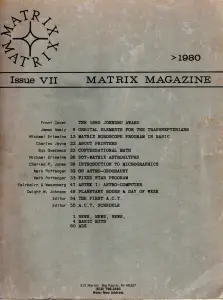
Computerized Astrology, Astrological Programming, A.C.T. Conference, Trans-Neptunian Planets. This issue of Matrix Magazine serves as a bridge between early computing technology and professional astrological practice. It focuses heavily on the technical application of microcomputers (Commodore PET, Apple II, TRS-80) to astrological research, offering BASIC programming code for chart calculations, orbital elements for Trans-Neptunian planets (Cupido, Hades, Zeus, Kronos, Apollon, Admetos, Vulkan, Poseidon), and instructions for printer-based astroglyph generation. The magazine also introduces the “ASTEK I,” a specialized astrological computer, and discusses the use of microfilm for archival astrological data storage.

Issue Highlights:
The 1980 Johndro Award is presented to Neil F. Michelsen for his pioneering work in computer-assisted ephemerides and astrological software. The issue also provides a comprehensive schedule for the first Astrological Conference on Techniques (A.C.T.) held in New Orleans, covering a wide array of research topics from planetary cycles to rectifiction methods.

Articles:
Orbital Elements for the Transneptunians – James Neely
Matrix Horoscope Program in BASIC – Michael Erlewine
Conversational Math – Buz Overbeck
Dot-Matrix Astroglyphs – Michael Erlewine
Introduction to Micrographics – Charles Paul Jones
On Astro-Geography – Mark Pottenger
Fixed Star Program – Mark Pottenger
ASTEK I: Astro-Computer – Fairbairn & Wesenberg
Planetary Hours & Day of Week – Dwight W. Johnson

Discussion:
Application of BASIC programming in natal astrology
Technical specifications and history of the ASTEK I calculator
Astro-Geography and meridian contacts
Statistical analysis of astrological data
Microfilm implementation for astrological libraries
Planetary rulers and the day of the week

Chart data:
Michael Erlewine (Born 7/18/1941, 4:03 PM EST, Lancaster, PA)

Notable contributors:
Michael Erlewine (Editor/Computing), James Neely (Orbital elements/programming), Mark Pottenger (Fixed star programming), Charles Jayne (Conference/Techniques advice), Buz Overbeck (Conversational math)

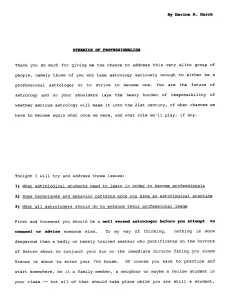
Dynamics of Professionalism

Marion D. March, Special Collections

Astrological Ethics, Professional Practice, and Astrological Education. This archival document is a lecture transcript titled “DYNAMICS OF PROFESSIONALISM” by Marion D. March. March addresses three main areas necessary to establish astrology as a respected profession in the 21st century: student education, client consultation practices, and improving public perception. She cautions against amateur astrologers making damaging, fatalistic predictions, emphasizing the need for formal counseling training, boundaries, and compassion without judgment. March details practical consultation standards, including obtaining verified birth data, setting appropriate professional fees to overcome “poverty consciousness” (referencing advice from astrologer Barbara Watters in 1975), maintaining a professional office setting, avoiding jargon, and respecting client privacy. To elevate the field, she advocates separating professional astrology from entertainment (such as 900-numbers and psychic fairs), pursuing university-level degree programs like the Kepler Project, and exploring professional licensing frameworks similar to those used for acupuncturists.

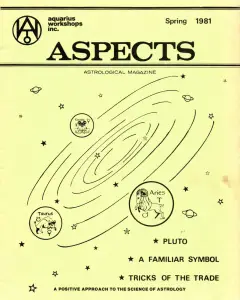
ASPECTS Vol 6 No 2 Spring 1982

ASPECTS Magazine, Special Collections

Astrological Methodology, Natal Analysis, and Evolutionary Astrology. This issue of Aspects features extensive technical discussions regarding the practical application of astrology. A significant portion of the magazine is dedicated to the philosophy and mechanics of individual charts, notably through Robert Carl Jansky’s detailed exploration of the Sun symbol as a representation of personal space, ego-control, and evolutionary potential. The discourse extends to professional practice with Robert Glasscock’s insights into client management, chart rectification techniques, and the “degree for a year” predictive method. Additionally, Jeff Green provides a deep dive into evolutionary astrology, examining Pluto’s role in the birth chart as a primary indicator of karmic patterns and the soul’s path through incarnation, utilizing the charts of historical figures like Richard Nixon as case studies.

Issue Highlights:
The magazine explores mundane astrology through the lens of the 1981 Aries Ingress chart, projecting potential national trends in economy, diplomacy, and global politics. Practical “building blocks” are provided for students, including a breakdown of the 6th House by Joan McEvers and an introduction to the inconjunct (quincunx) aspect by Nancy Cassidy. The content is further enriched by a Q&A interview with Angela Gallo, who discusses the challenges of teaching astrology and the ethical considerations of working with clients, as well as a data column by Lois Rodden verifying birth times for various famous women in sports.

Articles:
A New Look at a Familiar Symbol – Robert Carl Jansky
Pluto: The Evolutionary Cause of Incarnation – Jeff Green
Tricks of the Trade: Confessions of a Professional Astrologer – Robert Glasscock
Aries Ingress – Judy Johns
Sixth House – Joan McEvers
Inconjunct – Nancy Cassidy
Basic Delineation: The Overview – Marion March

Discussion:
Techniques for client management and professional ethics.
Evolutionary astrology and the role of Pluto and the Nodal axis.
Practical applications of the inconjunct aspect in natal charts.
Mundane analysis of the 1981 Aries Ingress.

Chart data:
Richard Nixon
Vincent Van Gogh

Notable contributors:
Robert Carl Jansky (Sun Symbolism)
Jeff Green (Evolutionary Astrology)
Robert Glasscock (Professional Techniques)
Marion D. March (Chart Delineation)
Lois Rodden (Data/Research)

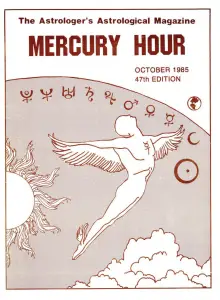
Astrological Techniques, Astrology History, and Mundane Astrology. This archival item is the October 1985 issue (47th Edition) of Mercury Hour, a quarterly magazine edited by Edith Custer and Jewell Fahey in Lynchburg, Virginia. Key contents include technical articles such as John F. Gay, III’s guide to calculating house cusps and astronomical coordinates using scientific calculators, Joan McEvers’s second installment on interpreting Lunar Returns, and Dorothy Willis’s foundational rules for astro-meteorology. Mundane and historical pieces feature Marc Penfield’s chart rectifications for Russia’s 1917 Bolshevik Revolution and the “Chart Mart” data collection, Fran Rosen’s explorations of the Kabbalistic Tree of Life and Tarot symbolism, and Gilbert Navarro’s definition of horary astrology. Additional contributions include reviews by Marion March, reports on the 7 Hills Astrological Conference, an analysis of the 1985 Bradford football stadium fire by Olivia Barclay, and reader discussions surrounding topics such as ethics, licensing, house systems, and birth data for figures like Ronald Reagan, Mikhail Gorbachev, and Mary Baker Eddy.


Issue Highlights


Book Reviews

By Marion March:

Celestial Psychology: An Astrological Guide to Growth and Transformation by Doris A. Hebel

Astrochemistry: A Study of Metal-Planet Affinities by Nick Kellerstrom

Instant Astrology by Mary Orser, Rick and Glory Brightfield

The Astrology of Deep Space by Philip Sedgwick

Spiritual Astrology: A Layperson’s Guide to Self-Unfoldment by Jan Spiller

The Practice and Profession of Astrology by Stephen Arroyo

Birth Pattern Psychology by Tamise Van Pelt

The Astrological Prayer Book by Alda Marian Jangl
Your Key to Astrology [book plus] Astrological Key Cards: Planets, Signs, Houses, Aspects by Bill Hansen – Edith Custer


Articles

Astrology and the Weather – Dorothy Willis

Lunar Return Notes, Part II – Joan McEvers

Calculation Without Tables of the Julian Day & Century, Obliquity of the Ecliptic, MC, ASC, and Houses, Part I – John F. Gay, III

The Tree of Life: An Overview – Fran Rosen

Astrological Hall of Fame Awards – Fraternity for Canadian Astrologers [2nd National Conference]

Along the Tarot Path – Fran Rosen

How I Survived my Pluto Square Pluto and Other Transits – Carol Hemingway

The Luscher Color Test, A Symbolic Testing Model – Zan Key

Observations on Astrology, Original & Borrowed – John F. Gay, III

I’m Mad at You!!!! – Mary Ellen Glass

The Horoscope of Russia – Marc Penfield

Chart Mart – Marc Penfield

A Trip Round the Hawaiian Zodiac, Part II – Cheryl Niggle

Astrology and the Weather: Forecasting the Weather, Part I – Dorothy Willis

Horary Astrology: A Definition – Gilbert Navarro

The Business Cycle, Part II – Bill Hansen

Neptune, The Collective Fantasy, and Popular Music – Amy Franco

The Mystery of the Chinese Zodiac, Now Revealed for the First Time – Frank Hampton

The Qualities of Time, Part I – Tundra Wind


Discussions

Astrology, licensure, & ethics

Quadrant house systems vs. Equal Houses

Radix-based Tarot technique

Natal location in Return chart

Birth time of Ronald Reagan

Seven Hill Astrological Conference [reports]

Mercury retrograde


Chart data

Anderson, Loni
Benetar, Haley (daughter of Pat Benetar)
Bowie, David
Eddy, Mary Baker
Eisenhower, Melanie (daughter of Julie Nixon and David Eisenhower)
Gorbachev, Mikhail
Jagger, Elizabeth (daughter of Mick Jagger and Jerri Hall)
Kennedy III Robert F.
Morgan, Vicki
Neves, Tancredo
Pace, Canio and Thomas (cross-year twins)
Reagan, Ronald
Schwab, Loluis and Leona (cross-year twins)
Spielberg, Max (son of Steven Spielberg and Amy Irving)Vaughn, Sarah

Frustaci sextuplets
Czar Nicholas II
Prince Henry

Air India 747 jetliner crash
Christian Science Church
Formation of the Soviet Union
Founding of Tel Aviv
Halley’s Comet return
Live Aid Concert 1985


Notable contributors

Joylyn Hill (Chart of Israel, chart of Robert E. Lee, the nature of Venus)

Olivia Barclay (astrological signature of fires and explosions)

Misty Kuceris (7 Hills Conference)

Robert Pelletier (7 Hills Conference)

Zane Stein (Solstice points, Sabian symbols)

Erin Sullivan (Mercury retrograde)

Michael and Margaret Erlewine (Matrix Heart Center)

Eleanor Bach (Marc Edmond Jones Award)

Lee Lehman (Kundalini and asteroid Sappho)

Ask A Librarian

Need assistance with your research or navigating our collection? Our library team is here to help.

Please fill out the form below with details about the topics, authors, or archival materials you are looking for, and one of our librarians will review your query and respond shortly.

Help

Whether you are looking for rare historical texts or trying to locate a specific book nearby, Alexandria iBase offers two primary ways to search. Here is how to choose the right tool for what you need:

The Library Catalogue

Think of this as your global master index.

The Catalogue works just like a traditional library search system, designed to help you locate books and media across the broader astrological landscape.

  • Physical Books: Find out where physical copies of books are held in libraries, archives, or collections near you.

  • Digital Files: Access downloadable or viewable digital editions when available.

  • Best Used For: Standard research, finding specific ISBNs or authors, and tracking down physical items in the real world.

Browse Catalogue

SPECIAL COLLECTIONS

Think of this as Alexandria’s exclusive private vault.

Collections gives you direct access to Alexandria’s own curated archive of rare, proprietary, and historic astrology media.

  • Exclusive Material: Features unique texts, manuscripts, audio recordings, and visual media that are not available anywhere else.

  • Direct Access: Digitized content ready to explore straight from the platform.

  • Best Used For: Deep-dive research, discovering hidden gems, and exploring rare, one-of-a-kind astrological resources.

Browse Special Collections

Cash & In-Kind Donations

Make a one-time or recurring tax deductible cash donation.

Payment options include donating directly with us, PayPal Giving and GoFundMe.

GoFundMe for Charities and PayPal Giving are registered for tax deductions and have no required processing fees. It does offer the option to tip.

Donate

*Subject to 2.5% processing fees

Contact Us

Have a question, feedback, or a inquiry about our archives? We’d love to hear from you. Please fill out the form below with your details and message, and a member of our team will get back to you as soon as possible.

Thank you for reaching out to the Alexandria iBase Project!